
Source: Technews
At the 2005 WWDC, Steve Jobs announced an important plan: to move Mac from IBM’s PowerPC to Intel’s x86 architecture. However, at that time, Apple was also secretly working on two major projects: developing a tablet computer and a prototype phone that was still based on the iPod design but included communication features.
Apple’s Early Mobile Devices: Why ARM?
Apple actually began developing a touchscreen tablet earlier than the phone. Jobs admitted that he learned about Microsoft’s design of a tablet operated by a stylus while attending the wedding of a high-level Microsoft engineer (Note 1). At that time, Apple’s idea for a phone had not completely departed from the iPod’s click wheel, until Jony Ive presented Jobs with a multitouch prototype that allowed users to scroll through pages with their fingers. Jobs then decided to shift the multitouch technology originally intended for the tablet to the phone.

Apple’s multitouch patent diagram released in 2004
Although to manage risks, the iPod-style click wheel version of the iPhone continued to be developed, the new multitouch prototype also underwent a significant rewrite of the mobile version of Mac OS X from the ground up, removing the mouse pointer and using fingers instead. To integrate OS X and the new multitouch into a much smaller phone while retaining a Mac-like UI effect, Apple realized it needed a set of efficient and power-saving CPU and GPU architectures, which had to be compactly integrated into a single SoC.
Apple actually had experience with relevant suppliers. The iPod, which accounted for 40% of the company’s revenue at the time, used ARM architecture processors designed by PortalPlayer until 2006, when it switched to Samsung due to supply shortages. At that time, Samsung was almost the only manufacturer capable of integrating PowerVR and ARM architecture SoC designs while consistently shipping millions of units each year. Apple continued to use Samsung’s ARM architecture application processors until the iPhone 3GS.
However, in reality, Apple’s relationship with ARM began even earlier than one might think. Before Jobs returned to Apple in 1997, Apple had released a handheld computer called “Newton” in 1994 and participated with Acorn in the founding of ARM to develop the processor for Newton. This continued until Jobs returned to Apple, leading to the discontinuation of Newton and the disposal of Apple’s ARM shares (Note 2). Subsequently, ARM became the almost exclusive application processor architecture in the mobile field, following Nokia’s success.
Intel Atom, ARM, and XScale
When starting the development of mobile devices, in addition to ARM and Samsung, Apple also considered another option: Intel.
In 2005, Apple had just transitioned the Mac from PowerPC to Intel x86. To save development resources, Jobs initially considered using Intel’s Atom processor for the iPad. Although Atom was still in development, Jobs, who met with Intel CEO Otellinii quarterly, trusted his capabilities—there was no other manufacturer globally that could produce better-performing products than Intel. Jobs even went so far as to disband Apple’s chip design department, which had been established for the Mac, in 2005.
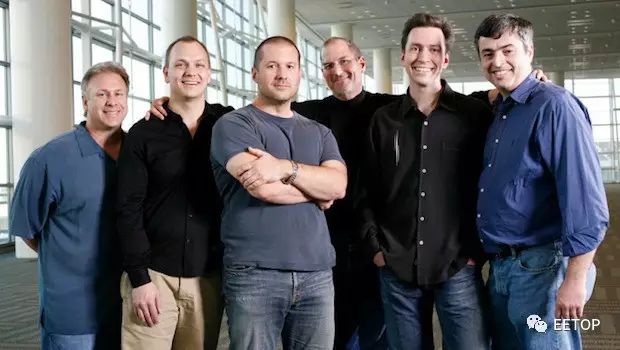
Tony Fadell is second from the left
However, Tony Fadell strongly opposed the use of Atom. Fadell, who was instrumental in integrating the iPod’s hardware and software design, became Apple’s second-in-command. With his insistence, Jobs agreed to switch to the simpler and more power-efficient ARM architecture (Note 3). Jobs later recalled:
Intel indeed has the best processors in the world, but that is predicated on not caring about power consumption and price. Moreover, their chips are only processors, so other types of chips are needed to complement them… But over the years, we have consistently told Intel that their graphics chips are subpar. Initially, we collaborated well, and Intel wanted to work with us to develop iPhone chips, but they were too slow and lacked adaptability; we couldn’t keep waiting for them. Furthermore, we didn’t plan to teach Intel everything and then let them sell the products to competitors.
Although Intel’s former CEO Otellinii later stated that the reason there was no collaboration on mobile device chips was simply that Intel was dissatisfied with Apple’s offer and judged that Apple’s mobile device shipments would only be a few hundred thousand units, which could not make Intel profitable, in any case, Intel’s decision ultimately led Apple to turn to Samsung-designed ARM architecture application processors.
Interestingly, Intel did have its own ARM architecture team, a company it acquired called “XScale.” At that time, Intel was still interested in iPods and the new mobile devices Apple was secretly developing, hoping to use XScale to penetrate markets outside of PCs. However, after Apple switched the iPod to Samsung ARM architecture processors in 2006, Intel sold XScale in 2006 and shifted its focus to the X86 architecture Atom.
Samsung and the First Generation iPhone
In 2007, Apple released the revolutionary first-generation iPhone, which used a Samsung-designed ARM architecture SoC, while the GPU was provided by Imagination Technology’s PowerVR. However, as soon as the iPhone was released, Jobs was acutely aware of its shortcomings: no front camera, only supported AT&T’s 2G, and had poor battery life. The larger flaw was that although the iPhone was advanced in design, it was merely a product created by integrating various resources. The chips it used (which were not specifically named) were originally designed for Samsung’s DVD players.
However, this SoC from Samsung was indeed quite good. At that time, the mobile operating systems running on ARM architecture, such as Nokia’s Symbian, Microsoft’s Windows CE, Blackberry, and even the initial version of Android, were all relatively simple lightweight systems. However, Samsung’s SoC enabled Apple to run a Unix system rewritten from Mac OS X on ARM architecture, while also maintaining a complete UI effect. Apple’s success prompted these manufacturers to adjust their development plans, including future competitor Google Android.
Jobs noticed potential competitors. To accelerate development efficiency while maintaining the uniqueness and first-mover advantage of iOS, Apple needed a chip that could be 100% controlled to serve as the foundation for the iPhone. However, having just disbanded its chip development team in 2005, Apple not only lacked enough capable engineers to negotiate with Samsung for the desired SoC, but the SoC used in the first-generation iPhone, while good, was not a design fully endorsed by Apple.
So, less than a year after the first-generation iPhone was released, Apple secretly signed an agreement with Imagination Technology and Samsung to develop GPU and SoC, while also starting to recruit employees to rebuild its chip team.
A4: Apple’s First Self-Designed SoC
In 2008, Apple poached Johny Srouji from IBM. He would later become the vice president of Apple’s chip division, overseeing the design of every generation of Apple SoCs. Shortly after Srouji joined, Apple secretly acquired the Silicon Valley startup P.A Semi for $278 million in April 2008. The patents and team from this company became the core of Apple’s future SoC designs, allowing Apple’s chip team to grow from 40 to 150 people. By the time of Jobs’ death in 2011, Apple’s chip engineers had exceeded 1,000, marking one of the most far-reaching decisions made by Jobs in his later years.
In a 2009 interview with Time magazine, Jobs briefly discussed the reasons for acquiring P.A Semi a year prior:
P.A Semi will specialize in designing SoCs for iPhone and iPod.
However, at that time, Jobs omitted two important points. First, Apple did not acquire P.A Semi solely to design SoCs for the iPhone and iPod. Its independently designed first SoC was actually initially used in Apple’s 2010 new product, the iPad, rather than the iPhone and iPod. Additionally, Apple had already signed a cooperation agreement with Imagination Technology and Samsung for SoC development, so Apple was not initially fully independent in developing its own chips.
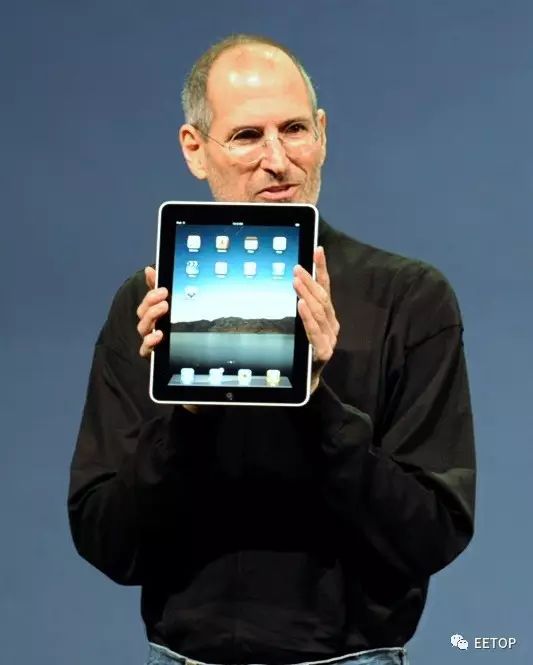
The first-generation iPad
In 2010, with the debut of the first-generation iPad, Jobs presented Apple’s first self-designed SoC, the “A4.” A4 used ARM’s Cortex-A8 as the CPU core and Imagination Technology’s PowerVR SGX 535 as the GPU. Although it used ARM’s Cortex-A8, Apple optimized the CPU architecture through collaboration with Samsung and a U.S. company, Intrinsity, allowing the A4’s Cortex-A8 clock speed to exceed that of other processors using the same Cortex-A8 while remaining fully compatible with the ARM architecture.
Apple’s collaboration with Samsung also came with its costs. It is unclear whether this was through the collaboration with Intrinsity or a tripartite agreement with Apple, but Samsung later called this modified Cortex-A8 CPU core “Hummingbird” and used it in its own SoC “S5PC110.” Subsequently, in 2011, Samsung renamed S5PC110 to Exynos 3, becoming Samsung’s first SoC to bear the “Exynos” name, and it was used in the first-generation Galaxy S, Galaxy Tab, and Google’s second-generation Nexus S. Even before the iPad was released, Samsung had already used Hummingbird in its own SoC for two of its phones.
Therefore, perhaps to guard against competition with Samsung, Apple urgently acquired Intrinsity three months after the first-generation iPad was released.
In fact, the design of Exynos 3 was almost identical to that of A4, with only slight differences in circuit design. This incident may also have marked the beginning of a series of infringement lawsuits between Apple and Samsung after Tim Cook took over as Apple’s CEO. In fact, the Galaxy S, which used Exynos 3, was later sued by Apple for copying the iPhone 3GS.
A5 to A10: Further Progress
In the following years, Apple gradually increased its investment in chip research and development. After 2011, Apple’s annual R&D expenditure continued to rise, and from 2014 onwards, it grew by $2 billion each year, eventually surpassing $10 billion in 2016. Among these, chips, electric vehicles, and wearable devices were considered the three main focuses of Apple’s R&D investment; Apple’s CFO Luca Maestri also stated that most of these investments were concentrated on chips.
A5
Apple’s second-generation SoC is the “A5.” Like the previous A4, it was initially used in the new iPad 2 and was quickly allocated to the iPhone 4s. A5 was Apple’s first dual-core CPU and GPU SoC, a strategy that has continued to this day with the iPhone 7. A5 was slightly larger than A4 and integrated a new ISP to optimize white balance. For a long time afterward, white balance in imaging remained a strong point of the iPhone camera.
To accommodate Siri, A5 also added a region called “earSmart,” which was likely specifically used to execute voice recognition algorithms. This led to the A4 products without earSmart, such as the iPhone 4, being unable to use Siri. Apple also claimed that A5’s GPU performance was nine times that of A4, and it later upgraded A5’s GPU architecture to four cores, renaming it A5X, which was used in the first iPad to support Retina Display. However, due to performance issues, the iPad 3 was discontinued just seven months after its release, making it the shortest-lived iPad.
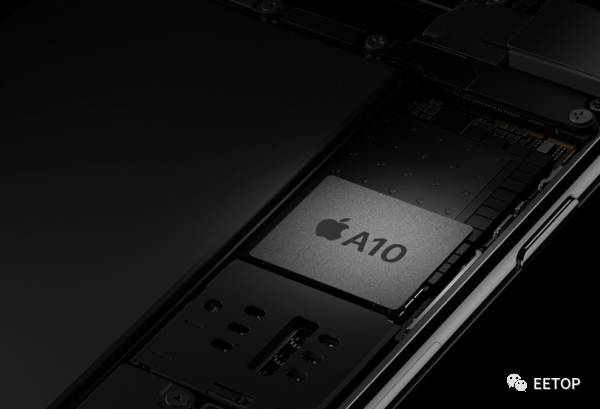 The A10 Fusion is actually Apple’s first four-core SoC. However, its design consists of two large cores and two small cores, operating similarly to a dual-core.
A6
The third-generation SoC “A6” marked a new beginning for Apple. Starting with A6, Apple no longer used ARM’s public design solutions, such as the previous Cortex-A series used in A4 and A5, but instead signed a licensing agreement with ARM to develop its own CPU architecture “Swift” based on ARMv7-A—coincidentally sharing the same name as Apple’s later programming language. This move made Apple the second company, after Qualcomm, to develop SoCs based on ARM instruction sets.
A6 also doubled the memory from 512MB LPDDR2-800 in the previous A5 to 1GB LPDDR2-1066, while achieving nearly twice the CPU and GPU performance in a package that was 22% smaller than A5, and it was more power-efficient. This gave subsequent iPhone 5 and iPhone 5c a significant advantage when upgrading iOS compared to iPhone 4s.
A7
The A7, which debuted in the iPhone 5s in 2013, may be the SoC that had the most profound impact on the mobile industry. Apple almost stealthily upgraded the mainstream 32-bit architecture of the mobile industry to 64-bit, becoming the first SoC with a 64-bit CPU in modern smartphones and tablets, forcing Qualcomm to abandon all 32-bit product development and fully follow Apple’s lead. The GPU architecture it used, PowerVR G6430, also made A7 a product with graphics performance close to that of Xbox 360 and PS3.
Another feature of A7 is that it created a region called “Secure Enclave” based on ARM’s TrustZone solution to specifically store Touch ID fingerprint information. To this day, this solution has not been cracked at the hardware level, laying the foundation for future Apple Pay. Additionally, to handle the power consumption generated by upgrading to 64-bit, A7 also removed the accelerometer, electronic compass, and gyroscope, integrating them into a new co-processor called “M7.” The M7 has since been upgraded to M10.
After A8 to A10, Apple has continuously updated its SoCs to elevate them to the industry’s top-performing chips under the ARM architecture. Starting with A8, TSMC began to replace Samsung as the manufacturer of Apple’s SoCs. Although in some key technologies, Apple still lags behind Samsung, such as integrating regulators into CPUs, this technology seems to have been somewhat resolved in the A10 Fusion.
Regardless, Apple’s reliance on Samsung, ARM, and even Intel since 2006, to beginning to design its own architectures, has now evolved into a level of IC design company comparable to Qualcomm. Apple is even preparing to develop its own GPUs and is rumored to no longer use Dialog Semiconductor’s power management chips.
Future: Will Apple Create Its Own GPU?
In April 2017, Imagination Technology, which had signed a GPU licensing agreement with Apple as early as 2007 and 2008, issued a statement on its official website confirming that Apple would terminate its agreement with Imagination Tech within 15 months to 2 years and shift to developing its own GPUs. In 2008, Apple had also engaged in several rounds of stock competition with Intel, ultimately resulting in Apple holding about 10% of Imagination Tech’s shares, making it the fourth-largest shareholder, and receiving 30% of revenue distribution. Apple’s orders also accounted for over 50% of Imagination Tech’s revenue.
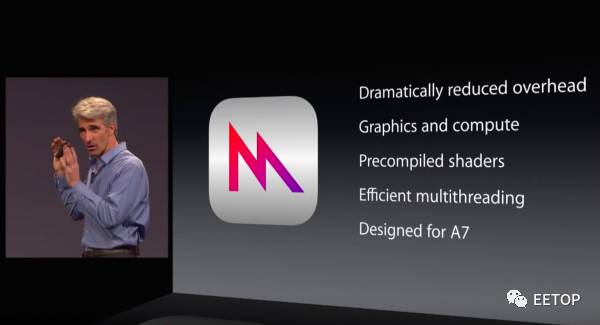
Since the first-generation iPhone, focusing on using Imagination Tech’s PowerVR has been a strategy for Apple, as this alleviates developers’ concerns and allows for a focus on optimizing APIs for iOS, such as the Metal API, which underwent significant changes in iOS 8. This integration of software and hardware has also made iOS a smoother platform for mobile games.
In contrast, Samsung’s SoC GPU choices have been more chaotic, often switching between ARM’s Mali and PowerVR, and even using VideoCore’s GPU in the early years. Although Qualcomm has consistently used its own Adreno, the operating system’s distribution among Google and various manufacturers has limited its ability to build a cohesive system.
In fact, it is no secret that Apple has wanted to replace PowerVR with its own architecture for GPUs for some time. Starting with the A8 SoC used in the iPhone 6, Apple began customizing some core components of the GPU using its own technology, such as the “heart” of the GPU, the shader core. Apple has also customized the compiler on the CPU and the graphics drivers for the GPU to further optimize the Metal API, which underwent significant changes in iOS 10.
Despite Imagination Tech’s claims of legal action to prevent Apple from doing so, leading to renewed rumors of Apple acquiring Imagination Tech, or that this statement was merely a tactic by Apple to lower PowerVR’s price, in any case, Apple has indeed begun accumulating the capability to create its own GPUs. This will make Apple the second company after Qualcomm to have its own GPU architecture.
Interestingly, the announcement of Apple’s intention to terminate the PowerVR agreement coincides with the expiration date of Apple’s contract with Dialog Semiconductor for power management chips. For Apple, which aims to enable AR capabilities in mobile devices and promote wearable devices like the Apple Watch, both “power efficiency” and “GPU” are key technologies, which may lead Apple to venture further down the path of “self-controlled chips,” although before that, users may first see the iPhone 10.
Note 1: Bill Gates also attended that wedding and was very unhappy with a big-mouthed employee. In fact, the employee who leaked information to Jobs was the groom himself.
Note 2: Jobs disposed of his shares in ARM to cash out. According to him, Apple was on the verge of bankruptcy at that time.
Note 3: Tony Fadell went so far as to threaten to resign to persuade Jobs to abandon Intel Atom. Years later, he also left due to internal struggles and founded Nest in 2010, which was later acquired by Google.
To facilitate better communication and learning, EETOP has established several WeChat groups by region. We welcome netizens from each region to join their respective groups. To join, please add jack_eetop as a friend and send the following information: Join Group + Region + Organization (or Institution) + Occupation. If you are joining a group based on province, please send the joining information in the following format: Join Group + Province Name + City Name + Organization (or Institution) + Occupation
For example: Join Group + Beijing + Lida Technology + Digital IC Design
Join Group + Zhejiang + Hangzhou + xxx Company + xxx Design
Currently, we have opened the following seven regional groups, and you are welcome to join accordingly.
Long press the QR code to add the group owner as a friend and have them add you to the group

EETOP Beijing Group EETOP Suzhou Group
EETOP Shanghai Group EETOP Shenzhen Group
EETOP Chengdu Group EETOP Xi’an Group
EETOP Zhejiang Group
In addition, we will also open some industry groups in the future. Currently, the EETOP Automotive Electronics Group is open for industry professionals to join.
Please fill out the following format: Join Group + Automotive + Organization
To prevent bots from joining, please make sure to greet when you join for the first time!
Click to read the original text for more information