
Join the embodied intelligence industry group by adding WeChat gasgoo111 and presenting your business card.
If we rewind time to a year ago, humanoid robots were still “learning to walk,” requiring careful balance just to perform simple walking tasks.
Now, leading players in the humanoid robot sector can not only walk steadily but also run on athletic tracks, dance to music, and even perform high jumps and martial arts moves that require high levels of motion control, demonstrating remarkable stability and durability during sustained high-intensity activities.
As robots undergo a qualitative leap in performance, the global commercialization of humanoid robots has also hit the “accelerator” button. According to data compiled by Gaishi Automotive, several companies in the humanoid robot field, including Tesla, Figure AI, UBTECH, Yushun Technology, Zhiyuan Robotics, Star Motion Era, and Qianxun Intelligent, have begun small-scale deliveries, with delivery volumes ranging from dozens to thousands of units.
With the global humanoid robot industry officially entering mass production in 2025, Gaishi Automotive Research Institute predicts that the entire industry will further experience a commercial explosion in 2026. By 2029, the global humanoid robot market is expected to exceed 150 billion yuan, continuing its progression towards a “trillion-level” track.
Breaking the Ice in Humanoid Robot Commercialization
The global robotics industry is reshaping the world at an unprecedented pace, with humanoid robots, thanks to their humanoid form’s versatility, transitioning from laboratories to factories, retail stores, and even homes, becoming the core players in the next trillion-dollar market. Recently, multiple companies have intensively announced their progress in mass production and delivery, which serves as the most direct proof.
Recently, a representative from Kepler Robotics revealed that the company’s K2 Bumblebee began small-scale mass production on August 4, with an expected production of around 100 units this year, primarily targeting logistics for automotive companies and the education sector. Previously, the company had already secured logistics orders from several automotive companies and educational research orders from universities.
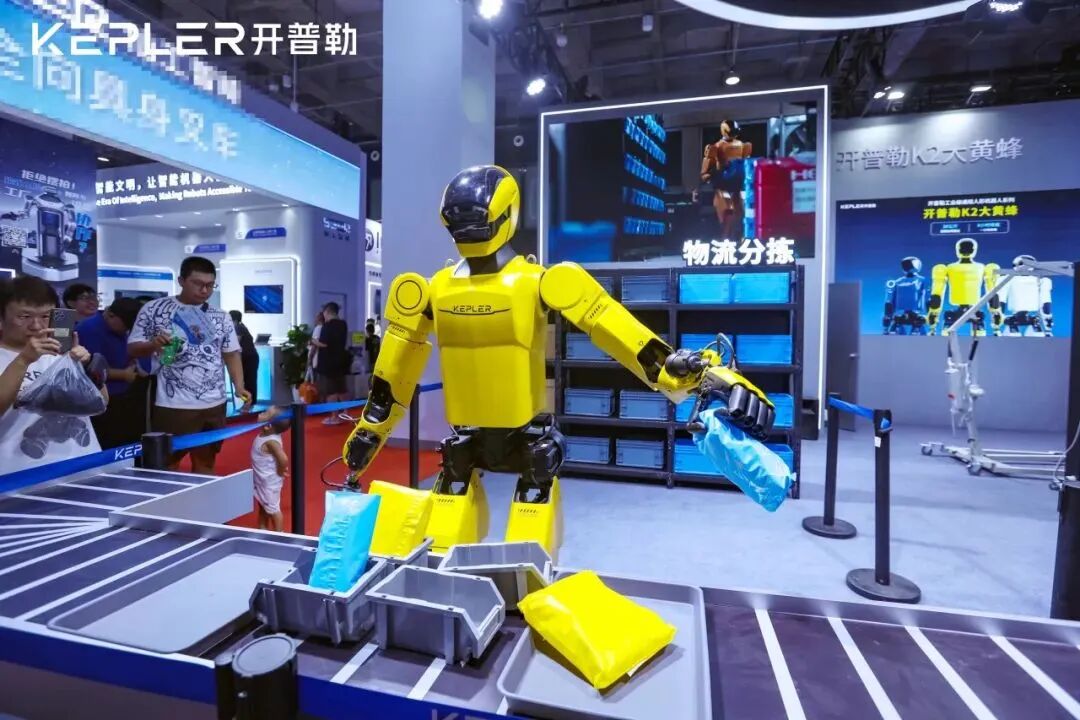
Image Source: Kepler Robotics
In early August, Songyan Power also announced that it delivered 105 humanoid robots in July this year. Among them, 92 units were N2 humanoid robots, and 13 units were E1 humanoid robots, representing a month-on-month growth of 176%. Songyan Power officially launched mass production of humanoid robots in June this year, and prior to that, it had already received over 2,000 orders for humanoid robots. The ongoing delivery of related orders indicates that Songyan Power has initially completed its commercialization loop.
In addition to Tesla, Figure AI, Xiaopeng Motors, Yushun, Zhiyuan Robotics, UBTECH, Zhongqing Robotics, and Star Motion Era, it is estimated that more than a dozen companies have initiated small-scale production of humanoid robots, with larger-scale mass production and delivery still ongoing.
Recently, Zhiyuan Robotics’ Chairman and CEO Deng Taihua revealed that the company expects to ship several thousand units this year, with hopes to reach tens of thousands of units annually in the coming years.
UBTECH has also secured numerous commercial bulk orders for humanoid robots this year, and it is estimated that the company is likely to deliver thousands of humanoid robots across different application scenarios.
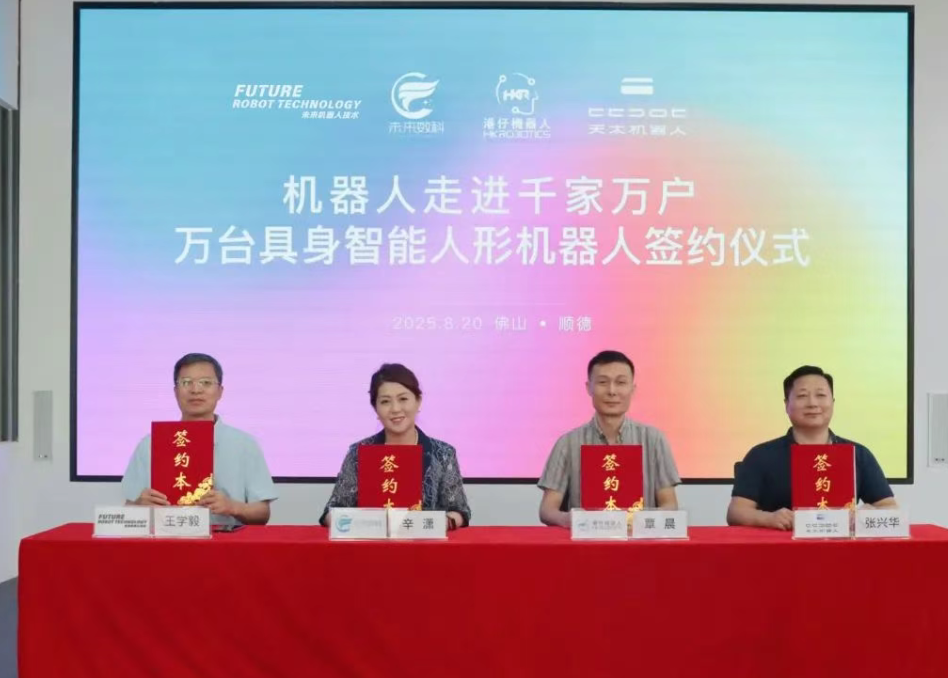
Image Source: Tiantai Robotics
Tiantai Robotics has signed an order for 10,000 humanoid robots with Shandong Future Robotics Technology Co., Ltd., Shandong Future Data Technology Co., Ltd., and Gangzi Robotics Group. This is reportedly the largest single order in the global humanoid robot industry since its inception, primarily focusing on the home care sector.
Overall, following the commercial rule of “from easy to difficult, from specialized to general,” humanoid robots are being widely applied in industrial manufacturing scenarios. For instance, in the vehicle manufacturing process, Tesla’s third-generation humanoid robot, Optimus Gen3, has been tested in its U.S. factory, with mass production expected to begin in 2026, aiming for an annual output of 1 million units within five years. Several hundred humanoid robots have also been deployed on Xiaopeng Motors’ production line. Additionally, UBTECH, Zhiyuan Robotics, Zhi Pingfang, Leju Robotics, and Fourier have all secured numerous orders from automotive companies for tasks such as cargo handling, quality inspection, intelligent sorting, and component assembly.
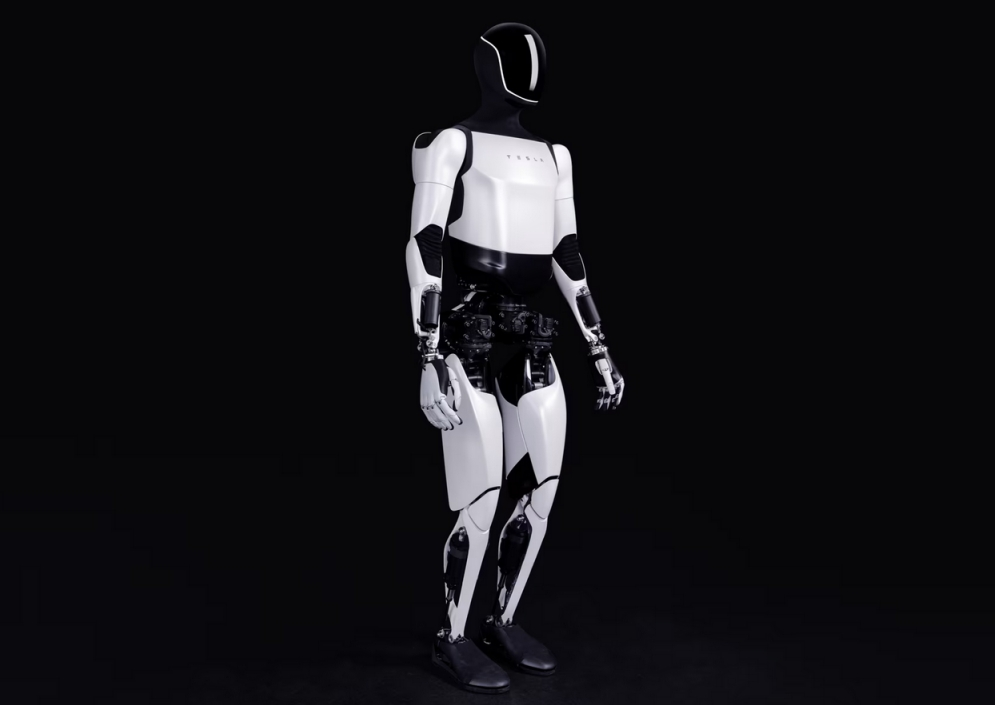
Image Source: Tesla
Moreover, humanoid robots are also conducting small-scale pilot projects in fields such as education and research, exhibition reception, retail delivery, agricultural production, and catering services.
The reason industrial scenarios have become the “first battlefield” for many humanoid robots lies in the relatively controllable industrial manufacturing environment, fixed paths, and standardized tasks, where robots only need to perform repetitive actions, resulting in a lower technical threshold. This is highly similar to the evolution process of autonomous driving.
In the field of autonomous driving, dedicated closed scenarios are generally considered to be the first to achieve high-level autonomous driving commercialization due to the relatively simple traffic elements and limited environmental variables, making technical validation and system optimization more manageable. In recent years, a number of innovative technology companies have emerged in vertical segments such as mining, ports, and sanitation, serving as direct evidence.
It is worth mentioning that autonomous vehicles, in a strict sense, can also be regarded as specialized “wheeled” robots, sharing a high degree of overlap with humanoid robots in terms of product operation logic and industry chain. As a result, it is becoming a trend for complete vehicle manufacturers and component companies in the automotive industry to cross over into the robotics business.
In the long run, as core technologies continue to upgrade and iterate, Gaishi Automotive Research Institute believes that humanoid robots will gradually move towards the most complex and versatile household service scenarios in the order of “industrial manufacturing to commercial services to extreme operations to household services,” ultimately achieving “full-scenario coverage” and truly entering the lives of ordinary consumers. It is expected that at least 3 to 5 more years will be needed to gradually usher in the commercial “breakthrough” in extreme operational scenarios and household fields.
Chen Jianyu, founder of Star Motion Era, also believes that household robots are likely to experience explosive growth within the next five years. Before that, due to the continuous evolution and diversification of application scenarios, various forms such as wheeled, half-body, full humanoid robots, and even non-humanoid robots are expected to coexist.
Threefold Drivers: Policy, Capital, and Technology
The heat in the embodied intelligence and humanoid robot sector is not coincidental; it is the result of the combined effects of policy guidance, capital support, and continuous breakthroughs in core technologies.
After the market warming at the conceptual level in 2024, the 2025 “Government Work Report” first listed “embodied intelligence” and “intelligent robots” as key cultivation directions for future industries, marking the official elevation of this field to a national strategy. Subsequently, local governments responded quickly, forming a policy synergy with the central government, creating a development pattern of “national coordination and local competition.”
Beijing has proposed that by 2027, it will cultivate no less than 50 core enterprises in the upstream and downstream of the industry chain, forming no less than 50 mass-produced products, and achieving no less than 100 large-scale applications in three major scenarios: scientific research and education, industrial commerce, and personalized services.
Guangdong Province announced in the “Implementation Rules for Financial Management Related to the Innovative Development of Artificial Intelligence and Robotics Industry” that it will provide financial support for four categories of key projects, including construction funding support for national-level manufacturing innovation centers, with a maximum subsidy of 50 million yuan for a single project, in conjunction with national support policies.
Shanghai has proposed to achieve a scale of 50 billion yuan in the core industry of embodied intelligence by 2027, focusing on key technology breakthroughs in perception decision-making and motion control, providing up to 30% support for approved project total investments, not exceeding 50 million yuan; for industrial innovation service platform construction projects, providing up to 50% support, not exceeding 20 million yuan; and for industrial innovation integration demonstration application projects, providing up to 20% support, not exceeding 10 million yuan.
Under the demonstration and leadership of first-tier cities, the competition for industrial layout around the field of embodied intelligence has entered a white-hot stage nationwide. According to incomplete statistics from Gaishi Automotive, over 20 provinces and cities in China have released policies related to embodied intelligence in the past six months, providing comprehensive support for the development of the embodied intelligence and humanoid robot industry from multiple dimensions, including financial subsidies, infrastructure construction, key technology breakthroughs, and application promotion.
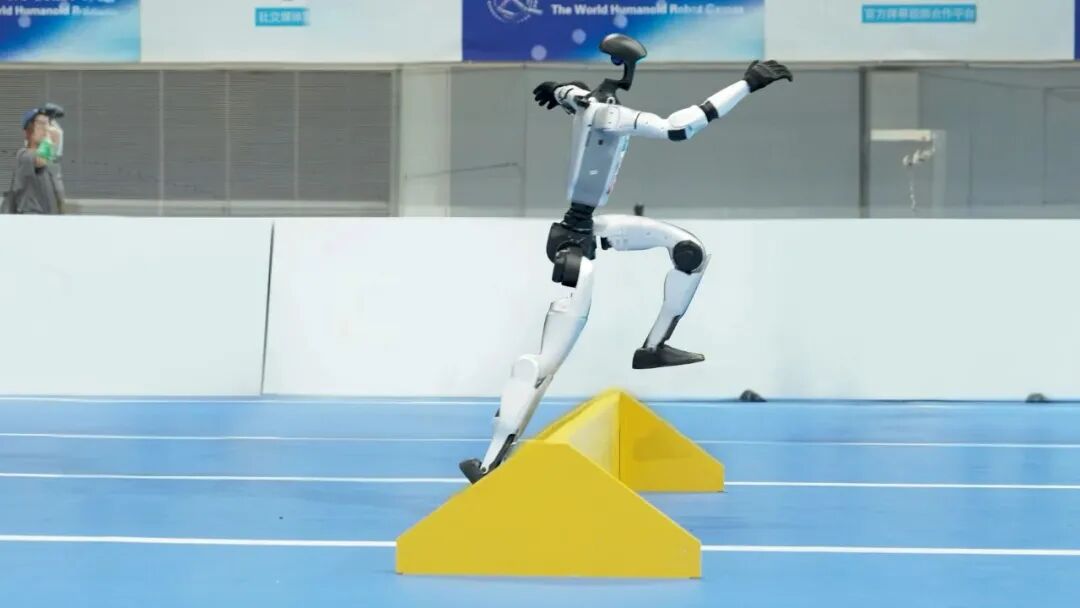
Image Source: Yushun Technology
If policy is the “compass” for the development of embodied intelligence, then capital is the “fuel,” continuously injecting sufficient energy into the industry’s development.
According to statistics from IT Juzi, in the first half of 2025, there were 114 investment and financing events in the domestic embodied intelligence field, with a total financing amount exceeding 14.5 billion yuan, surpassing the total for the entire year of 2024.
Among them, there were several large financing events exceeding 1 billion yuan, such as Galaxy General, which completed a new round of financing totaling 1.1 billion yuan in June. Additionally, companies like Shizhi Navigation, Qianxun Intelligent, Xinghai Map, and Digua Robotics also secured new financing exceeding 500 million yuan in the first half of the year.
From the perspective of financing rounds, the financing in the embodied intelligence field is mainly concentrated in the angel round, Pre-A round, and A round. This indicates that the industry is still in its early development stage while also highlighting the capital’s high recognition of the long-term potential of the sector, willing to “bet” on companies at the technology research and development stage to provide them with “supplies.”
Beyond these two points, the “core engine” driving the development of humanoid robots is the continuous “breakthrough” at the technical level.
In terms of composition, humanoid robots mainly consist of three parts: the brain, the cerebellum, and the limbs, which integrate key technologies such as AI chips, sensors, joint modules, dexterous hands, and batteries. Over the past two years, these technologies have made significant progress, providing solid support for the evolution of robots from “being able to walk” to “being able to use.”
For example, dexterous hands, as the ultimate “touchpoint” connecting the digital world and the physical world, need to possess high flexibility and precise control capabilities to better simulate the dexterous movements and fine control of human hands. Currently, advanced dexterous hand products on the market can achieve 22 degrees of freedom, close to human hand levels—human hands have approximately 21 to 27 degrees of freedom.
For instance, Tesla’s Optimus third-generation dexterous hand has increased its degrees of freedom to 22; Zhiyuan Robotics’ OmniHand 2025 series dexterous hands have 16 and 19 degrees of freedom for the agile and professional versions, respectively; and Yushun Technology’s Dex5 dexterous hand, launched in April this year, integrates 20 degrees of freedom in a single hand.
Overall, domestic research and manufacturing of key components for humanoid robots have achieved varying degrees of independent production. In areas such as high-precision reducers, high-performance motors, and intelligent sensors, Gaishi Automotive Research Institute estimates that the main core components have a cost advantage of 60%-70% compared to foreign counterparts.
The technological advancements and increased localization rates have led to a rapid decrease in costs. In the past two years, the price of a humanoid robot often exceeded one million yuan, but now it generally ranges from 300,000 to 500,000 yuan, or even lower.
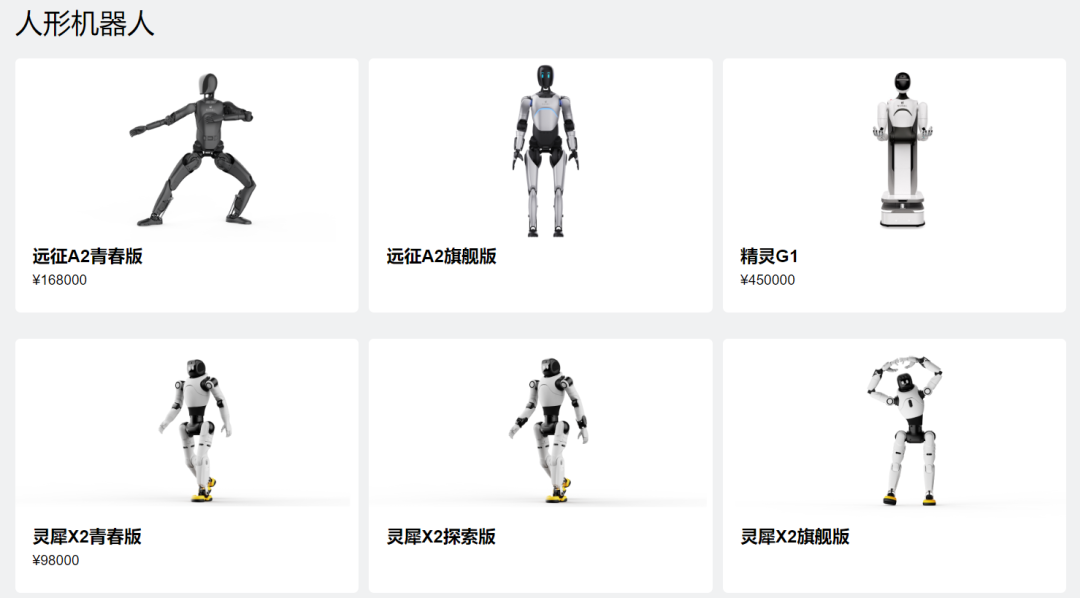
Image Source: Zhiyuan Robotics
Recently, Zhiyuan Robotics officially launched its entire product line, with the humanoid robot Expedition A2 Youth Edition priced at 168,000 yuan, the Lingxi X2 Youth Edition fully intelligent dexterous robot priced at 98,000 yuan, and the Spirit G1 intelligent robot priced at 450,000 yuan; UBTECH’s full-size scientific research and education humanoid robot “Tiangong Walker” is priced at 299,000 yuan; and Kepler’s K2 Bumblebee starts at only 248,000 yuan, which has officially begun mass production pre-sale in early August; Zhongqing Robotics’ upcoming “first humanoid robot for young people”—Zhongqing “Player One” SA02, is priced as low as 38,500 yuan.
There is reason to believe that as the key components of humanoid robots continue to iterate and upgrade, and as the localization rate continues to increase, along with larger-scale mass production further expanding, the cost of humanoid robots will continue to decrease.
Scaling Commercial Use Still Takes Time
Undoubtedly, humanoid robots have passed the exploratory phase of “from 0 to 1” and are entering the growth phase of “from 1 to 100.” According to estimates from Gaishi Automotive Research Institute, by 2025, the global mass production scale of humanoid robots is expected to be around 30,000 units, with an overall market size of approximately 9 billion yuan.
Wang He, founder of Galaxy General, predicts that in about six years, the humanoid robot industry scale is expected to exceed 100,000 units, corresponding to a market space in the hundreds of billions. “In the next ten years, we will see a market that surpasses all industrial robots, and in the following ten years, it may surpass the automotive and mobile phone industries, becoming a trillion-level market,” Wang believes.
However, despite the broad market prospects for humanoid robots, the challenges they face cannot be ignored. A practical issue is that current humanoid robots are more like “specialized athletes” rather than “all-rounders,” capable of completing single tasks in specific scenarios, and existing orders are mainly concentrated in non-core scenarios such as performance demonstrations and data collection. Once the scenario changes, their performance significantly declines, and they are still far from becoming truly versatile robots for multiple scenarios.
“Currently, being able to replace 0.6 to 0.7 of a person’s workload is already quite good; they still cannot fully act like humans,” pointed out Wang Chuang, President of the General Business Department at Zhiyuan Robotics.
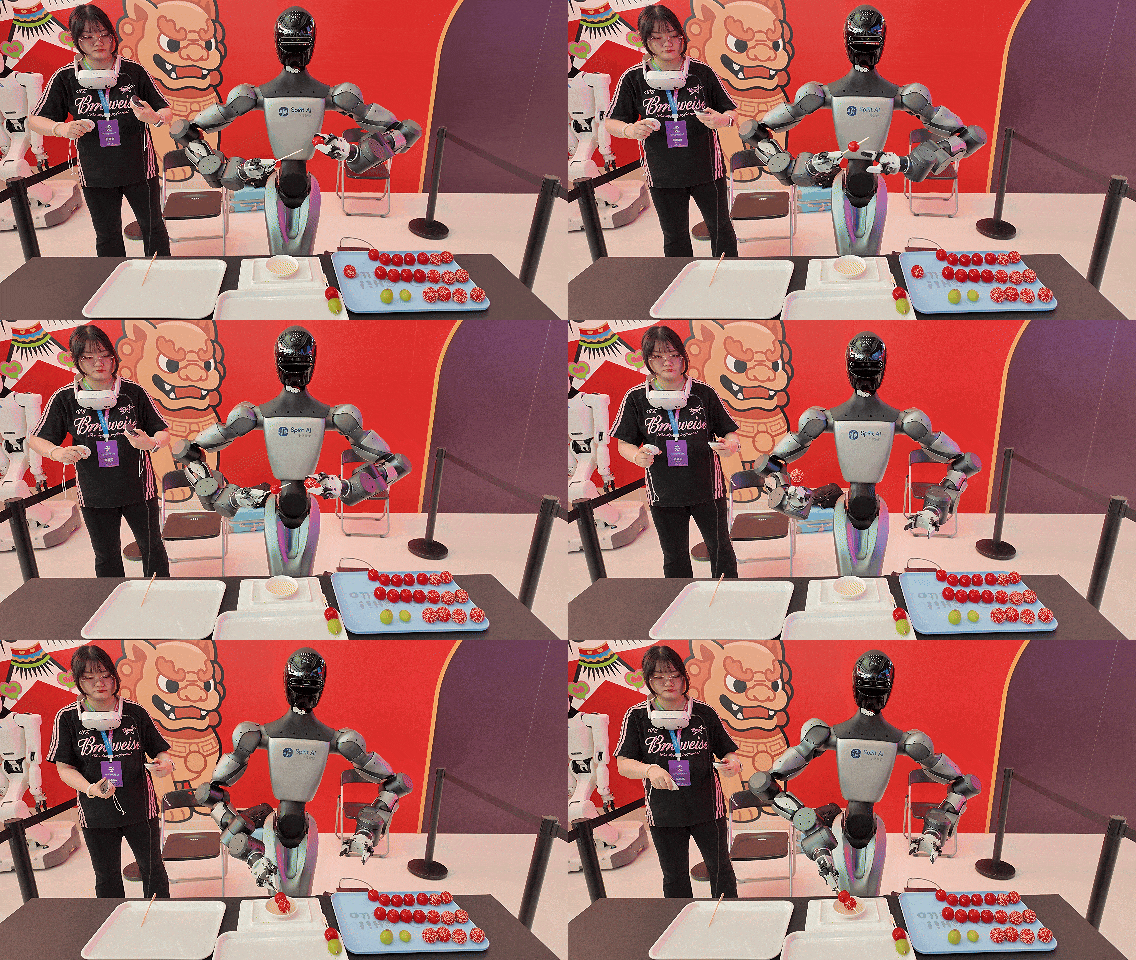
Image Source: Qianxun Intelligent
Even many robots that appear to be able to work autonomously still require a certain degree of human assistance. For example, some robots struggle to navigate complex environments and cannot avoid sudden obstacles without remote human control; others have a low success rate when grasping fragile items and require manual adjustments to their posture.
The challenges behind this are multifaceted. First is the data; similar to autonomous driving, the iteration of embodied intelligence algorithms requires a massive amount of multimodal data, yet the industry as a whole faces the dilemma of “insufficient data and difficulty in reuse.” On one hand, the degrees of freedom, output dimensions, and sensor types of different robots may vary, making direct reuse of data and models challenging; on the other hand, collecting multimodal data in the real world is difficult, especially in dynamic scenarios, where the authenticity and completeness of the data are hard to guarantee, further restricting technological development. For instance, in household scenarios, the movements of the elderly and the placement of objects are random, making it difficult for robots to collect complete and effective data.
To address this issue, Guangdong is planning to create an embodied intelligence training ground for large-scale data collection and production of humanoid robots, providing key support for developing general-purpose robot foundational models.
Beijing has also established a dedicated data training center for humanoid robots, focusing on data collection and model training by building ten real-world application scenarios, including 3C factory assembly lines, automotive assembly, and new dining robotics. It is expected that this center will produce over a million high-quality multimodal data entries annually.
Secondly, the “cerebellum” capabilities are insufficient, meaning the dexterous operation software’s generalization ability is weak. The “brain” of humanoid robots is responsible for decision-making and planning, while the “cerebellum” is responsible for motion control and fine operations. Although the “brain” algorithms have progressed rapidly and can generally understand scenarios and plan tasks, the “cerebellum” is limited by the ability to collect multimodal data in the real world, and the dexterous operation software’s generalization ability is weak, necessitating significant improvements in dexterous operation capabilities—such as quickly adjusting force and posture when grasping different shapes and weights, and achieving precision and efficiency in assembly and disassembly tasks that are far from human levels.
Additionally, the lack of unified technical routes and industry standards also somewhat restricts the development of embodied intelligence. For example, the model architecture has not converged, and the robot interfaces and control protocols of different companies are not standardized, leading to high adaptation costs, poor capability reuse, and high development thresholds, severely hindering the large-scale implementation of embodied intelligence.
To address this, the Beijing Humanoid Robot Innovation Center has taken the lead in developing the “Requirements for Electric Drive Integrated Joint Interfaces for Humanoid Robots” standard, aiming to standardize the mechanical, electrical, and communication interfaces of humanoid robot electric drive integrated joints, and in July further led the project for the “Application Framework and Interface Specification for Artificial Intelligence Embodied Intelligent Agents” group standard.
Moreover, the application of humanoid robots will also raise privacy and security issues, such as the handling of information collected in household scenarios and safety concerns during elderly care or supervision, necessitating more unified standards and regulations in the industry.
However, despite the numerous challenges, embodied intelligence is set to become another disruptive species following smartphones and smart cars, and this trend is already certain.
Standing at the new starting point of a trillion-level market, the humanoid robot industry is opening up infinite possibilities. When robots can understand the world like humans and act autonomously, when care robots can provide companionship to the elderly, and when industrial robots can safeguard worker safety—a new era of “human-robot collaboration” is about to arrive.
-END-
Previous Hot Topics
|
1 |
The State Council Deploys “Artificial Intelligence +” Three-Year Campaign: Core Industry Scale to Break Through by 2027 |
|
2 |
Zhuo Yu: Hongqi Models First Deploy End-to-End 2.0 System OTA Upgrade |
|
3 |
Intelligent Driving Integration Accelerates, Chuan Siwei Plans to Acquire Jian Zhi Robotics |
▼▼ Explore More ▼▼












Please give me a like before you leave.