Approximately 950 words, estimated reading time 4 minutes
Recently, the Xiaomi YU7 has gained significant attention, especially regarding the Snapdragon 8 Gen3 chip, which has sparked intense discussions online. To be honest, as someone who has been in the automotive industry for over a decade, I find this topic quite interesting. The use of consumer-grade chips in vehicles, especially with automotive-grade certification, raises the question: is this a technological advancement or a compromise on costs? Today, let’s delve into this topic.
Have you noticed that buying a car has become increasingly complex? In the past, it was just about checking the appearance and testing the power; now, one must also understand chips and smart technology. My friend Zhang recently complained, “Buying a car now requires learning programming; this is unbearable!” Haha, while that’s a bit exaggerated, it does reflect a real issue:the intelligence of vehicles has become an unavoidable topic.
Is the Snapdragon 8 Gen3 reliable for automotive use?
When it comes to the chip used in the Xiaomi YU7, many people might be concerned. The Snapdragon 8 Gen3, isn’t that a mobile chip? How did it end up in cars? In my opinion, this needs to be viewed from two perspectives.
From a performance standpoint, the CPU performance of the Snapdragon 8 Gen3 is about 40% higher than that of the traditional automotive-grade 8295, and its GPU performance is significantly superior, with AI computing power at 60 TOPS, which is double that of the 8295. What does this mean? It means that playing games, watching videos, and using voice assistants in the car will be incredibly smooth. I previously tried my friend’s Model Y, and the lag was truly frustrating.
However, the issues are also quite apparent:how can reliability and safety be ensured? The differences between automotive-grade chips and consumer-grade chips go beyond just performance. Automotive-grade chips must operate stably in extreme environments ranging from -40°C to 125°C, have a lifespan of over 10 years, and maintain a failure rate of less than 0.00001. In contrast, consumer-grade chips can tolerate a failure rate of up to 0.0005, which is a significant difference that cannot be ignored.

What exactly is automotive-grade certification?
Many people might not fully understand what the AEC-Q104 certification means. In simple terms, it is the “entry ticket” for the automotive industry; without this certification, your chip cannot be installed in a vehicle.
Xiaomi claims that their Snapdragon 8 Gen3 core board has passed this certification and has undergone 280 testing scenarios covering 17 types of environments, verifying an equivalent of a 10-year usage cycle. Sounds impressive, right? But to be frank, it’s hard for ordinary consumers to gauge the depth of this claim.
I asked a few friends working in the chip industry, and their opinions varied. Some said this is a technological breakthrough, as consumer-grade chips can meet automotive-grade standards through improved packaging processes; others feel it resembles a “grey area” since there are no mandatory automotive-grade requirements for cockpit chips.
The art of balancing cost and experience
Ultimately, Xiaomi’s choice of the Snapdragon 8 Gen3 is largely driven by cost control. Automotive-grade chips are not only expensive but also have long delivery cycles, which is indeed a headache for new automotive companies pursuing rapid iteration.
Consider this: for the same performance, a consumer-grade chip might only cost half that of an automotive-grade chip. How tempting is that? Moreover, the Snapdragon 8 Gen3 has already been widely used in the Xiaomi 14 series smartphones, making software and hardware adaptation relatively mature, which is a significant advantage for Xiaomi.
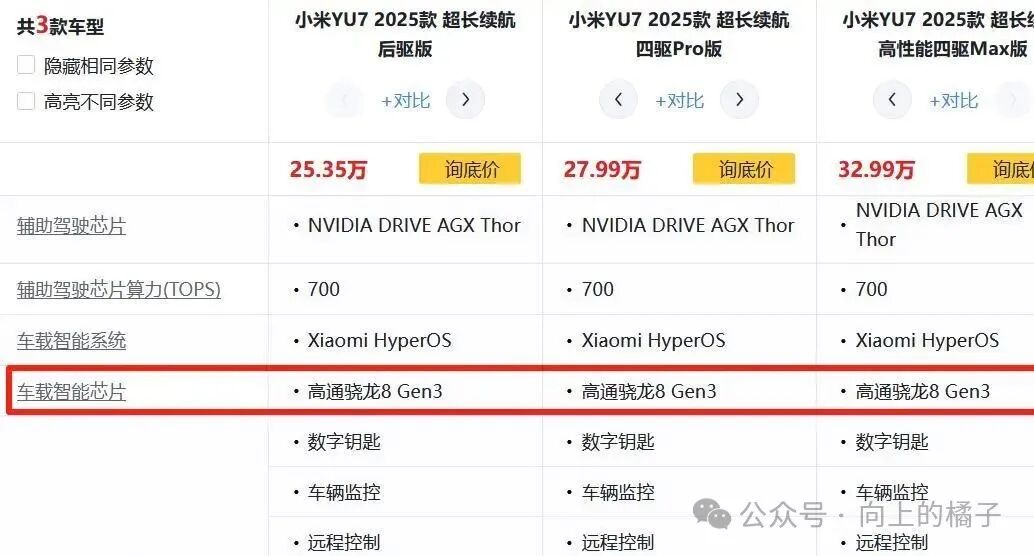
However, I believe Xiaomi has indeed put effort into user experience. Features like 35 seconds boot time, smooth gaming in the car, and 15-minute full vehicle upgrades are truly impressive. To be honest, many current vehicle systems are as slow as old phones, but Xiaomi’s configuration is at least not an issue in terms of smoothness.
Safety concerns cannot be overlooked
Although the performance and experience are quite good, safety issues cannot be ignored. The intelligent cockpit may seem unrelated to vehicle control safety, but think about it: if you suddenly lose the central control screen and navigation while taking an exit on the highway, how dangerous could that be?
Moreover, the cockpit systems are becoming increasingly complex, with higher interconnections to other vehicle systems. If a system bug occurs one day, or if the chip malfunctions in extreme weather, the consequences could be more severe than we imagine.
I remember Tesla also used consumer-grade chips in the early days, but later added independent safety chips as a backup. What does this indicate? It shows that this path is indeed feasible, but it requires more redundancy design and safety guarantees.
Final thoughts
I believe Xiaomi YU7’s choice is a inevitable trend in technological development. The traditional automotive-grade system is indeed too slow to keep up with the pace of intelligent development. However, as consumers, we should not only focus on surface performance parameters; safety and reliability are equally important.
Ultimately, whether this path can be successful will depend on market and time validation. After all, a car is not a phone; no one wants to face problems after spending hundreds of thousands on a vehicle.
What do you think about Xiaomi’s approach? Is it a technological innovation or a risky attempt? Feel free to share your thoughts in the comments!