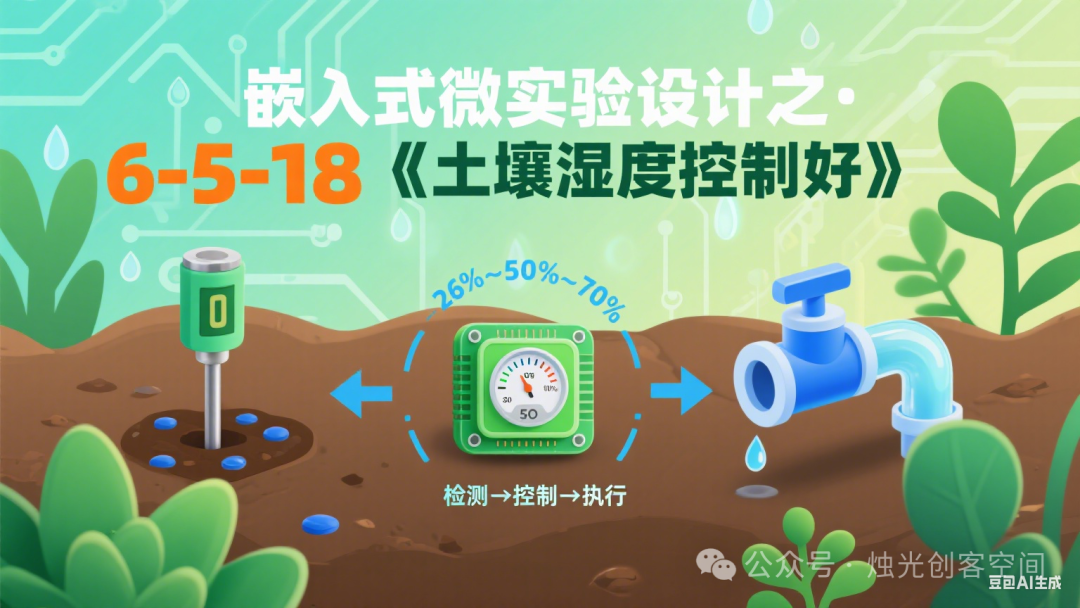
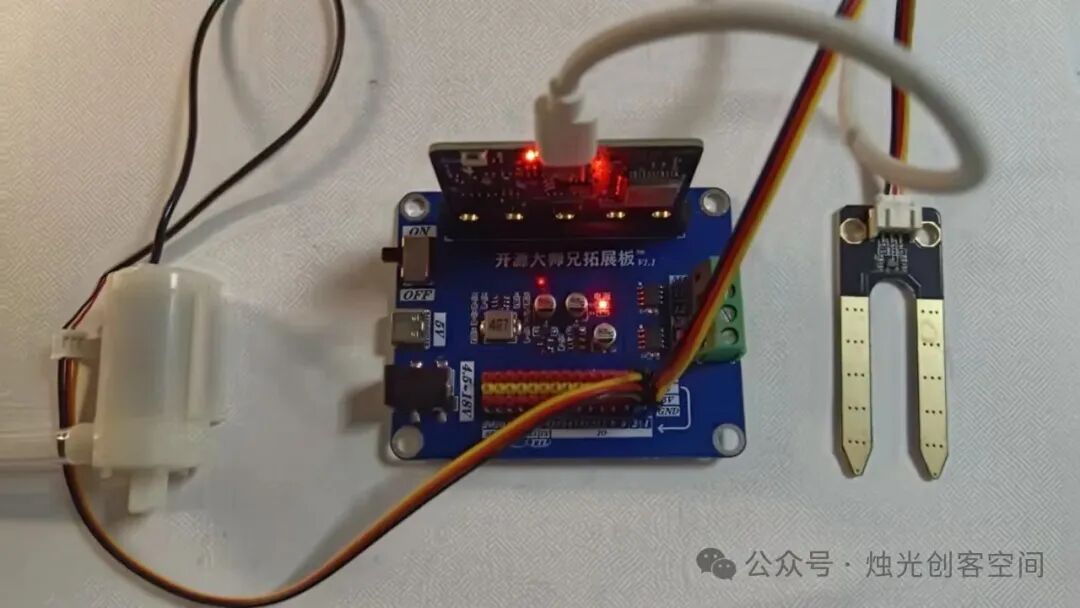
 Lesson 18: Effective Soil Moisture Control in the Fifth Unit of Intelligent PlantingFramework for Large Unit Teaching Design1. Unit ThemeControl Systems in Intelligent Planting (This unit includes lessons 16-19, focusing on “Exploring Intelligent Greenhouses, Designing Planting Gardens, Soil Moisture Control, and Light and Temperature Regulation.” The core is to understand the collaborative working principles of multiple subsystems in intelligent planting, master the application of closed-loop control in environmental regulation, and cultivate system design and practical abilities.)2. Context CreationProject: “Campus Intelligent Planting Garden Designer” The overarching context is to “design and optimize the campus intelligent planting garden to achieve automatic adjustment of the plant growth environment”: from exploring the subsystems of intelligent greenhouses, to planning the hardware and functions of the planting garden, to specifically controlling soil moisture, light, and temperature, ultimately completing the design and simulation operation of a small intelligent planting system, forming a complete practical chain of “exploration – design – control – optimization.” Lesson 18: Effective Soil Moisture Control in Embedded Micro-Experiment Design1. Micro-Experiment Design(1) Define Experiment Objectives Based on the core content of Lesson 18 on “Effective Soil Moisture Control,” set the experiment objectives:1. Understand the components of a simple soil moisture control system: soil moisture sensor (input), control board (core), watering device (output), and describe the function of each part.2. Understand the role of thresholds: the ability to set soil moisture thresholds to achieve the logic of “moisture below threshold → start watering, above threshold → stop watering.” 3. Experience the characteristics of closed-loop control: through real-time feedback of soil moisture from the sensor, the system automatically adjusts the watering state to maintain stable moisture.(2) Design Experiment Tasks Design two progressive tasks around the logic of “sensor data collection → threshold judgment → closed-loop control”:1. Basic Task: Connect the soil moisture sensor to the control board, read soil moisture data (continuous variable), and display real-time values on the OLED screen, observing the value differences between dry and moist soil.2. Advanced Task: Set a moisture threshold (e.g., 50%), program to implement closed-loop control: when moisture < threshold, start the simulated watering device (e.g., small water pump or LED light); when moisture ≥ threshold, stop watering (turn off the device), verifying the system’s automatic adjustment capability.(3) Prepare Experiment Resources Hardware: Control board (including OLED screen, GPIO interface), soil moisture sensor (e.g., FC-28), simulated watering device (small water pump + hose, or red LED light), expansion board, dry soil sample, moist soil sample, plastic flower pot.
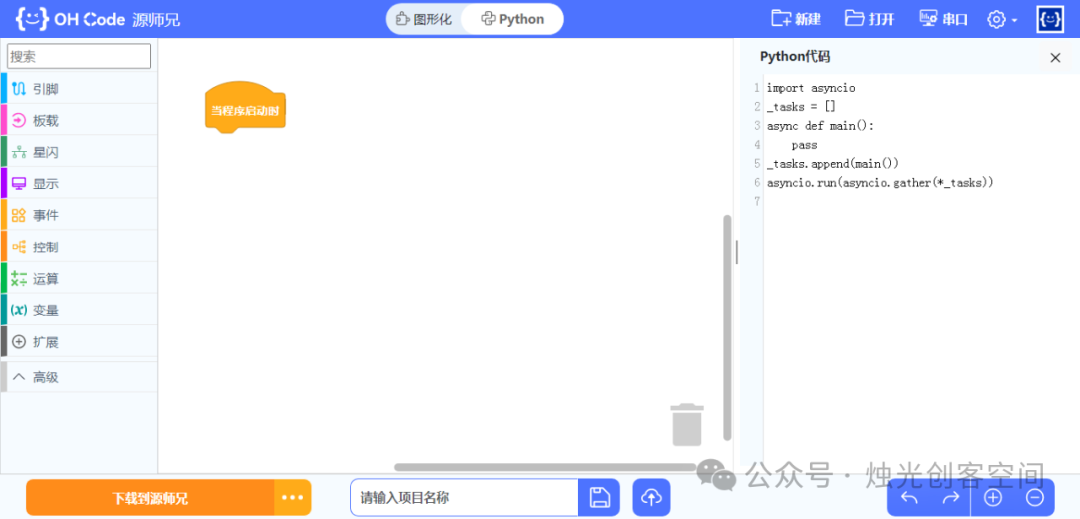
 Software: Control board graphical programming environment (including blocks for “reading sensor,” “conditional judgment,” and “controlling output”).
 Materials: Diagram of the soil moisture control system components, data recording sheet (refer to the format in the document), example diagram for threshold setting.(4) Experiment Implementation (20 minutes)1. Basic Task Operation (8 minutes) Connect devices: Soil moisture sensor connected to control board expansion pin A1, simulated watering device connected to GPIO pin (e.g., P1). Programming to read and display:① Drag the “infinite loop” block, add “read soil moisture sensor value (P1 pin)” (store as “moisture value”).② Add “OLED screen displays ‘Soil Moisture: [moisture value]%'”.
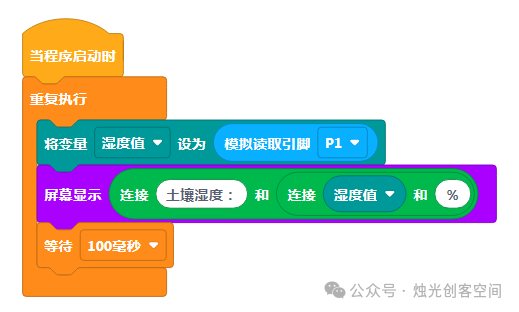 Operation: Insert the sensor into dry soil and moist soil respectively, record the value differences (e.g., 20% when dry, 70% when moist), understanding that “moisture is a continuously changing quantity.” 2. Advanced Task Operation (12 minutes) Explain control logic: Combine with the “intelligent greenhouse soil moisture control” case, explain that the threshold is the standard for judging watering, and the system achieves automatic adjustment through sensor feedback (closed-loop control). Programming to implement control:① In the “infinite loop,” add the branch “if [moisture value < 50]”: OLED screen displays “Watering in progress,” start the watering device (P2 pin outputs high level).② “Else” branch: OLED screen displays “Moisture suitable, stop watering,” turn off the watering device (P2 pin outputs low level).
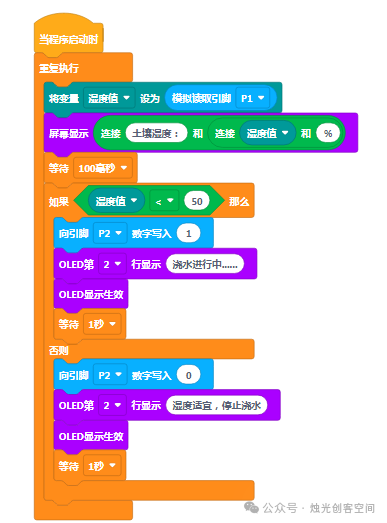 Testing and Adjustment: Insert the sensor into dry soil (<50%), observe whether the device starts; Manually water until the soil is moist (≥50%), observe whether the device stops, record the threshold activation process.
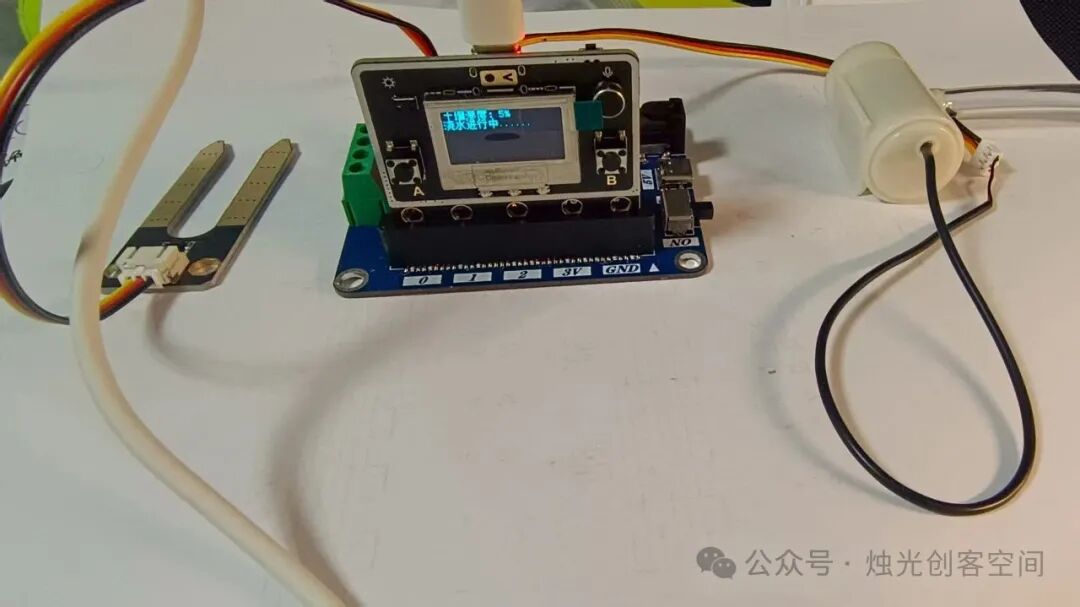 (5) Result Recording and Analysis Students fill out the “Soil Moisture Control Experiment Record Sheet”:
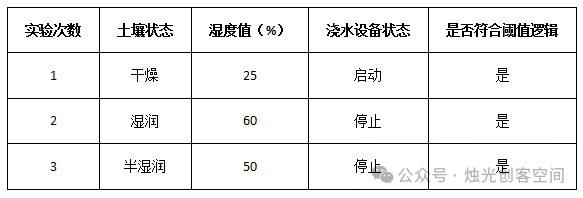 Group Discussion: “Why can the system automatically stop watering?” – Summarize the core of closed-loop control: the sensor provides real-time feedback of moisture data, which is compared with the threshold to automatically adjust output, achieving the cycle of “detection → judgment → control.” (6) Summary and Extension Teacher guides the summary: The simple soil moisture control system achieves automatic adjustment through “soil moisture sensor data collection → control board threshold judgment → control watering device,” reflecting the characteristics of closed-loop control “with feedback, can stabilize”; the threshold setting must be based on plant needs (e.g., succulent plants have a low threshold, while pothos have a high threshold). Extension Task: Research to set a reasonable moisture threshold for a specific plant in the campus garden (e.g., rose), modify the program, and test the effect.2. Micro-Experiment Activity Design Sheet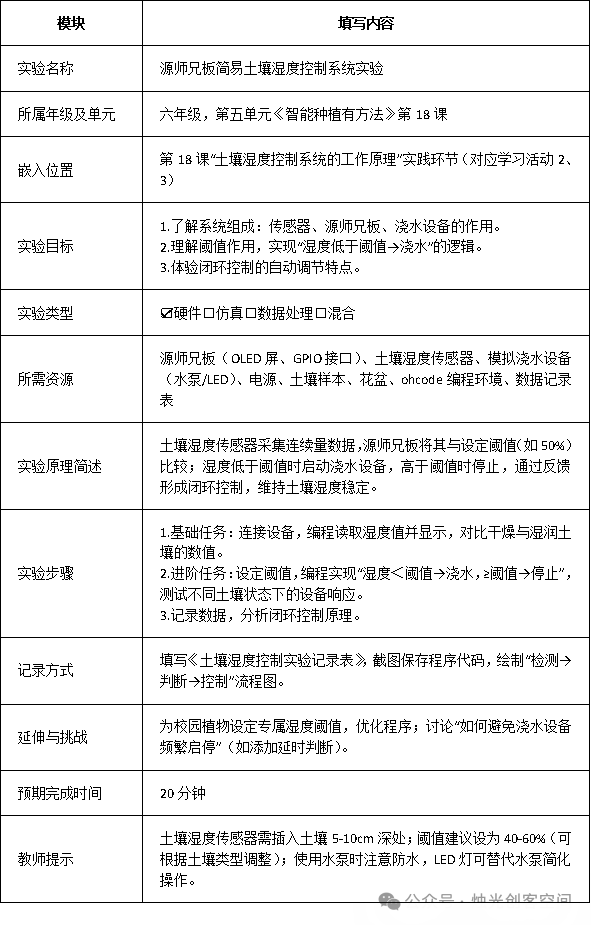
Previous Exciting Articles:
[AI Empowering Teaching] No. 23: Doubao Super Creative 2.0, Stunning Your Beauty in Bulk Generation
[AI Empowering Teaching] No. 22: AI Unlocks Math Magic for Kids: A Research Learning Journey from 4×4 Grids to Cognitive Leap
[AI Empowering Teaching] No. 21: A Different Approach, Generating Audio for Three Different Lesson Activities
[AI Empowering Teaching] No. 20: AI Podcast Teaching Guide: A Versatile Assistant from Lesson Preparation to Home-School Communication
[AI Empowering Teaching] No. 19: AI Creates Subject-Specific Rewards, Making Kids Love Your Class
[AI Empowering Teaching] No. 18: AI Prompt List, Helping Improve the Quality and Efficiency of Party Building Materials
[AI Empowering Teaching] No. 17: When AI Meets Andersen: Unlocking the Magic of Fully Automatic Bilingual Picture Books
[AI Empowering Teaching] No. 16: AI Generates Historical Figures Biography Videos, Making Students Love Middle School History[AI Empowering Teaching] No. 15: AI Assists in Choosing Colleges and Majors During Volunteer Filling[AI Empowering Teaching] No. 13: Nezha’s Transformation from “Demon Child” to “Model Student” – An AI Transformation Guide![AI Empowering Teaching] No. 11: AI Aids in English Memory, Easily Mastering a Whole Book of Words in 30 Days[AI Empowering Teaching] No. 10: AI Empowers Traditional Cultural Education: From Generative Tool Practice to New Paths of Cultural Dissemination[AI Empowering Teaching] No. 6: AI Assists in Writing Classroom Analysis Reports[AI Empowering Teaching] No. 5: AI Assists in Primary School Science and Junior High School Information Technology Experiment Teaching[AI Empowering Teaching] No. 3: AI Assists in Assigning and Grading Layered Math Homework in Primary School[AI Empowering Teaching] No. 2: DeepSeek Assists in Designing Activities for Telling Chinese Stories in English[AI Empowering Teaching] No. 1: DeepSeek Combined with Traditional Art Activities in Rural Primary Schools [Candlelight Maker Space]