
With the increasing maturity of HarmonyOS, the Harmony ecosystem continues to expand, currently covering key areas in various industries such as communication, security, healthcare, finance, industry, parks, education, and home, with a continuously increasing market share. A transformation driven by “new scenarios and new experiences” has already begun.
As embedded developers, understanding and mastering this emerging operating system is essential for better career development. Today, I will help you understand: what are the differences between traditional embedded systems Linux and HarmonyOS?
01
Overview of HarmonyOS
Part.1
Positioning and Core Features of HarmonyOS
HarmonyOS is positioned as a new distributed operating system for the era of the Internet of Everything. Its core features are as follows:
Distributed Architecture: Based on a distributed soft bus, it enables hardware cooperation and resource sharing among devices, such as a mobile phone calling a TV screen for seamless collaboration.
High Performance and Smoothness: Through a deterministic latency engine and high-performance IPC, it ensures fast application response, efficient communication, and smooth multitasking.
Security and Trustworthiness: With a microkernel design, key modules run in kernel mode, combined with formal methods, providing high security guarantees for financial transactions and more.
Unified and Flexible Deployment: Adapts to multiple terminals, with one system meeting the needs of different devices, such as seamless connections and shared resources for office equipment.
Efficient Development: Provides multiple frameworks, supports business and interface logic reuse, allowing developers to develop once and deploy on multiple ends, reducing costs.
Part.2
Differences from Linux Operating System
| Feature | Traditional Embedded System Linux | HarmonyOS |
|
Kernel Architecture |
Uses a monolithic kernel, integrating most system functions such as file systems and device drivers. |
Uses a microkernel, retaining only basic functions like process scheduling, with other services as independent modules. |
|
Distributed Capability |
No built-in distributed architecture; additional configuration is required for device collaboration. |
Built-in distributed architecture, allowing seamless collaboration and resource sharing between devices. |
|
Lightweight Degree |
Focuses on generality, with high resource consumption and weak adaptability to small devices. |
LITEOS kernel is compact, with low resource consumption, adaptable to various terminals. |
|
Development Model |
Device-independent development, with complex application adaptation. |
Provides multiple frameworks, supporting one-time development and multi-end deployment. |
|
Security Features |
Primarily relies on process isolation; a crash in the monolithic kernel may lead to system downtime. |
Microkernel design combined with formal methods provides strong security isolation. |
02
Learning Plan for HarmonyOS Development
Part.1
Self-assessment of Knowledge Base
If you want to learn HarmonyOS development, you can first assess whether your knowledge base is sufficient:
Essential Basics: C/C++ programming, operating system principles, embedded system development experience
Beneficial Background: Linux kernel development experience, understanding of ARM architecture, concepts of distributed systems
Part.2
Phase Learning Objectives for HarmonyOS
| Phase | Learning Objectives | Recommended Duration |
| Entry | Compare the similarities and differences between HarmonyOS and Linux, complete environment setup and first demo | 1 week |
| Basic | Master Harmony-specific APIs and component-based development, implement basic applications | 2-3 weeks |
| Advanced | Master distributed soft bus and cross-device collaborative development | 1-2 months |
| Proficient | Deep dive into kernel and driver adaptation, participate in open-source contributions or performance optimization | 3-6 months |
Part.3
Preparation of Development Tools
HarmonyOS development mainly relies on the following tools:
DevEco Studio: Official IDE, supports the entire application development processDevEco Device Tool: Toolchain for device-side developmentHarmonyOS SDK: Software Development KitDevEco Testing: Testing toolsDevEco Service: Cloud service tools
03
Skill Mapping from Linux to HarmonyOS
Part.1
Skill Mapping Comparison
|
Linux Development Skills |
Corresponding HarmonyOS Development Skills |
|
Linux Kernel Module Development |
HDF Driver Framework Development |
|
Linux System Calls |
Harmony NDK Capability Interface |
|
Linux Inter-Process Communication |
Distributed Soft Bus Communication |
|
Linux Device Driver Development |
HDF Hardware Driver Development |
|
Linux GUI (GTK/Qt) |
ArkUI Declarative Development |
Part.2
Core Concept Transformations and Understanding
Memory Management → Unified Memory Management: Supports dynamic allocation and sharing of memory between different devices, improving resource utilization.
Task Scheduling → Distributed Task Scheduling: Achieves task collaboration and migration across devices, enhancing task execution efficiency.
Network Communication → Distributed Soft Bus Communication: Provides high-speed, low-latency, and highly reliable communication capabilities between devices, simplifying device networking.
Inter-Process Communication → Distributed Inter-Process Communication: Enables inter-process communication across devices, supporting interaction between distributed application components.
04
Highlights of the Baishi Harmony Embedded Development Course
Features the first domestic all-scenario domestic Harmony embedded teaching system
The Harmony embedded course covers mainstream Cortex+RISC dual-core teaching, including the first domestic all-scenario teaching platform for Harmony.
Enterprise-level project practice, achieving Harmony’s “Internet of Everything”
Immersive enterprise project practice from 0-1, IoT app hands-on, balancing software and hardware data intercommunication, truly achieving “Internet of Everything” with Harmony’s north-south development linkage.
Graduates can participate in the “Soft Exam” certification
Baishi graduates have technical capabilities that can directly cover the national “Soft Exam” – Embedded System Designer and System Architect exams.

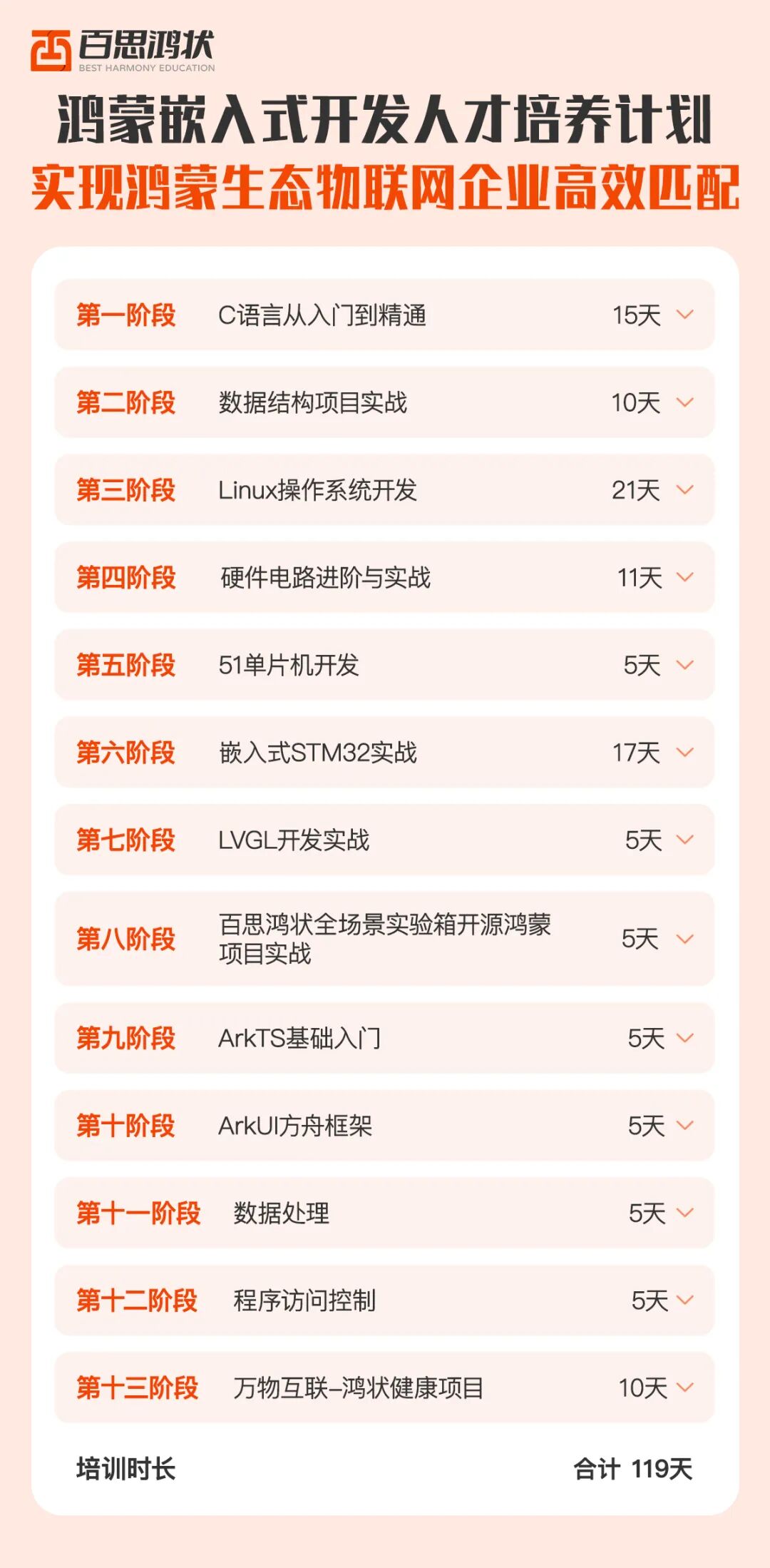
Learning Roadmap

Scan to Add Teacher
Consult about career planning and learn more about course details


Like and Share

Share

Recommend