Quick Overview: Three “Counterintuitive” Knowledge Points about Digital Isolators in Huichuan’s Medium PLC IO Module
We assist hardware engineers by providing selection references and focusing on the domestic chip replacement community. If interested, please follow our public account below, where we regularly share information on new chips, domestic replacements, and teardown analyses!
📌 Teardown of Huichuan AM600 IO Control Board & The Real Value of Digital Isolators
The AM600 is actually composed of multiple functional boards: including the main control board, power board, communication board, and the IO control board, which is responsible for the “perception and execution” tasks between the PLC and external devices.
🧠 The Role of the “Digital Isolator” in the PLC AM600 IO Control Board
We found two domestic digital isolators in the AM600 IO board — NaXin Micro NSI8240W0 Series. This type of isolator is commonly found in variable frequency drives and motor control scenarios, but its function and design logic in PLC IO modules are not entirely the same, warranting deeper exploration.
In this board, the isolator serves the following typical functions:
- 1. Achieve electrical isolation between the IO channels and the control core (MCU/FPGA), enhancing anti-interference capability;
- 2. Prevent abnormal IO interface issues (such as surges, high voltage, ground potential differences) from interfering with the main control system;
- 3. Act as a communication bridge across voltage domains (e.g., 3.3V control + 5V IO drive);
- 4. Isolate different GNDs, suppress ground loops, and optimize signal quality.
📌 In other words: this is not merely “protection”, but rather the “signal gatekeeper” in the IO control system.
🔍 Control Board Structure Analysis: The Actual Layout and Role of NSI8240W
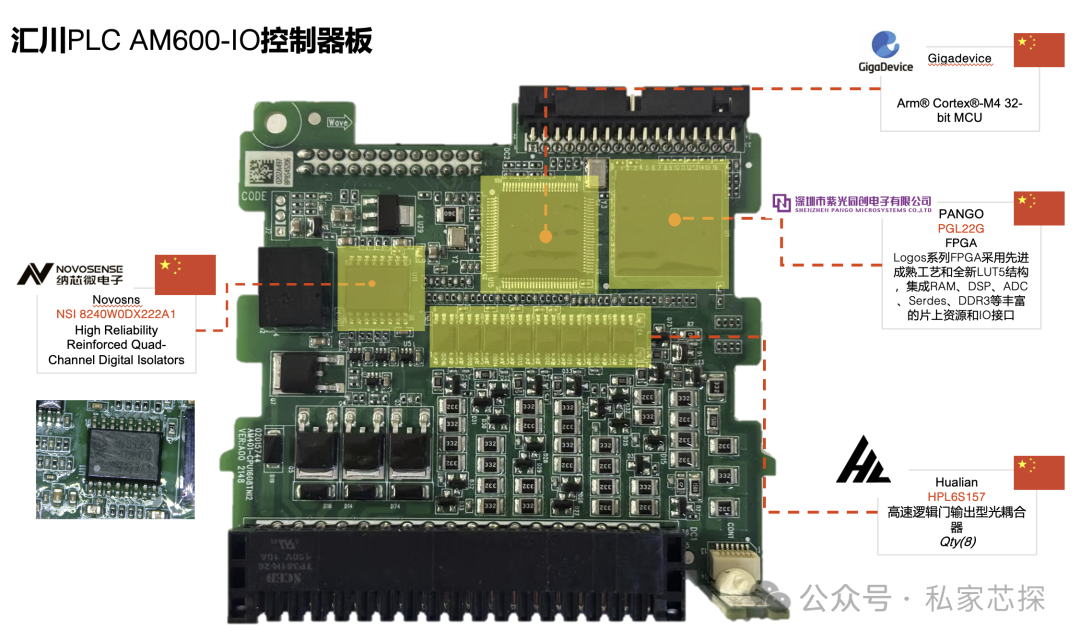
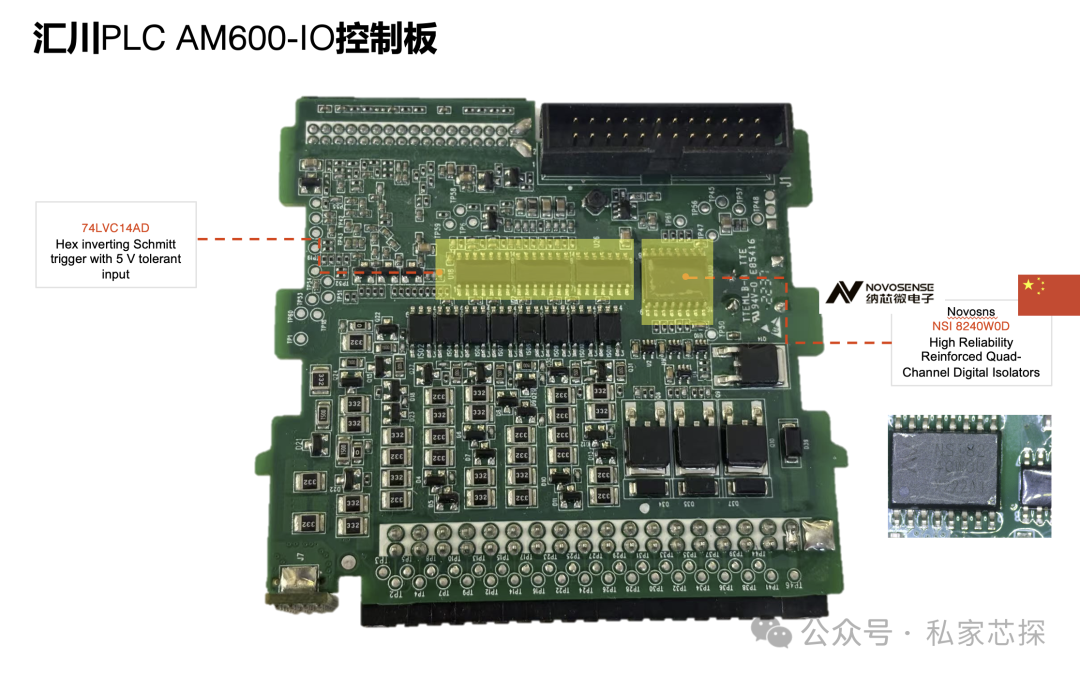
- • The control core uses GigaDevice GD32F303 MCU (Cortex-M4)
- • The co-processor is PANGO PGL22G FPGA
- • Multiple NSI8240W digital isolators are located between the FPGA/MCU and IO drivers
- • High-speed output is driven by HuaLian HPL6S157 optocoupler
It can be seen that the isolator is on the “front line” between the control logic and external loads, making it one of the key components for the stable operation of the PLC IO board.
📘 Three “Counterintuitive” Misconceptions about Digital Isolators in PLC IO Modules
✅ 1. High CMTI (Common Mode Transient Immunity) is not just for motor control; PLC IO also needs it
Traditional View: High CMTI is only needed for variable frequency drives and high-speed power systems; PLC IO interfaces do not require it.
Reality: PLC’s digital IO is often connected to field devices with the strongest electromagnetic interference (such as high-power contactors, inductive loads, and long-distance IO cables). Ground potential shifts, surge interference, etc., can easily affect the main control through the IO channels.
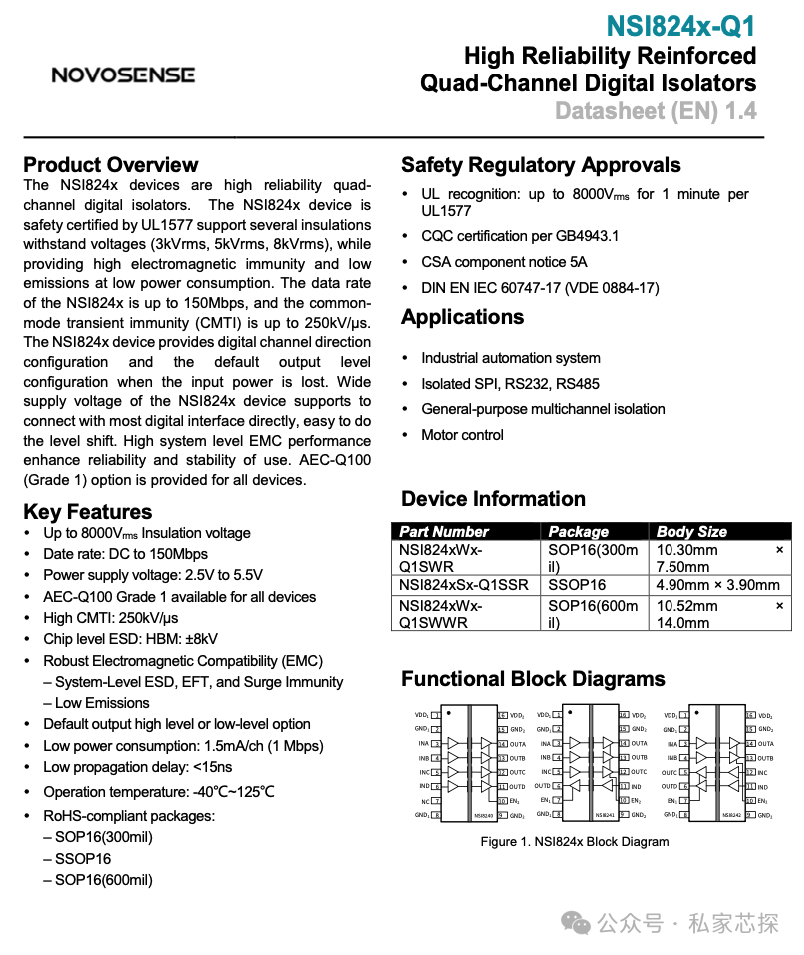
The NSI8240W provides ±250kV/μs CMTI, effectively isolating ground potential drift, electromagnetic shocks, and other interference sources, a capability that traditional optocouplers struggle to achieve.
✅ 2. Multi-channel low latency ≠ exclusive to real-time systems; PLC IO also has strict synchronization requirements
Common Misconception: PLCs are inherently slow and not sensitive to latency.
Actual Situation:The AM600-CPU1608TN is configured with 16 high-speed outputs + 32-axis EtherCAT control, and these IO output signals (such as PWM pulses) involve servo/stepper control, where synchronization errors directly affect control accuracy.
The NSI8240W supports <15ns latency, 2.5ns channel deviation, enabling multi-channel high-synchronization IO output in conjunction with FPGA, avoiding timing misalignment between channels and ensuring servo control consistency.
✅ 3. Low power consumption + default output state configuration is not exclusive to low-power applications, but is a key aspect of industrial safety design
Traditional Understanding: PLC systems have stable power supply, so device power consumption is not a concern.
Actual Challenges:
- • The area of the IO board is limited, isolators are densely packed, and thermal accumulation is a common hazard;
- • When the controller loses power or malfunctions, the default output state of the isolator must be controllable, otherwise it may inadvertently trigger IO outputs or actuator actions, posing safety risks.
The NSI8240W has a power consumption as low as 1.5mA/channel, and supports default output states of high, low, or high impedance (W0/W1 versions), ensuring control logic safety even in power-off scenarios.
✅ 4. Domestic isolators have better “adaptability” than imported ones: truly achieving plug-and-play for domestic control systems
Conventional View: Domestic isolators can replace imported ones as long as they can perform the required functions.
Engineering Reality: TI/ADI’s isolators are often optimized for their own chips, leading to issues such as level incompatibility and power-on logic conflicts in domestic systems. What PLC manufacturers need most is system-level “stable cooperation”.
The NSI8240W supports 2.5–5.5V power input, compatible with 3.3V / 5V levels, seamlessly adapting to domestic main control chips like GD32F303 and PGL22G without the need for external adapter components, saving hassle and materials.
🎯 Summary: The Core Value of NSI8240W in the AM600 IO Control Board
| Capability Dimension | Actual Role | Breaking Common Misconceptions |
| ±250kV/μs CMTI | Resist industrial site interference | High CMTI is not only needed for motor drives |
| <15ns latency / 2.5ns deviation | Achieve high-speed multi-channel IO synchronous control | PLC also requires high synchronization IO output accuracy |
| Selectable default output state | Ensure safe output state during power loss/exceptions | Risks of industrial equipment losing control must be avoided |
| Low power design | Reduce board heating, enhance system stability | Control boards also suffer from heat, not just handheld devices |
| High adaptability of domestic systems | Seamless compatibility with GD32 / PGL22G | More “domestic-friendly” than TI/ADI |
📝 Technical Disclaimer: This article is based on physical teardown and data speculation. If there are discrepancies with different version designs, please feel free to point them out. The purpose of this article is solely for learning and communication.
We assist hardware engineers by providing selection references and focusing on the domestic chip replacement community. If interested, please follow our public account below, where we regularly share information on new chips, domestic replacements, and teardown analyses!
📮 Public Account: Private Chip Explorer | Domestic Replacement is More Than Just Replacement, It’s Optimization