Welcome to follow the public account belowAbao1990, this public account focuses on autonomous driving and smart cockpits, providing you with automotive insights every day. We start with cars, but we are not limited to cars.

Recently, we disassembled the headlight driver board of the Wanjie M7, where the proportion of domestic chips surprised everyone. Following this, curiosity arose about the chip localization rate of other components in the Wanjie vehicle. Therefore, in this video, we will disassemble a Wanjie M7 host.
Disassembly
The disassembly process can be viewed in the video; I won’t elaborate further in the article. The family photo of the Wanjie M7 host after disassembly is shown below.
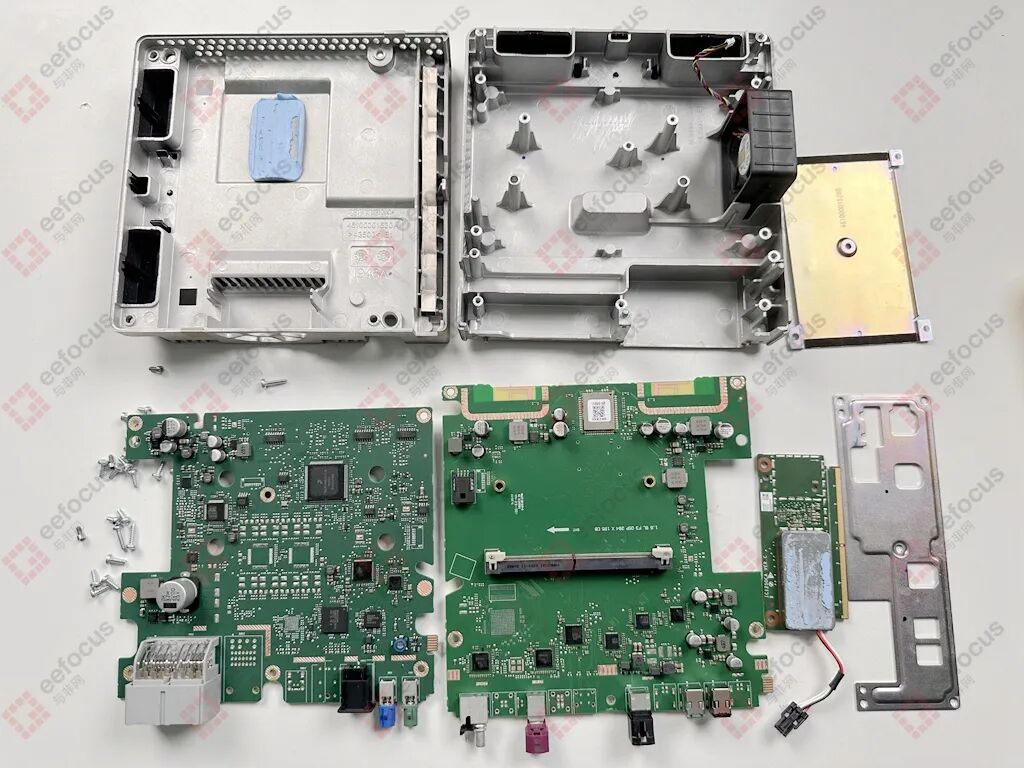
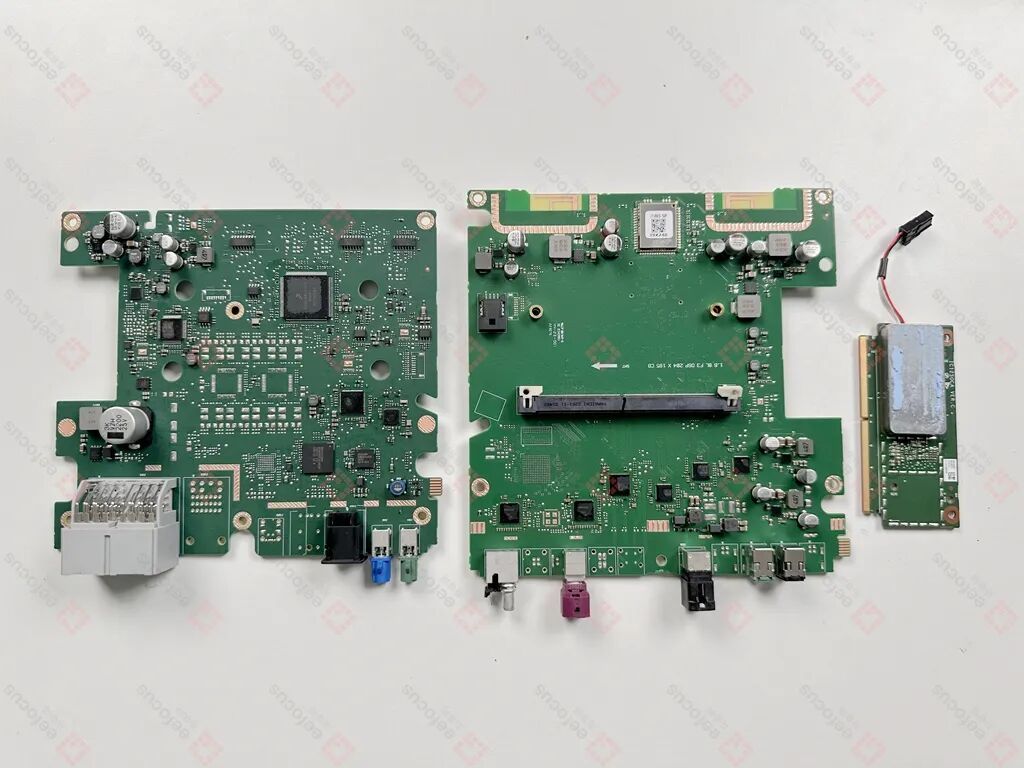
The host shell has an AVC cooling fan (DA05015B12SPT02). Inside the host, there are mainly three PCB boards: two large boards and one small board. The two large boards are connected via a B2B connector, while the small board connects to one of the large boards through a PCIe-like gold finger interface.
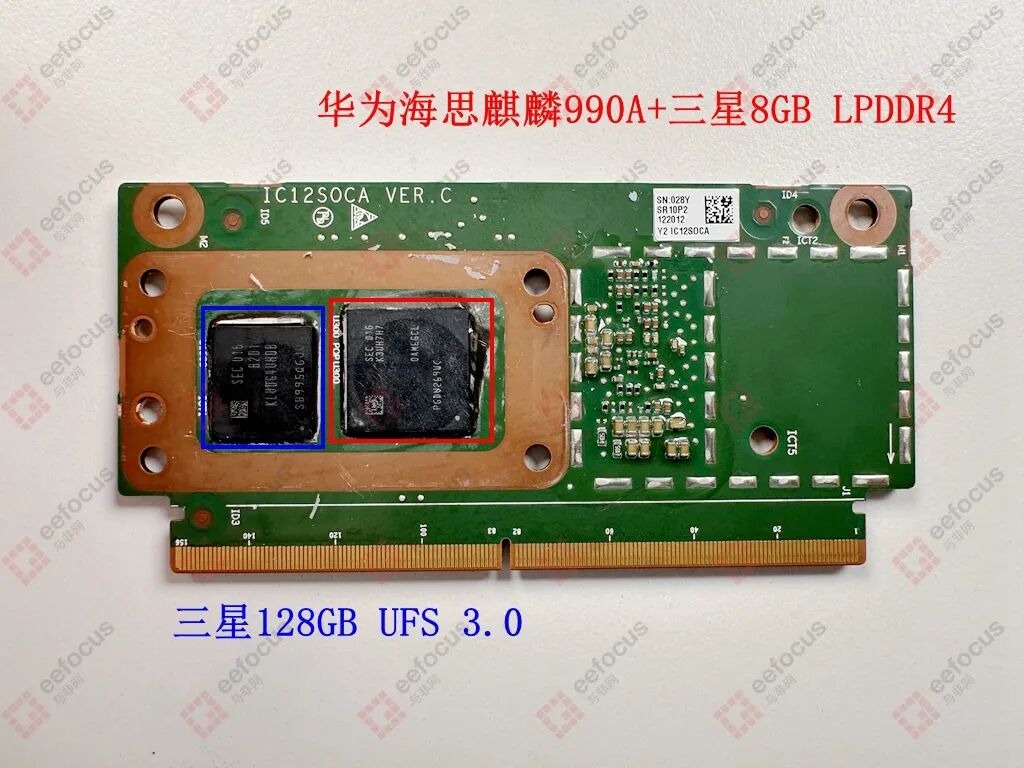
What is particularly noteworthy is that the cooling of the small PCB board actually uses a semiconductor cooling plate, which is the first time I have seen this used in a mass-produced product! The semiconductor cooling plate covers a chip that includes 1 Samsung 8GB LPDDR4 and 1 Samsung 128GB UFS3.0 storage. Initially, I didn’t understand why memory and storage would use a semiconductor cooling plate for heat dissipation, as the heat generated shouldn’t be that significant. After searching around, I couldn’t find the core SoC of the board. Upon closer inspection, I found that the Samsung memory uses a stacked package, similar to the current high-end smartphone SoCs and memory stacking. Therefore, it is not difficult to speculate that the core SoC is beneath this Samsung memory, which is likely Huawei HiSilicon’s Kirin 990A, targeting the current mid-to-high-end new energy vehicle cockpit solutions. It is considered a chip with mid-tier performance, and from the semiconductor cooling plate’s heat dissipation circuit above, it indicates that the heat generation is not small. However, an important point is that it is an automotive-grade chip.
The back of the small PCB board is filled with Huawei HiSilicon power chips, including the power management chip Hi6421 and different models of power chips Hi6S21, Hi6S22, Hi6S21A.
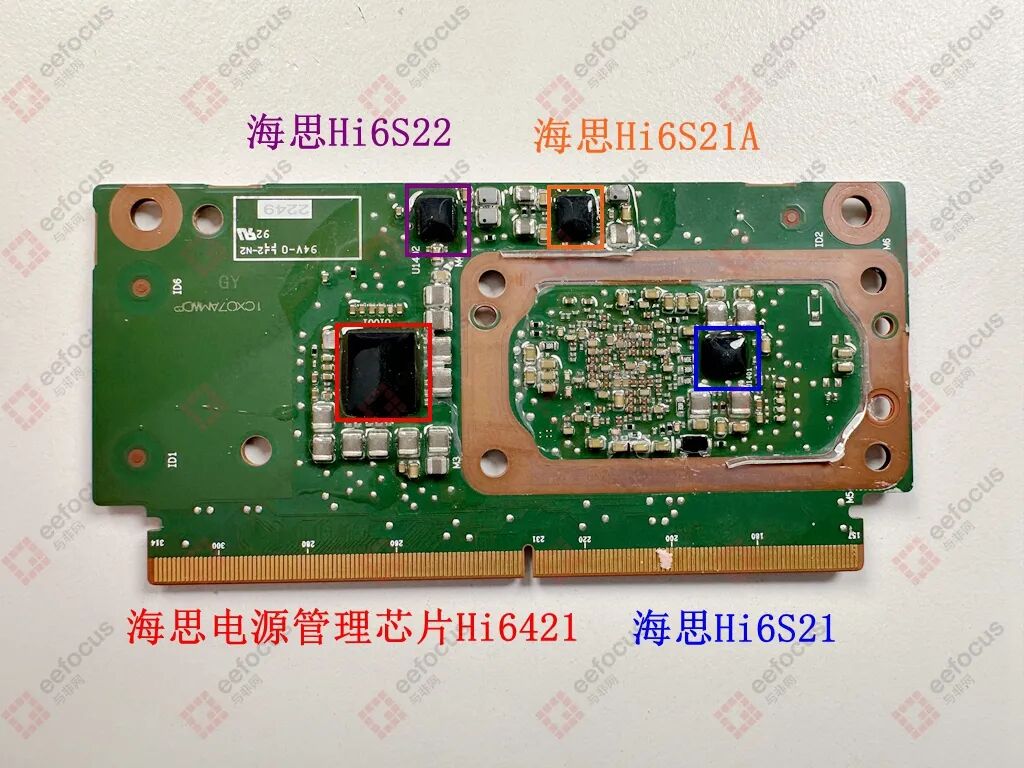
Next, let’s look at the large PCB board connected to this small board, which has many more chips.
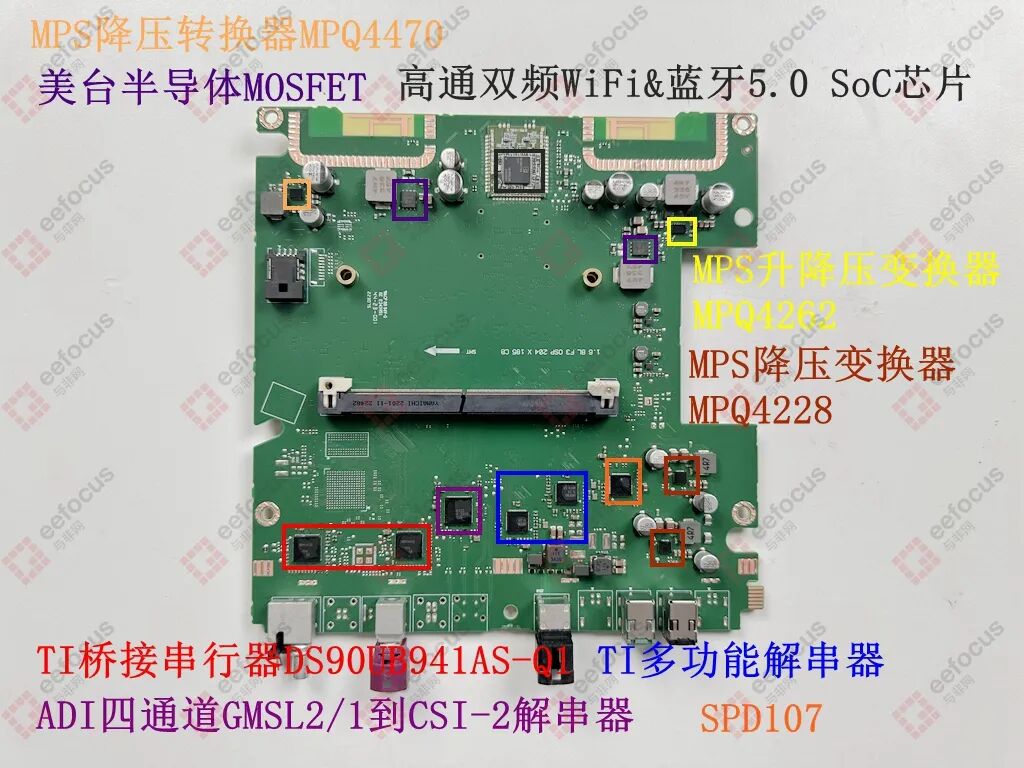
The chips involved in the audio and video data circuit include: Texas Instruments’ bridge serializer (DS90UB941AS-Q1), ADI’s four-channel GMSL2/1 to CSI-2 deserializer (MAX96722); Texas Instruments’ multifunction deserializer (DS90UB936-Q1), which can receive serialized sensor data from the source via the FPD-Link III interface. There is also a chip with the silk screen SPD107, but I couldn’t find out which manufacturer’s product it is. If anyone knows, please feel free to leave a comment.
The power circuit chips include: MPS’s buck converter MPQ4228, MPQ4470; MPS’s automotive-grade 36V, 100W buck-boost converter (MPQ4262); and a MOSFET from Meitai Semiconductor (DMTH4014LD).
The wireless module uses Qualcomm’s wireless SoC chip (QCA6574A), supporting dual-band WiFi and Bluetooth 5.0.
Now let’s look at the back of this board.
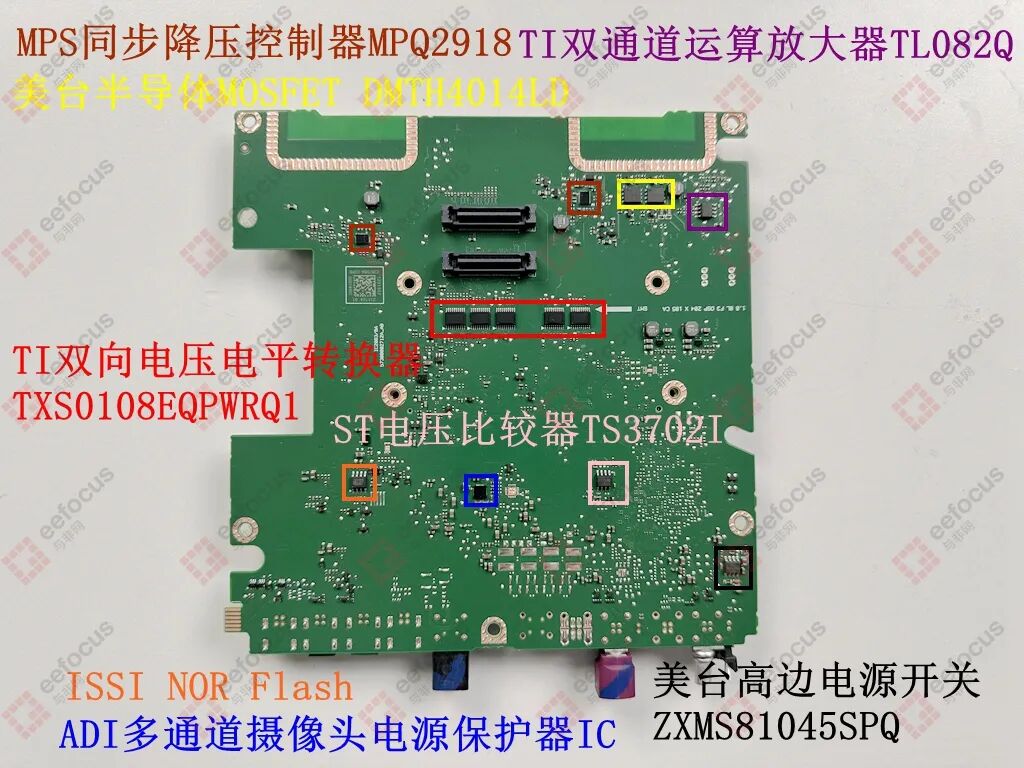
MPS current mode synchronous buck converter (MPQ2918); Meitai Semiconductor’s MOSFET (DMTH4014LD); Texas Instruments’ dual-channel operational amplifier (TL082Q); five automotive-grade 8-bit bidirectional voltage level translators (TXS0108EQPWRQ1) from Texas Instruments; ISSI’s NOR Flash (IS25LP040E); ADI’s automotive-grade multi-channel camera power protection IC (MAX20086ATPA/VY); STMicroelectronics’ voltage comparator (TS3702I); and Meitai Semiconductor’s high-side power switch (ZXMS81045SPQ), which integrates a MOSFET.
Next, let’s look at another large board connected to the previous one via a B2B connector.
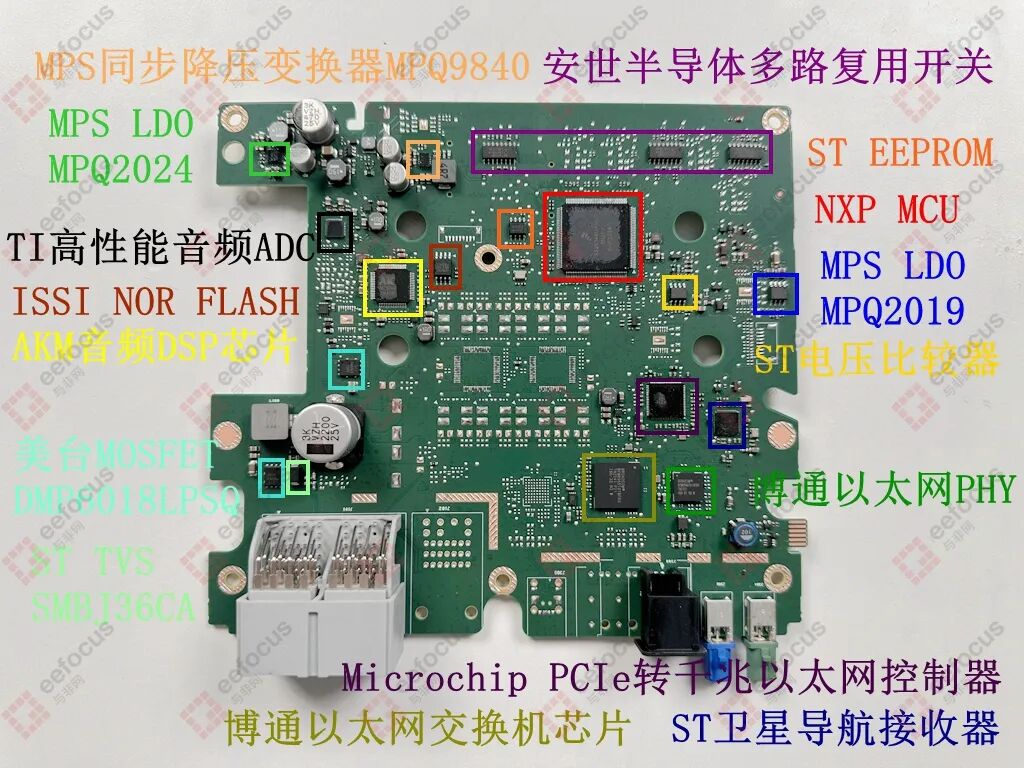
The core main control is NXP’s 32-bit microcontroller (FS32K148UAVLQ), based on the Arm Cortex-M4F processor.
STMicroelectronics’ EEPROM (M24C64), STMicroelectronics’ voltage comparator (TS3702I), and STMicroelectronics’ automotive-grade satellite navigation receiver chip (STA8089FGA), which integrates RF and built-in flash memory, supporting satellite navigation including GPS/Galileo/GLONASS/Beidou/Quasi-Zenith.
Three multiplex switches from Nexperia, which have now been acquired by Wingtech Technology, but it seems that very few people directly refer to them as Wingtech products.
The audio circuit includes: AKM’s automotive audio DSP chip (AK7016VQ); Texas Instruments’ high-performance audio ADC (PCM6360-Q1); and ISSI’s NOR FLASH (IS25LP01).
The power section includes: MPS’s low quiescent current adjustable output linear regulator (MPQ2019); MPS’s low dropout linear regulator (MPQ2024); and MPS’s low quiescent current synchronous buck converter (MPQ9840). Two P-channel MOSFETs from Meitai (DMP6018LPSQ); STMicroelectronics’ TVS diode (SMBJ36CA), which is a transient voltage suppression diode; and aluminum electrolytic capacitors from Lelon Electronics.
The communication circuit of the M7 host includes: Microchip’s PCIe to Gigabit Ethernet controller (LAN7431), which integrates Ethernet MAC/PHY; Broadcom’s automotive 100Mbps Ethernet switch chip (BCM89551B1BFBG) and Broadcom’s Ethernet PHY chip (BCM89887A1AFBG).
Some chip conditions on the back of this large PCB board are as follows.
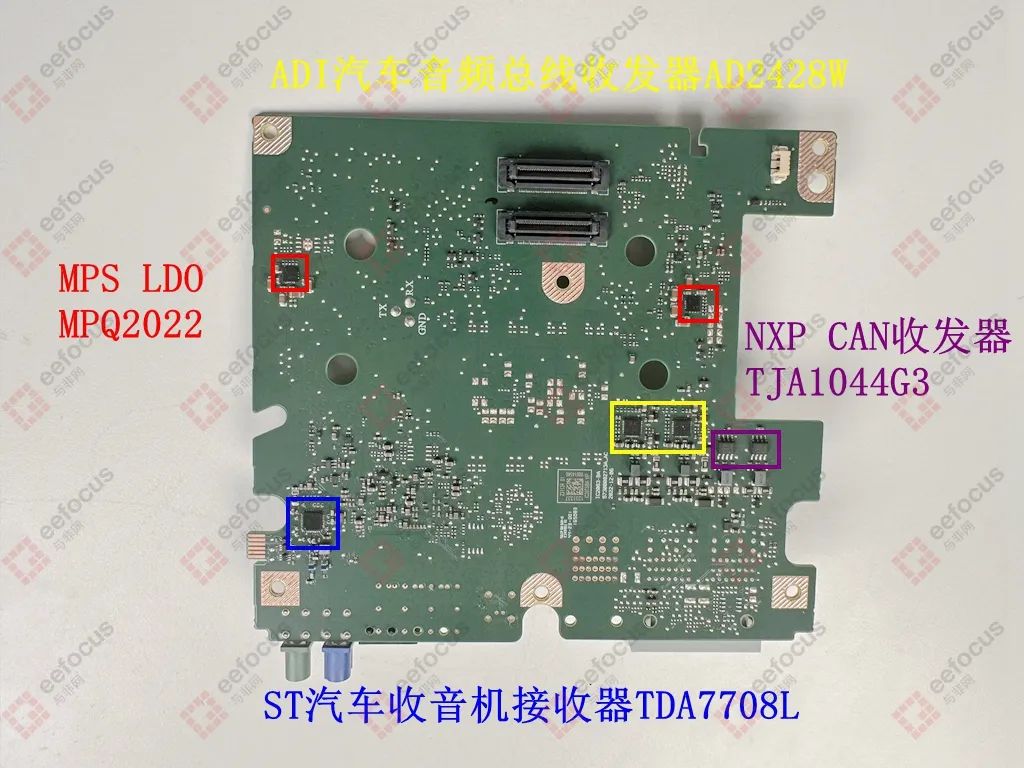
MPS’s dual-channel LDO (MPQ2022), which integrates a serial digital interface and ADC for digital diagnostics and protection.
STMicroelectronics’ automotive radio receiver chip (TDA7708L).
ADI’s automotive audio bus transceiver chip (AD2428W).
NXP’s high-speed CAN transceiver (TJA1044G3).
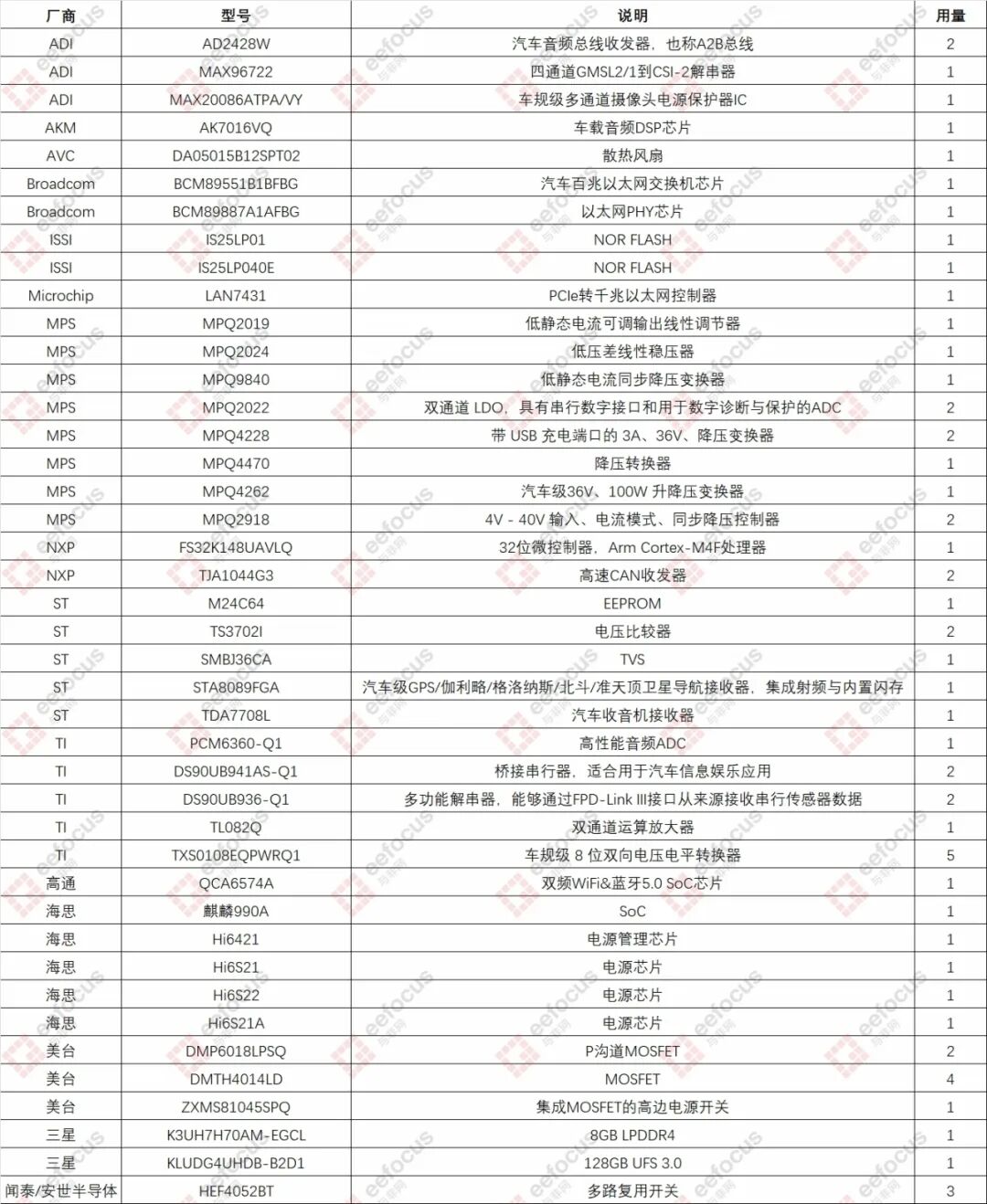
The above BOM table outlines the core hardware scheme inside the Wanjie M7 host. From the chip selection perspective, the proportion of domestic chips is very low, almost the opposite of the chip selection in the previously disassembled Wanjie M7 headlight. Apart from Huawei HiSilicon and a few domestic chips, the main chips come from foreign semiconductor manufacturers such as Samsung, STMicroelectronics, Texas Instruments, Broadcom, Qualcomm, NXP, Microchip, ADI, and MPS, most of which are automotive-grade chips. Speaking of automotive-grade chips, I believe everyone has noticed a term that has recently become popular alongside Xiaomi’s YU7, called “automotive-grade tissue box.” I won’t comment on this matter itself, but it has made the concept of automotive-grade deeply ingrained in people’s minds. As we all know, during the era of fuel vehicles, without those fancy functions, all circuits were basically important safety carriers, so as long as related chips were used, they were basically automotive-grade chips. However, with the rise of new energy vehicles, the concept of entertainment + intelligent driving + rapid iteration has allowed consumer-grade chips to enter the supply chain of automotive manufacturers, and these consumer-grade chips generally do not play a role in the main safety functions of vehicles. As we can see from the previous chip selection of the Wanjie M7 headlight, but when it comes to safety, as seen in the hardware selection of the Wanjie M7 host, it still mainly uses automotive-grade products. So, do you understand?
Click to play
Summary
The Wanjie M7, as a representative model of the smart cockpit empowered by Huawei, carries key tasks such as infotainment, assisted driving, and network communication within its core onboard host system. In the wave of automotive electrification and intelligence, what will be the future of the supply chain security and localization capability of automotive-grade chips? We shall wait and see!
A group of like-minded friends gather in the Knowledge StarSphere
Join the “Abao Talks Cars” Knowledge Star, and you can obtain relevant learning materials for these modules (currently including research reports, online expert sharing, and offline closed-door meetings), covering 16 major sections, detailed list as follows: