Definition and Key Segments of the Industrial Internet of Things (IIoT)
The Industrial Internet of Things (IIoT) can be defined as “the advanced data analytics results achieved through the transformation of business operations by machines, computers, and personnel to realize intelligent industrial operations.”
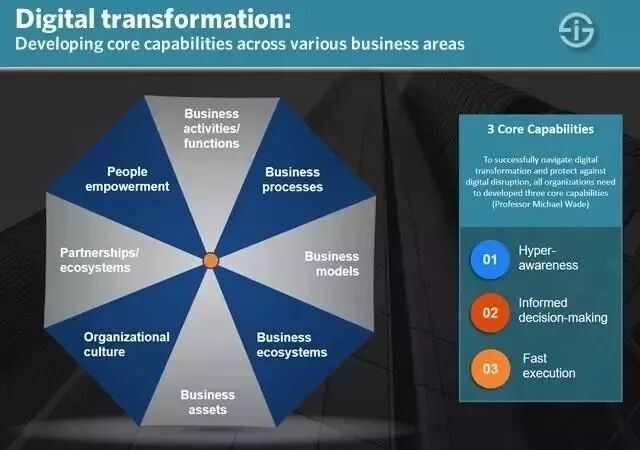
In the context of Industry 4.0 or the “Industrial Internet,” we view the IIoT as part of an integrated approach, positioning it as a central stage for digital transformation, where data is a key asset and production resource in relevant products, and analysis is an essential function in the application of globally connected products throughout their lifecycle.
The IIoT is the largest and most important component of the Internet of Things (IoT), but from a spending perspective, consumer applications currently represent the largest application area of the IoT. The application of IIoT primarily began around 2018; nevertheless, it is becoming increasingly important and advanced within the overall IoT application landscape.
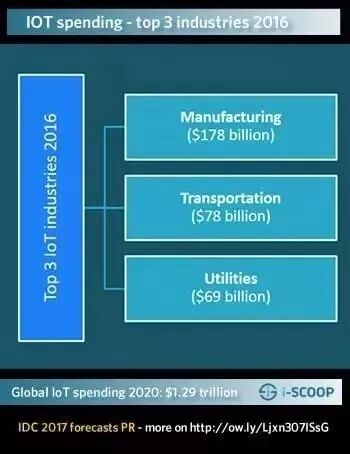
Before 2020, manufacturing, transportation, and utilities were expected to be the largest industries investing in IoT.
According to IDC’s 2017 IoT investment spending forecast, the three major industries preparing to invest in IoT before 2020 are all part of the industrial internet market.
Manufacturing: The Largest Market for IIoT
The primary application area within the IIoT is manufacturing. It is also the largest industry for IoT spending (including software, hardware, connectivity, and services).
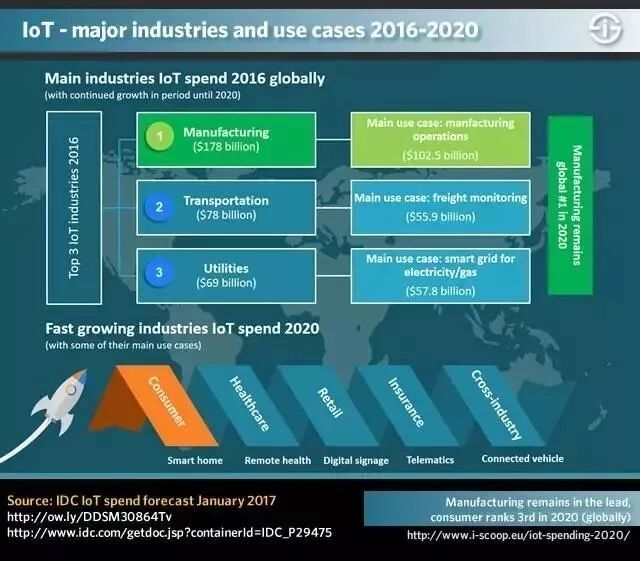
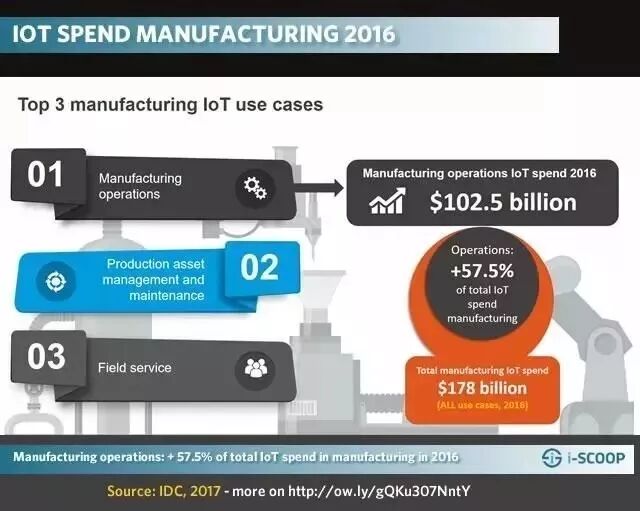
In 2016, manufacturing alone accounted for $102.5 billion in investment, while the total IoT investment reached $178 billion, as all IoT application scenarios converge in manufacturing. The overall spending for IoT was $178 billion, with manufacturing being the largest application industry for IoT to date, surpassing the total investment of all other consumer IoT applications.
According to research released by IDC in early 2017, aside from operations, two other significant application scenarios in manufacturing are production asset management and maintenance, as well as field services.
Applications of IIoT in Connected Logistics and Transportation
Transportation is the second-largest market for IoT spending. Transportation and logistics (T&L) companies are seeking to enhance their position across the value chain through advanced communication and monitoring systems provided by IoT.
The transportation market has reached an IoT spending scale of $78 billion and will continue to grow rapidly, similar to the IoT market in manufacturing. The primary use case in transportation is freight monitoring, with total IoT spending for goods transportation amounting to $55.9 billion, which will remain a major driver of investment in the market before 2020.
By 2020, the global connected logistics market is expected to grow at a compound annual growth rate (CAGR) of around 30%.
Looking at the overall development of IIoT in transportation and logistics, we see the rise of digital supply chains and connected logistics. Similar to manufacturing, one of the challenges in the T&L market is that many players are being pressured by market conditions to accelerate their digital transformation without having established a digital strategy. Approximately 20% of the digital transformation costs in T&L are allocated to supply chain transformation. Clearly, IoT plays a significant role here.
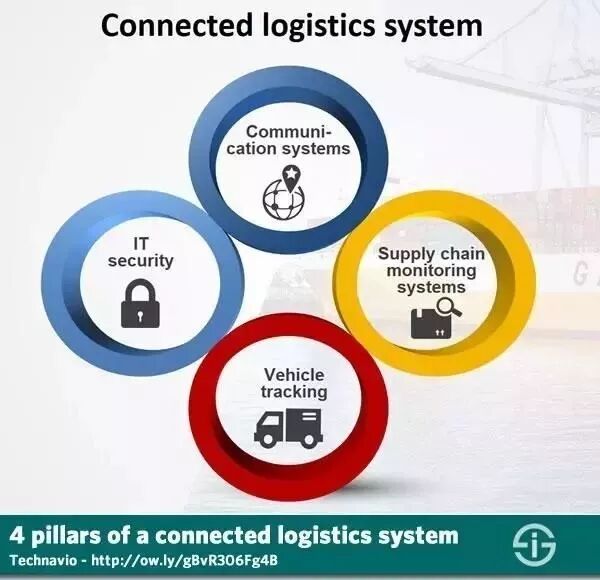
Industry experts have defined four pillars for connected logistics systems: IT security, communication systems, supply chain monitoring systems, and vehicle/transport tracking. Along with cloud and analytics, IIoT is the driving force in the connected logistics field, where freight monitoring is the leading application scenario.
Applications of IIoT in Energy and Utilities
The oil and gas, smart grid, and many other evolutions and use cases in the energy and utilities market are also major components of the IIoT market.
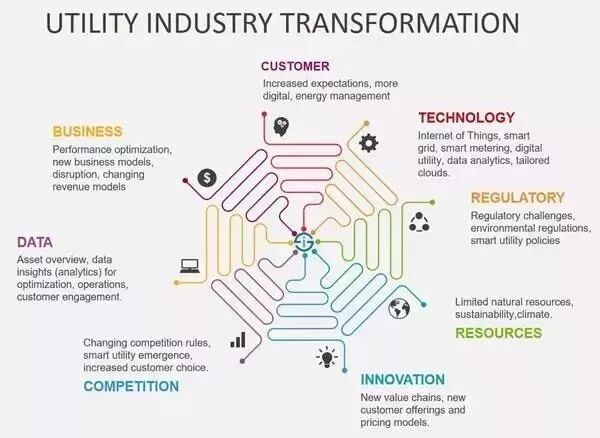
According to earlier mentioned data from IDC, utility applications are the third-largest industry in terms of IoT spending, with utilities alone reaching $69 billion in spending in 2016. Additionally, there is a significant investment area: smart grid applications for electricity and gas, which saw total investments of $57.8 billion in 2016.
IIoT plays a crucial role in the overall digital transformation process, with many areas of digital transformation involving the realization of digital supply chains and value chains of large ecosystems, which clearly also involves retail/consumer-facing applications.
However, from the perspective of IIoT, smart grids are key to electricity supply and network transmission/distribution. Other applications include factory efficiency, as well as maintenance and data-driven opportunities resulting from operations and services supported by smart grids and IoT.
Applications of IIoT in Other Industries
Maintenance and services implemented with the support of IIoT are two key application areas across almost all IIoT industries.
Predictive maintenance, data-driven services, and remote monitoring possibilities across multiple fields, from service to control and operational optimization, include applications in healthcare (remote health monitoring, equipment maintenance, etc.), aerospace, and many other IIoT application scenarios such as robotics, coal mining, oil and gas, mining, metallurgy, etc.
As mentioned above, according to industry forecasts, broader application scenarios for IIoT also include agriculture, smart cities, and other fields.
——New Yun
Source: Chengyi Business Community