■ Abstract: The construct of language testing determines what is tested and how it is tested, and also affects the subsequent impact of the test on education and society. The definition of the construct is the foundation of test design and score interpretation, while construct validity is a core concept in the validity research of language testing. Since the 1960s, the understanding of constructs and construct validity in the field of language testing has deepened, while continuously exploring models for defining constructs. To promote deeper exploration of constructs and construct validity in the field of language testing in China, this article reviews the theoretical research on construct validity in education and psychological measurement, elaborates on the development of perspectives on constructs and construct validity in language testing, and points out the future directions for research in constructs and construct validity in language testing.
■ Keywords: Language testing; validity research; construct; construct validity

Citation: Jin Yan. 2022. Constructs and Construct Validity in Language Testing [J]. Language Testing and Evaluation, (1): 44-57.
1
Introduction
There was once a commentary article discussing the reform of elementary school Chinese language education online. A teacher asked: What happens after ice melts? A student answered “spring” and was marked wrong. The testing objective of this question is the literacy in the Chinese language subject, such as language comprehension and expression skills, thinking skills, and literary appreciation abilities. If the answer is “water,” what ability is being tested? What impact will the test have on Chinese language teaching? In foreign language testing, we also encounter similar issues. For example, should oral or writing tests assess students’ critical thinking skills? When reporting individual skill scores in proficiency tests, how should the scores for cloze tests be reported? These are all questions related to the construct of language testing.
Language testing is a measurement tool that first needs to consider why and what is being measured, which is the construct of language testing. Defining the construct is the basis for interpreting language test scores; secondly, it is necessary to argue for the rationality of score interpretation and the effectiveness of test use, that is, the validity of language testing. Since the early 21st century, scholars in China have closely followed the development of validity theory in language testing, introducing and reviewing research results on validity (e.g., Li Qinghua 2006; Xu Yun 2011; Han Baocheng, Luo Kaizhou 2013; Luo Kai 2019; Liu Jianda et al. 2021). However, there has been little theoretical discussion in academia about the constructs and construct validity of language testing, and even less practical exploration of defining constructs. Therefore, this article reviews the development of construct validity theory in the fields of education and psychological measurement, elaborates on the exploration of constructs and construct validity in language testing, discusses the academic debate on “construct validity”, and points out the future directions for research on constructs in language testing.
2
Development of Construct Validity Theory
2.1 Construct Validity from the Perspective of Classification Validity
“Construct” is a rather perplexing concept. The Standards for Educational and Psychological Testing (hereinafter referred to as the Standards) (AERA et al. 2014) defines a construct as “the concept or characteristic measured by the test” (p.11). Unlike test content, item types, guidelines, scoring rubrics, etc., the construct is a more abstract concept. Scholars in China have used various expressions such as “structure”, “concept”, “experiment”, “conceptualization”, and “construct”. Xie Xiaoqing (2001) believes that the term “concept” is closer to the meaning of construct but does not emphasize the notion of building or creating. The term “construct” is a newly created Chinese vocabulary that accurately reflects the main meaning of construct.
Construct validity was first proposed by psychometric scholars. In the 1950s, the definition of validity was “to what extent does the test measure what it intends to measure” (Cureton 1951:621). Validity evidence is the degree of correlation between this test and other measurement tools. Subsequently, members of the American Psychological Association’s Committee on Psychological Testing, P. E. Meehl and R. C. Challman, proposed the theory of construct validity and included it in the Technical Recommendations for Psychological Tests and Diagnostic Techniques (APA 1954). In this report, validity includes concurrent validity, predictive validity, content validity, and construct validity. In the widely cited article “Construct Validity in Psychological Tests” (Cronbach & Meehl 1955), the authors explored the significant importance of construct validity for psychological measurement. They argued that a construct is a hypothesized attribute of a person expressed through test performance (p.283). Construct validity explores the relationship between test performance and the construct, answering three questions: How are test scores interpreted? Is the interpretation of scores sufficiently supported? What kind of evidence and argument support it? (p.297) Loevinger (1957) further pointed out that construct validity is a core concept in psychological measurement, and all validity evidence is aimed at demonstrating construct validity. Despite the initial emergence of a validity perspective centered on constructs, the 3rd to 5th editions of the Standards (APA et al. 1966, 1974, 1985) still adhered to the classification validity perspective.
In the 1980s, scholars in China introduced construct validity theory. Xie Xiaoqing (1988) started from the general laws of scientific activity to explain the “concept validity” of psychological measurement (p.173). He pointed out that the purpose of scientific research is to generalize measurable empirical facts into concepts to reveal the essential connections between these phenomena. Researchers first propose concepts, then establish dimensions, conduct quantitative measurements, and only then can theoretical formulas be established. Therefore, concept validity is “the extent to which the test measures a certain trait concept”; the questions answered are “What psychological traits does the test measure? How well does the test measure this psychological trait?” (p.175). Wang Xiaoling (1989) pointed out that structural validity does not examine the predictive effect of the test on criteria or the representativeness of test content, but rather theoretically explores whether the constructed hypothetical attributes or theoretical concepts are valid, that is, “the extent to which the test measures the hypothetical attributes or theoretical concepts of a person” (p.123).
2.2 Construct Validity from the Perspective of Overall Validity
As research on validity theory deepened, the classification validity perspective faced various criticisms. Messick (1989a) pointed out that classification validity seems to imply that a certain type of validity evidence is sufficient to support certain uses of the test. Brennan’s (1998) summary is also representative: the classification of three types of validity seems somewhat arbitrary, and the categories are certainly not complete enough. In the 3rd edition of Educational Measurement, Messick (1989b) proposed the overall validity theory. He pointed out that validity is a comprehensive concept centered on constructs, evaluating the interpretation and use of scores. Messick presented a layered overall validity perspective through a progressive matrix. Validity includes two levels: “test interpretation” and “test use”, and validity arguments require two types of evidence: “evidence base” and “consequential basis”. Each cell in the matrix contains construct validity, indicating that construct validity is not only the evidence base for test interpretation but also the foundation for other levels, and each level requires construct evidence as a basis.
Messick (1995) further pointed out that overall validity integrates content, criterion, and consequential validity into a construct framework to guide empirical research on score interpretation and usefulness hypotheses. Messick believes that content and criterion evidence are arguments for score interpretation, while the argument for test use is essentially also about interpreting the meaning of scores. Therefore, all validity evidence supports (or undermines) the sufficiency and rationality of the interpretation and use of test scores, which is “construct validity”. Construct validity evidence comes from six aspects: content analysis, experimental analysis, internal structure, generalization analysis, extrapolation, and consequential evidence. From the perspective of overall validity, the connotation of construct validity has been greatly expanded, becoming a comprehensive argument for score meaning and test use. More importantly, validity is no longer a test of its own quality but an evaluation of score interpretation and use. This represents a significant advancement in the theory of validity in education and psychological measurement.
Since the 6th edition, the Standards (AERA et al. 1999) has abandoned the classification validity perspective and all related terms, including construct validity. This edition replaced “construct validity” with “validity” because the concept of construct validity has become redundant, and the validity argument process is precisely the process of establishing construct validity. However, the application of overall validity theory has faced challenges. As a result, researchers have been committed to developing validity argument frameworks or models. We will elaborate on the validity argument framework in the language testing section.
3
Constructs in Language Testing
3.1 Perspectives on Constructs in Language Testing
Language testing is a typical interdisciplinary field. Li Xiaojun (2001) believes that the disciplines feeding content into language testing are mainly linguistic sciences and various language-related sciences; the disciplines providing means for language testing mainly include measurement science, experimental methodology, and information technology. The development of validity theory in the field of education and psychological measurement highlights the importance of score interpretation. The meaning of scores comes from the interpretation of the stability of test performance. In language testing, the stability of test performance is determined by two factors: language ability and communicative context. How to understand the relationship between language ability and communicative context is the perspective on constructs in language testing.
Chapelle (1998) summarized three perspectives on constructs in second language acquisition research: trait theorists, behaviorists, and interactionalists. Bachman (2007) elaborated on the trait/ability-focused perspective and task/context-focused perspective in language testing, and expanded the interactional perspective. Bachman’s classification system targets language testing and combines specific application models (see section 3.2), so this article briefly reviews that system. Purpura (2016) proposed a meaning-based perspective on constructs, which will not be elaborated on here due to space constraints (readers can refer to Xi et al. 2021; Gao Miao 2022).
The “trait/ability perspective” regards the learner’s language ability as the construct of the test. Ability is a relatively stable individual trait that is not affected by situational changes, while the situation is the way in which candidates demonstrate their language ability, which is unrelated to the construct but affects candidates’ performance in the test. The “task/context perspective” regards the performance in completing communicative tasks as the construct of the test. Researchers, influenced by behaviorist theory, believe that tests cannot assess learners’ potential but can only observe their behavioral performance. These two types of construct perspectives reflect competency-centered and task-centered testing philosophies. The ability perspective emphasizes determining the construct of the test under the guidance of language ability theory, inferring the ability represented by scores through candidates’ performance, and strategy ability can explain test performance in different contexts. The task perspective infers candidates’ ability to complete communicative tasks in real situations based on their performance on test tasks, thus focusing on the authenticity of test tasks and advocating the use of task-based or performance assessments.
The “interactional perspective” focuses on the mutual influence between language ability and context, where language ability is constrained by context, and changes in context affect the use of language ability. The interactional perspective is divided into strong interactionalists, moderate interactionalists, and minimal interactionalists. Strong interactionalists believe that interaction is the construct, as the theory of interactional competence asserts that true communicative competence is reflected in the purposeful and meaningful co-construction of discourse, influenced by sociocultural and pragmatic factors (He & Young 1998). Moderate interactionalists define the construct as the language ability demonstrated by language users in context, which is a locally constrained construct (Chalhoub-Deville 2003). Minimal interactionalists focus on the social attributes and functions of language, emphasizing the impact of context on language acquisition and use, and viewing strategy ability as a medium of interaction (Chapelle 1998; McNamara 2001).
3.2 Models for Defining Constructs in Language Testing
Language testing is a highly practical discipline, and the purpose of theoretical exploration is to guide testing practice. Bachman (2007) pointed out that different understandings of constructs are a tricky issue in theoretical research on language testing, and this problem may not be satisfactorily resolved at the theoretical level. To illustrate the application of construct perspectives in language testing practice, Bachman (2007) analyzed seven types of models for defining constructs in language testing in detail. Among them, types 1, 3, 4, 5, and 6a reflect the trait/ability perspective, while types 2 and 6b are task/context perspectives, and type 7 represents the interactional perspective.
1) Skills and components. The construct is the candidate’s language ability, namely skills like listening, speaking, reading, writing, and components such as phonetics, intonation, syntax, and vocabulary.
2) Direct tests/performance-based tests. The construct is the behavior of candidates in real language communicative tasks, using short essays/application writing and face-to-face communication; emphasizing the authenticity of test tasks, predicting candidates’ behavior in real contexts through scores.
3) Pragmatic language testing. Based on the single ability hypothesis, using item types such as cloze tests and dictation to assess pragmatic expected grammar.
4) Communicative language testing. Research on communicative language ability draws from findings in functional linguistics, sociolinguistics, discourse analysis, psycholinguistics, language acquisition, etc., greatly enriching the construct of language testing. Communicative language testing emphasizes communicative context and task authenticity, but the main focus is on language communicative ability.
5) Interaction-ability. This view proposed by Bachman (1990) and Bachman & Palmer (1996) acknowledges the interaction between language ability and context, but when interpreting scores, it is necessary to separate language ability from context, inferring language ability through task performance. This model differs from performance-based tests in that it focuses on language ability, and describing test methods or task characteristics is aimed at better reflecting target domain characteristics. Although this model helps address the issue of grounding constructs, it cannot explain the interaction between ability and context.
6) Task-based performance testing. This model can be subdivided into two categories: 6a is similar to the interaction-ability perspective, recognizing the interaction between language ability and context but viewing language ability as the construct; 6b defines the construct as candidates’ performance in communicative tasks, requiring evaluation based on standards in real communicative contexts.
7) Interactive. The interactive perspective mainly comes from discussions on the evaluation of oral tests. Although the interactive construct perspective provides many insights for defining constructs in language testing, it still faces many challenges in testing practice, especially the strong interactionalists’ theory of interactional competence.
There is no right or wrong in construct perspectives, and different viewpoints are not necessarily mutually exclusive. Under different construct perspectives, the concepts of test design vary, the perspectives on score interpretation differ, and the generalizability of scores also varies. The trait/ability perspective has advantages in score generalization and extrapolation, thus being slightly more operational in practice. The interactional perspective has significant theoretical value, but it poses challenges in application, such as difficulties in score extrapolation and a lack of relevant literature and research (see Zhang Lin, Jin Yan 2016). Bachman (2007) emphasized that if test designers focus solely on one construct perspective while excluding other viewpoints, it may lead to flawed test designs or limited uses. Therefore, it is necessary to consider the three different construct perspectives in the design, development, and use of language tests.
4
Constructs in Language Testing
4.1 Perspectives on Validity and Construct Validity in Language Testing
The development of validity theory in the fields of education and psychological measurement has promoted research on constructs in language testing while also influencing the perspectives on validity in language testing. In the foundational work in the field of language testing, Language Testing: The Construction and Use of Foreign Language Tests: A Teacher’s Book (Lado 1961) proposed that the evaluation criteria for language testing include validity, reliability, scoring feasibility, economy, and implementability. Validity is whether the test measures what it intends to measure, demonstrated through surface validity, content validity, control of irrelevant factors, response modes, and empirical research. Validity is viewed as a correlation, for instance, empirical research compares test performance with language use in real contexts or other tests that have been validated.
In China, Zhang Houcan and Gui Shichun’s Introduction to Standardized Testing (National Education Commission Student Management Department 1985) classified validity into content validity and criterion-related validity. Gui Shichun’s Standardized Testing: Theory, Principles, and Methods (1986) provided a more detailed classification of validity, including content validity, predictive validity, concurrent validity, and experimental validity. Among them, the purpose of “experimental validity” is “to experiment on psychological traits and abilities” (p.141), which refers to the research on constructs of the test. Li Xiaojun (2001) also elaborated on the classification of validity in The Science and Art of Language Testing (2nd Edition), clearly stating that structural validity is the most important: “Structure does not refer to the structure of items or test papers, but to the theoretical structure on which the entire exam is based. To put it simply, structural validity is the validity of the theoretical principles of the exam. Clearly, this is the foundation of all other types of validity.” (p.39) It is evident that the construct validity under the classification validity perspective is a demonstration of the narrow theoretical construct of testing.
In the 1980s, the field of language testing expanded the three-part validity perspective composed of criterion-related validity, content validity, and construct validity, introducing types of validity such as response processes (Henning 1987) and washback effects (Hughes 1989). The watershed moment for the transition of language testing from the classification validity perspective to the overall validity perspective was Bachman’s Fundamental Considerations in Language Testing (1990) (Chapelle 1999). In discussing different aspects of validity evidence, Bachman (1990) elaborated on the understanding of construct validity: test scores represent ability, and test use inevitably involves score interpretation. When we want to answer the question “What does this test actually assess?”, we need to conduct construct validity arguments. Construct validity is a comprehensive concept, and construct validity arguments are the process of integrating all previously discussed evidence.
Since the 1990s, overall validity theory has been widely accepted, but its specific application in validity research has faced challenges. The main questions are: where should validity research begin? How to conduct systematic arguments? How should evidence be presented? How to integrate conclusions? How to prevent researchers from only presenting favorable evidence? To better guide validity research, scholars have been committed to developing validity argument frameworks. In China, over the past two decades, large-scale language testing has rapidly developed in practice, establishing a relatively complete test development and implementation system, and conducting numerous washback effect studies. However, there has been little exploration, reflection, and innovation at the theoretical level of construct validity theory in China, often merely introducing existing theories or referencing existing frameworks for validity research.
4.2 Validity Argumentation in Language Testing and Construct Validity
This section reviews four influential validity argument frameworks in the field of language testing, focusing on their understanding and explanation of constructs and construct validity.
Bachman & Palmer (1996) proposed a “test utility framework” that evaluates test utility from six aspects: reliability, construct validity, authenticity, interactiveness, consequential validity, and operability. To reflect the idea of overall validity, the authors proposed three principles for using the framework, emphasizing the significance of comprehensive evaluation and enhancing the overall utility of the test. The authors established a working framework for language ability and test characteristics, helping test developers define the test construct and enhancing the practicality of the utility framework. It is worth mentioning that the authors used the term “construct validity” as an independent standard to evaluate whether the interpretation of test scores is meaningful and rational (p.21; see p.41, note 2).
Weir (2005) introduced the concepts of situational validity and theoretical validity in his “social-cognitive framework” to argue for the rationality of test design. The author believes that the construct is not an individual’s language ability, but rather the interaction between communicative context and cognitive ability, which is also the reason he named the framework the social-cognitive framework (p. 18-19). This framework also includes scoring, criterion-related validity, and consequential validity to verify the validity of test scores. The author specifically pointed out that “construct validity” can refer to overall validity or specifically to theoretical construct validity, which can easily lead to confusion. Therefore, it is recommended to restore the term “validity” to denote overall validity of the test (p.14).
Chapelle et al. (2008) constructed an “explanatory argument framework” for the new TOEFL test. In the argument-based validity verification model, the explanatory argument presents all inferences and assumptions regarding the interpretation and use of scores (Kane 2006). This explanatory argument framework includes domain definition, scoring, generalization, interpretation, extrapolation, and use, connecting target domains, observations, observed scores, expected scores, constructs, target scores, and test uses. Based on Kane (1992) and Kane et al. (1999), this framework adds “domain definition” and “interpretation” inferences, highlighting the importance of construct evidence and more fully reflecting the overall validity perspective centered on constructs.
Bachman & Palmer (2010) provided a “test use argument framework” that offers comprehensive and systematic theoretical and evidential support for language testing decisions and uses (see Gu Xiangdong, Peng Kangzhou 2008; Zhao Zhongbao, Fan Jinsong 2012). The four main claims of this framework state the core viewpoints, and the six elements describe the reasoning process of the claims. Directly related to constructs is Claim 3: the interpretation of the measured language ability is meaningful, fair, generalizable, relevant, and sufficient. The authors elaborated on the ways of defining constructs and their impact on score meaning and extrapolation, pointing out that the argument for score interpretation is the basis for the argument for decision-making (Claim 2) and consequences (Claim 1).
All these frameworks reflect researchers’ emphasis on defining constructs and score interpretation. Except for Bachman & Palmer (1996), other authors have avoided the term “construct validity”, instead using “validity” to indicate Messick’s (1989b) “construct validity”. Nevertheless, some scholars have pointed out that the test utility framework and social-cognitive framework lean towards technical argumentation, listing evidence in a checklist manner, favoring confirmation rather than falsification; compared to the argument-based validity verification model, the logical relationships between modules in these two frameworks are not clear enough, and the shadows of classification validity perspectives are still visible (Fulcher 2015; Han Baocheng, Luo Kaizhou 2013; Luo Kaizhou 2019).
5
Future Directions for Research on Constructs in Language Testing
5.1 Expanding Constructs in Language Testing
Messick’s (1989b) overall validity theory proposed two major factors that threaten construct validity: insufficient construct representativeness and construct-irrelevant variance. To enhance the representativeness and relevance of constructs in language testing, test developers should continuously explore the connotation of constructs to ensure that test scores are meaningful. Linguistic research can help us gain a deeper understanding of the essence of language ability and describe language ability more accurately and in detail. At the same time, the construct of the test should be continuously expanded based on changes in social needs. Since the 21st century, the education sector has proposed “21st-century core competencies” in exploring talent cultivation goals, including problem-solving ability, critical thinking, computer and information literacy, collaboration ability, civic awareness, intercultural communication, innovation, and creativity (Greiff & Kyllonen 2016). Although these competencies are not new concepts, they have not received sufficient attention in teaching. If these competencies can be integrated into the testing constructs, it is expected to promote the cultivation of these abilities in teaching.
For example, regarding critical thinking ability, it is a high-level thinking ability and one of the educational goals that urgently need to be strengthened in higher education in China (Huang Yuanshen 2010; Wen Qiufang 2012; Sun Youzhong 2019). Critical thinking ability is not merely criticism or negation, but rather the formation of one’s viewpoint based on analysis, evaluation, reasoning, and other processes. The evaluation of critical thinking ability can include objective evaluation, subjective evaluation, and a combination of both (He Lianzhen, Lin Xiao 2017). Currently, the assessment objectives of language tests, especially oral or writing tests, mainly revolve around language expression, topic development, discourse organization, etc., without incorporating critical thinking abilities as explicit task requirements or evaluation criteria into the testing constructs. If the test does not require critical thinking abilities, it will not have a positive washback effect on teaching. Therefore, it is necessary to expand the constructs of language testing based on the new requirements for talent cultivation in the 21st century, increasing the requirements for critical thinking abilities in task design or scoring criteria to achieve assessment of critical thinking abilities in language testing.
Methodologically, it may be attempted to co-construct language testing constructs with stakeholders. For example, conducting surveys or interviews among candidates and test users to understand their views on language communicative abilities in specific communicative contexts, allowing the testing constructs to comprehensively reflect the perspectives of stakeholders. This is particularly important in Language for Specific Purposes (LSP) testing, as LSP candidates or users often possess more professional knowledge than test designers and have a better understanding of LSP ability needs, learning objectives, and evaluation standards.
5.2 Analyzing Characteristics of Communicative Contexts
The communicative context is an important component of constructs in language testing. Test designers should continuously explore how to more fully reflect real language communicative contexts in constructs. For instance, direct tests of oral interaction abilities often adopt face-to-face communication formats, which have good interactivity but low efficiency; semi-direct tests record candidates’ responses using recording devices, lacking interactivity in test tasks, and the scoring method of listening to recordings also affects scoring validity; computerized oral tests improve efficiency, but the test tasks are still predominantly monologues, making it difficult to assess interactional abilities.
In the new technological era, language communication increasingly highlights digital and multimodal characteristics. For example, on social media like WeChat, people can engage in multimodal communication based on computers through various means such as text, voice, images, and videos. Moreover, since the outbreak of the COVID-19 pandemic in the 21st century, various online education and testing platforms and online communication tools have emerged, significantly impacting the methods of language teaching and testing. In online learning environments, students participate in various digital and multimodal learning activities, such as reading text materials, attending online classes, viewing slides or short videos, searching online for information, engaging in online communication with classmates and teachers, and completing assignments and tests online.
Multimodal computer-mediated communication has its unique contextual characteristics, differing from face-to-face communication and from computer-based voice or video communication (Herring 2016). Test developers need to gain a deeper understanding of the impact of multimodal information on communication. For example, which modality makes communication more effective and conveys information more accurately? More importantly, test design should better reflect the interactivity, multimodality, and authenticity of language communication in the new era (Isbell & Kremmel 2020:616). To enhance the authenticity of testing contexts, possible methods include:
-
Designing new types of test tasks, such as multimodal information integration, to better simulate communicative contexts;
-
Providing a question bank for candidates to choose topics or genres of interest or related to their specialties;
-
Providing automatic spell-checking functions, automatic grammar-checking functions, and online dictionaries or materials for candidates;
-
Allowing candidates to decide the order of task completion to better leverage strengths and compensate for weaknesses;
-
Allowing candidates to complete tasks at their own pace to reduce test anxiety;
-
After candidates answer questions, allowing them to review and be given the opportunity to revise completed tasks;
-
Allowing candidates to choose their exam locations, such as home exams, while ensuring test fairness.
5.3 Exploring Construct Validity Theory
Currently, the mainstream view in the field of validity research is consistent with the latest edition of the Standards (AERA et al. 2014), which states that validity is the argument for score interpretation and use, requiring multi-faceted evidence and logical reasoning to form a complete chain of evidence. However, some scholars still adhere to traditional views of validity, arguing that validity is merely the argument for whether the test measures what it intends to measure. Danny Borsboom is a typical representative. Borsboom et al. (2009) questioned the construct validity theories proposed by Cronbach & Meehl (1955), Messick (1989b), etc., asserting that the construct-centered overall validity theory deviates from the original intention of validity research. They argue that the construct validity theory in psychology has been doomed to failure since its inception because psychology lacks the nomological network required for construct validity arguments. Thus, does validity research under the guidance of overall validity theory truly explore the constructs of tests? How does the definition of constructs in language testing affect score interpretation and use?
Lissitz (2009) raised doubts about construct validity from a terminological interpretation perspective. He believes that constructs, latent constructs, and construct validity are all difficult to understand and explain. Moreover, the connotation of construct validity has undergone significant changes, from the narrow theoretical construct validity to the broad overall validity, leading to potential confusion. This issue also exists in the field of language testing. Chapelle et al. (2008) proposed the “interpretation argument” to argue whether the test has assessed the defined construct. Research on this argument is one of the main lines of validity research in language testing, and numerous related studies have been conducted domestically (e.g., Wang Shunyuan 2006; Zhang Xiaoyi, Jin Yan 2019; Chen Ting 2022), using the term “construct validity”. However, when reporting the research results of the interpretation argument for the new TOEFL test, Chapelle et al. (2008) employed a discourse system based on arguments, avoiding the term “construct validity”. Therefore, does the term “construct validity” still have value for retention? After all, compared to other aspects of validity evidence, construct-related evidence plays a crucial role in score interpretation. However, some scholars have pointed out that Bachman & Palmer’s (2010) “test use argument” framework attempts to address the terminological issues in validity research using a set of argument-based discourse systems (Luo Kaizhou 2022). However, can this system cover all the complex contents of validity research?
The understanding, translation, and interpretation of terminology are significant tasks in academic research, playing a crucial role in academic communication and exchange. Research on language testing in China needs to further clarify the connotations of terms related to validity theory and construct a unified discourse system. For example, the translation of the term “overall validity perspective” has various versions, such as “overall view of validity” (Li Qinghua 2006), “unified validity” (Gao Huaiyong et al. 2013), and “monistic validity” (Yang Huizhong 2015). This term is easier to resolve than “construct” or “construct validity” because various translations are clear in meaning, and a unified expression would be even better.
6
Conclusion
This article elaborated on the construct validity theory from the perspectives of classification validity and overall validity, reviewed the mainstream viewpoints of construct validity theory, and analyzed the progress and future directions of research on constructs in language testing. Over the past half-century, the field of language testing has drawn rich knowledge from the theories of validity in education and psychological measurement, and has deepened its understanding of constructs in language testing in line with the development of linguistic theories, developing validity research frameworks and conducting validity arguments for score interpretation and use in language testing. From the perspective of future directions, test developers need to gain a deeper understanding of the characteristics of language ability and communicative contexts, researching the interaction between the two; at the same time, fully utilizing technologies such as artificial intelligence, virtual reality, or augmented reality, continuously innovating in test task design, item presentation, and response modes. Only in this way can language testing better simulate language communication in real contexts and fully reflect the characteristics of language communication in the multimodal, digital age. The history of research on constructs in language testing is essentially the history of the development of language testing, and many issues are worth exploring. This article is merely a starting point, hoping to inspire more thoughts and explorations among scholars in China regarding research on constructs in language testing.
References
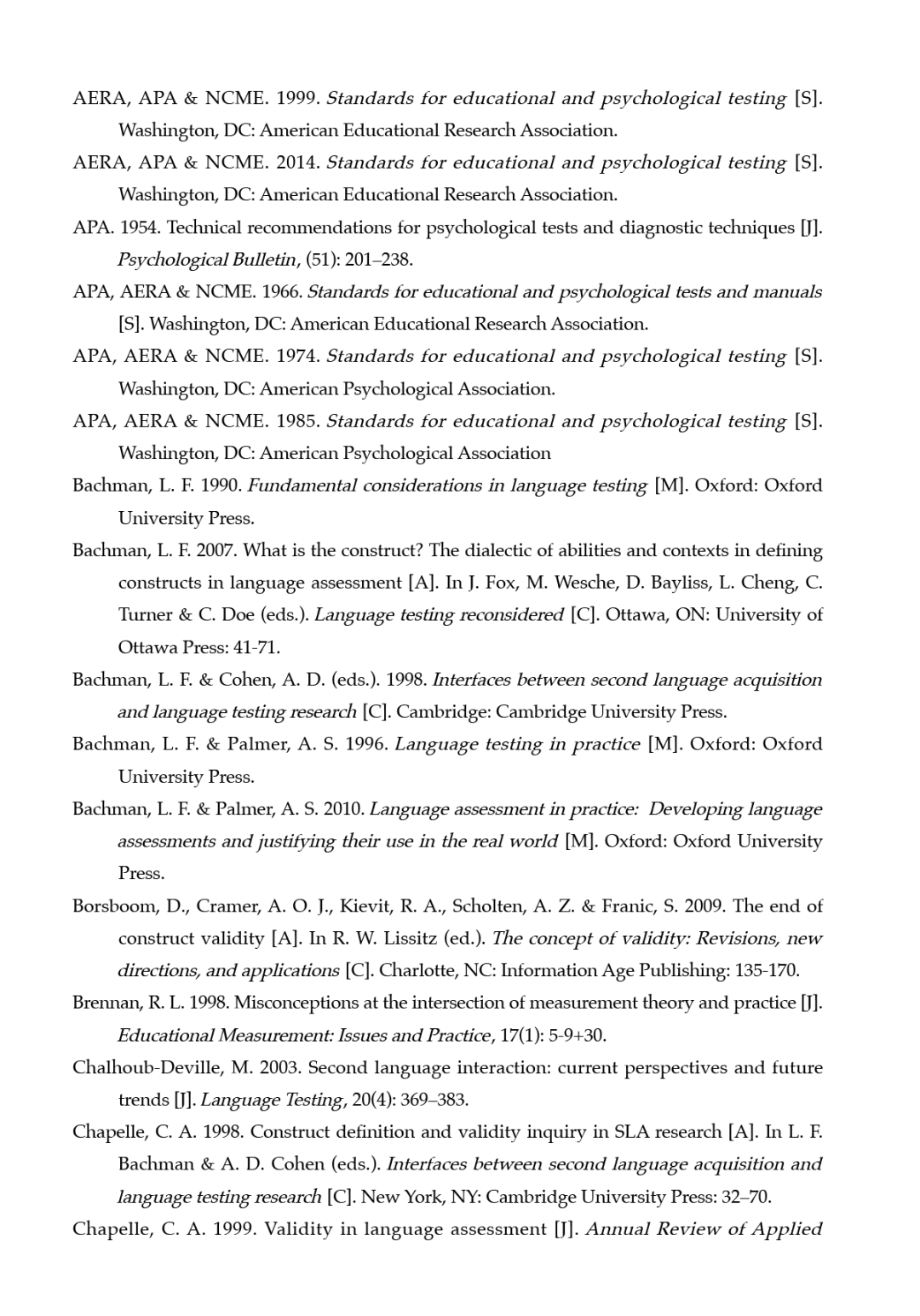
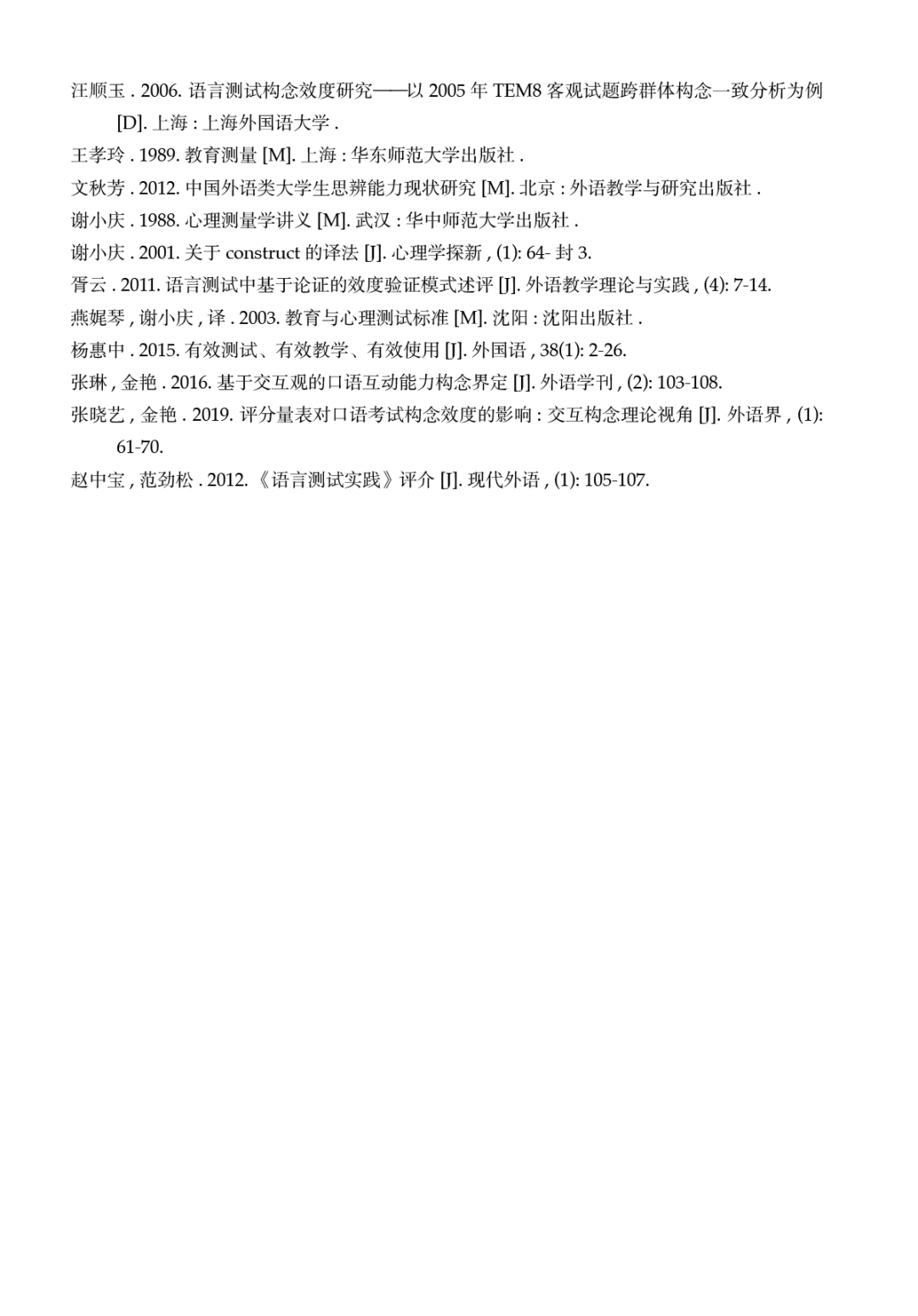
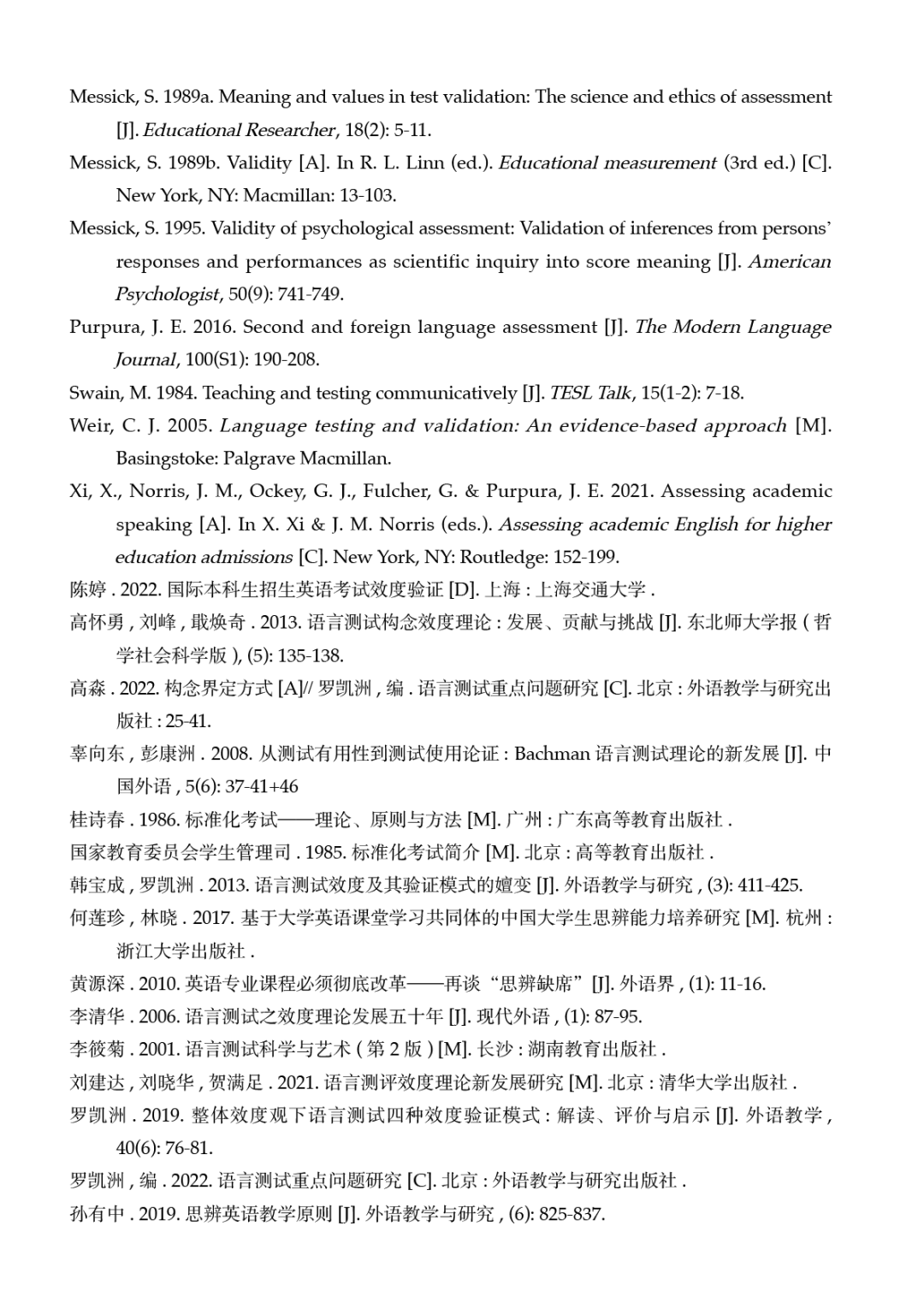
Swipe left to view all references
Author Introduction
Jin Yan, Professor at the School of Foreign Languages, Shanghai Jiao Tong University. Main research direction: language testing. Email: yjin@sjtu.edu.cn
Full Text Reading and Download
This journal has been fully indexed by the CNKI database, Chinese Science and Technology Journal Database (Weipu), Chaoxing Network, and Zhongyou Network. Readers are welcome to query and search.
Database Search Journal: Language Testing and Evaluation
Inclusion Period: 2022-01
CNKI Download:
https://navi.cnki.net/knavi/journals/YYCS/detail?uniplatform=NZKPT
Weipu Download:
http://qikan.cqvip.com/Qikan/Journal/Summary?kind=1&gch=59485X&from=Qikan_Search_Index
Mark us for unlimited excitement
If you like us, please mark us as a star~
Pin the “Foreign Language Teaching and Research Press Higher English Information” WeChat public account,
to get the latest teaching resources, research information and competition dynamics in real-time, accompanying you every day in teaching and research!