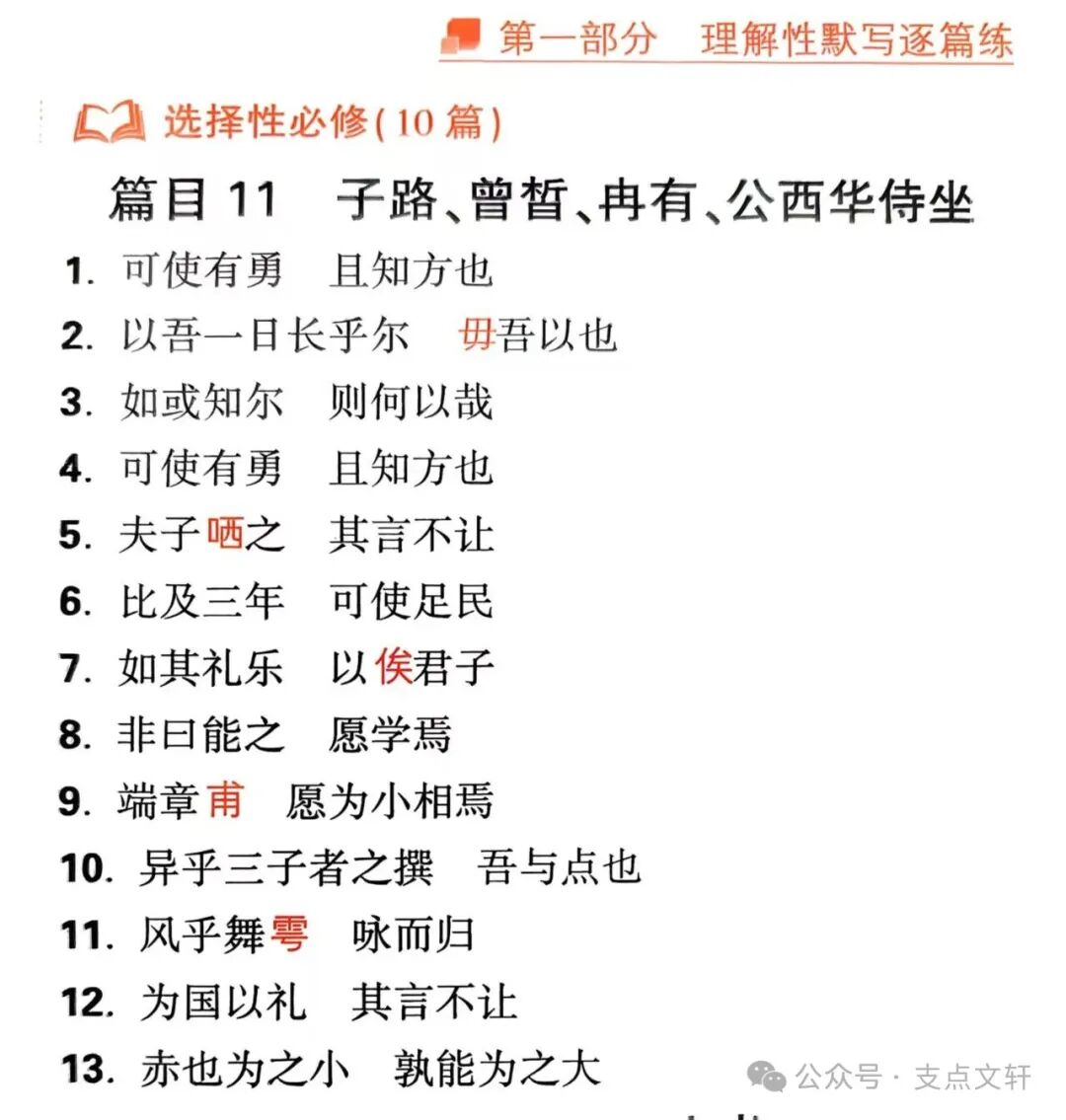
Title11 Zi Lu, Zeng Xi, Ran You, and Gong Xi Hua Sitting Together2020 New I] 10 Year Real Questions
1. [2020 New College Entrance Examination I Volume] In “The Analects: Advanced”, it is mentioned that Confucius’s four disciples expressed their aspirations while sitting together. Zi Lu’s ambition is to govern a country that has suffered greatly in three years, “ , “.
Classic Simulation
2. “Zi Lu, Zeng Xi, Ran You, and Gong Xi Hua Sitting Together” begins with Confucius discussing aspirations with his disciples, where “ , ” two lines fully demonstrate Confucius’s approachable, humble, and amiable attitude.
3. In “Zi Lu, Zeng Xi, Ran You, and Gong Xi Hua Sitting Together”, the sentence where Confucius gently guides his students with hypothetical questions is: “ ?
4. In “Zi Lu, Zeng Xi, Ran You, and Gong Xi Hua Sitting Together”, the lines ” , ” are Zi Lu’s beautiful vision of his achievements in governing the country.
5. In “Zi Lu, Zeng Xi, Ran You, and Gong Xi Hua Sitting Together”, the line ” ” indicates Confucius’s attitude towards Zi Lu through an action, while the subsequent line “ ” reveals the reason behind Confucius’s attitude towards Zi Lu while answering Zeng Xi’s doubts.
6. In “Zi Lu, Zeng Xi, Ran You, and Gong Xi Hua Sitting Together”, Ran You’s aspiration is to govern a small country with few people, thus achieving the social ideal of “ 9 “.
7. In “Zi Lu, Zeng Xi, Ran You, and Gong Xi Hua Sitting Together”, the lines ” , ” highlight Ran You’s humble and practical image from the perspective of language description.
8. [New Examination Method: Situational Application Type] Young people in this era should possess the excellent quality of humility and a thirst for knowledge, maintaining the mindset of Gong Xi Hua in “Zi Lu, Zeng Xi, Ran You, and Gong Xi Hua Sitting Together” “ , ” when facing things beyond their capabilities, they should not easily give up but should strive to learn and achieve self-improvement.
9. In “Zi Lu, Zeng Xi, Ran You, and Gong Xi Hua Sitting Together”, Gong Xi Hua humbly expresses that his political ambition is to serve the lords during ancestral sacrifices or when meeting the emperor, “ , “.
10. In “Zi Lu, Zeng Xi, Ran You, and Gong Xi Hua Sitting Together”, when Confucius asks Zeng Xi about his political ambitions, Zeng Xi’s answer is “ “; after hearing Zeng Xi’s political ideals, Confucius sighs, “ “.
11. In “Zi Lu, Zeng Xi, Ran You, and Gong Xi Hua Sitting Together”, the sentence describing Zeng Xi’s ideal society, where he and his companions enjoy the breeze on a high platform and sing on their way back, is “ , “.
12. In “Zi Lu, Zeng Xi, Ran You, and Gong Xi Hua Sitting Together”, Confucius points out Zi Lu’s shortcomings with the lines “ ” which implicitly criticizes him.
13. In “Zi Lu, Zeng Xi, Ran You, and Gong Xi Hua Sitting Together”, the sentence where Confucius indirectly praises Gong Xi Hua with a rhetorical question is: “ , ?
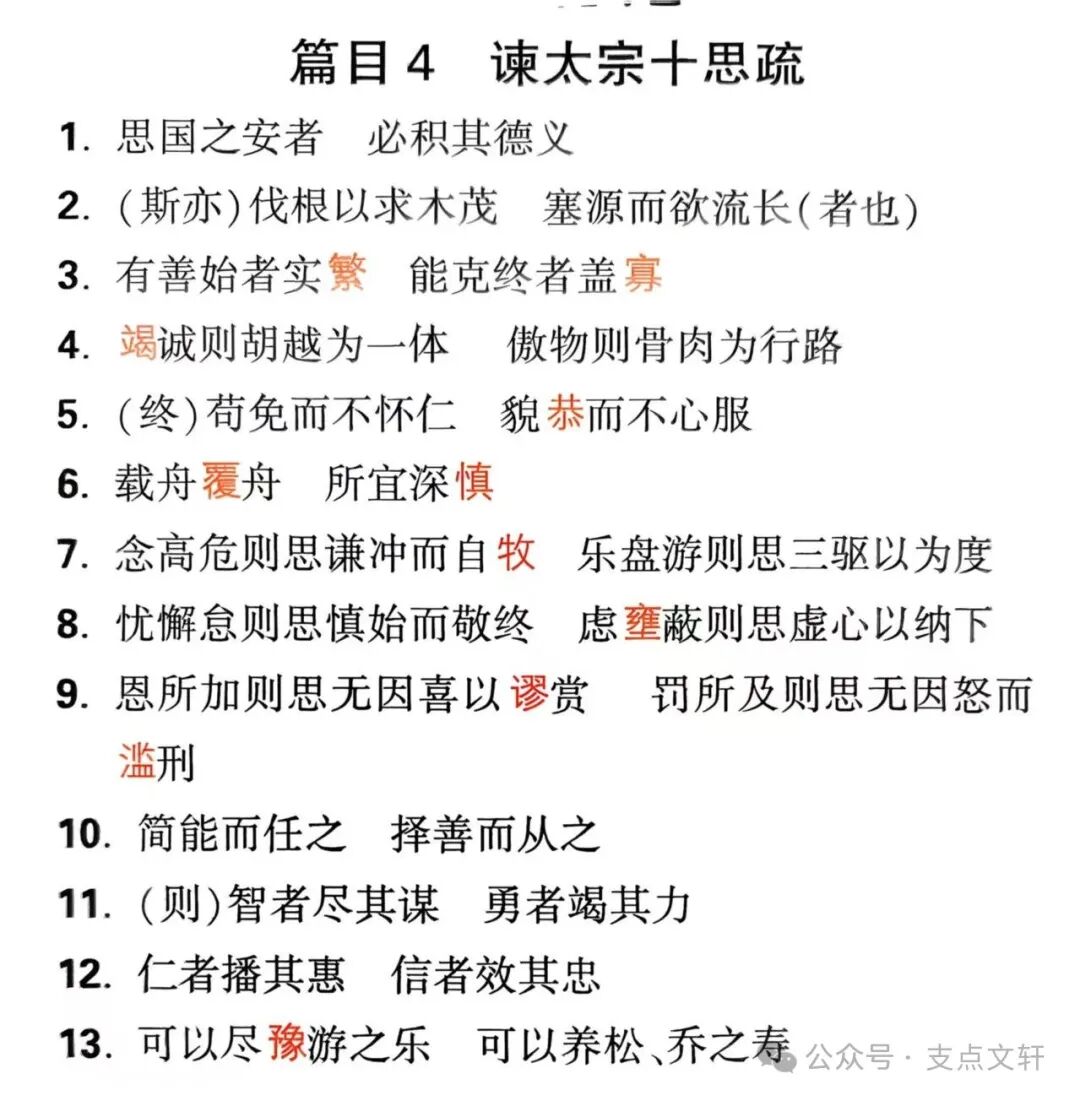
Title4 Memorial to Emperor Taizong: Ten ReflectionsCorrections and Notes
1. In the opening of “Memorial to Emperor Taizong: Ten Reflections”, Wei Zheng uses the metaphor of “strengthening the foundation and deepening the source” to propose the central argument of “ , “.
2. Idioms like “seeking fish up a tree”, “abandoning the root and pursuing the branches”, and “adding fuel to the fire” all tell us that if the direction or method is wrong, it is impossible to achieve the goal. Wei Zheng expresses a similar viewpoint in “Memorial to Emperor Taizong: Ten Reflections” with the sentence “
3. In “Memorial to Emperor Taizong: Ten Reflections”, Wei Zheng summarizes historical experience with the lines “ ” pointing out the general rule that historical monarchs cannot start and finish well in governing the country.。
4. In “Memorial to Emperor Taizong: Ten Reflections”, Wei Zheng emphasizes the importance of treating people with sincerity through a contrast of positive and negative examples with the lines “ “.
5. In “The Analects: Governance”, it is said, “Govern by law, regulate by punishment, and the people will be free of shame.” Wei Zheng similarly believes that relying on harsh laws to deter the people will lead to the adverse consequences of “ , “.
6. In “Memorial to Emperor Taizong: Ten Reflections”, Wei Zheng uses the relationship between “water” and “boat” to metaphorically express that the people’s hearts determine life and death with the sentence “ , “.
7. In “Memorial to Emperor Taizong: Ten Reflections”, the line “ ” advises Emperor Taizong to strengthen moral cultivation, using the imagery from the “Book of Changes: The Hexagram of Humility”; the line “ ” advises Emperor Taizong to hunt with moderation, using the imagery from the “Book of Changes: The Hexagram of Comparison”.
8. In “Memorial to Emperor Taizong: Ten Reflections”, Wei Zheng suggests that Emperor Taizong should always act cautiously and humbly accept advice, with the sentence “
9. In “Xunzi: Self-Cultivation”, it is said: “Anger does not exceed deprivation, joy does not exceed giving.” This sentence indicates the attitude that should be taken when implementing rewards and punishments. In “Memorial to Emperor Taizong: Ten Reflections”, the lines “ ” also express a similar attitude.
10. [New Examination Method: Situational Application Type] Selecting talented individuals and ensuring that everyone is utilized according to their abilities is the correct direction for personnel selection; broadening the channels for expression and accepting good advice is an important manifestation of democracy. Wei Zheng once said in “Memorial to Emperor Taizong: Ten Reflections” “ ,. ” which still holds significant reference value today.
11. [New Examination Method: Situational Application Type] As young people in the new era, we should integrate our personal dreams into the Chinese dream, doing our utmost to contribute our wisdom and strength to the great rejuvenation of the Chinese nation, just as Wei Zheng proposed in “Memorial to Emperor Taizong: Ten Reflections” with the lines “ “.
12. Wei Zheng proposed in “Memorial to Emperor Taizong: Ten Reflections” that if the monarch can select and employ virtuous individuals and listen to good opinions, then the performance of benevolent and trustworthy individuals will be “ ” and “ “.
13. In “Memorial to Emperor Taizong: Ten Reflections”, Wei Zheng believes that if all civil and military officials strive to serve, and the monarch is not troubled by major issues during his reign, then it will be “ “.
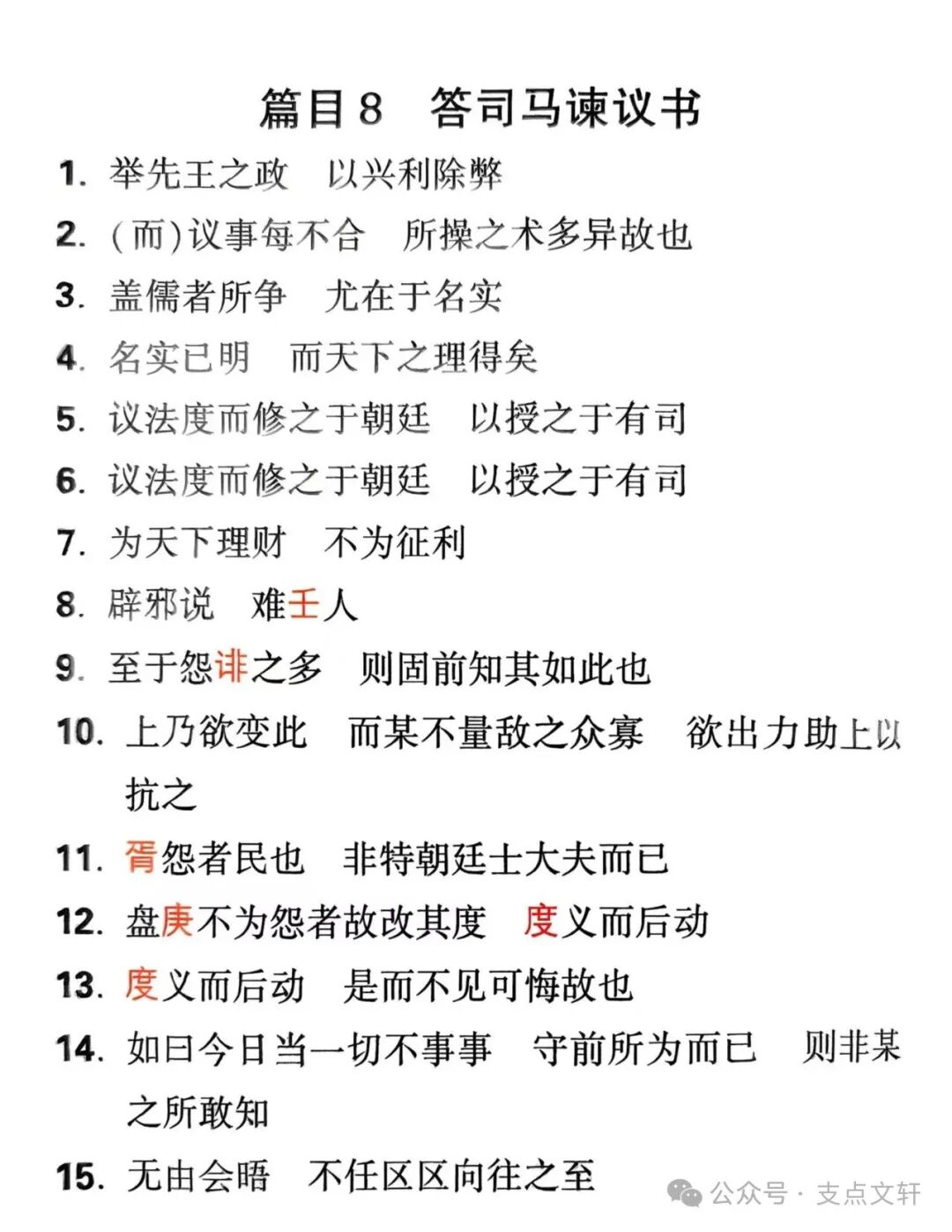
Title8 Response to Sima’s Memorial[2021 New I]Corrections and Notes
10 Year Real Questions
1. [2021 New College Entrance Examination I Volume] In “Response to Sima’s Memorial”, the sentence expressing not to create trouble is “ ,. “.
Classic Simulation
2. In “Response to Sima’s Memorial”, Wang Anshi uses “ , ” to express the reasons for his disagreement with Sima Guang’s political views.
3. In “Response to Sima’s Memorial”, Wang Anshi points out the content of the debate among knowledgeable scholars with the lines “ , “.
4. In “Response to Sima’s Memorial”, Wang Anshi uses “ , ” as the basis for his argument, while emphasizing the importance of distinguishing between name and reality.
5. In “Response to Sima’s Memorial”, Wang Anshi states that he received orders from the emperor, “ , ” which cannot be considered as usurping official power.
6. In “Response to Sima’s Memorial”, Wang Anshi explains that the formulation and implementation of new laws are completely reasonable and legal with the lines “ ” which breaks the narrative of “usurping official power”.
7. In “Response to Sima’s Memorial”, Wang Anshi, who is accused of “seeking profit” for promoting reforms, refutes this with the sentence “ ,. “.
8. In Wang Anshi’s view, only rejecting correct criticism and covering up mistakes can be called “refusing advice”. In “Response to Sima’s Memorial”, he points out that “ , ” does not count as refusing advice.
9. In “Response to Sima’s Memorial”, the lines “ ” indicate that Wang Anshi had anticipated the resentment brought by the reforms.
10. In “Response to Sima’s Memorial”, Wang Anshi reveals that the reason for the accusations against him by the officials is “ , “.
11. In “Response to Sima’s Memorial”, when Pan Geng decided to move the capital, “ ^ ” but Pan Geng did not care about this resentment.
12. In “Response to Sima’s Memorial”, Wang Anshi praises Pan Geng’s determination to act once he has considered matters, and will not easily change plans with the lines “ ” which also expresses his determination to persist in reform.
13. In “Response to Sima’s Memorial”, Wang Anshi conveys a principle of action with the lines “ , ” which summarizes the spirit of reformers in history who are resolute and unrepentant.
14. In “Response to Sima’s Memorial”, Wang Anshi expresses his attitude with the lines “ , ” and directly points out the essence of conservative thought.
15. In “Response to Sima’s Memorial”, Wang Anshi expresses that although he has not had the opportunity to meet Sima Guang, he admires him with the lines: “ , !”
Title7 Discussion of the Six StatesAnswer Link:P2
10 Year Real Questions
1. [2020 New College Entrance Examination II Volume] Su Xun analyzes in “Discussion of the Six States” that the land acquired by the Qin state through war is far less than that obtained through other means, thus “ , ” which is not primarily about war.
Classic Simulation
2. Su Xun clearly points out the fundamental reason for the downfall of the six states in “Discussion of the Six States” with the line “ ” and then provides a specific explanation for this reason with the line “ “.
3. In “Discussion of the Six States”, Su Xun reveals the reason why those states that did not bribe Qin ultimately perished with the lines “ , “.
4. In “Discussion of the Six States”, the lines “ , ” describe how the Qin state gained substantial rewards through war and other means.
5. In “Discussion of the Six States”, the descendants of the six states, who served Qin to the utmost, only received the result of “ ” and upon waking up, they found “ “.
6. In “Discussion of the Six States”, the lines “ ” reveal that ceding land to seek peace does not solve the fundamental problem of the six states being invaded by Qin.
7. In “Discussion of the Six States”, Su Xun writes that the vassal states’ continuous ceding of land still cannot satisfy Qin’s greed, but instead leads to more frequent invasions by Qin with the lines “ , “.
8. In “Discussion of the Six States”, the lines “ , ” indicate that the downfall of the six states was expected.。
9. In “Discussion of the Six States”, the lines “ , ” use exquisite metaphors to vividly argue against the irrationality of the six states’ bribery of Qin.
10. In “Discussion of the Six States”, Su Xun explains that the kings of Yan and Zhao were initially able to defend their territories and uphold justice with the lines “ , “.
11. In “Discussion of the Six States”, the line “ ” states the outcome of the battle between Zhao and Qin, while the line “ )” expresses a helpless sigh over Zhao’s defeat.
12. In “Discussion of the Six States”, Su Xun summarizes the direct cause of Zhao’s downfall and its consequences with the lines “ , “.
13. In “Discussion of the Six States”, the lines “ , ” analyze the methods that Yan and Zhao could have used to avoid their downfall from the perspective of assassins and generals.
14. Governing a country relies on talent. In “Discussion of the Six States”, the lines “ , ” point out that when the six states govern, they should show sufficient sincerity to recruit talent.
15. At the end of “Discussion of the Six States”, Su Xun advises the Northern Song rulers not to repeat the historical tragedies with the lines “贤才,封赏有功之士。” “.