Recently, I came across a teardown article by a netizen about a gas alarm, which features a simple circuit structure that differs from the power integrated chip solutions we usually see. The following image shows the teardown of the gas alarm.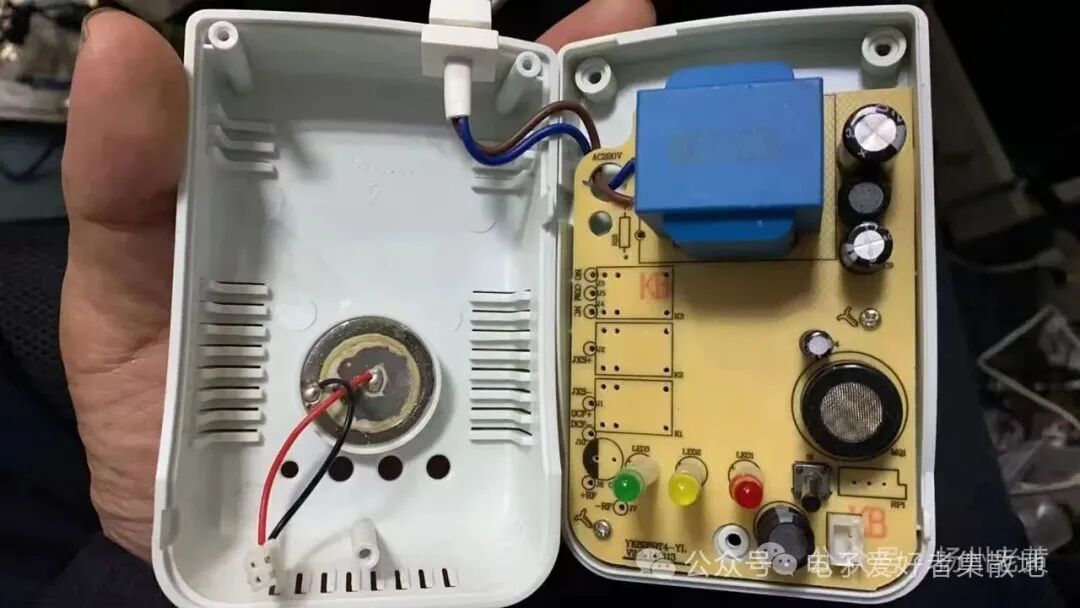 This solution steps down AC220V through a transformer to a secondary voltage of 10V, and then uses a rectifier bridge to filter and supply power to other circuits. (LDO can be omitted) The following image shows the circuit’s step-down block diagram.
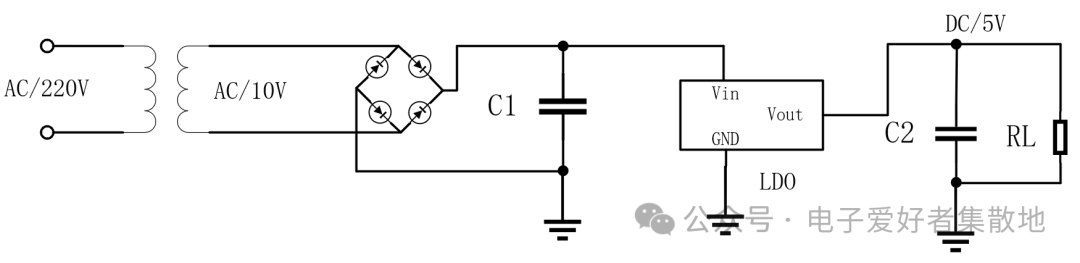 This traditional solution clearly does not meet the demands for precision and miniaturization in the new era, and we need to seek integrated circuit solutions, such as mobile phone chargers, which are a good example. They utilize switch-mode power supply chips to output the required voltage.Now, let’s discuss the differences between these two solutions.1. Efficiency Comparison
| Solution | Typical Efficiency | Energy Loss Sources |
|---|---|---|
| Transformer + Linear Regulator | 30%~50% | Iron loss, copper loss, linear regulator voltage drop loss (e.g., 7805) |
| Switching Power Supply Chip | 70%~90% | Only switching transistor conduction loss and high-frequency switching loss |
Example:
-
When outputting 5V/1A (5W):
-
Transformer solution: Input power ≈ 10~15W (loss 5~10W).
-
Switching chip solution: Input power ≈ 6~7W (loss 1~2W).
The efficiency of the switching chip solution can generally reach over 85%. The transformer solution is less than 50%.2. Size and Weight
| Solution | Size | Core Reason |
|---|---|---|
| Transformer Step-down | Large (requires a power frequency transformer) | Power frequency transformers (50Hz) require a lot of iron cores and copper wire |
| Switching Power Supply Chip | Small (SMD IC + inductor) | High-frequency switching (50kHz~2MHz) allows the use of miniature magnetic components |
Typical Applications:
-
The size of a mobile phone charger (switching chip solution) is only 1/5 that of the traditional transformer solution.
3. Cost Analysis
| Solution | BOM Cost | Hidden Costs |
|---|---|---|
| Transformer Step-down | Higher (transformer accounts for 50%) | Heat sink, linear regulator costs |
| Switching Power Supply Chip | Lower (integrated) | Reduced PCB area, lower assembly costs |
5W power module:
-
Transformer solution cost ≈ $2.5.
-
Switching chip solution cost ≈ $1.5 (e.g., OB2354).
4. Performance Advantages
| Parameter | Transformer + Linear Regulator | Switching Power Supply Chip |
|---|---|---|
| Input Voltage Range | Narrow (requires precise matching of transformer turns ratio) | Wide (85V~265V universal input) |
| Temperature Rise | High (linear regulator generates significant heat) | Low (efficient, generates less heat) |
| Noise | Low (no high-frequency switching noise) | Requires EMI filtering optimization (e.g., adding common mode inductors) |
5. Integrated Function Comparison
| Function | Transformer Solution | Switching Chip Solution |
|---|---|---|
| Overcurrent Protection | Requires external fuse | Chip built-in (e.g., IPD function) |
| Short Circuit Protection | None (may burn out the regulator) | Chip automatically restarts or latches |
| Soft Start | None (large inrush current) | Built-in (prevents surge current) |
6. When to Choose Transformer Solutions?
Although switching chips dominate the market, transformer solutions are still suitable for:
-
Extreme Low Cost: Simple circuits with no efficiency requirements (e.g., LED indicators).
-
High Reliability: Power frequency transformers have strong surge resistance (e.g., industrial control cabinets).
-
Noise Sensitivity: Medical devices need to avoid high-frequency interference (requires linear regulation).
7. Conclusion:
| Reasons to Choose Switching Chips | Limitations of Transformer Solutions |
|---|---|
| High efficiency (energy-saving, low temperature rise) | Low efficiency, significant energy waste |
| Small size (friendly for portable devices) | Bulky, difficult to miniaturize |
| Wide voltage input (universal worldwide) | Poor input voltage adaptability |
| High integration (simplifies design) | Complex peripheral circuits |
| Low cost (advantages of mass production) | High material costs (copper, iron) |
Design Recommendations:
-
Prioritize AC-DC chips with built-in MOSFETs (e.g., PI’s TinySwitch series).
-
If low noise is required, add LDO regulation after the switching power supply (e.g., AMS1117-5.0).