AR synchronization solutions achieved through beacon technology (i.e., Bluetooth Low Energy (BLE) and Ultra-Wideband (UWB))
(Nweon, July 21, 2025) Cross-session/device synchronization in augmented reality (AR) presents challenges. In a study, the team from City University of Hong Kong proposed a solution utilizing beacon technology (i.e., BLE and UWB) to address scalability issues and inconsistencies in existing AR systems.
The related framework is divided into two approaches: BLE-assisted and UWB-assisted AR synchronization. The BLE-assisted method utilizes iBeacon technology for room environment recognition and combines it with Apple’s ARKit ARWorldMap and Google’s ARCore Cloud Anchors. The UWB-assisted solution employs precise beacon ranging capabilities fused with device azimuth to establish a fixed spatial reference in AR sessions/devices.
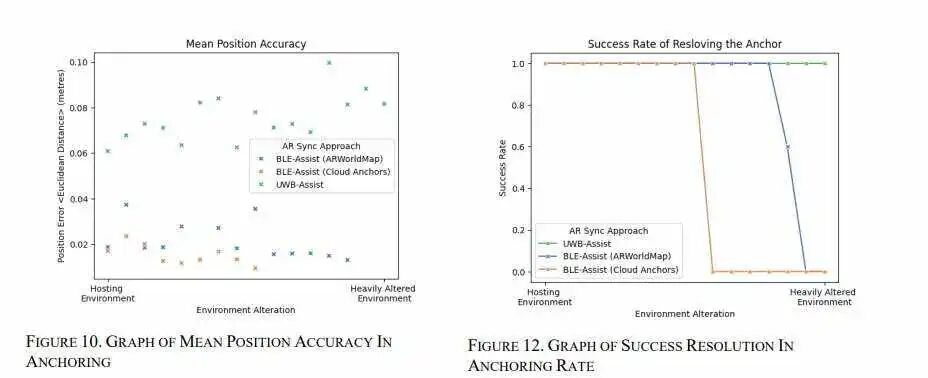
Comparative evaluations indicate that the UWB-assisted method outperforms the BLE-assisted method in terms of reliability across various environmental changes, successfully addressing the virtual anchor problem regardless of physical environment variations. However, the BLE-assisted implementation is often more accurate in resolving virtual anchors, with an average positional error of 0.02 meters and a directional error within 0.03 radians. In the UWB-assisted method, the average disparity of the calculated fixed spatial reference is 0.04 meters, with a pose error of 0.11 radians. The UWB-assisted method is ideal for scenarios requiring continuous successful positioning and acceptable accuracy. In contrast, the BLE-assisted method is more suitable for virtual anchor points and performance trade-offs that demand higher precision during environmental changes, such as for short-term AR sessions.
Most AR applications in the market support multi-user scenarios, aligning coordinates across all sessions and devices to create a consistent spatial virtual world in the physical realm. Existing methods for synchronizing AR sessions primarily stem from vision-based environmental understanding, decomposing global coordinate systems into each local AR session, such as ARWorldMap in ARKit and Cloud Anchors in ARCore, to achieve persistent anchoring across all sessions and devices.
However, the aforementioned APIs are primarily reliant on visual feature point mapping, making them susceptible to the following threats:
-
Scalability in larger workspaces
-
Reliability under visual environmental changes
Therefore, the previously mentioned APIs are designed to operate within a room-sized space for short durations, rather than preserving or reusing over time. Thus, additional methods are needed to enhance the AR experience to support the concept of a digital twin world, where the virtual world can be stably aligned with the physical world, scalable, and durable against surrounding visual changes.
In a study, the team from City University of Hong Kong developed two solutions to improve synchronization in AR sessions:
-
Using iBeacon technology to broadcast location context and applying it to existing AR synchronization frameworks for room-based positioning.
-
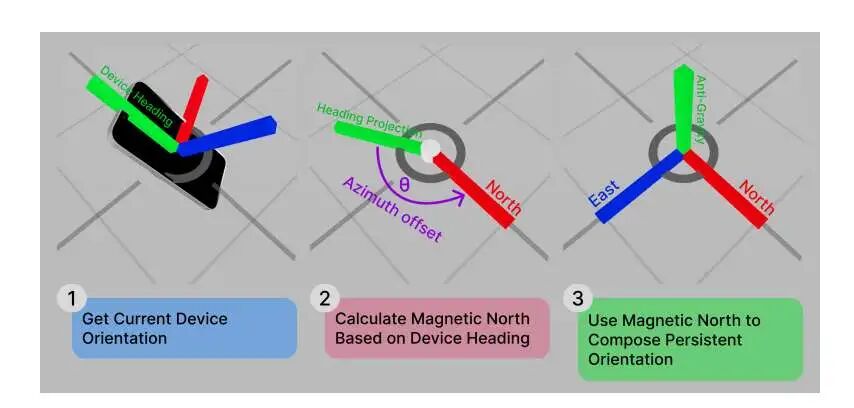
UWB-assisted AR synchronization utilizes centimeter-level precise ranging capabilities fused with magnetic compass heading information to establish a fixed reference pose for carrying and resolving nearby anchors.
By leveraging BLE and UWB technologies, the research achieved unified virtual coordinates for each user in every session. Additionally, UWB-assisted AR synchronization ensures adaptability of the AR experience in dynamic spaces to environmental changes.
The main idea of BLE-assisted AR synchronization is to decompose spacious workspaces (such as buildings) into multiple rooms, optimizing the AR experience through traditional spatial anchoring frameworks. This includes acquiring the current room environment of the user and coordinating the spatial anchoring framework accordingly. The proposed method listens for iBeacon broadcasts from ESP32, which serves as a beacon placed in the expansive workspace to obtain room context.
The iBeacon standard allows devices to determine the distance between the broadcaster (beacon) and the observer (AR device), whether direct, near, or far. Therefore, we can assume the nearest beacon referencing the current room, as each beacon is registered to a virtual room in a many-to-one relationship. When the current room changes, such as when a user enters a new room, it triggers an update of the spatial anchoring.
A common practice with ARWorldMap is to archive ongoing AR sessions from the host device as encoded data and transmit them over the network for decoding and localization to the receiving AR session. Upon successful resolution, the coordinates of the host AR session are applied, and existing anchors are passed to the receiving AR session. By providing room context, the proposed method can download and upload a scaled-down ARWorldMap based on user location, preventing overwhelming map sizes for transmission and localization across a wide available area. However, when multiple users concurrently modify the mapping, conflicts in saving the inherited mapping must be addressed.
In contrast to the practice of sharing maps in ARWorldMap, the practice of Cloud Anchors involves hosting and resolving individual anchors to the ARCore API server, where each anchor’s time-to-live (TTL) can last up to a year. When a new anchor is added to any local AR session, we can host the anchor through the ARCore API and record the returned anchor identifier pairs with the current room context in our shared database. Once entering a new room, the proposed solution can extract a list of anchor identifiers related to the room from the shared database and resolve them in the local AR session, requesting only nearby anchors to avoid computing unnecessary remote anchors.
The fixed reference pose space constructed from UWB beacons and magnetic heading consists of position and direction components. To establish a fixed reference pose, persistence of position and direction must be maintained across all sessions. The researchers used the UWB module DWM3001CDK, compatible with the FiRa standard, as a beacon, while a UWB-supported iPhone serves as the AR device, obtaining the beacon’s position in AR through the Apple Nearby Interaction framework.
Observations during the initial ranging period indicated that the beacon’s position in AR was inconsistent. Therefore, the researchers applied a stabilization algorithm, considering the position valid once it consistently remains within a predefined disparity threshold over a period of time between each observation. Currently, distance stability is the main delay in UWB-assisted AR synchronization positioning. Since UWB beacons cannot display their direction to the device, continuous orientation can be achieved by referencing the Earth’s magnetic field and gravity detected by the device’s inertial measurement unit (IMU). Typically, in the AR framework, the y-axis in AR coordinates is parallel to gravity, resulting in the xz plane being parallel to the ground. We can project the device’s azimuth from the AR camera direction onto the horizontal plane and adjust it based on the IMU’s magnetic heading angle.
Since the BLE-assisted implementation relies on optical references, while UWB-assisted relies on radio signals and magnetic field measurements, the BLE method is more precise in pose accuracy. In contrast, the UWB method is less accurate but still within a reasonable range. The team further investigated the accuracy of establishing reference poses in the UWB-assisted implementation and showed promising results.
In terms of reliability, the UWB method is ideal, consistently achieving successful positioning, while the BLE implementation fails under significantly changing environments. Although the positioning delay of UWB-assisted AR synchronization is not pleasant, it can be enhanced through more effective stabilization algorithms or the ability to know when the ranging results are stable. Additionally, there is room for improvement at the hardware level to achieve greater concurrent communication capacity.
One advantage of the UWB method is the ability to manipulate anchoring through homogeneous measurements without requiring an AR session, unlike the BLE method, which operates through existing spatial anchoring frameworks, where hosting anchor points can only be performed through ongoing AR sessions. In large-scale AR synchronization work, BLE beacons can scale down the map to the local AR session’s room through existing spatial anchoring frameworks, while stationary UWB beacons can establish a persistent pose as a reference for virtual anchor points through relative transformations, achieving consistent anchor points across AR sessions.
According to evaluations, BLE-assisted AR synchronization is accurate in anchor poses, but the success of positioning is inconsistent. Meanwhile, in UWB-assisted AR synchronization, although positioning is consistently successful, pose accuracy is lower. Unlike the UWB method with constant delay, the low-frequency method’s positioning delay is significantly affected by environmental changes. Although the average positioning delay of the UWB method is not satisfactory, improvements can be made in various aspects.
Related Paper: A BLE and UWB Beacon-Assist Framework for Multiuser Augmented Reality Synchronization Across Multiple Devices in Shared Environments
https://arxiv.org/pdf/2504.05293
In summary, when emphasizing successful anchoring resolution rather than high precision, UWB-assisted AR synchronization is suitable for extensive work areas. In contrast, due to its inability to discern under environmental changes, BLE-assisted AR synchronization is ideal for short-term AR sessions, offering higher accuracy in anchoring.
—Original link: https://news.nweon.com/131163