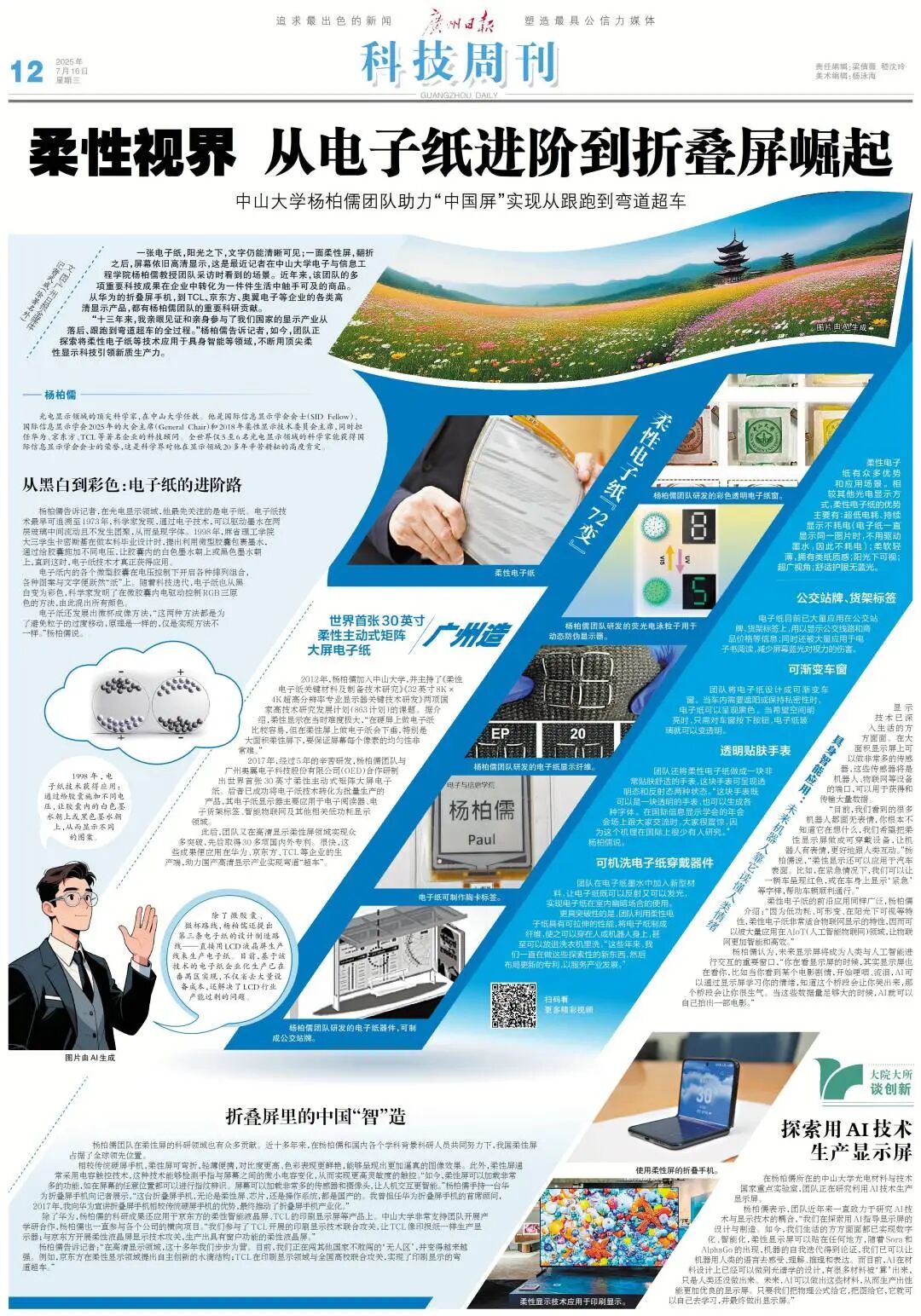
An electronic paper that remains clearly visible under sunlight; a flexible screen that continues to display high definition even after being folded. This was the scene observed by reporters during an interview with Professor Yang Bairu’s team at the School of Electronics and Information Engineering, Sun Yat-sen University.In recent years, several significant technological achievements from this team have been transformed into accessible products in the market.From Huawei’s foldable smartphones to various high-definition display products from companies like TCL, BOE, and OED, the contributions of Yang Bairu’s team are substantial.
“Over the past thirteen years, I have witnessed and personally participated in the entire process of our country’s display industry evolving from being behind to overtaking others on the curve,” Yang Bairu told reporters. Today, the team is exploring the application of technologies such as flexible electronic paper in fields like embodied intelligence, continuously leading new productive forces with cutting-edge flexible display technology.
From Black and White to Color: The Evolution of Electronic Paper
Yang Bairu informed reporters that in the field of optoelectronic displays, he first focused on electronic paper.The technology of electronic paper can be traced back to 1973 when scientists discovered that ink could be driven to flow between two layers of glass without clumping through electronic technology, thus presenting characters. In 1998, a junior student at MIT, Kaminsky, proposed using microcapsules to encapsulate ink for his undergraduate thesis, allowing the white ink to rise or the black ink to rise by applying different voltages to the capsules. It was only then that electronic paper technology truly found its application.
Each microcapsule in the electronic paper opens various combinations under voltage control, allowing patterns and text to leap onto the “paper.” With technological iterations, electronic paper has evolved from black and white to color, with scientists inventing methods to control RGB primary colors within microcapsules, thus mixing all colors.
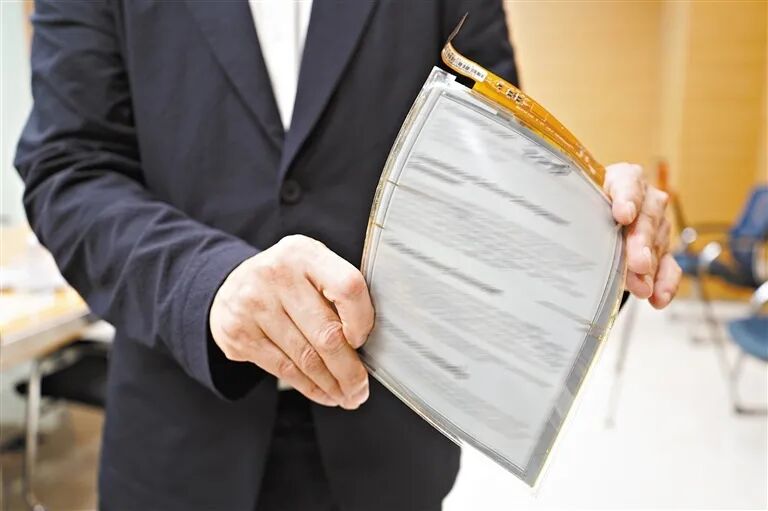
Flexible electronic paper
Electronic paper has also developed microcup imaging methods. “Both methods aim to avoid excessive movement of particles; the principle is the same, only the implementation methods differ,” Yang Bairu said.
Yang Bairu:
A leading scientist in the field of optoelectronic displays, he teaches at Sun Yat-sen University. He is a Fellow of the Society for Information Display (SID Fellow), the General Chair of the Society for Information Display’s 2025 conference, and the Chair of the Flexible Display Technology Committee in 2018. He also serves as a technology advisor for renowned companies such as Huawei, BOE, and TCL. Only 5 to 6 scientists in the field of optoelectronic displays worldwide have received the honor of being a Fellow of the Society for Information Display, which is a high recognition of his over 20 years of hard work in the display field.
The World’s First 30-Inch Flexible Active Matrix Electronic Paper Made in Guangzhou
In 2012, Yang Bairu joined Sun Yat-sen University and led two national high-tech research and development projects (863 Program): “Research on Key Materials and Preparation Technologies for Flexible Electronic Paper” and “Key Technology Development for 32-Inch 8K×4K Ultra-High-Resolution Professional Displays.” It was noted that flexible displays were extremely challenging at that time, “It is easier to make electronic paper on hard screens, but making electronic paper on flexible screens causes sagging, especially for large-area flexible screens, ensuring uniformity of each pixel on the screen is very difficult.”
In 2017, after five years of hard research and development, Yang Bairu’s team collaborated with Guangzhou OED Technology Co., Ltd. to develop the world’s first 30-inch flexible active matrix electronic paper. The latter has successfully transformed electronic paper technology into mass-produced products, with its electronic paper displays mainly used in e-readers, electronic shelf labels, smart IoT, and other related low-power display fields.
Since then, the team has achieved numerous breakthroughs in the field of high-definition flexible screens, obtaining over 30 domestic and international patents. Soon, these achievements were applied in the production lines of companies like Huawei, BOE, and TCL, helping the domestic high-definition display industry achieve an overtaking on the curve.
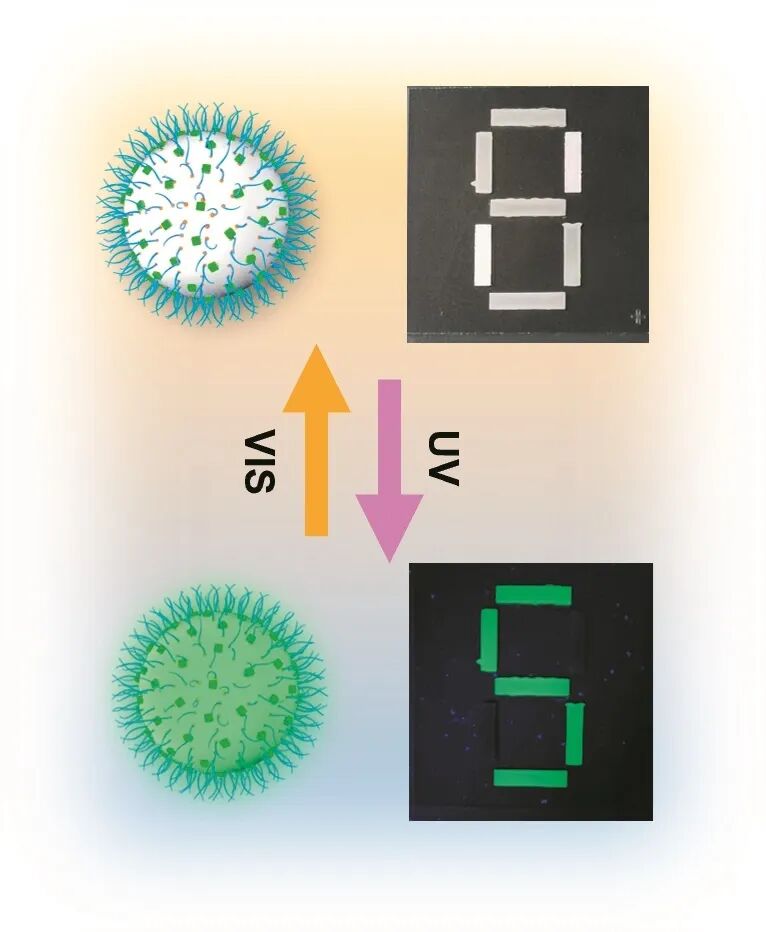
Yang Bairu’s team developed fluorescent electrophoretic particles for dynamic anti-counterfeiting displays.
Flexible Electronic Paper’s “72 Transformations”
Flexible electronic paper has numerous advantages and application scenarios. Compared to other optoelectronic display methods, the main advantages of flexible electronic paper include: ultra-low power consumption, continuous display without power consumption (when electronic paper continuously displays the same image, it does not need to drive the ink, thus consuming no power); soft and lightweight, with a paper-like feel; visibility under sunlight; ultra-wide viewing angles; and comfortable, eye-friendly without blue light.
01Bus Stop Signs, Shelf Labels
Electronic paper is currently widely used in bus stop signs and shelf labels to display bus routes and product prices; it is also extensively used in e-book reading, reducing the blue light damage to eyesight.
02Gradual Transition Car Windows
The team designed electronic paper to create gradual transition car windows. When the interior needs shading or privacy, the electronic paper can appear black. When a bright space is desired, simply pressing a button can make the electronic paper glass transparent.
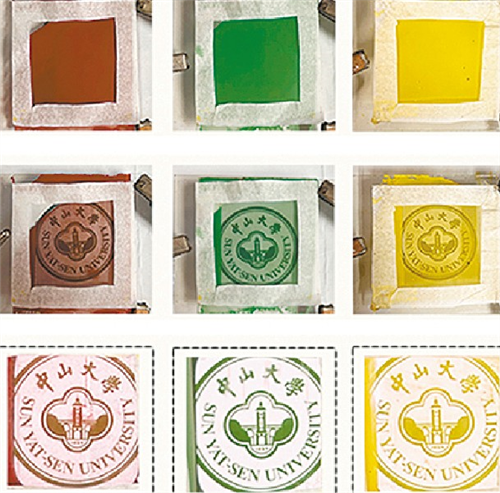
Yang Bairu’s team developed a color transparent electronic paper window.
03Transparent Skin-Fitting Watch
The team also created a very skin-friendly and comfortable watch using flexible electronic paper, which can present both transparent and reflective states. “This watch can be a transparent watch or display various fonts. When I shared this at the annual meeting of the Society for Information Display, everyone was shocked because this mechanism is rarely studied internationally,” Yang Bairu said.
04Washable Electronic Paper Wearable Devices
The team incorporated new materials into the electronic paper ink, allowing it to both reflect and emit light, enabling the use of electronic paper in dim indoor settings.
More groundbreaking is that the team utilized the stretchable properties of flexible electronic paper to create fibers, allowing it to be worn by humans or robots and even washed in a washing machine. “Over the years, we have been exploring these innovative new things and laying out new patents to serve industrial development,”
Embodied Intelligence Applications: Future Robots Understanding Human Emotions
Display technology has penetrated all aspects of life. Large display screens can host numerous sensors, which will serve as ports for robots, IoT devices, and can be used to obtain and transmit vast amounts of data.
“Currently, many robots appear expressionless, and you cannot tell what they are thinking. We hope to make flexible displays into wearable devices, allowing robots to have expressions and interact better with humans,” Yang Bairu said. “Flexible displays can also be applied to car surfaces. For example, in emergencies, we can make a car display red or show words like ‘Emergency’ on its body to help the vehicle pass smoothly.”
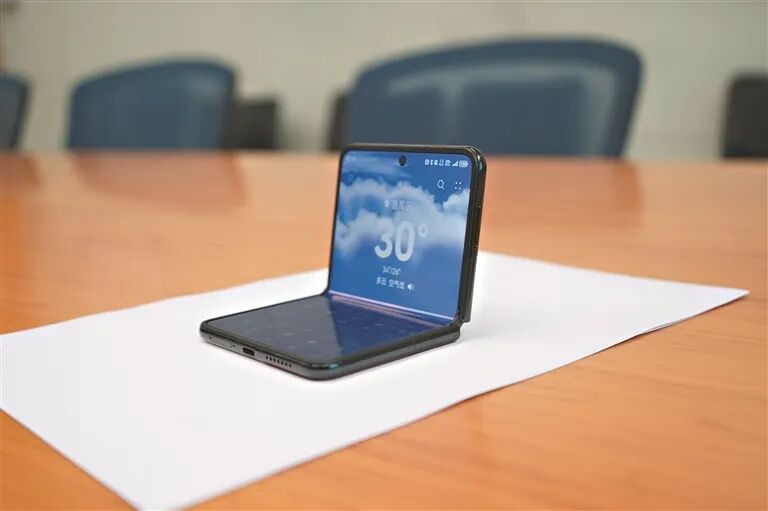
Foldable phones using flexible screens.
Frontier applications of flexible electronic paper are also extensive. Yang Bairu explained: “Due to its low power consumption, deformability, and visibility under sunlight, flexible electronic paper is very suitable for IoT display characteristics, thus can be widely applied in the AIoT (Artificial Intelligence Internet of Things) field, making IoT smarter and more efficient.”“
Yang Bairu believes that in the future, displays will become an important window for human interaction with artificial intelligence. “When you look at a display, it is actually looking back at you. For example, when you watch a movie scene and start to choke up or cry, AI can learn your emotions through the display, knowing which scene makes you cry and which makes you angry. When the data volume is large enough, AI can even create a movie by itself.”
Chinese “Intelligent Manufacturing” in Foldable Screens
Yang Bairu’s team has also made numerous contributions in the research field of flexible screens.Over the past decade, with the joint efforts of Yang Bairu and researchers from various disciplines in China, our country has taken a leading position globally in flexible screens.
Compared to traditional hard-screen phones, flexible screens can be bent, are lightweight and portable, have higher contrast, and more vivid color representation, capable of presenting more realistic image effects. Additionally, flexible screens typically use capacitive touch technology, which can detect minute capacitive changes between the finger and the screen, achieving higher sensitivity in touch. “Today, flexible screens can load many functions, such as fingerprint recognition at any position on the screen. The screen can accommodate numerous sensors and cameras, making human-computer interaction smarter.” Yang Bairu demonstrated to reporters while holding a Huawei foldable phone, “This foldable phone, whether it is the flexible screen, chip, or operating system, is all domestically produced. I served as the chief consultant for Huawei’s foldable phone, and in 2017, I presented the advantages of foldable phones over traditional hard-screen phones to Huawei, ultimately promoting the industrialization of foldable phones.”
In addition to Huawei, Yang Bairu’s research achievements have also been applied to BOE’s flexible smart LCD screens, TCL’s printed display screens, and other products. Sun Yat-sen University strongly supports the team in conducting industry-university-research cooperation, and Yang Bairu has been actively involved in various companies’ horizontal projects. “We participated in the joint efforts of TCL in printed display technology, enabling TCL to produce displays like printing newspapers; and collaborated with BOE on flexible LCD display technology to produce flexible LCD screens with window functions.”
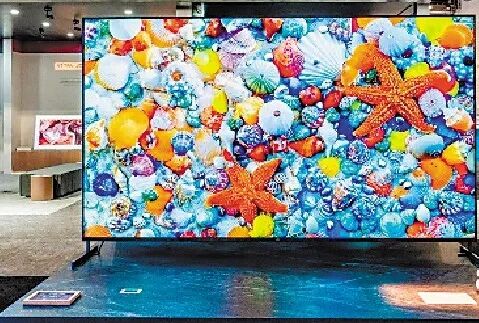
Flexible display technology applied to printed displays.
Yang Bairu told reporters: “In the field of high-definition displays, we have been making steady progress over the past decade. Currently, we are venturing into ‘unmanned areas’ that other countries dare not explore, and we are becoming stronger. For example, BOE proposed an innovative water droplet structure in the field of flexible displays; TCL has achieved an overtaking on the curve in printed displays through joint efforts with universities nationwide.”
Innovation in Major Institutions: Exploring AI Technology for Display Production
At the State Key Laboratory of Optoelectronic Materials and Technologies at Sun Yat-sen University, the team is researching the use of AI technology for display production.
Yang Bairu stated that the team has been dedicated to researching the coupling of AI technology with display technology in recent years, “We are exploring using AI to guide the design and manufacturing of displays. Nowadays, every aspect of our lives has been digitized and intelligentized; flexible displays can be attached anywhere. With the emergence of Sora and AlphaGo, the self-iteration of machines has been validated, and we can now enable machines to feel, understand, reason, and express using human language. Currently, AI can already achieve spectral design in material design, with many materials being ‘calculated’ that humans have yet to create. In the future, AI can produce these materials, thus manufacturing displays with superior performance. As long as we provide it with physical formulas and diagrams, it can learn by itself and ultimately produce displays.”

Edited by: Liang Qianwei, Ji ShenlingText, Images / Guangzhou Daily All-Media Reporter Wu WeiVideo / Guangzhou Daily New Flower City Reporter: Wu WeiGuangzhou Daily New Flower City Editor: Li Xiang

扫码观看
广州日报视频号