 ▎Edited by the WuXi AppTec Content Team
In the history of decoding genetic information in humans, Francis Crick has left his name on two milestones. In 1953, he and James Watson discovered the famous double helix structure of DNA; five years later, Crick proposed the far-reaching central dogma, a rule written in high school biology textbooks that clarifies the direction of genetic information transfer: DNA is transcribed into RNA, and RNA is translated into proteins. Therefore, the transmission of genetic information can be described as a “one-way street.”In 1970, the central dogma received a new supplement. David Baltimore and Howard Temin discovered reverse transcriptase in RNA viruses almost simultaneously, an enzyme that can reverse transcribe RNA into DNA. Since then, the flow of genetic information has had a two-way road.Half a century later, this story has taken an even more astonishing turn. Scientists from Columbia University in the United States have discovered for the first time while studying a bacterium’s reverse transcriptase that this enzyme can not only generate DNA from RNA templates but can also further generate entirely new genes! This unprecedented mechanism helps these bacteria resist attacks from bacteriophages. Researchers point out that this discovery challenges the traditional paradigm of encoding genetic information.Recently, this research was featured in a headline on the Nature website. It should be noted that this research is currently published on the biological preprint site bioRxiv and is still awaiting peer review results.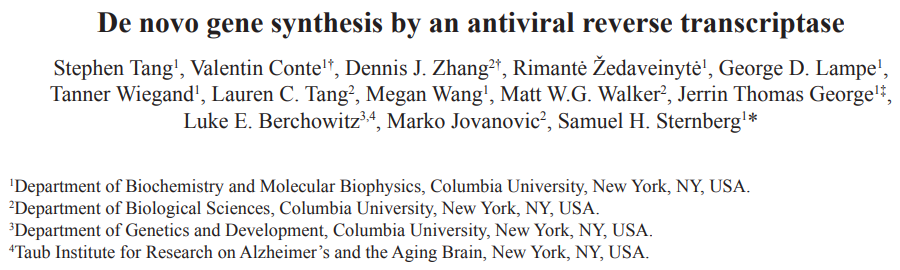 To resist infections from foreign invaders (especially bacteriophages), bacterial immune systems continuously evolve through competition. Among them, defense-associated reverse transcriptase (DRT) is used by bacteria to target foreign nucleic acids. As a class of reverse transcriptase elements with anti-bacteriophage functions, DRT not only reverse transcribes RNA into DNA but also typically encodes additional proteins that may act as effectors during immune responses.However, a particularly special type of DRT—DRT2—has caught the research team’s interest. Unlike other DRTs, the DRT2 system lacks additional protein-coding genes, and thus cannot form the aforementioned effectors. On the other hand, the DRT2 system also contains a segment of non-coding RNA with an unknown function. So, what does the DNA product (cDNA, i.e., DNA complementary to mRNA) generated by DRT2 look like? How does it help bacteria resist bacteriophage infections?
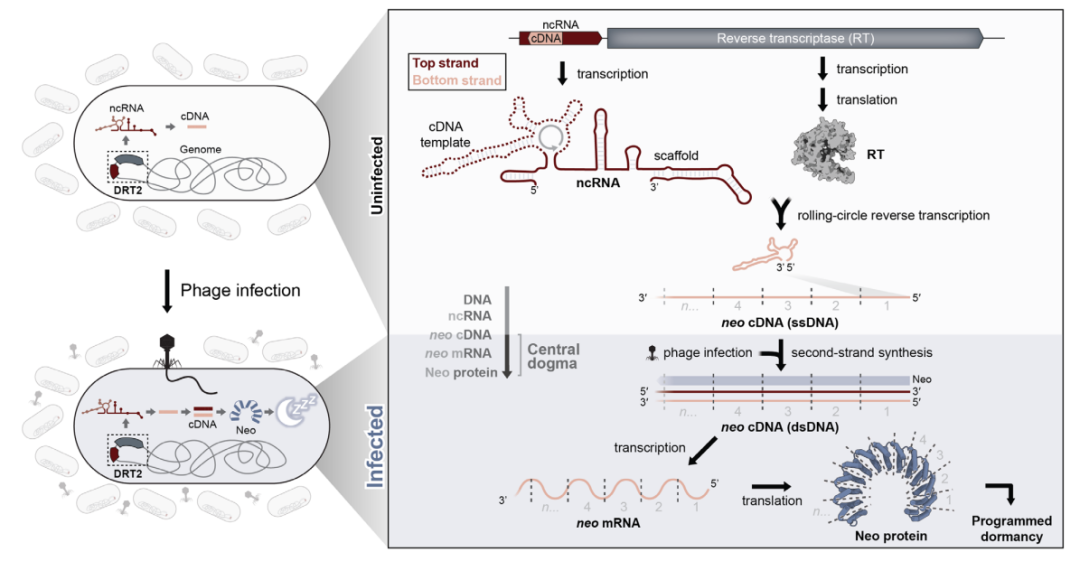 ▲Schematic diagram of the research mechanism: This study reveals the mechanism by which DRT2 resists bacteriophage infections(Image source: Reference [1])The research team hypothesized that the cDNA generated by reverse transcription likely plays an important role in the immune mechanism of DRT2. To verify this hypothesis, the authors developed a new tool to systematically analyze the cDNA products of reverse transcriptase and chose the DRT2 system of Klebsiella pneumoniae for analysis.The results showed that the researchers discovered unprecedented reverse transcription activity, with the cDNA sequences generated being extremely long and containing a large number of repetitive segments. This result is due to the interesting behavior of the reverse transcriptase. The reverse transcriptase catalyzes repeatedly around the hairpin structure of the RNA sequence, causing the RNA sequence to be reverse transcribed multiple times, forming repetitive segments in the DNA sequence.It is important to note that these DNA fragments generated from RNA reverse transcription do not participate in protein coding, but when continuous DNA sequences form, the situation changes significantly. Within this repetitive sequence, there are open reading frames (ORFs) required for protein coding. ORFs need to contain start codons and stop codons, and in this repetitive sequence, the start codon is located at the junction of the repetitive segments, while the stop codon is absent.In other words, theoretically, this sequence can continuously code for proteins. The research team named this sequence “neo“, meaning “never-ending open reading frame.”
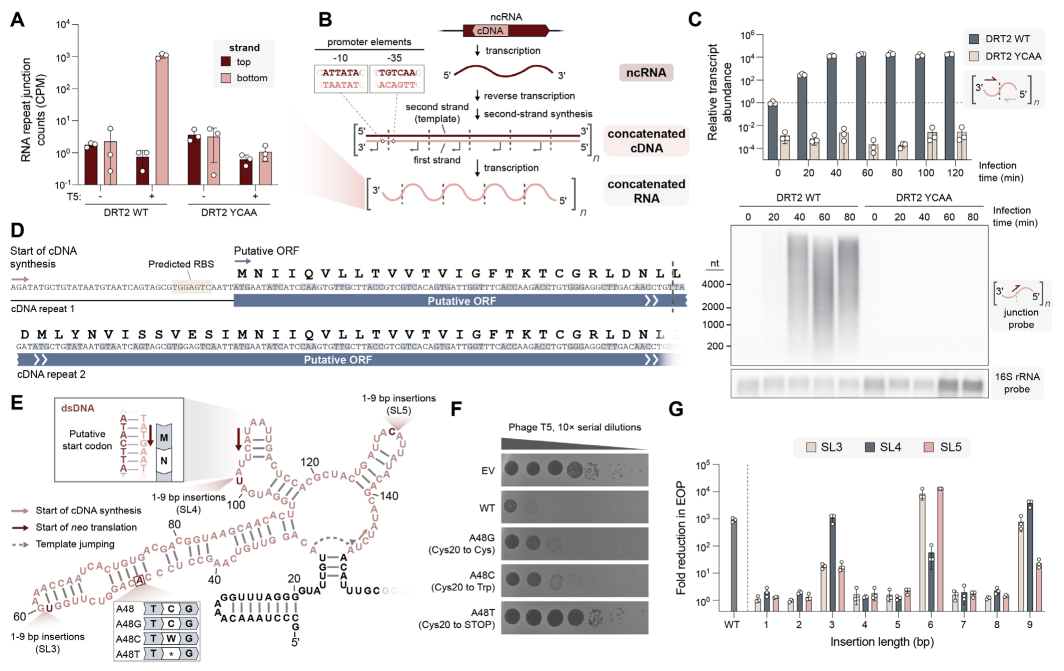 ▲cDNA products contain the “never-ending open reading frame” (neo)(Image source: Reference [1])As mentioned earlier, the reverse transcription of DRT2 should be related to resisting bacteriophages, and subsequent research has also found the mechanism behind it. When nothing happens, these bacteria grow and divide normally; however, once bacteriophages are present, the expression of the neo gene is regulated by the bacteriophages, inducing the production of Neo proteins. It is these Neo proteins that quickly halt bacterial growth and induce programmed dormancy, acting as effectors of the immune system, thus protecting bacteria from bacteriophage invasion.Thus, this research elucidates that bacterial reverse transcriptases, beyond their known functions, can create entirely new genes, challenging the established central dogma. In the report on the Nature website, even scientists not involved in the study commented that this looks “like biology from extraterrestrial organisms.” The authors point out that in the future, new cases of protein-coding genes may be discovered in a wider range of organisms.Cover image source: 123RFReferences:[1] Tang, S. et al. Preprint at bioRxiv https://doi.org/10.1101/2024.05.08.593200 (2024)[2] Bizarre bacteria defy textbooks by writing new genes. Retrieved on May 22nd, from https://www.nature.com/articles/d41586-024-01477-8
This article is from the WuXi AppTec content WeChat team. Feel free to share it with your friends, but please do not repost it on other platforms. If you need to set up a whitelist, please reply “repost” on the “Academic Weaving” public account homepage to obtain reposting instructions. For other collaboration requests, please contact [email protected].
Disclaimer: The WuXi AppTec content team focuses on introducing global biopharmaceutical health research progress. This article is for informational exchange purposes only, and the views expressed do not represent the position of WuXi AppTec, nor do they indicate WuXi AppTec’s support or opposition to the views expressed. This article is not a treatment recommendation. For treatment guidance, please visit a regular hospital.
More Recommendations



Tap “View” before you go~