According to reports from Electronic Enthusiasts (by Zhou Kaiyang), as users, we have witnessed the evolution of artificial intelligence from products to functionalities, and this trend is now spreading to the edge. However, due to strict power consumption and computing requirements at the edge, some existing solutions perform poorly, leading to edge AI often being labeled as a “pseudo-demand.” Nevertheless, AI chip manufacturers, IP suppliers, and software solution providers are all striving to prove their potential.
Pursuing Low Power Consumption in Various Ways
Many people view AI chips as being divided into cloud and edge. Cloud AI chips are aimed at servers and HPC, naturally requiring high performance, but this also means high power consumption, often separating inference from training. In contrast, edge chips prioritize low power consumption first and foremost.
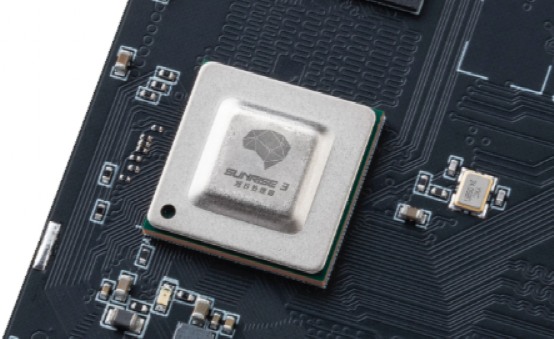
Sunrise 3 / HorizonGiven the current trend, the range of edge devices is vast, from smart water meters to autonomous vehicles, leading to varying requirements for computing power and power consumption. Therefore, even among edge AI chips, direct comparisons are challenging. For instance, some are standalone AI chips, while others serve as co-processors. The Horizon Sunrise 3 series is an edge AI chip targeting the smart front-view and edge computing market, with the X3M providing 5 TOPS of AI equivalent computing power and the X3E offering 3 TOPS. With TSMC’s 16nm process and Horizon’s chip design, this series achieves a power consumption of 2.5W. However, even such low power consumption cannot cover all edge AI scenarios.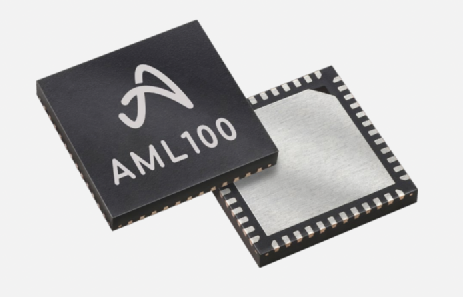 AML100 / AspinityEarlier this year, AI startup Aspinity released the AML100 AnalogML chip, a low-power edge AI chip focused on analog machine learning, supporting up to four analog sensors. This chip is aimed at edge AI applications requiring real-time wake-up, such as security monitoring in smart homes, smart voice control in wearable devices, and anomaly detection in preventive and predictive maintenance. These applications share a common trait: they rely heavily on sensors. Traditional real-time wake-up architectures transmit the analog signals from sensors to an ADC, converting them into digital signals before sending them to a digital processor. Nowadays, such solutions can achieve extremely low power consumption.
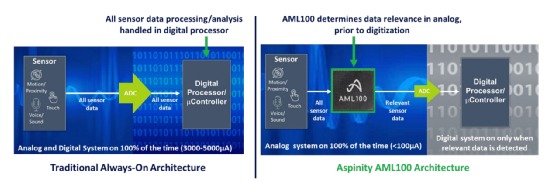 Comparison of Traditional Architecture and AML100 Architecture / AspinityHowever, Aspinity believes that this structure requires both the analog and digital systems to remain online in real-time, with the ADC accepting all data from the sensor outputs. Consequently, the digital processor bears the burden of processing all digital signals, resulting in power consumption levels typically between 3000-5000µA. In contrast, the AML100’s configurable analog core supports specific signal processing directly on the analog data, such as spectral analysis and neural network feature extraction, ultimately outputting genuinely useful sensor data to the digital processor. This way, the digital processor does not need to be in a constant wake state, only waking when necessary data is detected, allowing the analog system composed of AML100 to achieve power consumption below 100µA. According to Aspinity, the AML100 can extend battery life by 20 times.
Challenges Posed by Models
Relying solely on AI chips is insufficient to support the entire development of edge AI; it is well-known that models are an indispensable part of AI. However, the definition of edge inherently limits the ability to run large-scale AI models, necessitating the use of smaller, scalable machine learning models, such as TinyML. Thus, the software stack for the edge also faces significant challenges. Additionally, adjusting AI models for different hardware is a major pain point in deploying AI at the edge. Consequently, while many edge AI chips have achieved excellent performance, the lack of a mature software ecosystem means that application scenarios remain scarce. Therefore, optimization of edge AI often focuses on reducing overhead to adapt models to the edge application scenario, achieving absolute advantages in low power consumption.Recently, another American AI startup has emerged, securing $10 million in seed funding from Qualcomm Ventures and Foothill Ventures. The founding team includes Han Song, co-founder of Deep Vision Technology (acquired by Xilinx) and developer of Deep Compression technology, and Di Wu, former technical director of Facebook AI. Given the backgrounds of the founders, all of whom have rich experience in AI and deep learning and are alumni of Tsinghua University’s Electronic Engineering department, it is not surprising that Foothill Ventures is the rebranded version of Qingyuan Ventures. Founders of OmniML / OmniMLWe won’t delve too much into the team, as even the most impressive startup must prove itself through capability. What is OmniML’s ace? Based on the past achievements of the founders, they are indeed skilled in reducing model compression and optimization, particularly as they are active in the TinyML development community. According to OmniML’s website, the software solutions they provide can optimize AI/ML models for easy deployment on edge devices without sacrificing performance and accuracy. At the same time, OmniML offers a hardware-aware neural architecture search that allows models to be trained once and deployed on any hardware, whether GPU, AI chip, or low-power MCU, enabling even older hardware to gain powerful AI/ML capabilities with OmniML’s assistance.According to Qualcomm, OmniML’s neural architecture search is not merely about compressing models for optimization; it creates an efficient new model from the outset. For customers with edge hardware, this not only reduces time and financial costs but also effectively improves accuracy. OmniML claims that their neural architecture search has already been utilized in Amazon’s AutoML and Meta’s PyTorch deep learning framework.Considering the development team’s strong background in machine vision, OmniML is initially targeting autonomous driving and smart cameras, showcasing a 3D detection solution that fuses data from six vehicle-mounted camera sensors, as well as human detection and face/mask detection based on the Cortex M7 MCU.
The Demand for Edge AI is Not Niche
In the face of endless potential, edge AI is often marginalized. However, if we look directly at the application market, we find that the demand for edge AI is enormous. Whether it is active noise cancellation in TWS headphones, voice recognition in service robots, or autonomous driving in vehicles, the development of edge AI will undoubtedly bring greater power consumption advantages to these scenarios, saving costs while accelerating deployment speed.


Disclaimer: This article is originally from Electronic Enthusiasts, please cite the source above. For group discussions, please add WeChat elecfans999, for submission inquiries, please email [email protected].
More Hot Articles to Read
- Once criticized for blocking Ziguang Zhanrui, now selling technology assets, Lianxin Technology exits the mobile chip business
- Q3 real car appears, is “Xiaomi making cars” exceeding expectations, success in sight?
- With revenue below 300 million and gross profit lower than peers, how does this power IDM qualify for the Growth Enterprise Market?
- The U.S. re-exempts 352 Chinese import goods from tariffs, including motors, sensors, aluminum electrolytic capacitors, and many electronic components
- Latest! ZTE ends the U.S. government’s 5-year “compliance observation period,” reborn!