News Highlights:
- Arm enables automakers to bring new models to market at least a year ahead of traditional timelines
- Zena CSS accelerates software and chip development, facilitating faster and more efficient delivery of AI capabilities
- The pre-validated, safety-compliant platform is expected to save 20% in engineering resources, reducing development costs and complexity
- In the coming years, most OEMs will develop based on the Zena CSS product line
Today, bringing innovation to drivers faster is one of the most significant challenges faced by automakers. Traditional chip development cycles often delay vehicle launches, hindering automakers from delivering the AI-driven features that today’s drivers expect.
Arm’s Zena Compute Subsystem (CSS) will change this situation.
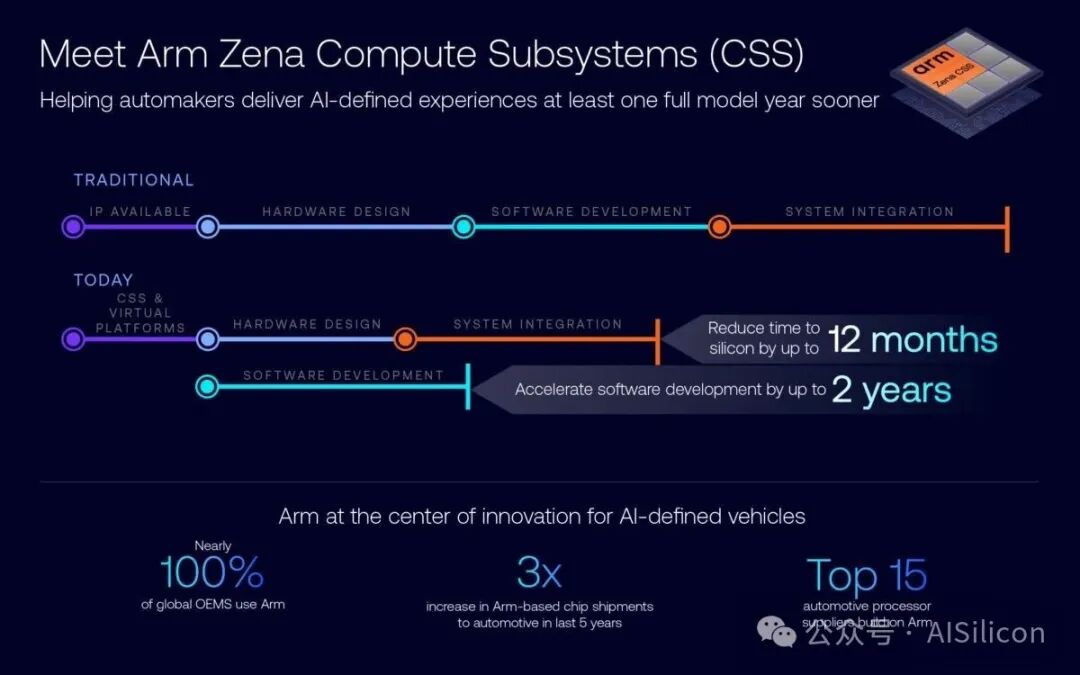
Zena CSS allows automakers to bring new models to market at least a year ahead of schedule through a standardized, pre-integrated computing platform. This platform significantly shortens development cycles and enables software teams to start earlier—even before the chips are physically available. This accelerates time-to-market, extends AI capabilities across entire vehicle lineups, and helps automakers remain competitive in the rapidly evolving era of AI-defined vehicles.
Today, nearly all global OEMs, including Tesla, Rivian, NIO, Mercedes-Benz, Honda, and Geely, rely on Arm technology as the foundational computing platform powering everything from safety-critical ADAS to immersive cockpit experiences. Next-generation vehicles will demand more: the ability to adapt and update in real-time, with ubiquitous and personalized intelligence throughout the vehicle.
Accelerating AI-Defined Experiences for Every Model
To compete in the AI era, automakers need scalable computing power without sacrificing safety, energy efficiency, or flexibility. Zena CSS reduces chip development time by up to 12 months and decreases the chip engineering workload for each project by up to 20%, helping OEMs and chip providers bring new models equipped with intelligent voice and touch interfaces, immersive digital cockpit experiences, driving assistance and automation, and real-time perception capabilities to market faster.
Introduction to Arm Zena CSS
Next-generation vehicles need to run diverse workloads on a single platform, including advanced driver assistance systems (ADAS), in-vehicle infotainment systems (IVI), and vehicle control systems, each with different safety requirements and real-time constraints. Zena CSS is built on Armv9 Automotive Enhanced (AE) technology and is Arm’s first pre-integrated, pre-validated platform for AI-defined vehicles, offering:
- 16 Armv9-based Cortex-A720AE cores, optimized for ADAS and IVI applications
- A safety island powered by Cortex-R82AE, unique to Zena CSS, for real-time ASIL D processing capabilities such as fault management, safety monitoring, system control, and SoC boot
- A Runtime Security Engine, equipped with a safety-compliant Hardware Root of Trust (RoT), leveraging Arm TrustZone technology to manage SoC-level security
- CPU coherency and chip-to-chip connectivity provided by CMN S3AE
- Optional image signal processing, supported by Mali-C720AE and Mali GPU, suitable for ADAS use cases including surround view and driver monitoring
- Support for easy integration of accelerators and partner-specific logic, to meet the evolving workload demands of advanced, AI-enabled SoC designs
This standardized computing platform empowers OEMs and chip providers to reuse architectures and software, accelerating global vehicle delivery and simplifying system development and integration—while also streamlining functional safety and security certification. This is crucial, as developing customized hardware and software stacks for each model and application is costly, time-consuming, and burdensome in terms of validation and certification. Importantly, Zena CSS allows Arm’s partners to innovate and differentiate on top of a standard platform, focusing on areas that add unique value to their product lines.
Leading OEMs (including top electric vehicle manufacturers) and major chip providers have already licensed Zena CSS or are in deep collaboration stages. Arm expects that most players in the industry will develop based on the Zena CSS product line in the coming years.
Empowering Developers to Innovate from Day One
In addition to shortening chip time-to-market, Arm’s partners can immediately leverage cloud-based virtual platform support from AWS, Cadence, Siemens, and Synopsys to start software development on Zena CSS, accelerating software innovation time-to-market by up to two years.
Arm has an ecosystem of over 20 million developers—including numerous partners such as Denso, GitHub, Green Hills, Mapbox, Red Hat, and Panasonic Automotive—who can now build and test on a complete software stack and a common computing platform. Zena CSS is built on open standards, including AUTOSAR, COVESA, eSync, and Virtio, and is supported by SOAFEE (with over 150 members, including General Motors, CARIAD, Continental, and Tata Motors).
The Era of AI-Defined Vehicles Based on Arm
In the past five years, shipments of Arm-based chips in the automotive market have doubled. Now, with Zena CSS, Arm provides automakers with the tools to build software-defined, AI-enabled vehicles faster, smarter, and more efficiently. Coupled with the unique advantage of “cloud-to-car parity”—developing and testing in the cloud using the same Arm architecture that will be deployed in vehicles—this means Arm’s partners can be confident that software will run seamlessly from minimal sensors to Arm-based cloud.
By shortening chip development time by 12 months, reducing engineering workload, and supporting earlier software innovation, Zena CSS helps automakers deliver AI-defined experiences at least a full model year ahead—all made possible on Arm.
Partner Support Quotes:
-
Keiichi Aida, Executive Vice President, Chief Technology Officer, Chief Information Security Officer, and Head of Technology Development at Astemo, Ltd. (formerly Hitachi Astemo):“Astemo has been closely collaborating with Arm to leverage the advantages of SOAFEE through our IoV platform. With the launch of Arm Zena Compute Subsystem (CSS), we see an opportunity to further accelerate our development by porting our IoV platform to a standardized computing architecture. Arm Zena CSS enables us to scale more efficiently, taking advantage of virtual prototyping, and meet the growing demands of software-defined vehicles. We are excited to continue our collaboration with Arm and help drive the industry towards a more connected and software-centric future.”
-
Dr. Martin Tietze, Vice President of New Technologies at BMW Group:“At BMW, we are constantly exploring innovative approaches to future vehicle computing architectures. Currently, we are focused on hardware-software co-design for advanced embedded machine learning applications, such as autonomous driving features, and participating in defining future chiplet reference architectures for the open automotive chiplet ecosystem. Arm Zena Compute Subsystem (CSS) provides an excellent starting point for our semiconductor simulation work. Arm’s architecture is deeply embedded throughout the automotive ecosystem, and we highly welcome and appreciate the support and collaboration Arm provides in initiatives like imec’s automotive chiplet program.”
-
Magnus Östberg, Chief Software Officer at Mercedes-Benz AG:“The transition to software-defined vehicles requires us to change the way we handle computing architectures. Standardized, pre-validated compute subsystems like Arm Zena CSS can significantly accelerate the development timelines across the industry and reduce complexity. By integrating such solutions early in the development chain, the automotive industry can simplify complexity and lay a stronger foundation for delivering safe, intelligent, and connected experiences for next-generation vehicles. At Mercedes-Benz, we recognize the value of collaborative platforms that drive the entire ecosystem forward.”
-
Masashige Mizuyama, Executive Vice President and Chief Technology Officer at Panasonic Automotive Systems Co., Ltd.:“At Panasonic Automotive Systems, we are committed to accelerating the development of software-defined vehicles, and Arm Zena Compute Subsystem represents a significant step in this transformation. Based on our ongoing collaboration with Arm and our work within the SOAFEE community (including SOAFEE blueprints based on the standard device virtualization framework VirtIO, such as Unified HMI and vSkipGen), we see tremendous value in porting workloads to the standardized, scalable platform provided by Arm Zena CSS. Virtual prototyping on a common computing foundation not only shortens time-to-market but also aligns with our vision for a more software-centric and flexible automotive ecosystem. With Arm’s extensive presence across the industry, we are excited to deepen our collaboration and shape the future of automotive computing together.”
-
Jang-kyu Lee, CEO of Telechips Inc.:“Telechips has been a long-term partner of Arm, and this ongoing collaboration is crucial to our mission of providing high-performance, cost-effective semiconductor solutions to the global automotive market with shortened development times. Arm Zena Compute Subsystem (CSS) provides a standardized and scalable computing platform that enables us to accelerate development and focus on unique areas of innovation. Arm Zena CSS helps us bring competitive, future-ready solutions to market faster—meeting the demands of software-defined vehicles and the expectations of leading OEMs and tier-one suppliers.”
This article is from the ARM official website