
In the global server processor market, the X86 architecture has long dominated. However, it is now facing one of the most severe challenges in nearly two decades. With continuous technological advancements and transformations, Arm servers are emerging in the market, showcasing strong development potential and are expected to significantly shake the dominance of X86.
The Core Differences Between Arm Servers and X86 Servers
So what are the differences between the two?
In fact, the Arm architecture is based on RISC (Reduced Instruction Set Computing), with fixed-length and simple instructions that execute efficiently in a single cycle, resulting in lower hardware design complexity. This characteristic makes it extremely suitable for low-power scenarios. In the mobile device sector, Arm architecture has been widely adopted due to this advantage, achieving long battery life. For example, in smartphones, Arm chips can support prolonged device operation under limited power, meeting users’ daily usage needs.
In contrast, the X86 architecture is based on CISC (Complex Instruction Set Computing), with variable-length and complex instructions that can perform multiple operations in a single instruction. This gives the X86 architecture strong capabilities in handling complex tasks, but its hardware decoding logic is complex, prioritizing high performance at the expense of power efficiency. In the personal computer market, the X86 architecture has long dominated, easily handling complex tasks such as graphics rendering, big data analysis, and running complex software applications.
From a hardware design perspective, Arm adopts a modular design, supporting multi-core (such as 4-8 cores) flexible expansion, with single-node power consumption as low as 15W, suitable for horizontal scaling of lightweight tasks. In contrast, X86 relies on high-performance single-core and multi-threading technology, with denser hardware resources (such as more than 16 cores), suitable for high-concurrency computing, but typically exceeding 100W in power consumption.
In terms of energy efficiency, Arm servers show a clear advantage, with energy efficiency improved by over 50% compared to traditional servers. In edge computing scenarios, performance per watt significantly outperforms X86, making it suitable for IoT, AI inference, and other low-power demanding scenarios. For instance, in real-time data processing for smart cities, devices based on the Arm architecture equipped with NPU accelerators can efficiently perform local inference while maintaining low power consumption.
X86 servers have stronger single-core performance, excelling in high-performance computing fields such as scientific simulations and database processing. However, their power consumption is high, with some server CPUs exceeding 400W. In data centers, while X86 servers can meet high-load computing demands, the high electricity costs have become a significant part of operational expenses.
In terms of computing power scalability, Arm can achieve linear scalability through multi-node clusters (such as Kunpeng 920 clusters), with costs 30%-40% lower than X86, making it suitable for cloud computing distributed architectures. In contrast, X86 relies on hardware upgrades (such as Intel’s Xeon series) to enhance single-machine performance, with scalability limited by physical resources, making it more suitable for centralized high-load scenarios.
Additionally, Arm faces challenges in the software ecosystem. It requires binary translation (such as Microsoft’s Prism emulator) to run some X86 applications, with performance losses of 20%-40% for professional software (such as the Adobe toolchain) during runtime. Developers also need to adapt to the Arm native compilation environment.
On the other hand, the X86 architecture, with decades of accumulation, has a software ecosystem covering over 90% of commercial scenarios, with extensive software support. Almost all mainstream database management systems (such as Oracle, MySQL, PostgreSQL, SQL Server) are fully optimized and supported on the X86 architecture. Its mature ecosystem, including rich hardware, software resources, and strong community support, makes problem-solving and system optimization more convenient.
Arm’s Push into the Server Market
Market research firm IDC points out that Arm servers are attracting significant attention, thanks in part to the launch of large-scale rack configuration systems, such as NVIDIA’s DGX GB200 NVL72 system designed for AI processing. In the latest “Global Quarterly Server Tracker” report, IDC estimates that servers based on the Arm architecture will account for 21.1% of global shipments this year, although this figure falls short of the 50% target claimed by Arm infrastructure head Mohamed Awad in April.
Servers equipped with at least one GPU (sometimes referred to as AI servers) are expected to grow by 46.7%, nearly accounting for half of this year’s total market value. The rapid adoption by hyperscale customers and cloud service providers is driving the growth of the server market, with IDC stating that the market size will double in just three years.
The entire server market is projected to reach a record $95.2 billion in the first quarter of 2025, a year-on-year increase of 134.1%. In light of this, IDC has raised its full-year forecast to $366 billion, representing a 44.6% increase, which would set a new historical high.
The “industry standard” X86 segment is expected to grow by 39.9% by 2025, reaching $283.9 billion, while non-X86 systems are expected to grow even faster, with a year-on-year increase of 63.7%, forecasting a total of $82 billion.
From a regional market perspective, IDC’s forecast indicates that the United States will achieve the highest growth, jumping 59.7% compared to 2024, and by the end of 2025 will account for nearly 62% of total server revenue. China is another hot sales region, with IDC predicting a growth of 39.5%, accounting for over 21% of global quarterly revenue. Growth rates in Europe, the Middle East, and Africa, as well as Latin America, are in single digits, at 7% and 0.7%, respectively, while Canada is expected to decline by 9.6% this year due to an unspecified “hyperscale deal” occurring in 2024.
IDC’s Vice President of Global Infrastructure Research, Kuba Stolarski, commented on the growth of servers, stating that the demand for more computing power to handle AI is likely to persist. “The evolution from simple chatbots to inference models to intelligent agents will require several orders of magnitude more processing power, especially in inference.”
AI Drives the Surge in the Arm Server Market
So why is the growth of Arm servers so rapid?
Historically, the high energy efficiency of Arm architecture processors has been its standout advantage, making it dominant in mobile applications. Over the years, with its monopoly in the mobile market, Arm has accumulated a vast ecological advantage. As the server and PC markets increasingly emphasize processor energy efficiency, Arm has begun to achieve rapid development in these two major markets, significantly increasing the number of related applications and developers.
According to data disclosed by Arm, since 2021, the number of applications running on the Arm architecture has roughly doubled, reaching 9 million; the number of developers based on the Arm architecture has also increased by 1.5 times, reaching 22 million. Arm has stated that the number of server customers using processors based on the Arm architecture has grown to 70,000, increasing 14 times since 2021.
The rapid growth in the number of Arm server customers is largely driven by the demand growth brought about by the recent surge in generative AI computing.Arm CEO Rene Haas also stated that a significant portion of the growth from the data center market for Arm is due to AI. Since the AI boom began in 2021, the number of startups using Arm chips has surged 12 times.
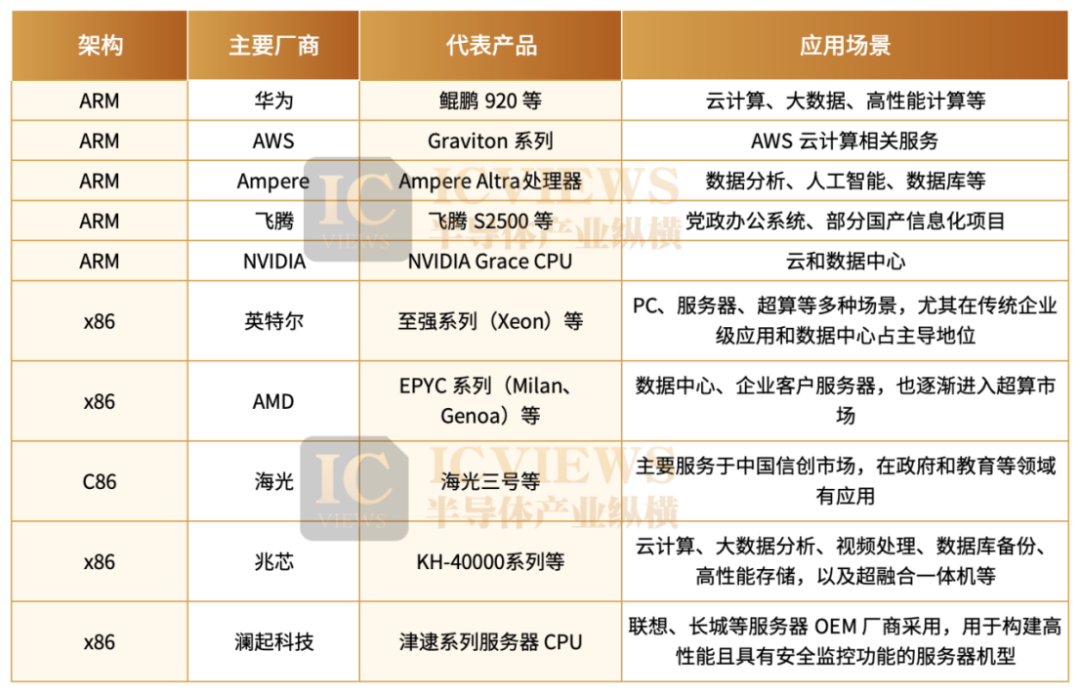
Currently, cloud computing giants such as Amazon AWS, Alibaba Cloud, Google, Microsoft, and Huawei have launched their self-developed server processors based on the Arm architecture, widely used in their data centers. For example, Amazon has launched several generations of server processors since 2018, including AI versions, with millions of Arm chips deployed in its data centers.
More critically, NVIDIA’s AI chips, such as the GB200/300 series, integrate NVIDIA’s self-developed Arm architecture Grace CPU, which has been widely adopted by numerous AI server manufacturers, with a large number of downstream AI software customers. Notably, Qualcomm has announced its return to the Arm server chip market, acquiring SerDes giant Alphawave for $2.4 billion.
Additionally, Arm seems to be developing its own server CPUs for large cloud service providers like Meta. If Meta deploys in bulk, it will inevitably control a significant portion of the server CPU market, as Meta is one of the major procurement customers globally. Recently, SoftBank Group announced its acquisition of Ampere for $6.5 billion, which is considered a move to help Arm better explore the server market.
Ampere Computing is a company focused on Arm cloud-native server CPUs. In its 2023 strategic and product roadmap update, Ampere announced the launch of the new AmpereOne series processors, manufactured on a 5nm process node, featuring up to 192 single-threaded Ampere cores, setting the highest core record in the industry. This core count far exceeds that of Intel and AMD server CPUs at the time. When running virtual machines (VMs) in a cloud environment, the 192-core AmpereOne can run 2.9 times the number of VMs compared to AMD Genoa and 4.3 times compared to Intel Sapphire Rapids.
Arm Servers Present Opportunities for Chinese Enterprises
One of the biggest advantages of the Arm architecture is its energy efficiency. In data centers, electricity costs are a significant part of operational expenses, and energy consumption directly relates to real monetary expenditure. Traditional x86 processors are powerful but also consume a lot of power. With advancements in process technology, Arm is rapidly closing the performance gap while maintaining its energy-saving advantage. Additionally, Arm ‘s licensing model is flexible, unlike the near-monopoly of Intel and AMD in the x86 space, allowing more manufacturers to participate in design and optimization, providing ample space for innovation.
However, the challenges faced by Arm cannot be ignored. The biggest obstacle is the software ecosystem. The x86 architecture has decades of accumulated enterprise software, databases, and middleware with mature versions. For Arm to achieve true widespread adoption, it requires the collaborative support of the entire software ecosystem, which cannot be accomplished overnight. Moreover, customer trust is also an issue. Enterprise users tend to be conservative when choosing critical business system technologies, preferring proven technologies. Arm needs more successful cases to prove its strength.
According to data, the Chinese server market is expected to grow by 39.5% this year, accounting for over 21% of the global market share. Behind this data lies a significant opportunity for the Chinese chip industry. The rise of Arm servers provides new opportunities for Chinese chip companies. In the x86 field, the moats of Intel and AMD are nearly unshakeable, with high patent barriers. However, Arm is different; its licensing model is relatively open, providing more room for newcomers. Huawei’s Kunpeng processor is a good example, as it is based on the Arm architecture and has gained a certain influence in the server market. Alibaba’s Yitian 710 also showcases the strength of Chinese enterprises in Arm server chips.
More importantly, we are currently in the construction phase of the Arm server ecosystem. Work on software adaptation, application optimization, and standard formulation is underway. For Chinese enterprises, this is a rare opportunity to participate in ecosystem construction, rather than passively adapting to others’ standards as in the past. China has a large number of internet companies and cloud service providers that are highly sensitive to cost control and more willing to try new technologies. Companies like Alibaba Cloud, Tencent Cloud, and Huawei Cloud are actively promoting the application of Arm servers. This domestic market support provides valuable practical environments for Chinese Arm chip companies.
However, the design difficulty of Arm server chips is quite high, requiring a balance between performance, power consumption, and cost. From operating systems to databases, from compilers to development tools, every aspect needs continuous improvement. But overall, the development of the Arm server market brings unprecedented opportunities for Chinese enterprises, which are expected to achieve breakthroughs and development in this field, occupying an important position in the global server market.
-More Exciting Content-