Armv9 specifically introduces new features such as security, AI, and signal processing.”
Author | Wang Deqing
Arm today released its next-generation chip architecture, Armv9. Its predecessor, Armv8, was launched ten years ago, and while there have been numerous changes and updates to Armv8, the new architecture brings even more significant updates to the platform, justifying the change in version number.
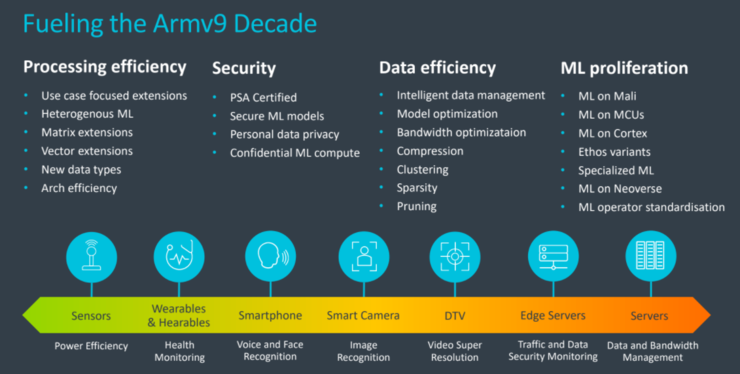
Not surprisingly, Armv9 builds on V8 and is backward compatible, but it specifically introduces new features for security, AI, signal processing, and performance.
In the past five years, over 100 billion chips based on the Arm architecture have been shipped globally. However, Arm believes that its partners will ship more than 300 billion units in the next decade. We will also see the first mass-produced chips based on ArmV9 later this year.
Ian Smythe, Vice President of Customer Business Marketing at Arm, stated that this new architecture will change the way we compute over the next decade. He said, “We will deliver higher performance, improve security features, and enhance workload capabilities as we see the shift in computing happening.”
“The reason we are taking these steps is to see how we can provide the best experience to handle the data explosion, the demand for processing data, the need to move data, and the need to protect data.”
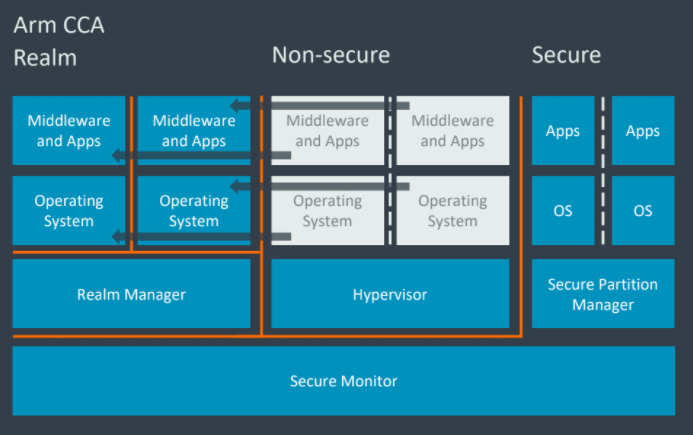
In terms of security, ArmV9 will introduce Arm’s Confidential Computing Architecture and the concept of Realms. These realms allow developers to write applications where data is isolated from the operating system and other applications on the device. For example, using Realms, business applications can isolate sensitive data and code from the rest of the device.
Richard Grisenthwaite, Chief Architect at Arm, remarked, “What we are doing with Arm’s Confidential Computing Architecture is concerning because all our computing runs on the operating system and hypervisor’s computing infrastructure,”
“The code is very complex, so if there is a problem, it can penetrate. And it is in an incredibly trusted position, so we are moving some workloads to run on very small code segments. Only the Realm Manager can truly see the data in operation. This is about one-tenth the size of a typical hypervisor and much smaller than an operating system.”
As Grisenthwaite pointed out, Arm spent several years researching the details of this security architecture to ensure it is robust enough—during which time Spectre and Meltdown emerged, delaying some of Arm’s initial work because some of the solutions it was exploring were vulnerable to similar attacks.
Another area of focus for the Arm team is enhancing CPU AI capabilities. AI workloads are ubiquitous now. Arm introduced its Scalable Vector Extension (SVE) several years ago, but at that time it was designed for high-performance computing solutions like the Fugaku supercomputer powered by Arm.
Now, Arm is launching SVE2 to enable more AI and digital signal processing (DSP) capabilities. For example, these can be used for image processing workloads and other IoT and smart home solutions. Of course, there are dedicated AI chips on the market now, but Arm believes that the entire computing stack needs to be optimized for these workloads, and in many use cases, the CPU is the right choice, especially for smaller workloads.
“We believe machine learning is appearing in almost everything. This will be done in GPUs, in dedicated processors, in neural processors, and it will also be done in our CPUs. And it is also very important to better integrate all these different components for machine learning,” Grisenthwaite said.
As for raw performance, Arm believes that its new architecture will provide chip manufacturers with over 30% more computing power in the next two generations of chips, applicable to both mobile CPUs and large cloud provider users like AWS.
Min Goo Kim, Executive Vice President of SoC Development at Samsung Electronics, stated, “Arm’s next-generation Armv9 architecture makes significant improvements in security and machine learning, both of which will be further emphasized in tomorrow’s mobile communication devices.”
“When we work with Arm, we expect to see the new architecture bring broader innovations to the next generation of Samsung’s Exynos mobile processors.”
This article is translated from:
https://techcrunch.com/2021/03/30/all-hail-armv9-arm-launches-the-next-generation-of-its-processor-architecture/