01Basic Understanding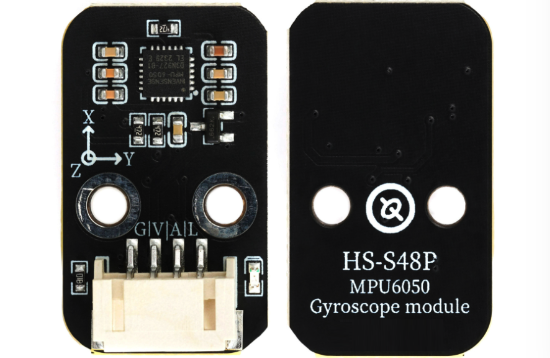 Model:HS-S48PName:MPU6050 Gyroscope ModuleSeries:SensorDescription:This is a 6 degrees of freedom (6DOF) motion sensor module that integrates a three-axis accelerometer and a three-axis gyroscope. It has a built-in digital motion processor (DMP) that can simultaneously detect the acceleration (linear motion) and angular velocity (rotational motion) of an object, outputting digital signals via I2C communication. It features high measurement accuracy, strong integration, and low power consumption, making it a core component for attitude control and motion tracking.Usage Scenarios:Robot posture balancing (e.g., self-balancing cars adjust motor speed by detecting tilt angles); drone flight attitude control (sensing roll and pitch angles for stable hovering); motion-sensing game controllers (capturing hand movements for game operations); sports health devices (recording steps and analyzing running posture); accessibility aids (controlling wheelchair direction through head posture); in primary and secondary school AI education, building “balancing cars” and “motion-sensing remote controls” to help students understand the principles of three-dimensional motion detection, in line with the practical requirements of the “General Education Guidelines for Artificial Intelligence in Primary and Secondary Schools (2025 Edition)”.Interdisciplinary Integration:Physics, Mathematics, Engineering, Information TechnologyEthical Education:The motion data recorded by the sensor (such as daily activity trajectories) may leak user behavior patterns, necessitating clear boundaries for data collection; high-precision motion detection used in military or sensitive fields must comply with relevant regulations; device attitude control failures may pose safety risks (e.g., drone loss of control), requiring the establishment of redundancy protection plans; incompatible data formats from different brands of sensors can lead to difficulties in device interaction, discussing the significance of “universal data standards”; over-reliance on automatic attitude control may reduce manual operation skills, requiring a balance between technological convenience and skill development.
02Technical Parameters
Working Principle:The core of the module is the MPU6050 chip, whose internal three-axis accelerometer detects the displacement of a mass block affected by acceleration, converting mechanical signals into electrical signals; the three-axis gyroscope detects changes in angular velocity during rotation based on the Coriolis force principle. The built-in DMP can fuse acceleration and angular velocity data, directly outputting Euler angles (pitch, roll, yaw), reducing the computational burden on the microcontroller. Data is transmitted to the main control device via the I2C communication protocol, supporting slave mode (can connect external magnetometers to expand to 9DOF).
Parameter Analysis:
G(GND): Power input negative/cathode
V(VCC): Power input positive/anode
A(SDA):I2C data transmission interface
L(SCL):I2C clock synchronization interfaceAccelerometer Range:±2g/±4g/±8g/±16g (programmable)Gyroscope Range:±250°/s±500°/s±1000°/s±2000°/s (configurable)Output Data Rate:4Hz-1kHz (data update frequency)Operating Temperature:-40℃~85℃Communication Protocol:I2C (default address 0x68 or 0x69, selectable via AD0 pin)Power Consumption:Approximately 5mA in normal operating mode, ≤10μA in low power mode03Code Example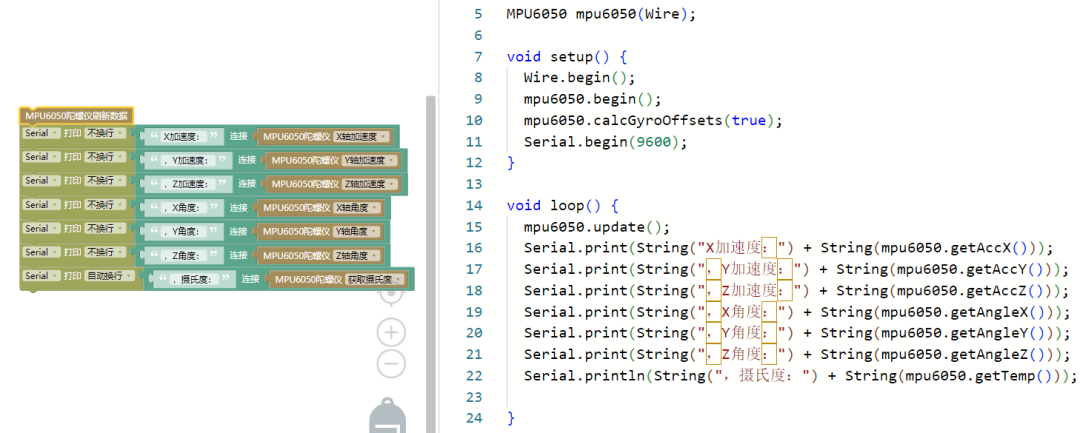
Connection for wiring pins.
Note: Pay attention to data changes.
04Safety Measures
1. Power off before wiring, ensure VCC is 3.3V (do not connect to 5V), reverse connection may burn the chip;
2. Avoid severe impacts or vibrations to the module, as internal sensitive components may be damaged due to mechanical stress;
3. When soldering, the soldering iron temperature should not exceed 300℃, and soldering time should be ≤3 seconds to prevent high-temperature damage;
4. Keep away from strong magnetic fields (e.g., magnets, motors) to avoid interference with gyroscope accuracy;
5. If the operating temperature exceeds the -40℃~85℃ range, stop using it to prevent performance drift;
6. During debugging, ensure the I2C address (0x68/0x69) does not conflict with other devices to avoid communication failure;
7. When not in use for a long time, power off and store in an anti-static bag to prevent static damage.
05Extensions
Students can try the following:
1. Create a “self-balancing car”: Combine with the L298N motor driver module, control motor speed based on the tilt angle detected by the MPU6050 using a PID algorithm to achieve balance;2. Build a “motion-sensing remote control”: Fix the module on the hand and control the remote car’s movement and direction through gestures (e.g., leaning forward, tilting sideways);3. Design a “motion recorder”: Connect an SD card module to record cadence, stride length, and posture changes while running, analyzing exercise habits;4. Develop a “robot obstacle avoidance balance system”: Work with the HS-S02P infrared obstacle avoidance sensor to maintain robot balance while detecting obstacles and changing direction. Arduino Sensors: HS-S01A Infrared SensorArduino Sensors: HS-S02P Infrared Sensor (Obstacle Avoidance)Arduino Sensors: HS-S03P Ultraviolet SensorArduino Sensors: HS-S05P Sound SensorArduino Sensors: HS-F07P Active BuzzerArduino Sensors: HS-S08P Flame SensorArduino Sensors: HS-S09LB Raindrop SensorArduino Sensors: HS-S09PC Soil Moisture Sensor
Arduino Sensors: HS-S10P Fog Sensor
Arduino Sensors: HS-S11-L Gas Sensor
Arduino Sensors: HS-S20P Ambient Light Sensor
Arduino Sensors: HS-S21P Tilt SensorArduino Sensors: HS-S22P Grayscale SensorArduino Sensors: HS-S23P Infrared Receiver ModuleArduino Sensors: HS-S24P Digital Temperature SensorArduino Sensors: HS-S26A Temperature and Humidity SensorArduino Sensors: HS-S28P Potentiometer
Arduino Sensors: HS-S29P Infrared Transmitter Module
Arduino Sensors: HS-S30P Clock Module
Arduino Sensors: HS-S31P Touch Sensor
Arduino Sensors: HS-S32L Rotary Encoder Module
Arduino Sensors: HS-S34P Dual-axis Joystick Module
Arduino Sensors: HS-S37PS Water Level Sensor
Arduino Sensors: HS-S38P Human Sensor
Arduino Sensors: HS-S40P Hall Magnetic Sensor
Arduino Sensors: HS-S45P Pressure Sensor
Arduino Sensors: HS-S46P Weight Sensor

— Previous Recommendations —