01Basic Understanding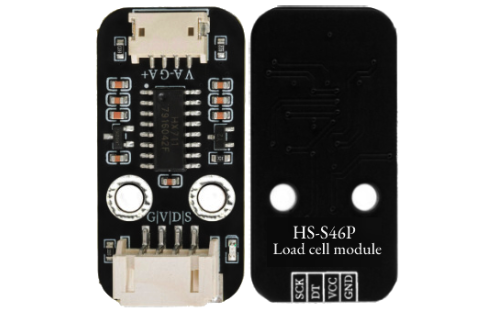 Model:HS-S46PName:Load Cell SensorSeries:SensorDescription:This is a weight detection module based on the principle of a resistive strain gauge, integrating a high-precision strain gauge and signal amplification circuit. It can convert the weight of an object into an analog electrical signal proportional to the weight, featuring high measurement accuracy, good linearity, and strong stability. It can achieve precise detection of weights from grams to kilograms, making it a core component for weighing and object identification.Usage Scenarios:Smart home ingredient weighing (e.g., kitchen scales linked to recipe recommendations); package weight detection (data uploaded via Bluetooth module); industrial assembly line weighing (e.g., part weight screening, removing defective products); agricultural planting monitoring (changes in pot soil weight to determine watering timing); middle and primary school science experiments (verifying the relationship between gravity and mass); accessibility assistance (determining wheelchair position through weight sensing to automatically open doors). This aligns with the “Guidelines for Artificial Intelligence General Education in Primary and Secondary Schools (2025 Edition)”, helping students understand the principles of electrical conversion and data calibration methods by building a “smart weighing system” and “weight alarm device”.Disciplinary Integration:Physics, Mathematics, Labor, Information TechnologyEthical Education:Weight data (e.g., ingredient weight reflecting dietary habits) may leak user privacy, requiring clear boundaries on data usage; deviations in weighing accuracy in commercial scenarios may involve transaction fairness, necessitating compliance with measurement standards; the environmental friendliness of strain gauge materials in sensor production must focus on sustainable development; excessive reliance on electronic weighing may reduce estimation abilities, requiring a balance between technological tools and life experience; handling defective products in industrial testing must explore the balance between resource conservation and quality control.
02Technical Parameters
Working Principle:The core of the module is a Wheatstone bridge composed of resistive strain gauges. When an object is placed on the sensor, the strain gauges undergo slight deformation due to the weight, causing a change in resistance, leading to an unbalanced bridge that outputs a weak voltage signal. The built-in high-precision instrumentation amplifier amplifies the weak signal (gain adjustable), and after filtering, outputs an analog voltage signal proportional to the weight. The microcontroller reads the signal through A/D conversion and calculates the weight value.
Parameter Analysis:
G(GND): Power input negative/ground
V(VCC):Power input positive/positive
D(DT): Data transmission interface
S(SCK):Signal output interfaceMeasurement range: 0-5kg (exceeding this range may cause permanent damage)Output characteristics: 1mV/V (1V supply voltage corresponds to 1mV output, full-scale output of 5mV at 5V supply)Sensitivity: 0.001V/kg (under 5V supply, each additional 1kg weight increases output voltage by approximately 0.005V)Non-linearity error: ≤0.1% FS (0.1% of full scale, ensuring measurement linearity)Operating temperature: -10℃~60℃ (temperature effects need to be compensated through software calibration)03Code Example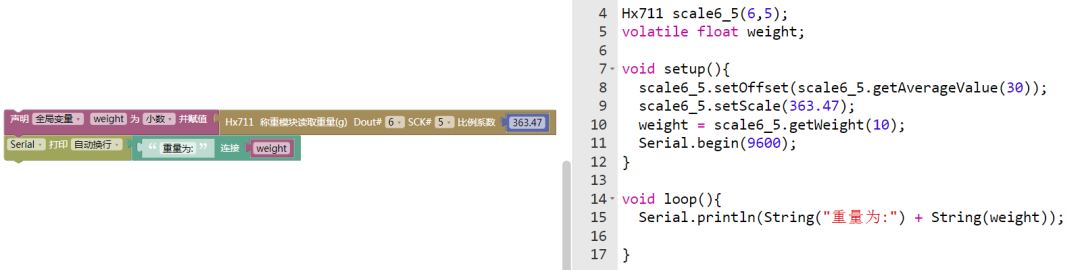
The connection pins are D5·6.
04Safety Measures
1.Power off before wiring, ensure VCC is 5V and the polarity is correct; excessive voltage or reverse connection may burn out the amplifier;
2. Do not exceed a 5kg load; overloading may cause permanent deformation of the strain gauge, rendering the sensor unusable;
3. When placing objects, handle them gently to avoid impact loads (e.g., dropping onto the sensor);
4. Avoid using in humid environments (humidity > 85% RH); moisture can corrode the strain gauge and circuit;
5. Ensure the sensor is evenly loaded during installation (load center at the center position); uneven loading may affect accuracy;
6. Keep away from strong electromagnetic interference sources (e.g., motors, transformers); use shielded cables to reduce signal noise;
7. If not used for a long time, unload and store to avoid fatigue from prolonged stress on the strain gauge.
05Extensions
Students can try the following:
1. Create a “smart kitchen scale”: combine with an OLED display to accurately show ingredient weight, with buttons to switch units (kg/g);2. Build a “package weighing system”: link with a Bluetooth module to automatically send weight data to a mobile app for recording;3. Design a “material sorting device”: in conjunction with relays and conveyor belts, automatically remove parts that exceed weight limits;4. Develop a “plant growth monitor”: place in potted plants to determine soil moisture through weight changes, automatically triggering watering. Arduino Sensors: HS-S01A Infrared SensorArduino Sensors: HS-S02P Infrared Sensor (Obstacle Avoidance)Arduino Sensors: HS-S03P Ultraviolet SensorArduino Sensors: HS-S05P Sound SensorArduino Sensors: HS-F07P Active BuzzerArduino Sensors: HS-S08P Flame SensorArduino Sensors: HS-S09LB Raindrop SensorArduino Sensors: HS-S09PC Soil Moisture Sensor
Arduino Sensors: HS-S10P Fog Sensor
Arduino Sensors: HS-S11-L Gas Sensor
Arduino Sensors: HS-S20P Ambient Light Sensor
Arduino Sensors: HS-S21P Tilt SensorArduino Sensors: HS-S22P Grayscale SensorArduino Sensors: HS-S23P Infrared Receiver ModuleArduino Sensors: HS-S24P Digital Temperature SensorArduino Sensors: HS-S26A Temperature and Humidity SensorArduino Sensors: HS-S28P Rotary Potentiometer
Arduino Sensors: HS-S29P Infrared Transmitter Module
Arduino Sensors: HS-S30P Clock Module
Arduino Sensors: HS-S31P Touch Sensor
Arduino Sensors: HS-S32L Rotary Encoder Module
Arduino Sensors: HS-S34P Dual-axis Joystick Module
Arduino Sensors: HS-S37PS Water Level Sensor
Arduino Sensors: HS-S38P Human Sensor
Arduino Sensors: HS-S40P Hall Magnetic Sensor
Arduino Sensors: HS-S45P Barometric Pressure Sensor

— Previous Recommendations —