For more in-depth information, reports, and knowledge about sensor technology, sensor testing technology, IoT sensor technology, etc., please follow the Sensor Expert WeChat public account and set it as a star to view past content.

The servo accelerometer is shown below, with a suspended high magnetic permeability mass hanging from a hinge. The “downward” or “zero position” is detected by a zero detector, and the balancing force is provided by a magnetic coil.
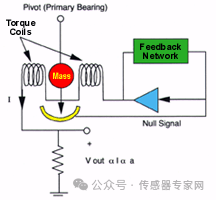
Servo Accelerometer
If acceleration is applied to this component, a force will be exerted on the mass, attempting to move it from the zero position. When the zero detector detects motion, the coil current is increased by the servo amplifier to maintain the zero position.
The coil current provides the restoring force needed to maintain the zero position, and this current will be proportional to the applied acceleration.
High-precision zero detectors can be easily manufactured because the total range of deflection is very small; in fact, increasing the resolution of the zero detector will lead to a corresponding increase in acceleration resolution.
Since the active elements of the servo accelerometer do not exhibit significant displacement during normal operation, this type of sensor has very low hysteresis performance, more due to electrical hysteresis in the circuit rather than actual mechanical hysteresis. The damping of the seismic device is accomplished electrically and mechanically with silicone oil.
Compared to strain gauge accelerometers, servo accelerometers have high zero Hertz stability and low thermal error microgravity resolution. The large inertial mass generates significant force during high-impact events; even in high-impact environments, this sensor may include excessive distance impact stops, but it is not suitable for high-impact environments.
Early force balance sensors provided piezoelectric or magnetic “jitter” mechanisms, which continuously oscillated the bearings slightly to reduce viscous effects, keeping the bearing friction coefficient within a lower dynamic range. Recent designs, utilizing high-resolution zero detection systems, have eliminated the need for bearings, completely replacing them with simple quartz bending. The excellent mechanical properties of crystalline quartz, acting as a pivot, provide substantial zero hysteresis performance due to the mass not exhibiting significant deflection.
The typical practical flat (±5%) frequency response bandwidth of servo accelerometers is generally less than 100 Hz. Based on a closed-loop control network, compared to the open-loop design of strain gauge accelerometers, the recovery time of servo accelerometers from over-range inputs can be quite long. In fact, the recovery time of the sensor after process input is a direct function of the total power available to the restoring force mechanism.
Typical servo sensors usually limit the input drive current to 50 or 100 mA, thereby “energy limiting” the restoring force mechanism generated.
The typical over-range recovery time is 100 milliseconds. The large thermal mass of this type of sensor makes the device relatively insensitive to thermal transients.
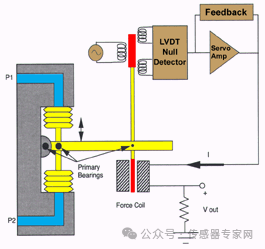
The figure shows how the servo concept based on the above principles is applied to manufacture extremely high-precision pressure sensors.
Servo pressure sensors are generally quite large and are usually not suitable for dynamic pressure measurements or physically hostile environments, but they are very suitable for high-precision and high-resolution pressure measurements in more benign physical environments.
Starred content = content you care about, according to the WeChat public account recommendation principle, if you do not set the Sensor Expert WeChat public account homepage as a star, you will not be able to receive the latest information in the sensor industry in a timely manner!
Source:Wangcai Servo and Motion Control
Disclaimer:Reprinting this article is for the purpose of conveying more information. If there are any errors in source attribution or infringement of your legal rights, please contact us, and we will correct or delete it promptly. Thank you.
If you have submission or interview needs, please send an email to:[email protected].Recommended Reading:
- China’s Sensors Depend on You! Summary of Sensor Research Information from 30 Top Universities
- Finally Understood, Modern Warfare is All About Sensors
- China’s Chip Tycoon Actually Comes from Sensors
- Waking Up to Find That Chinese Companies Can No Longer Design Sensors?!