The Internet of Things (IoT) is evolving from “connecting devices” to “empowering industries,” becoming the core driving force behind digital transformation. With technological breakthroughs (such as 6G and AI chips) and policy support (like China’s “New Infrastructure” plan), the IoT will create more value in areas such as smart healthcare, autonomous driving, and digital twins, ultimately building a digital ecosystem where everything is interconnected.
Part.01

Analysis of the Current State of the IoT Market

1. IoT Industry Chain
The IoT is divided into four levels: the perception layer, transmission layer, platform layer, and application layer. The perception layer mainly includes various basic chips, sensors, machine vision, high-precision positioning technology, radio frequency identification (RFID), QR code recognition, barcode recognition, and wireless sensing. The transmission layer is responsible for transmitting and processing the information obtained from the perception layer, which is divided into wired and wireless transmission, with wireless transmission (wide area networks, local area networks, etc.) being the main application of the IoT. The platform layer includes CMP device management platforms, DMP connection management platforms, AEP application enablement platforms, and BAP business analysis platforms. The application layer includes various smart terminal products, smart cities, smart healthcare, smart manufacturing, smart logistics, and the Internet of Vehicles.
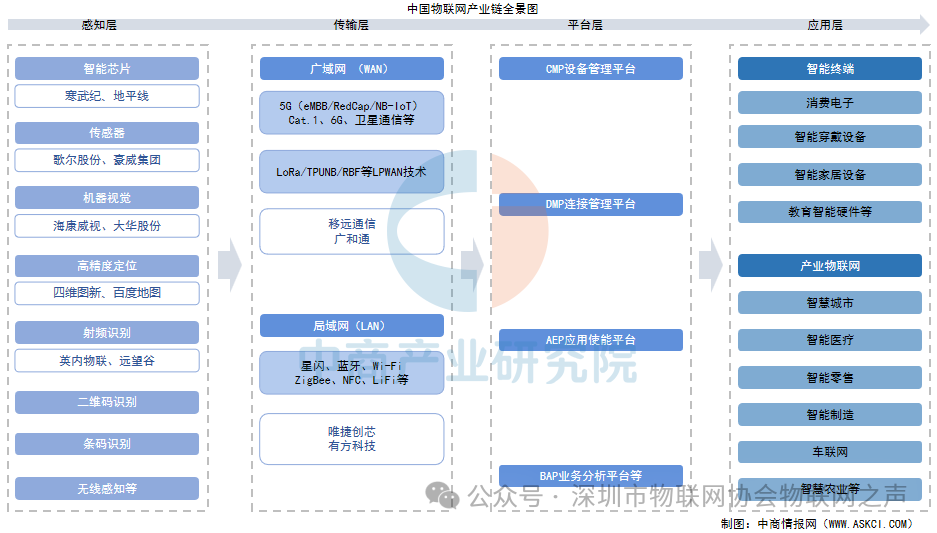
Source: Organized by the China Business Industry Research Institute
2. IoT Market Size
After years of rapid development, China’s IoT industry has formed a large market scale, achieving positive results in technological innovation breakthroughs, industry integration applications, and industrial ecosystem cultivation. According to the “2025-2030 China IoT Market Demand Forecast and Development Trend Report” released by the China Business Industry Research Institute, the national IoT market size is approximately 3.35 trillion yuan in 2023, a year-on-year increase of 9.84%, and the market size is expected to reach approximately 4.01 trillion yuan in 2024. Analysts predict that the market size of China’s IoT will reach 4.55 trillion yuan by 2025.
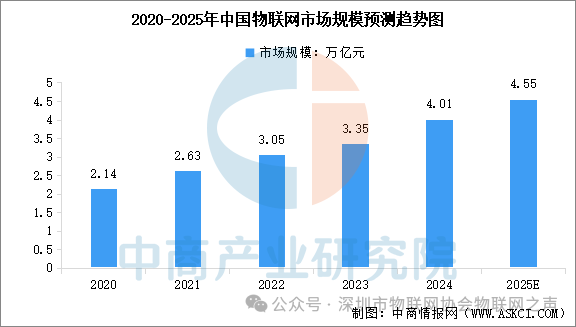
Data Source: Xinhua News Agency, Organized by the China Business Industry Research Institute
3. IoT Market Structure
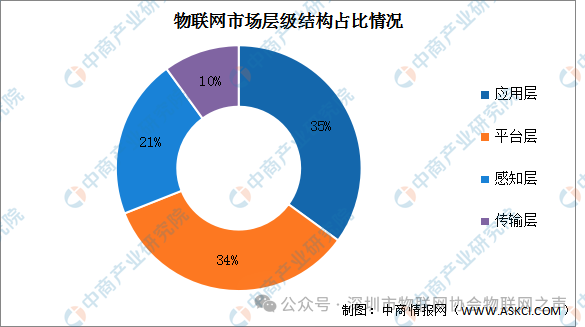
The IoT technology system can be divided into four layers: perception layer, network layer (transmission layer), platform layer, and application layer. Among them, the IoT industry application layer and platform layer contribute the largest added value, accounting for 35% and 34%, respectively; the perception layer, which includes a variety of components, has a significant industrial value, accounting for 21%; the transmission layer accounts for a smaller proportion, only 10%.
Data Source: McKinsey, Organized by the China Business Industry Research Institute
4. Key Enterprises in the IoT
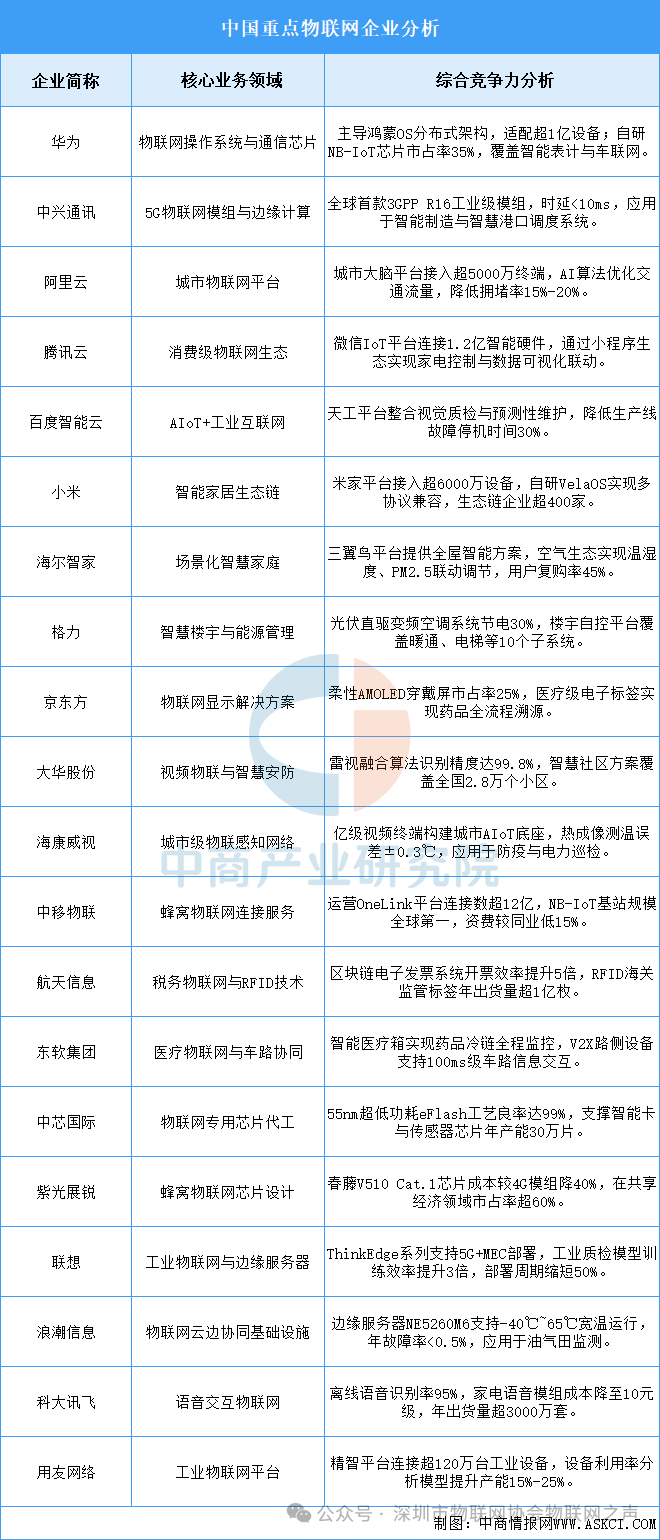
The IoT technology field is broad, and the competitive landscape of enterprises shows a diversified characteristic. Companies such as Huawei, ZTE, Alibaba Cloud, Tencent Cloud, and Baidu Cloud are in a leading position in the industry due to their outstanding contributions in IoT technology research and development, product innovation, and market promotion.
Source: Organized by the China Business Industry Research Institute
Part.02

Perception Layer Analysis

1. AI Chips
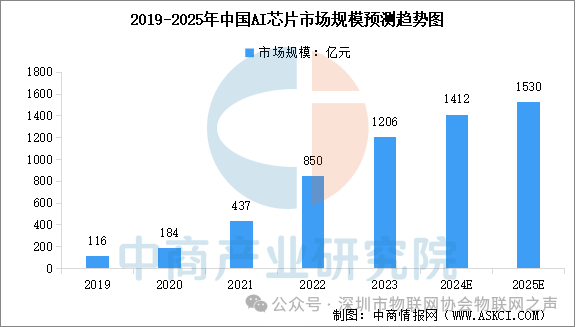
In recent years, China’s AI chip industry has received widespread attention, and the market size of the industry continues to grow. According to the “2025-2030 China Artificial Intelligence Chip Industry Market Development Monitoring and Investment Potential Forecast Report” released by the China Business Industry Research Institute, the market size of China’s AI chips reached 120.6 billion yuan in 2023, a year-on-year increase of 41.9%, and the market size is expected to be approximately 141.2 billion yuan in 2024. Analysts predict that the market size of China’s AI chips will increase to 153 billion yuan by 2025.
Data Source: Organized by the China Business Industry Research Institute
2. Smart Sensors
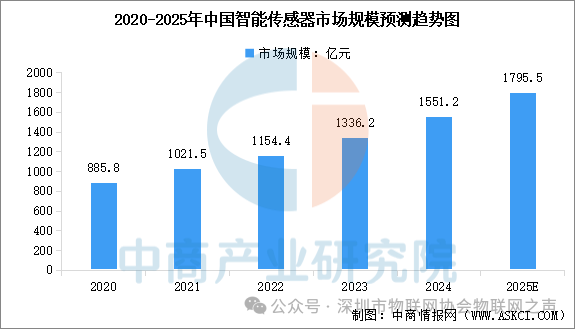
With continuous technological advancements and the expansion of application fields, China’s smart sensor market size is growing rapidly. According to the “2025-2030 Global and China Smart Sensor Market Survey and Industry Outlook Forecast Report” released by the China Business Industry Research Institute, the market size of China’s smart sensors was 133.62 billion yuan in 2023, with a compound annual growth rate of 15.96% over the past five years, and the market size is expected to be approximately 155.12 billion yuan in 2024. Analysts predict that the market size of China’s smart sensors will reach 179.55 billion yuan by 2025.
Data Source: Organized by the China Business Industry Research Institute
3. Machine Vision
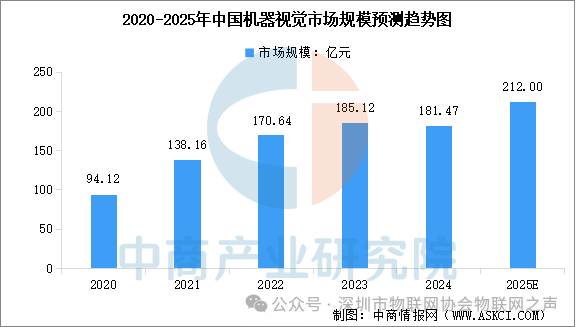
Machine vision is an important branch of artificial intelligence, enabling machines to “see” and “understand” through technologies such as image acquisition, preprocessing, feature extraction, and classification recognition. Affected by the overall market sentiment, investment and expansion in the machine vision market have slowed, and technical challenges remain to be overcome, hindering the promotion of applications and affecting the overall market size growth trend. According to the “2025-2030 China Machine Vision Industry Market Research and Investment Outlook Forecast Report” released by the China Business Industry Research Institute, the market size of China’s machine vision is expected to be 18.147 billion yuan in 2024, a year-on-year decrease of 1.97%. Analysts predict that the market size of China’s machine vision will exceed 21 billion yuan by 2025.
Data Source: Organized by the China Business Industry Research Institute
4. High-Precision Maps
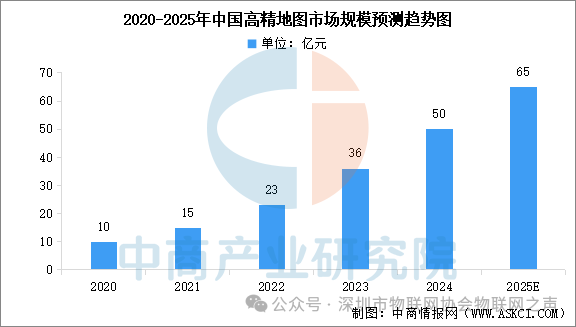
In recent years, China’s high-precision map market is expected to achieve rapid growth. According to the “2025-2030 China High-Precision Map Industry Market Status Research and Development Trend Forecast Report” released by the China Business Industry Research Institute, the market size of China’s high-precision maps is expected to reach around 5 billion yuan in 2024. Analysts predict that the market size of China’s high-precision maps will reach 6.5 billion yuan by 2025.
Data Source: Organized by the China Business Industry Research Institute
5. Radio Frequency Identification (RFID)
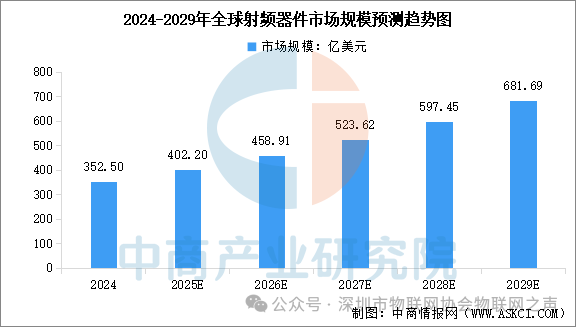
RFID is a non-contact automatic identification technology that automatically identifies specific tags and reads and writes related data through radio frequency signals without manual intervention, capable of identifying high-speed moving objects and recognizing multiple tags quickly and conveniently. According to the “2025-2030 Global RFID Device Industry Research and Development Trend Forecast Report” released by the China Business Industry Research Institute, the global RFID device market size is expected to be 35.25 billion USD in 2024. Analysts predict that the global RFID device market size will reach 40.22 billion USD by 2025 and 68.169 billion USD by 2029.
Data Source: Organized by the China Business Industry Research Institute
6. Key Enterprises in the Perception Layer
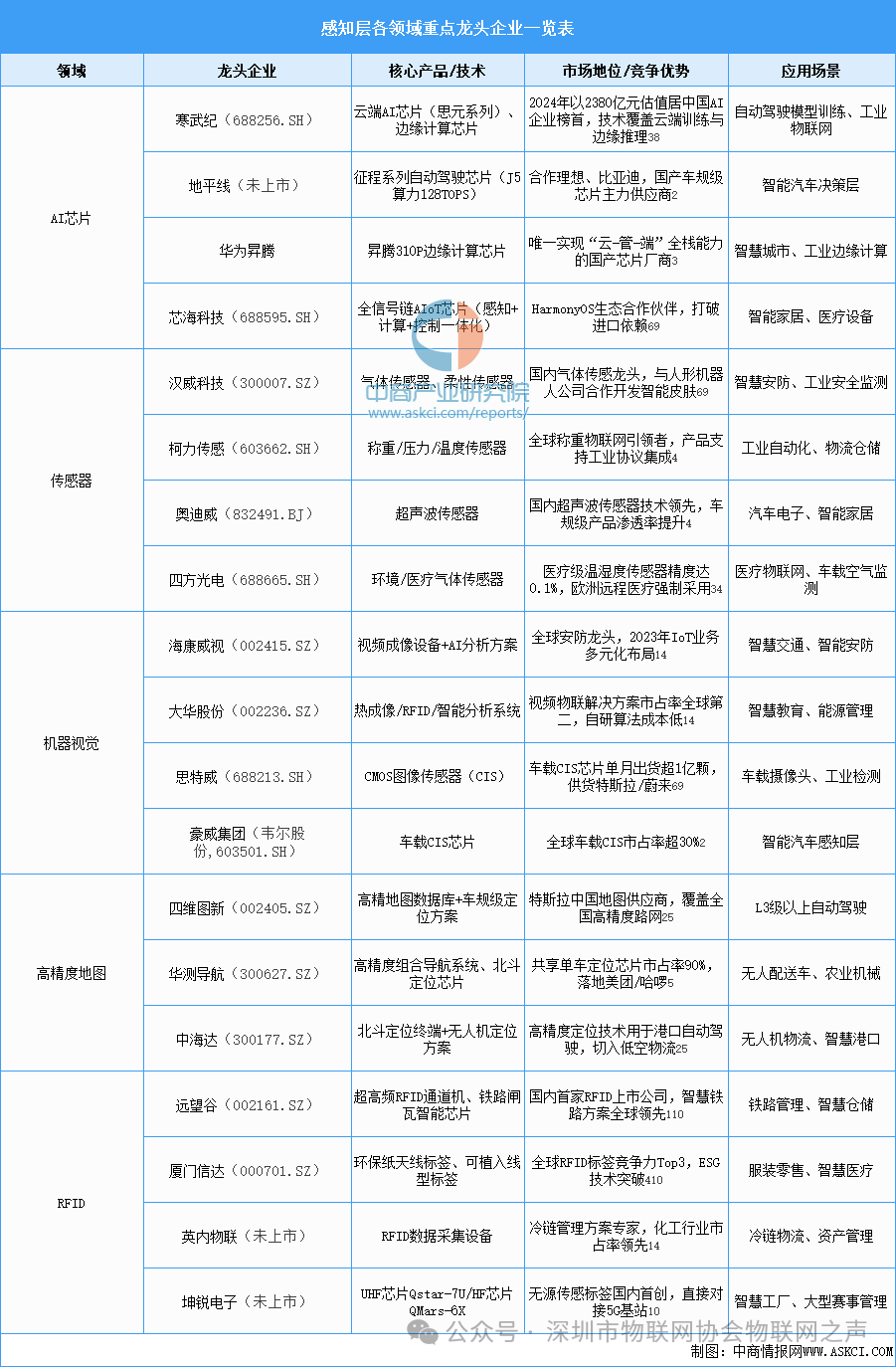
The perception layer, as the “nerve endings” of the IoT, mainly collects and captures information about the external environment or objects through sensing devices, possessing the ability to perceive and obtain information. Below is a list of leading enterprises in the main subfields of the IoT perception layer, covering AI chips, sensors, machine vision, high-precision maps, and RFID:
Data Source: Organized by the China Business Industry Research Institute
Part.03

Transmission Layer Analysis

1. Introduction to the Transmission Layer
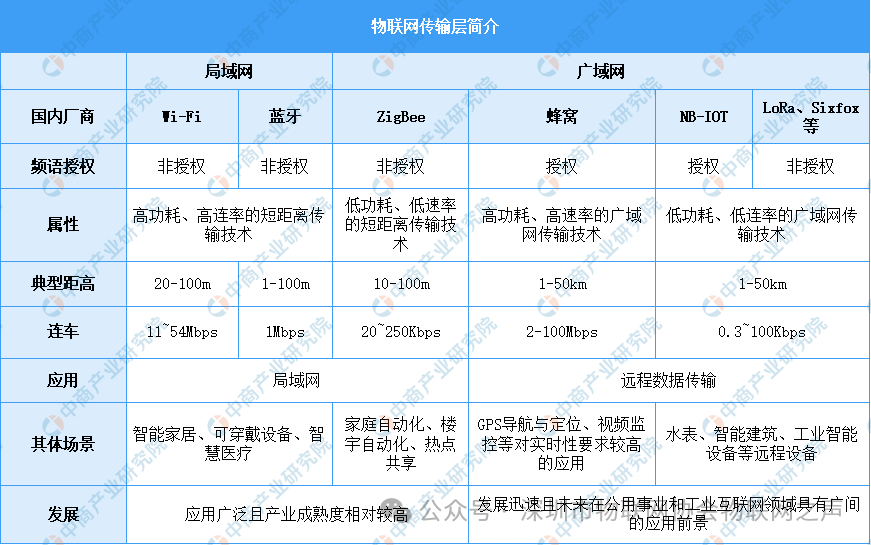
The transmission layer is the channel through which IoT devices connect, responsible for connecting terminal devices, edges, and the cloud. It involves various network transmission technologies, which can be divided into wireless transmission technologies and wired transmission technologies, with wireless transmission being the primary focus of the IoT’s transmission layer. Wireless transmission is divided into local area networks and wide area networks, with local area networks including Bluetooth, WiFi, etc.; wide area networks including NB-IoT, Sigfox, etc., as shown in the figure:
Data Source: Organized by the China Business Industry Research Institute
2. Market Size of Communication Modules
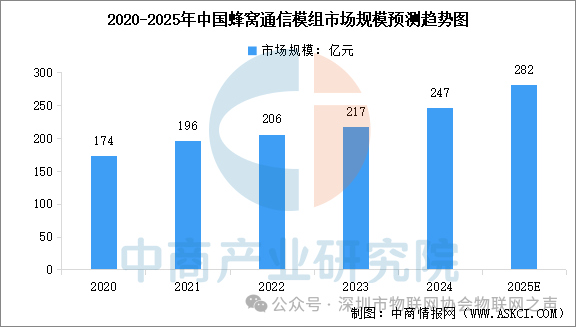
As the “nerve center” of the IoT, communication modules are driving digital transformation through technological innovation and multi-scenario penetration. With the continuous growth of the number of connected IoT devices in China and the expansion of application scenarios, the market for cellular communication modules in China is growing rapidly. According to the “2025-2030 Global and China Communication Module Market Status Research Analysis and Development Outlook Forecast Report” released by the China Business Industry Research Institute, the market size of China’s cellular communication modules is expected to grow from 17.4 billion yuan in 2020 to 24.7 billion yuan in 2024, with a compound annual growth rate of 9.15%. Analysts predict that the market size of China’s cellular communication modules will reach 28.2 billion yuan by 2025.
Data Source: Organized by the China Business Industry Research Institute
3. Competitive Landscape of the Communication Module Market
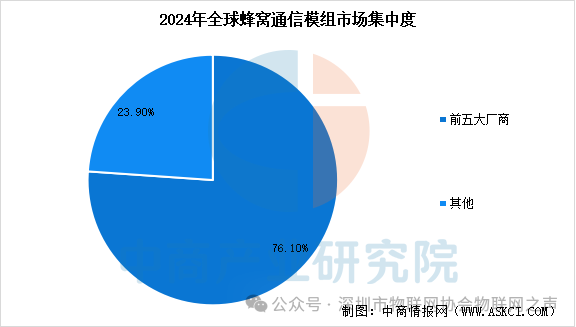
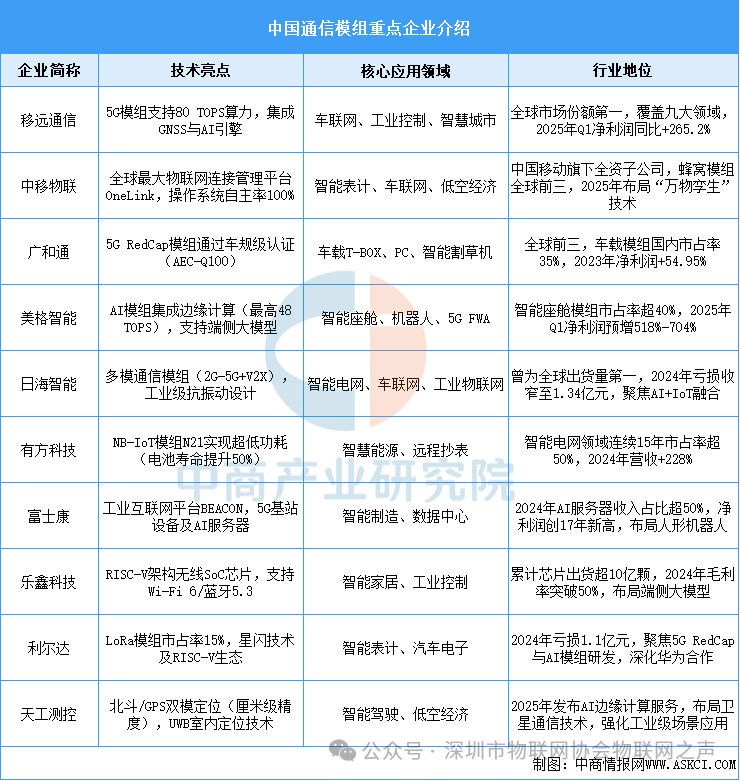
The Chinese communication module market is highly concentrated, with the top five manufacturers accounting for 76.1% of the market share by 2024, with leading companies such as Quectel, China Mobile IoT, Guanghetong, and Meig Smart occupying a dominant position.
Data Source: Organized by the China Business Industry Research Institute
Data Source: Organized by the China Business Industry Research Institute
Part.04

Platform Layer Analysis

In recent years, the Chinese government has listed the IoT as a strategic emerging industry and formulated relevant industrial plans and a series of encouraging industrial policies, creating a favorable growth environment for the industry. Currently, China’s IoT industry has become an important component of the global IoT industry and is expected to maintain rapid growth in the near future. According to the “2025-2030 China IoT Market Demand Forecast and Development Trend Report” released by the China Business Industry Research Institute, the number of connected IoT devices in China is expected to reach 7.1 billion units in 2024. Analysts predict that the number of connected IoT devices in China will reach 8 billion units by 2025.
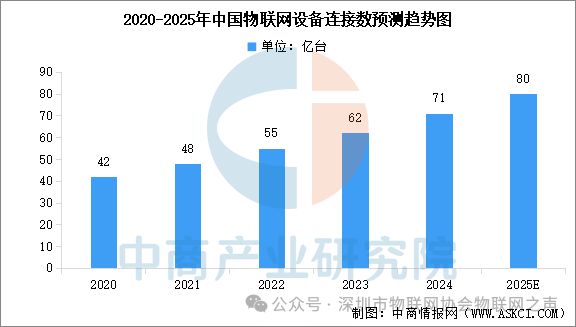
Data Source: GSMA, Organized by the China Business Industry Research Institute
Part.05

Application Layer Analysis

1. Smart Terminals
In recent years, the market size of smart terminals in China has continued to grow, but the growth rate has slowed due to macroeconomic factors and declining demand. According to the “2025-2030 Global and China Smart Terminal Market Status and Future Development Trends” released by the China Business Industry Research Institute, the market size of smart terminals in China is expected to reach 16.69 trillion yuan in 2024, with a compound annual growth rate of 7.16% over the past five years. Analysts predict that the market size of smart terminals in China will reach 17.53 trillion yuan by 2025.
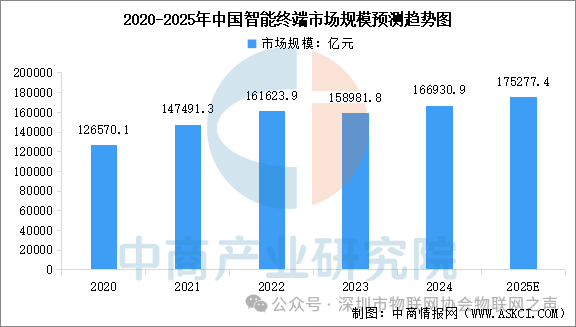
Data Source: Organized by the China Business Industry Research Institute
2. Smart Cities
With the widespread application of new generation information technologies such as big data, artificial intelligence, IoT, and cloud computing, the pace of smart city construction in China is accelerating. According to the “2025-2030 China Smart City Industry Market Research and Investment Outlook Forecast Report” released by the China Business Industry Research Institute, the market size of smart cities in China is expected to grow from 15 trillion yuan in 2020 to 36.8 trillion yuan in 2024, with a compound annual growth rate of 25.2%. Analysts predict that the market size of smart cities in China will reach 45.3 trillion yuan by 2025.
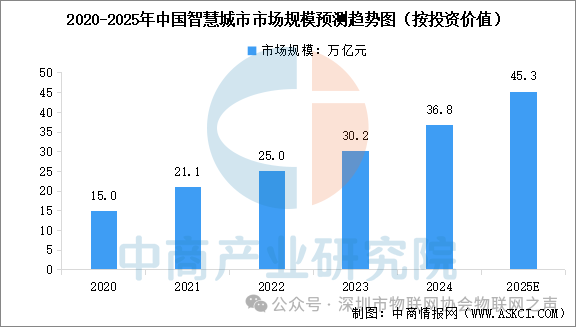
Data Source: Organized by the China Business Industry Research Institute
3. Smart Logistics
Smart logistics, as the core engine of the modern supply chain system, is driving the logistics industry towards efficiency, sustainability, and intelligence through the deep integration of IoT, big data, and artificial intelligence technologies. According to the “2025-2030 China Smart Logistics Market Survey and Industry Outlook Forecast Report” released by the China Business Industry Research Institute, the market size of the smart logistics industry in China is expected to be approximately 854.6 billion yuan in 2024, an increase of 8.14% from the previous year. Analysts predict that the market size of smart logistics in China will reach 965.5 billion yuan by 2025.
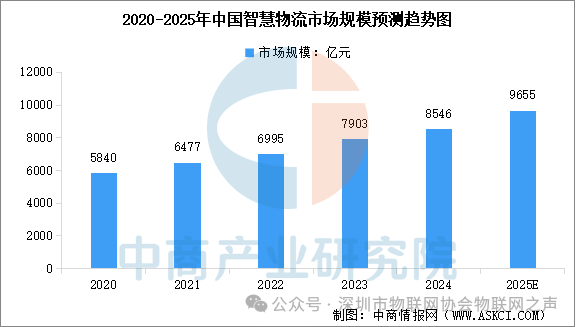
Data Source: Organized by the China Business Industry Research Institute
4. Smart Healthcare
With the continuous development of smart healthcare technologies and support from policies, the market size of smart healthcare in China is expanding rapidly and showing a trend of high-speed growth. According to the “2025-2030 China Smart Healthcare Industry Development Trends and Investment Risk Research Report” released by the China Business Industry Research Institute, the market size of the smart healthcare industry in China reached 6.285 billion yuan in 2023, with a compound annual growth rate of 53.37% from 2019 to 2023, and the market size is expected to be approximately 11.137 billion yuan in 2024. Analysts predict that the market size of smart healthcare in China will grow to 12 billion yuan by 2025.
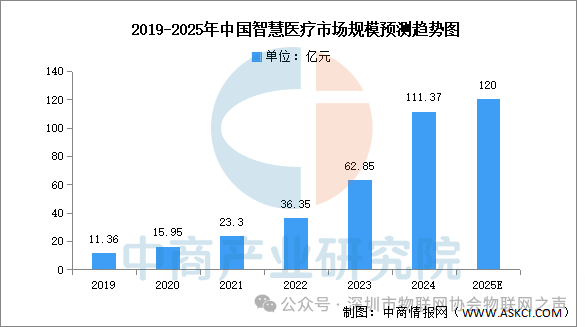
Data Source: Frost & Sullivan, Organized by the China Business Industry Research Institute
For more information, please refer to the report released by the China Business Industry Research Institute titled “2025-2030 China IoT Market Demand Forecast and Development Trend Report”, and the China Business Industry Research Institute also provides industrial big data, industry intelligence, industry research reports, industry white papers, industry status certificates, feasibility study reports, industrial planning, industrial chain investment maps, industrial investment guidelines, industrial chain investment inspections & recommendations, and the “14th Five-Year Plan” and other consulting services.
The above information is for reference only; if there are any omissions or deficiencies, please feel free to correct!















China Business Industry Research Institute

Founded in 2002, the China Business Industry Research Institute is a new type of industrial think tank based in Shenzhen and serving the whole country. For more than twenty years, the institute has adhered to the development concept of “Bay Area Gene, Global Vision,” with “data + platform” as the core driving force, relying on the multidimensional linkage of “capital + resources + projects” to provide high-value industrial consulting solutions for clients, assisting in industrial upgrading and high-quality development.