
Click the blue text to follow “Textile Report”

The cerebral cortex is the highest center regulating and controlling human body movement. Monitoring the activity state of the cerebral cortex plays a crucial role in studying the operational mechanisms of the human brain. The physiological activity of the cerebral cortex is usually manifested as neuronal firing and fluctuations in ion concentrations. Therefore, the common methods for recording cortical activity include cortical electroencephalography and fluorescence imaging for real-time monitoring of calcium ion concentration changes in the cerebral cortex. Although fluorescence imaging can quickly detect calcium ions within cells, it cannot quantify calcium ion concentrations; moreover, fluorescence imaging technology can only be used for calcium detection, while other ions that can reflect changes in the cerebral cortex, such as potassium and sodium ions, cannot be detected using fluorescence ion imaging.
To address this issue, a team led by Professor Peng Huisheng and Professor Sun Xuemei from Fudan University has developed an efficient sensor for real-time recording of cortical activity. The team utilized polydimethylsiloxane as the flexible substrate for the sensor and a carbon nanotube array as the electrode material, achieving real-time monitoring of calcium, sodium, and potassium ions in the cerebral cortex. During the 14-day usage period, the performance of the electrodes changed little, and even after 1000 cycles of dynamic folding, the electrode material could still be used for real-time monitoring of cortical activity.
The sensor electrodes monitor calcium, sodium, and potassium ions in cortical cells based on the principle of ion-selective electrodes. The main principle involves applying a certain voltage across an ion-selective permeable membrane, allowing the target ions in the cerebral cortex to diffuse into the membrane. This creates a double electric layer between the ion-selective permeable membrane and the cerebral cortex. The voltage of the formed double electric layer is related to the concentration of the ions selectively permeating the cerebral cortex, enabling real-time and accurate detection of the corresponding ion concentrations in the cerebral cortex.
The test electrodes need to be in close contact with the tested cerebral cortex, and the test electrodes should have excellent conductivity and double electric capacity. The research team creatively utilized a photolithographically patterned mold on a flexible substrate to achieve the preparation of the carbon nanotube array electrodes.
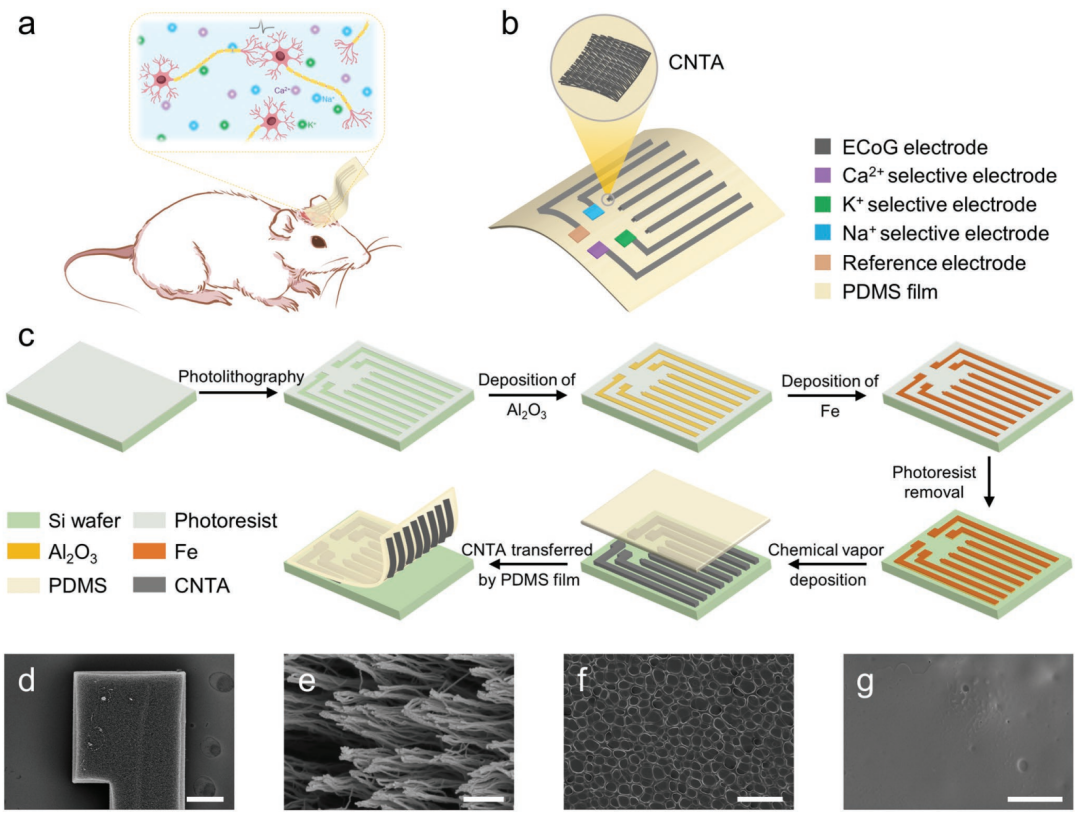
Preparation of the Nanotube Array Flexible Electrode Sensor
Compared to existing sensors made with gold substrates, the carbon nanotube array sensor electrode material has a relatively large specific surface area, resulting in a greater charge capacity. Additionally, the internal resistance of the carbon nanotube array sensor electrodes is much lower than that of gold substrate sensor electrodes, leading to higher detection accuracy. In multi-day monitoring experiments and multiple bending tests, the performance of the sensor electrodes remained largely unchanged, demonstrating the durability of the sensor electrode material.
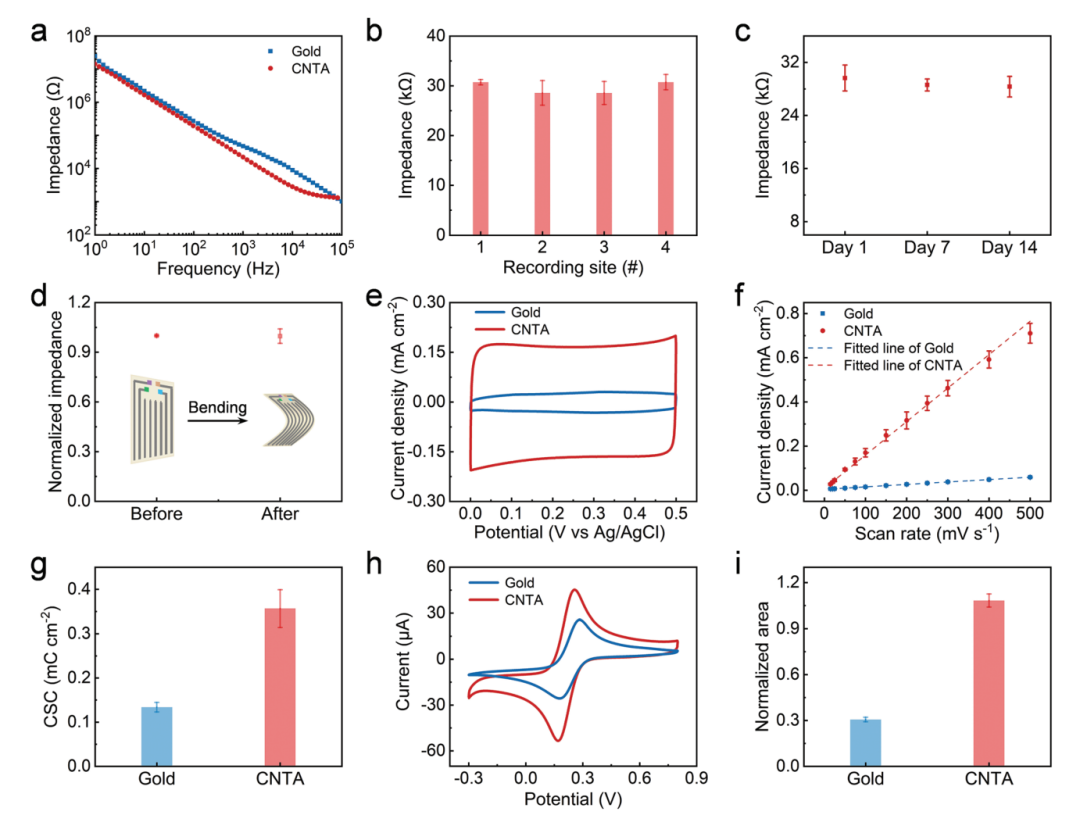
Comparison of Carbon Nanotube Array Sensor Electrodes and Gold Sensor Electrodes
When the concentration of measured ions such as calcium, sodium, or potassium ions is changed, the sensor’s voltage shows significant variation. However, when other interfering ions such as magnesium ions are introduced into the tested liquid, the sensor’s voltage does not change significantly. This proves that the sensor has good anti-interference performance.
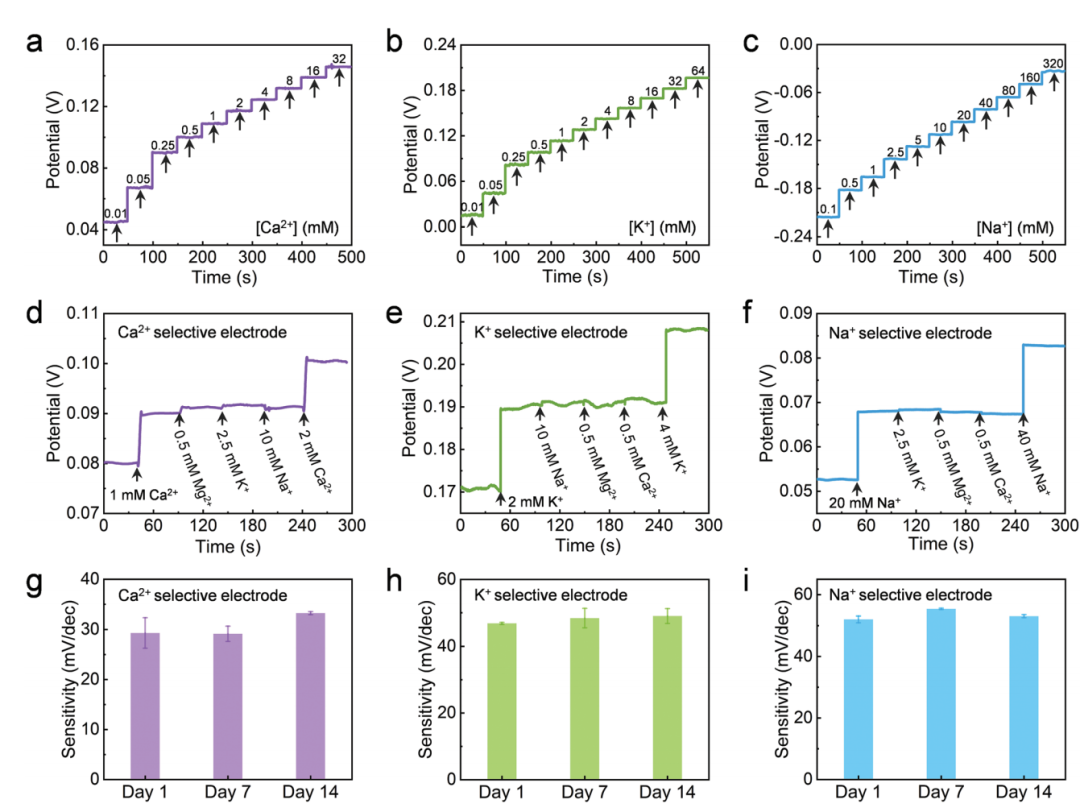
Responsiveness and Anti-Interference of the Carbon Nanotube Array Sensor
Finally, the research team directly applied the prepared sensor to detect the physiological activity of mouse cerebral cortexes, successfully recording the concentration changes of calcium, potassium, and sodium ions in the mouse cerebral cortex using the carbon nanotube array sensor. The related research was published under the title “Carbon Nanotube Array-Based Flexible Multifunctional Electrodes to Record Electrophysiology and Ions on the Cerebral Cortex in Real Time” in Advanced Functional Materials.
Source: Polymer Science Frontiers






[Review] Previous Quality WeChat:

Welcome to reprint, please indicate the source, thank you!
“Textile Report” magazine is a guiding scientific journal sponsored by the China Textile Information Center, aiming to provide in-depth reporting and analysis of textile technology development trends, authoritative interpretations of science and technology policies and industry regulations, serving as a barometer for government agencies and industry organizations regarding science and technology policy and trends, and an important window for helping industry and corporate decision-makers grasp the current state of textile technology and the technical market context.
Textile Report official website:www.texleader.com.cn
Textile Report Sina Weibo: Search “Textile Report”
Welcome to subscribe to “Textile Report”: Postal issuance code 82-908
Distribution Hotline: 010-84463638-8850
Advertising Inquiry: 010-84463638-8830