The vehicle real-time positioning system is one of the core technologies in the informatization construction of intelligent bus systems. The intelligent bus scheduling system utilizes satellite positioning technology, computer technology, and other means to manage the operation of buses through information technology, providing technical support for operational decision-making.


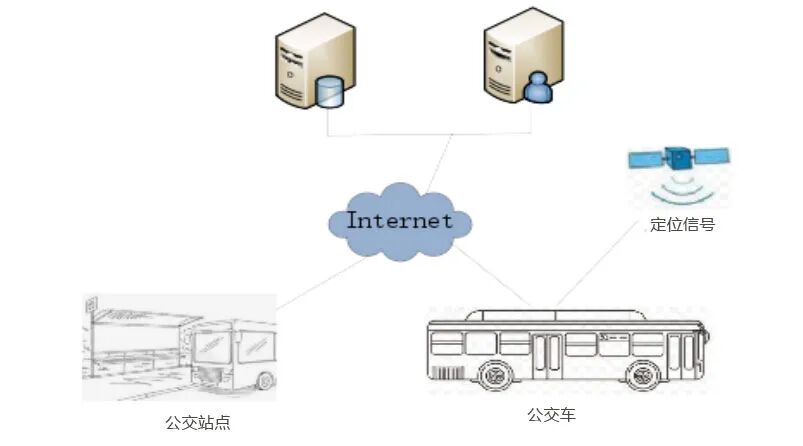
1、Bus Positioning System Architecture
The onboard terminal receives satellite navigation messages, and after parsing, it can obtain positioning information such as the vehicle’s current location, speed, and time. By calculating the current position against the stored station locations, when the vehicle arrives at a station, the voice announcement module is activated to realize the automatic announcement function. At the same time, the current position and other information are sent to the backend server via wireless communication. Dispatch personnel can manage and monitor moving vehicles in real-time through a visual management platform, allowing for timely problem detection and adjustment of departure status.

2、Real-Time Positioning Announcement Technology and Algorithms
During the operation of the bus, the current latitude and longitude coordinates are obtained in real-time and compared with the collected route station coordinates. Algorithms are used to calculate the vehicle’s accurate position, enabling automatic station announcements.


(1) Real-Time Positioning Coordinate Acquisition

Currently, many buses use a dual-system composite module of GPS and Beidou for positioning. The onboard terminal acquires real-time vehicle latitude, longitude, speed, and direction data. The automatic voice announcement system for buses utilizes this technology to provide touchless, fully automated announcements for entering and exiting stations, transfer prompts, and safety reminders for turns, among other automated service functions.
(2) Route Station Information Collection
Information is collected for each station on the route, measuring the latitude and longitude of each station. When mapping the route area, direction angles and other data must also be calculated, and the onboard data must be edited and adjusted. When collecting station information, the vehicle’s inbound and outbound directions must be determined, and the vehicle’s entry and exit from the station must be accurately judged to ensure that the announcement timing is appropriate. After information collection is completed, the station sequence must be entered into the onboard terminal’s backend system, and the prepared voice announcement files must be packaged and sent to the onboard terminal.
(3) Automatic Announcement Positioning Algorithm
The latitude, longitude, and azimuth information of each station are collected. When calculating the vehicle’s position, the current latitude, longitude, speed, and azimuth information are used. When the vehicle approaches the platform, the system determines that the vehicle is entering the station as it gets closer to the station. Conversely, if the vehicle moves further away from the station, the system determines that the vehicle is exiting the station. Taking Jinan public transport as an example, the system defaults to a 50-meter distance from the station. The vehicle begins announcing when it is 50 meters away from the station, and as the vehicle moves closer, it is considered to be entering the station, while moving further away is considered exiting the station. This is combined with the station sequence entered in the backend to determine the vehicle’s inbound and outbound direction.
3、The Importance of Real-Time Bus Positioning
The vehicle positioning data is the foundation for bus operation management, assessment, passenger services, and big data analysis. Only with accurate positioning data can precise management of buses be ensured, and the importance of precise vehicle positioning is self-evident.
(1) Operational Management
Bus operational management utilizes positioning, passenger flow collection, GIS, and other technologies to obtain real-time information on bus locations, operational status, and passenger flow, allowing for flexible adjustments to bus operation routes based on passenger flow status and unexpected events, using real-time positioning data for operational management.
(2) Intelligent Scheduling System Statistics and Assessment
The intelligent scheduling system assesses by mining massive vehicle positioning data, categorizing and statistically analyzing the data to automatically generate various operational and assessment reports, providing decision support for management. Based on vehicle operation conditions, statistics are made on vehicles, shifts, kilometers, punctuality of first and last shifts, and on-time rates of route operations, while assessment settings are made for parameters such as long intervals, vehicle bunching, on-time operations, and route timing. The system automatically generates assessment reports based on the set standards.
(3) Passenger Information Services
Real-time positioning vehicle data interfaces with the MaaS platform, utilizing the 369 travel APP to provide passengers with real-time data, allowing them to check vehicle locations, arrival and departure information, thereby enhancing the level of bus services and providing passengers with a good travel experience.
(4) Big Data Analysis
By analyzing real-time positioning data and combining it with passenger card swipe records, a comprehensive analysis of passenger flow, operational status, and other factors is conducted, analyzing the matching of transport capacity and demand, turnaround times, operational balance, and trends and possibilities in the data, providing decision support for network optimization assessments.
4、Conclusion
Jinan public transport continuously optimizes vehicle positioning algorithms through various informatization technologies, improving the accuracy of vehicle operational positioning data, which has now reached over 99.9%, achieving precise management of public transport and enhancing passenger service levels.
END
Source:Jinan Urban Transportation Research Center


Click and hold to recognize the QR code
Follow “Urban Public Transport”
Bus colleagues are watching