|
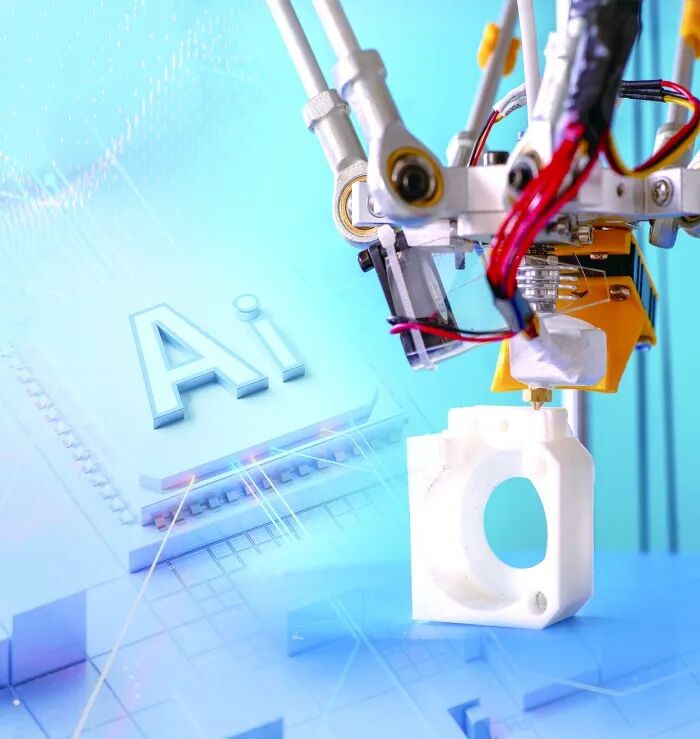
Recently, the Ministry of Industry and Information Technology released the key points for the integration of informatization and industrialization for 2025, which includes 17 items across five areas. In terms of enhancing intelligence levels, the Ministry has clarified the implementation of the “Artificial Intelligence + Manufacturing” initiative, supporting enterprises in applying general large models, industry-specific large models, and intelligent agents in key scenarios.
3D printing is a major focus area for the empowerment of artificial intelligence. Under the influence of AI, the 3D printing industry is showing three development trends: popularization, intelligence, and autonomy. With the implementation of the “Artificial Intelligence + Manufacturing” initiative, the 3D printing industry is expected to achieve higher quality development.
Li Fangzheng, Deputy Secretary-General of the China Additive Manufacturing Association, stated that multiple capabilities of AI align well with the industrial characteristics of 3D printing, helping it become one of the main application scenarios for “Artificial Intelligence + Manufacturing”.
AI Lowers the Barriers for 3D Printing
Li Fangzheng introduced that AI, through intelligent modeling and automatic optimization, has lowered the usage barriers of 3D printing equipment, allowing ordinary users to complete complex product designs, thus transforming 3D printing devices from professional tools to tools for the general public.
Previously, the technical barriers for users to operate 3D printing equipment were high, relying on professional scanning devices or manual modeling to complete product designs. Now, users can describe their creative ideas to AI to obtain design drawings, which are then converted into 3D model files for printing.
“With AI empowerment, the user base for consumer-grade 3D printing devices has changed,” said Li Haixiong, co-founder of the 3D printing industry platform Nanji Xiong. In the past, users of consumer-grade 3D printing devices were mainly “makers” with strong hands-on skills, but now more ordinary users are starting to use consumer-grade 3D printing devices.
The application scenarios for consumer-grade 3D printing devices are expanding into areas such as home DIY, education and training, and maker spaces. Han Zongbo, Marketing Director of Chuangxiang Sanwei, stated that in the field of consumer-grade 3D printing devices, AI helps ordinary users independently complete the entire process from modeling to finished product, continuously broadening the application scenarios for 3D printing devices.
In the industrial-grade 3D printing field, the integration of 3D printing and AI is driving a transformation in personalized medical fields, shifting from “experience-driven” to “data-driven”. For example, the orthodontic treatment model at Tongce Medical’s dental hospital has formed a digital orthodontic treatment model supported by 3D printing and AI technology.
Additionally, in the field of custom aids, a fully automated production chain is expected to form in the future, consisting of “image acquisition – AI planning – 3D printing – robotic surgery operation”.
AI Makes 3D Printing Smarter
AI is rapidly integrating into the manufacturing process of 3D printing, making 3D printing devices smarter, more efficient, and easier to use, reshaping the competitive logic and technical barriers of the 3D printing industry, thus driving continuous innovation in the sector.
Zong Guisheng, Chairman and General Manager of Beijing San Di Technology Co., Ltd., stated that AI runs through the entire chain of 3D printing products, including design, production, and post-processing, reconstructing the industrial value of 3D printing from multiple dimensions and promoting its leap from “manufacturing tools” to “intelligent systems”.
In the central control phase of printing, AI monitors defects in 3D printed products through closed-loop control functions and adjusts parameters such as power and speed of the 3D printing equipment in real-time, enhancing the operational stability and success rate of 3D printing devices.
In the post-processing and operation phase, AI coordinates various processes such as laser cutting and heat treatment, issuing timely warnings by analyzing historical data of user prints; in terms of ecological collaboration, AI enhances the usability of software related to 3D printing, making it more convenient, efficient, and precise to upload and search for models.
For example, Chuangxiang Sanwei’s 3D printing device K2 plus is equipped with dual AI cameras that can identify platform foreign objects and printing failures, actively intervening, and its 3D printing software Chuangxiang Cloud 6.0 version has introduced features such as AI-based model searching and AI-assisted model uploading.
3D Printing Devices Move Towards “Autonomous Operation”
It is reported that by integrating technologies such as AI and digital twins, the development model of 3D printing is transitioning from “human + experience” to “autonomous operation”.
For instance, Yiwo Zhikong’s AM Brain Pro software utilizes sensor data to detect the porosity and surface roughness of 3D printed products in real-time. Additionally, when the powder feeder prepares a new layer, the AM Brain Pro software calculates the scanning strategy for the next layer to repair defects and correct deformations.
Zong Guisheng stated, “In the future, 3D printing will achieve AI-driven design throughout the entire process, establishing a new manufacturing ecosystem characterized by on-demand creation and zero waste.”
Specifically, AI will reconstruct the supply chain of the 3D printing industry, driving it towards distributed manufacturing, enabling localized printing and delivery of products through global order scheduling, and forming a zero-inventory on-demand production model.
At the same time, 3D printing devices will achieve closed-loop control and zero-defect production, utilizing AI and sensor technology to detect printing conditions in real-time and dynamically adjust parameters.
“The production chain of 3D printing may further evolve towards a model of ‘fully autonomous operation’.” Wang Xiaoyan, a member of the Shanghai Additive Manufacturing Standardization Technical Committee, predicts that with the help of AI and digital twin technologies, the production process of 3D printing will achieve integrated decision-making for product processes, structures, and performance.
Wang Xiaoyan stated that AI large models will possess capabilities for perception, planning, execution, and reflection on produced products, and the underlying knowledge, design generation, and equipment operation of 3D printing will also be integrated, allowing the platform system of 3D printing to achieve “one-click printing” with zero human intervention.
Source: Shanghai Securities Journal