
Scientists and engineers, inspired by bees and wasps, have developed a swarm of drones equipped with 3D printers capable of constructing complete buildings. These drones are specially designed to print a cement-like material with sufficient precision to create towering structures. When these printing drones work in unison, they can complete tasks more rapidly. The research team envisions creating more environmentally friendly 3D-printed shelters compared to traditional construction methods, allowing drones to be utilized in areas that are difficult for humans to reach.
Feel free to click “Read the original article“ to read the related paper.
Welcome to visit and follow Nature Portfolio, to discover more fresh, informative, and interesting videos
Video Transcript:
Aerial Construction New Star: 3D Printing Drone Swarms
This is a 3D printer mounted on a drone. In fact, this is the first time that free-flying robots have achieved such precise 3D printing.
A group of scientists and engineers inspired by bees and wasps, which collaborate to place materials and create large and complex structures. They hope that this drone swarm can build houses or emergency shelters in remote areas in the future.
However, effectively combining 3D printing technology with flying robots is a significant challenge, with one of the biggest issues being precision. To ensure that towering structures are stable, each layer of material must be precisely stacked on top of the previous one. Therefore, researchers use scanning drones equipped with cameras to scan the already printed structures, and this information guides the printing drones to the correct position.
Keeping them in the correct position is also challenging, as drones can easily drift during flight, especially outdoors. Thus, the team developed a position-adjustable print head to compensate for the drone’s displacement. This achieved millimeter-level precision and fine filament printing.
This drone is printing with a foaming material, which has poor predictability during printing but is very lightweight. In fact, all components of the drone must be lightweight to conserve energy. The team even created a new type of cement-like material that can be carried by the drone—it is soft during printing and then hardens.
Inspired by bees and wasps, the team also wanted to ensure that multiple drones can collaborate efficiently. They allowed these drones to operate semi-autonomously, adapting to various changes during construction. In this extended construction test, the team virtually tracked the drone paths, demonstrating how to enable a group of devices to quickly print large structures.
The concept of 3D printing houses has already been realized by ground printers, but the team believes that flying printers will be more useful in hard-to-reach places, such as mountainous areas or disaster zones.
They can also be used for facade repairs—such as on towers or pipelines—without the need for scaffolding. Aerial printing also offers scalability; you do not need a printer larger than the object being constructed, just a swarm of small flying printers.
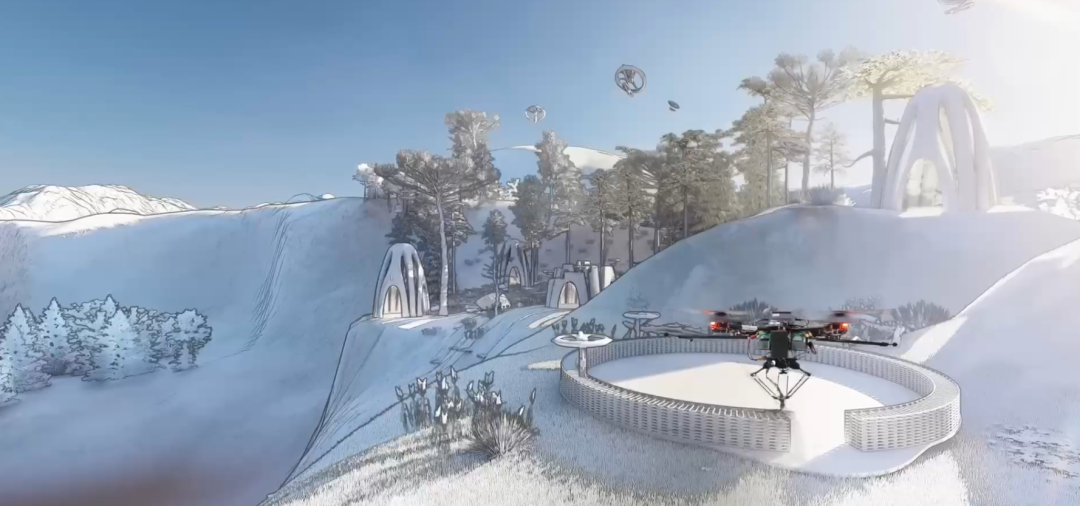
3D printing is expected to become an alternative option, more environmentally friendly than traditional construction methods. The nature-inspired drone printing may be a significant force in making construction greener.
© nature
This video was independently produced, feel free to click “Read the original article“ to view related articles
Aerial additive manufacturing with multiple autonomous robots
Copyright Notice:
This video subtitle was translated by the Springer Nature Shanghai office. The Chinese content is for reference only; all content is subject to the original English version. Feel free to share it in your circle of friends, and for reprints, please email [email protected]. Unauthorized translations are considered copyright infringement, and the copyright holder reserves the right to pursue legal responsibility.
© 2022 Springer Nature Limited. All Rights Reserved