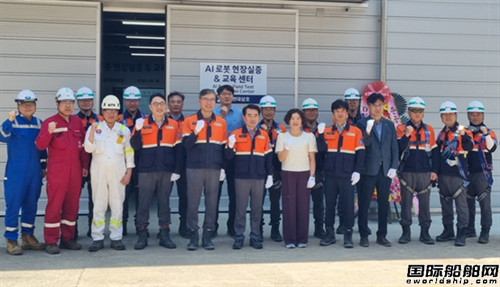
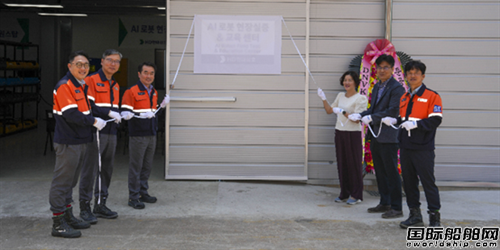
Recently, the completion ceremony of the “Artificial Intelligence (AI) Robot Field Testing & Training Center” was held at HD Hyundai Samho to promote automation innovation in the shipbuilding industry of Jeollanam-do, South Korea.
The center was built under a “public-private partnership” model, with project funding provided by the Ministry of Trade, Industry and Energy of South Korea and Jeollanam-do, and technical cooperation between HD Hyundai Samho and local small and medium-sized enterprises. The total investment for the project is 1.67 billion KRW (approximately 1.22 million USD or 8.73 million CNY), covering a total area of 360 square meters (2 floors).
This is a “one-stop” comprehensive platform that executes the entire process from the development of technologies such as welding robots required on-site at shipyards to testing, professional workforce training, and maintenance all in one place. After the center is put into operation, it will not only alleviate labor shortages but also quickly introduce new production and commercial technologies from the HD Hyundai Group’s future technology research institute.
Welding accounts for a significant portion of shipbuilding projects, with ship welding hours accounting for about 40% of the total manufacturing hours for the hull, and welding costs representing approximately 30-50% of the total manufacturing costs, significantly impacting overall manufacturing costs and efficiency. Especially under the trend of severe labor shortages in the South Korean shipbuilding industry, the demand for automation technologies based on AI data analysis and robot control technology is increasing.
HD Hyundai Samho stated that the completion of the AI Robot Field Testing & Training Center will serve as an opportunity to further expand the foundation for automation and intelligence that aligns with the characteristics of the shipbuilding industry, and to promote multiple follow-up projects by establishing an intelligent production system that allows small and medium-sized enterprises to easily adopt new technologies.
Kim Jae-Il, President of HD Hyundai Samho, and representatives from relevant institutions such as the Korea Small and Medium Shipbuilding Research Institute (RIMS) attended the completion ceremony and visited the AI Robot Field Testing & Training Center to discuss the future of intelligent shipbuilding.
Guo Fuying, head of the Basic Industry Division of Jeollanam-do, stated: “The government will actively support the construction of AI robot verification infrastructure, enabling the shipbuilding industry in Jeollanam-do to leap into a new stage of intelligent manufacturing through cooperation between large ship enterprises and small and medium-sized enterprises. We believe that through the application of AI robot technology, we can enhance the competitiveness of the regional shipbuilding industry while contributing to solving labor shortage issues.”
To accelerate the transformation into a digital intelligent shipyard, HD Hyundai Samho has been continuously increasing investments in various automation equipment, including robots. Currently, about 80 robots are in operation on-site, including Universal Robots, Rainbow Robotics, and Neuromeka’s “OPTi” series collaborative robots, far exceeding those of HD Hyundai Heavy Industries and HD Hyundai Ulsan, which are also subsidiaries of the HD Hyundai Group.
HD Hyundai Samho introduced that these collaborative robots are easy to operate, allowing even workers with little technical experience to proficiently operate the automatic welding system after a brief basic training. More importantly, the welds completed by the welding robots are uniform and smooth, far exceeding manual welding in precision, earning high praise from shipowners and classification societies. Although in some welding processes, manual speed may seem faster, considering the overall workload and efficiency, robots clearly outperform. This is due to the fact that robots are not affected by fatigue or distraction, maintaining high efficiency at all times. Given the outstanding efficiency demonstrated by collaborative robots, HD Hyundai Samho plans to further expand their introduction scale.
At the same time, HD Hyundai Samho has also established an efficient system where one operator can control up to six robots simultaneously. As a result, the labor intensity of the company’s workers has been continuously reduced, and production efficiency has been steadily improved.
HD Hyundai Samho expressed hope to develop and introduce more advanced collaborative robots, aiming to increase business volume while enhancing shipbuilding efficiency, with a target of achieving over 2.8 trillion KRW (approximately 142 billion CNY) in domestic revenue by 2030.