EdgeML (Edge Machine Learning) and TinyML (Tiny Machine Learning) are two important subfields that have rapidly developed in the field of artificial intelligence in recent years. They both aim to deploy machine learning models’ inference (and sometimes even training/fine-tuning) close to the data source (sensors, devices), rather than relying on cloud data centers.
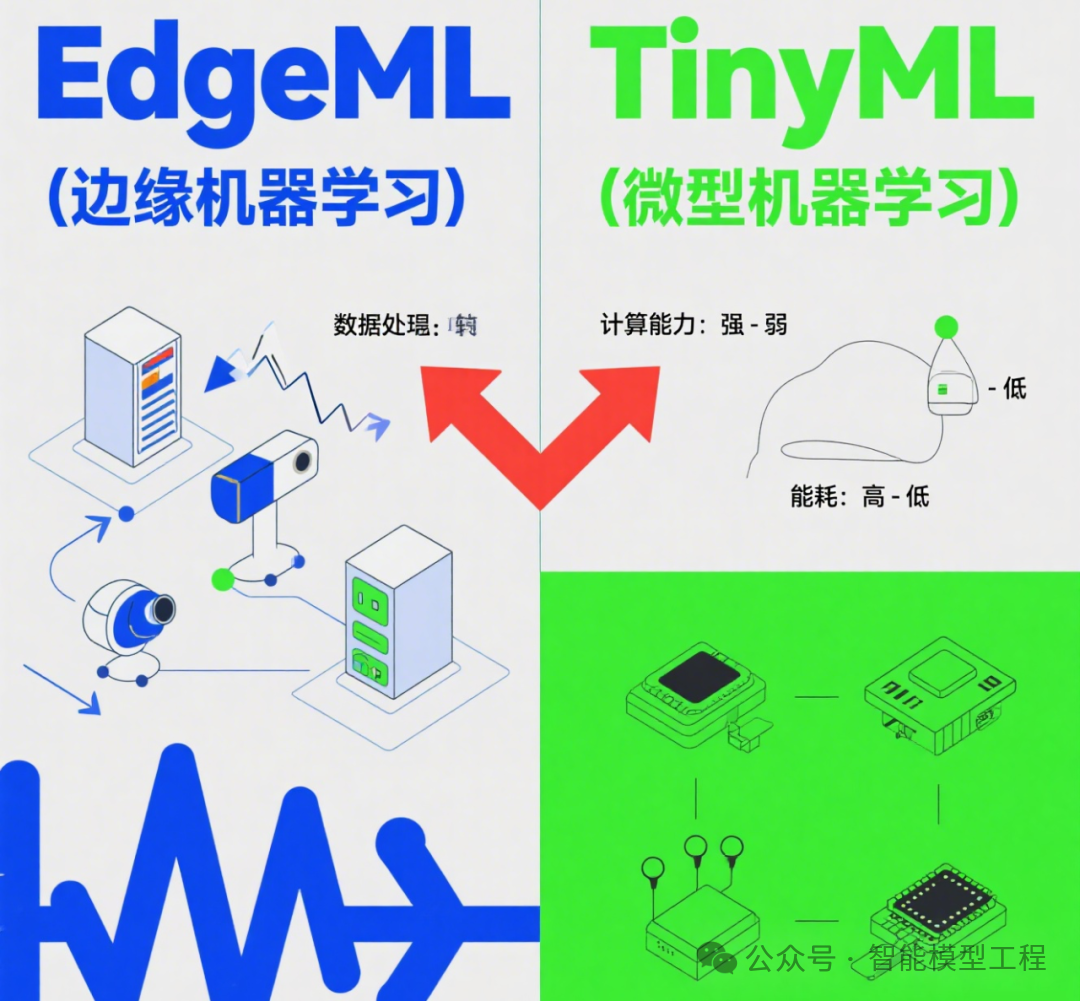
This brings the following common advantages:
- Low Latency Real-time response without network round trips.
- Privacy Protection Sensitive data (such as audio, video, health data) does not need to leave the device.
- Bandwidth Efficiency Reduces the amount of data that needs to be uploaded to the cloud (only upload results or metadata).
- Offline Operation Can still function when network connectivity is unstable or unavailable.
- Reliability Reduces dependence on the availability of cloud services.
- Scalability Distributed computing alleviates the burden on the cloud.
However, their focus and application scenarios differ. Below is a comparison table:
Table 1: Comparison of EdgeML and TinyML
| Comparison Item | EdgeML (Edge Machine Learning) | TinyML (Tiny Machine Learning) |
|---|---|---|
| Resource Constraints of Target Devices | Resource-constrained but relatively “powerful” edge devices | Extremely resource-constrained microcontroller unit devices |
| Typical Platforms | Edge gateways, industrial PCs, powerful single-board computers (such as Raspberry Pi 4, NVIDIA Jetson Nano/TX2/Xavier, Google Coral Dev Board), smartphones, augmented reality/virtual reality glasses, some smart cameras | Ultra-low power MCUs (such as Arm Cortex-M series – M0, M3, M4, M7, M33; ESP32; some RISC-V chips) |
| Resource Characteristics | – Processor: Typically has a relatively powerful CPU, possibly equipped with a GPU or NPU (Neural Processing Unit, such as Google Edge TPU)– Memory: Typically hundreds of MB to several GB of RAM.– Storage: GB level.– Power Consumption: Relatively high (watt level), usually has continuous power or a large battery.– Operating System: Typically runs a full operating system (such as Linux, Android, Windows IoT). | – Processor: Typically only low-power CPU (MHz level clock frequency), no dedicated GPU/NPU.– Memory: KB level (usually < 1MB, even < 256KB) of RAM and Flash. This is the core limitation.– Storage: KB to MB level Flash.– Power Consumption: Extremely low power (micro-watt to milli-watt level), designed to run for months or even years on button batteries or energy harvesting.– Operating System: Typically no operating system (Bare Metal) or runs a real-time operating system (RTOS), such as FreeRTOS, Zephyr. |
| Model Optimization | Typically employs model compression, quantization, and other techniques to optimize models for efficient operation on edge devices. | In addition to model compression and quantization, further optimization is needed to fit the constraints of microcontrollers, such as using lightweight neural network architectures. |
| Model Complexity | Can run relatively complex models, with model sizes ranging from hundreds of KB to tens of MB. | Model sizes must be compressed to tens of KB or even a few KB; almost entirely rely on model quantization (especially 8-bit, even 4-bit or binarization), model pruning, and selecting extremely streamlined architectures (such as micro CNNs, decision trees, ultra-small Transformer variants). |
| Technical Challenges | Optimizing model performance and efficiency under limited computing power and power consumption (model compression, quantization, pruning, knowledge distillation), and utilizing available hardware accelerators (such as NPU). | Models must run on KB-level memory and MHz-level CPUs; require specialized, highly optimized inference engines (such as TensorFlow Lite Micro, MicroTVM, CMSIS-NN); typically can only perform very specific, singular tasks (such as keyword detection, simple anomaly detection, gesture recognition). |
| Typical Application Scenarios | – Smart cameras (real-time face recognition, object detection);– Industrial automation (machine vision quality inspection, predictive maintenance);– Smart retail (customer behavior analysis, inventory management);– Augmented reality/virtual reality (localized gesture interaction, object tracking);– Internet of Vehicles (assisted driving features, driver state monitoring);– Smartphones (local voice assistants, photo processing) | – Always-on keyword wake-up (“Hey Siri”, “OK Google”);– Wearable devices (heart rate anomaly detection, simple gesture recognition);– Smart sensors (vibration/sound anomaly detection in predictive maintenance, environmental monitoring);– Ultra-low power smart home devices (voice-controlled switches, presence sensing);– Implantable medical devices (heart rhythm monitoring and early warning);– Agricultural sensors (soil moisture/nutrient prediction). |
| Development Toolchain and Ecosystem | Closer to traditional ML development processes; can use more feature-rich frameworks (such as TensorFlow Lite, PyTorch Mobile, ONNX Runtime), usually supporting Python/C++; can leverage SDKs provided by hardware vendors (such as NVIDIA TensorRT, Intel OpenVINO, Qualcomm SNPE) for hardware acceleration optimization; debugging and deployment are relatively convenient. | Requires extremely specialized, MCU-optimized toolchains; main framework: TensorFlow Lite Micro; development usually involves training and quantizing models on resource-rich machines (PCs) and then cross-compiling them into binaries that can run on MCUs; debugging is challenging (memory leaks, stack overflows are fatal issues in KB-level memory); requires a deep understanding of underlying hardware and embedded systems. |
Summary:
- EdgeML: A broad application of edge computing in ML. It focuses on deploying and optimizing ML models on resource-constrained but capable devices (gateways, industrial computers, powerful single-board computers, smartphones) close to the data source. The goal is to achieve practical ML functionality under resource, latency, and privacy constraints.
- TinyML: An extreme subset of EdgeML. It focuses on implementing ML inference on extremely resource-poor, ultra-low power edge devices (MCUs). Its core challenge is to break through the limits of KB-level memory and MHz-level CPUs, making machine learning possible on the smallest embedded devices. TinyML is the “last centimeter” or “front line” of edge intelligence.