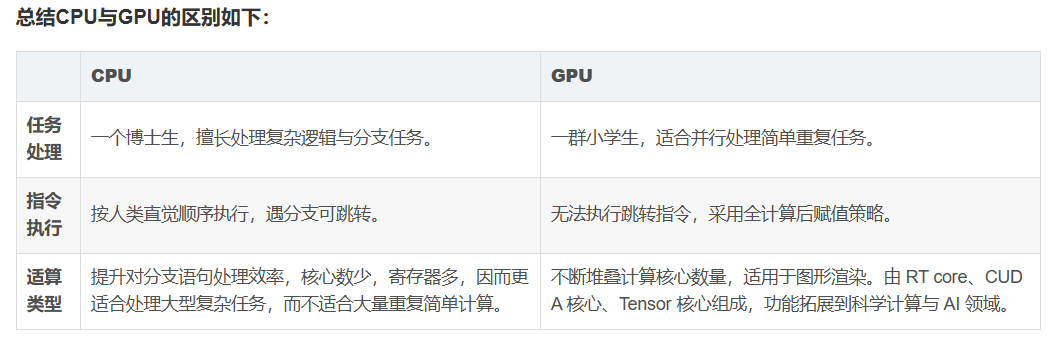
Since the birth of computers, the famous von Neumann architecture has been adopted.This is an architecture centered around computation and storage, with the CPU serving as the processing unit responsible for performing various arithmetic and logical calculations. The memory (RAM) and hard drive (external storage) are responsible for storing data and interacting with the CPU.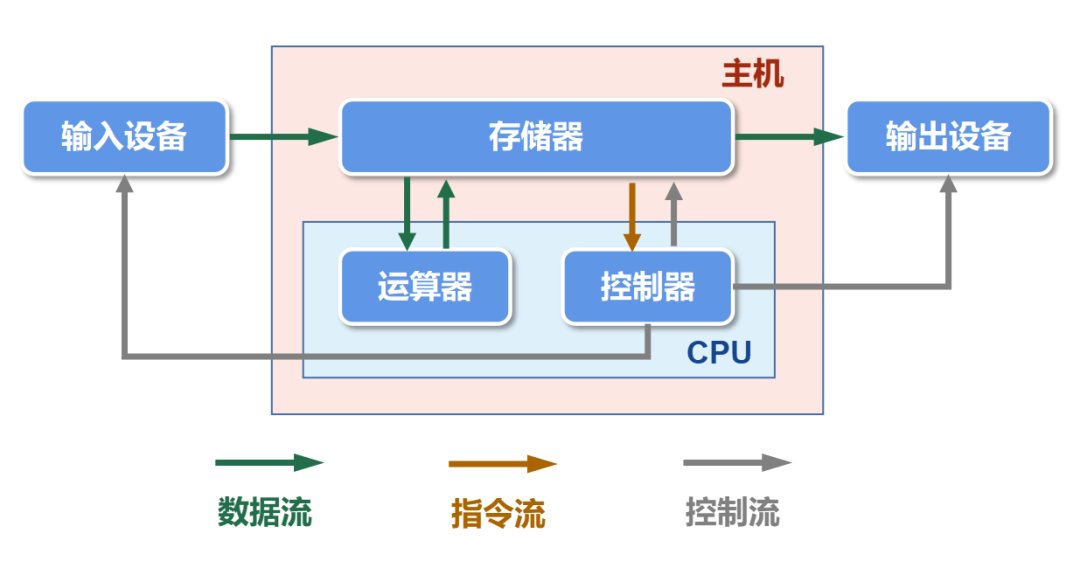 Von Neumann ArchitectureCPU (central processing unit) consists mainly of an arithmetic logic unit (ALU), control unit (CU), registers, cache, and the buses for data, control, and status communication between them.As multimedia graphics software such as gaming and 3D design developed, the workload for the CPU increased significantly and became more complex. The CPU could no longer handle it alone, leading to the creation of the GPU, which specializes in image and graphics-related computations to relieve the CPU’s burden.GPU (Graphics Processing Units) was initially not designed for intelligent computing but for rendering graphics in large online games. The principle of graphics processing involves calculating the coordinates of every line segment’s midpoint through numerous computing units simultaneously. The most basic type of computation in artificial intelligence is matrix operations, which are similar to graphics computations, thus making GPUs suitable for AI applications.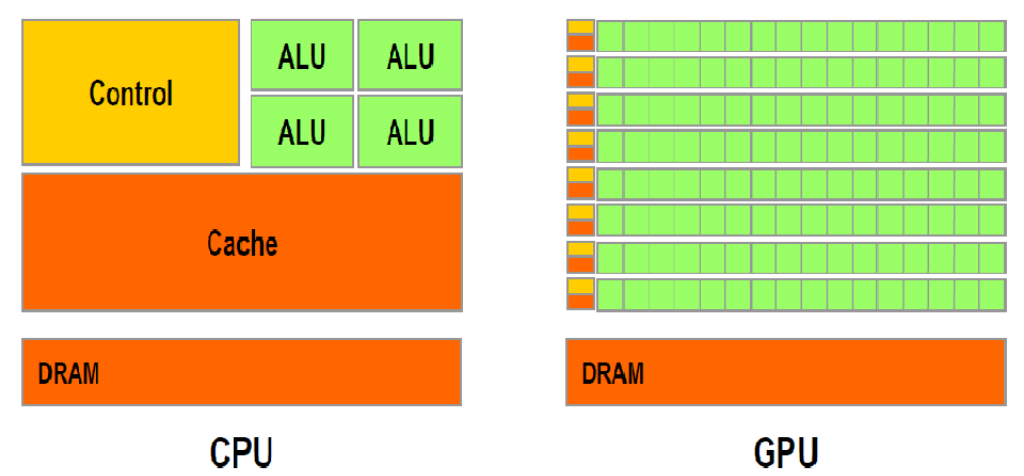
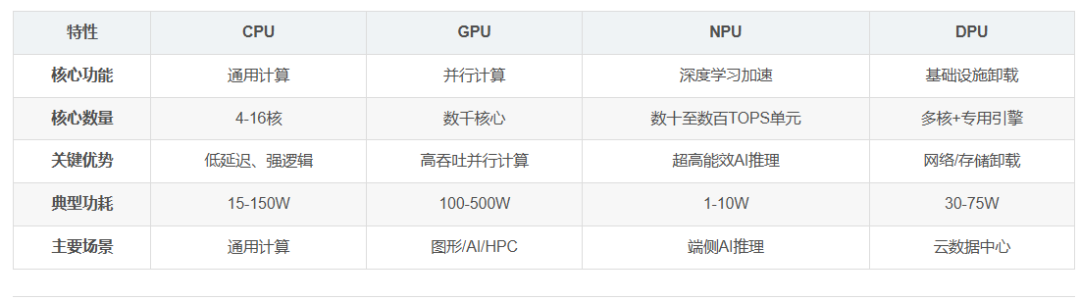
NPU (Neural Processing Units) is a processor specifically designed for artificial intelligence (AI) computations, primarily used for efficiently executing operations related to neural networks (such as matrix multiplication, convolution, activation functions, etc.). Compared to traditional CPUs and GPUs, NPUs have advantages in energy efficiency and computation speed, making them particularly suitable for mobile devices, edge computing, and embedded AI scenarios.
Domestic chips like Huawei’s Ascend 910 series are high-performance NPUs independently developed by Huawei, leading in comprehensive performance among domestic AI chips and demonstrating significant advantages in various industry applications.
TPU (Tensor Processing Unit) is a tensor processing unit launched by Google in 2016, primarily used for low-precision computations. This application-specific integrated circuit (ASIC) designed for machine learning achieves breakthroughs in performance, energy efficiency, and scalability through deep optimization of hardware and algorithms, becoming a crucial engine driving the evolution of AI technology.
DPU (Data Processing Unit) is a processor designed specifically for data centers, aimed at addressing the efficiency bottlenecks of traditional CPUs when handling network, storage, and security infrastructure tasks. As the “third main chip” following CPUs and GPUs, DPUs utilize hardware acceleration and task offloading to free up CPU computing power to support core business applications. The main roles of DPUs in artificial intelligence computing include:
- AI Inference Acceleration: DPUs support lightweight model inference, such as real-time object detection in smart cameras.
- Scientific Computing: Optimizing inter-node data transmission through RDMA technology to enhance distributed computing efficiency.
 “Knowledge Planet of the Little Chariot Action Group”————————————————

Recommended Reading:
About the Author
Using v4l2loopback to implement a virtual camera
Basics of Camera and Some Fundamental Concepts
Recommended Learning Path for Android Camera
Android Camera Development Series (Full of Practical Content)
Camera HAL | How to Learn a New Platform
An Article to Help You Understand the Latest Android Camera Framework
After Completing the Camera Introductory Course Video, Can You Start Job Hunting?