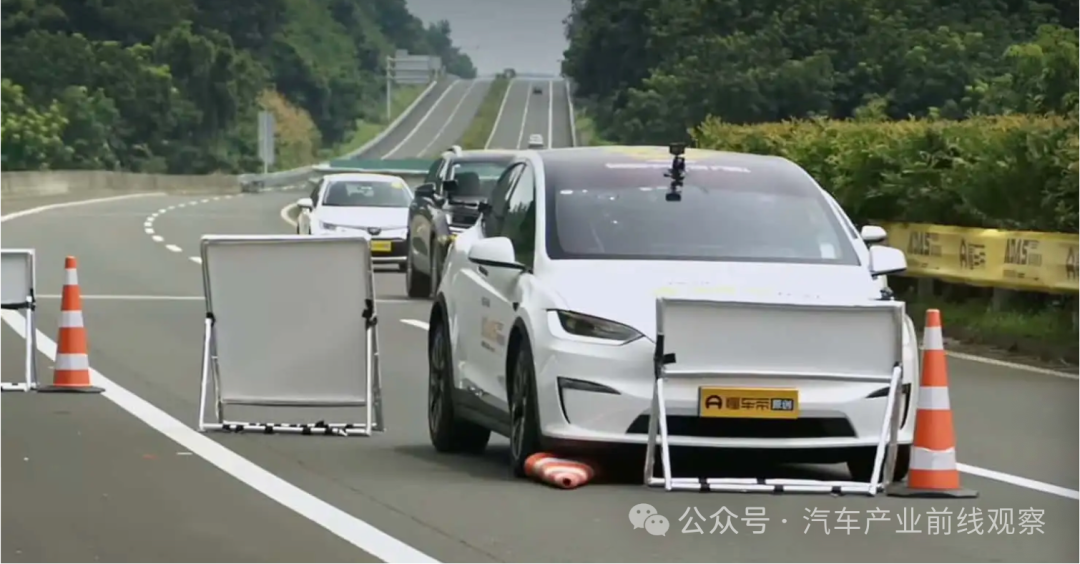
When the automotive platform Dongchedi, owned by ByteDance, collaborated with CCTV to close an entire highway and put 36 mainstream models’ Advanced Driver Assistance Systems (ADAS) through a series of nearly “find-the-flaw” real-world scenario tests, the entire industry held its breath for the results. This test, referred to in the industry as the “most rigorous high-speed trial,” not only allowed consumers to see the true level of current autonomous driving assistance technology but also unexpectedly revealed the strength gaps between different technical routes.
Six Realistic and “Brutal” Scenarios
To simulate the most realistic high-speed crises, the testing team designed scenarios that were truly “heart-stopping.” In the “sudden lane change” segment, the test vehicle was traveling at 100 km/h when a vehicle from the adjacent lane suddenly cut into its path, leaving the system less than 2 seconds to react; in the “dark construction zone” scenario, a stationary truck on a simulated unlit road only had a faint warning light, testing the system’s recognition ability in low-light conditions; during the “forced lane change” segment, the test vehicle was maliciously cut off twice, with the steering wheel frequently disturbed; and the “wild boar attack” simulated a wild animal crossing the road with a dummy moving at 30 km/h, replicating sudden situations on mountainous highways. Additionally, while most vehicles passed the standard automatic emergency braking tests, several cars experienced late braking due to recognition delays in the “continuous obstacles” scenario.
These scenarios are not imaginary—according to data from the Ministry of Public Security, sudden lane changes and construction zone accidents account for over 60% of highway incidents, while wild animal intrusions lead to over a thousand accidents annually on mountainous highways. Therefore, this test conducted by Dongchedi and CCTV has been deemed by the industry as “the most valuable reference for practical exercises.”
Tesla’s Comeback: Visual Solution Defeats LiDAR Army
The test results surprised many technical experts: Tesla’s visual solution, long regarded as a “weakness” by Chinese brands, surprisingly topped the charts with a pass rate of 5 out of 6, far exceeding Chinese competitors equipped with LiDAR.
The Model 3 and Model X demonstrated remarkable stability in five tests: when faced with a sudden lane change, the system could complete recognition and smoothly decelerate within 1.5 seconds; during forced lane changes, only slight corrections to the steering wheel were needed to maintain lane position; the automatic emergency braking segment led the field with a response time of 0.8 seconds. Its only mistakes occurred during the “wild boar attack” (Model 3) and the “dark construction zone” (Model X)—the former failed to capture the unconventional shape of the dummy due to camera limitations during rapid movement, while the latter misjudged the stationary truck’s status in extremely dark conditions.
In contrast, the performance of Chinese brands was somewhat lacking. Although popular models like the Xpeng G6 and BYD Z9GT EV are equipped with LiDAR, they only passed three tests. For instance, the Xpeng G6 deviated briefly from its lane during the “forced lane change” due to delays in data from the radar and camera recognition; the BYD Z9GT EV recognized the truck in the construction zone, but its algorithm was too slow in prioritizing “stationary obstacles,” ultimately passing just 30 cm from the obstacle. The failures of the AITO M9 and Zhijie R7 were more common: both experienced system overloads during the “continuous lane changes,” briefly exiting the assistance state.
The Technical Route Debate Heats Up
This test has pushed the “route debate” of autonomous driving to the forefront. The “LiDAR + vision” solution commonly adopted by Chinese brands was once considered a “safe choice” for complex road conditions—LiDAR accurately measures distances with laser beams, theoretically making it more reliable than vision-based solutions, especially in poorly lit or difficult object recognition scenarios. However, Tesla’s ability to surpass this with just eight cameras and neural network algorithms has led many to reassess the essence of the technology.
“LiDAR is not a panacea,” analyzed autonomous driving engineer Li Zhe, “the fusion algorithms of LiDAR data and visual data used by Chinese brands still need optimization, and sometimes can lead to decision delays due to ‘information overload.’ In contrast, Tesla’s pure visual solution has matured significantly over more than a decade of iterations, with its algorithms demonstrating strong predictive capabilities in high-speed scenarios.”
However, the industry also pointed out that this test did not involve adverse weather conditions such as heavy rain or fog—areas where LiDAR excels. The China Automotive Engineering Research Institute previously conducted comparative tests: in heavy rain, LiDAR’s obstacle recognition accuracy was 40% higher than that of vision solutions, which is also the core reason why companies like Xpeng and Huawei insist on “multi-sensor fusion.”
Musk’s “Data Paradox” and Industry Reflection
Tesla CEO Elon Musk’s response on social media added another layer to the discussion: “Due to data export regulations, we do not have local training data from China, yet we still managed to take first place.” This statement directly addresses the core contradiction of autonomous driving—the balance between data localization and algorithm generalization capabilities.
It is reported that Tesla generates massive virtual scenarios through global road simulators and combines them with real-world data from its California testing grounds to train its models, compensating for the lack of local data in China. This “feeding algorithms with virtual scenarios” model, while avoiding the challenges of data export, has also been criticized for being “disconnected from the realities of Chinese road conditions.” As autonomous driving expert Wang Jin stated, “Virtual scenarios cannot fully replicate the unique risks of Chinese highways, such as ‘electric bicycles intruding’ and ‘trucks shedding cargo,’ and Tesla’s victory may only apply to standardized scenarios.”
It is also noteworthy that the test clearly indicated that all participating models were L2 systems—this means that regardless of performance, drivers must keep their hands on the steering wheel. In recent years, accidents caused by mistakenly treating L2 as “autonomous driving” have been frequent, and even Tesla, which performed best in this test, still required driver intervention in extreme scenarios. This serves as a reminder to the industry: alongside technological advancements, user education and clear safety boundaries are equally important.
As Tesla expands its Robotaxi pilot in Austin, discussions about “when will unregulated FSD be implemented” are becoming increasingly heated in China. However, from this test, it is clear that whether through vision or LiDAR routes, both still need to overcome challenges such as “extreme scenario recognition” and “multi-sensor collaboration.” Perhaps, as one testing engineer said, “True autonomous driving is not about scoring high in closed environments, but about allowing drivers to safely let go of the steering wheel during every unexpected ‘wild boar moment.'” This test of 36 cars, rather than being a technical competition, serves as a “wake-up call” for the entire industry—there are no eternal winners in the race for autonomous driving, only a continuous respect for safety and real-world scenarios.