·Click the blue text to follow us / NEW TERM

The full text is 4000 words, requiring 20 minutes for in-depth reading.
In today’s increasingly frequent international trade, cross-border payment has become a key link in the smooth flow of the global economy.
In previous articles, we mentioned the application of blockchain, consensus mechanisms, and smart contracts in cross-border payments. Today, we will focus on a deep understanding of cryptographic algorithms.
In the modern digital world, cryptographic algorithms play the role of guardians, transforming readable information into unreadable ciphertext through complex mathematical rules, ensuring the confidentiality and integrity of data during transmission and storage.
Definition and Categories of Cryptographic Algorithms
✦
In blockchain technology, cryptographic algorithms are the core pillar of the entire system, providing security guarantees in a decentralized environment.
Depending on their working mechanisms and application scenarios, blockchain cryptographic algorithms can be mainly divided into three categories: Symmetric encryption, asymmetric encryption, and hash algorithms, each playing an irreplaceable role in the blockchain ecosystem.
Three Main Categories:
⭐️Symmetric Encryption Algorithms:Symmetric encryption algorithms (such as AES, DES) use a single shared key for encryption and decryption operations.The sender and receiver must securely exchange the same key in advance to achieve confidential communication.
The main advantage of this type of algorithm is its fast processing speed and high computational efficiency, making it particularly suitable for large data encryption scenarios.
For example, when the blockchain needs to encrypt and store massive transaction data, AES-256 (with a key length of 256 bits) can provide military-grade security.
However, its fatal weakness lies in the key distribution problem—how participants securely exchange keys in an open blockchain network becomes a significant challenge.
⭐️Asymmetric Encryption Algorithms (such as RSA, ECC) use a key pair mechanism: one is a public key that can be openly distributed, and the other is a private key that must be kept strictly confidential. Content encrypted with the public key can only be decrypted by the corresponding private key, and vice versa.
This design revolutionarily solves the key distribution problem, allowing strangers to communicate securely over insecure networks.
Although its computational efficiency is not as high as symmetric encryption (the encryption speed of RSA-2048 is only 1/1000 of AES-128), it is indispensable in scenarios such as digital signatures and initial key exchanges.
⭐️Hash Algorithms (such as SHA-256, Keccak) are the most frequently used cryptographic tools in blockchain, converting inputs of arbitrary length into fixed-length outputs (such as 256 bits).
Unlike the previous two types of algorithms, hashing is a one-way process—original data cannot be restored from the hash value.
An excellent blockchain hash algorithm must possess four key characteristics: fixed output length (the output length is consistent regardless of input size), irreversibility (it is impossible to derive the original data from the hash value), input sensitivity (a slight change leads to a dramatic result change), and collision resistance (it is difficult to find two different inputs that produce the same output).
Comparison of Major Cryptographic Algorithms in Blockchain

In practical blockchain applications, these three algorithms usually work together to form a hybrid encryption system, leveraging their respective advantages. For example, in a blockchain transaction:
✴️Transaction Initiation: Alice uses SHA-256 to generate a digital fingerprint (hash value) of the transaction information.
✴️Signature Generation: Alice encrypts this fingerprint with her private key, forming a digital signature.
✴️Session Encryption: The system generates a temporary symmetric key (such as AES-128) to encrypt the complete transaction data.
✴️Key Protection: Alice encrypts the symmetric key from the previous step with Bob’s public key, forming a digital envelope.
✴️Transaction Broadcasting: The encrypted data + digital signature + digital envelope are combined and broadcast to the blockchain network.
✴️Receiving Processing: Bob uses his private key to decrypt the symmetric key → decrypt the transaction data → verify the signature using Alice’s public key.
This combination strategy perfectly balances security and efficiency: asymmetric encryption ensures secure key exchange, symmetric encryption handles large data loads, and hash algorithms guarantee data integrity.
It is this precise collaboration that allows blockchain networks like Bitcoin to process trillion-dollar transactions in a public environment without being tampered with.
In-depth Analysis of Asymmetric Encryption Algorithms
✦
Cooperative Mechanism of Public Key and Private Key
The core of asymmetric encryption lies in the irreversible relationship of the key pair—the public key is derived from the private key, but it is computationally impossible to reverse this. This mechanism creates two revolutionary applications:
Public Key Encryption, Private Key Decryption: Anyone can encrypt information using the recipient’s public key, but only the private key holder can decrypt it. This solves the problem of information confidentiality without the need to exchange keys in advance.
Private Key Signing, Public Key Verification:: The private key holder generates a signature for the information, and anyone can verify the authenticity of the signature using the public key. This solves the problems of identity authentication and non-repudiation.
Imagine viewing the public key as a replicable safe and the private key as the unique key.
Anyone can put things into the safe (public key encryption), but only the key holder can open it (private key decryption).
Conversely, the key holder can embed a security seal in a document (private key signing), and others can verify its authenticity by comparing it with the publicly available seal sample (public key).
RSA Algorithm: A Classic Asymmetric Implementation
RSA (named after Rivest-Shamir-Adleman) is the earliest commercially used asymmetric algorithm, and its security is based on the difficulty of factoring large integers—it is computationally infeasible to factor the product of two large prime numbers back into the original primes.
2.2.1 Key Generation Process
1️⃣ Select large primes: randomly choose two different prime numbers p and q, each greater than 1024 bits (e.g., p=61, q=53).
2️⃣ Calculate modulus: n = p × q = 61×53 = 3233
3️⃣ Euler’s function: φ(n) = (p-1)×(q-1) = 60×52 = 3120
4️⃣ Choose public key exponent: select e such that 1<e<φ(n) and e is coprime to φ(n) (e.g., e=17)
5️⃣ Calculate private key exponent: find d such that e×d ≡ 1 mod φ(n), i.e., 17×d mod 3120=1 (d=2753)
Finally, we obtain:
Public Key: (e,n) = (17, 3233)
Private Key: (d,n) = (2753, 3233)
2.2.2 Encryption and Decryption Process
Encrypting plaintext: for plaintext m (where m<n), compute ciphertext c = mᵉ mod n e.g., if m=65, then c = 65¹⁷ mod 3233 = 2790
Decrypting ciphertext: for ciphertext c, compute m = cᵈ mod n2790²⁷⁵³ mod 3233 = 65 (recover original text)
2.2.3 Digital Signature Application
RSA also supports digital signatures, with the following process:
Signature Generation: for the message hash value h, compute s = hᵈ mod n
Signature Verification: the recipient computes h’ = sᵉ mod n and compares it with the original hash.
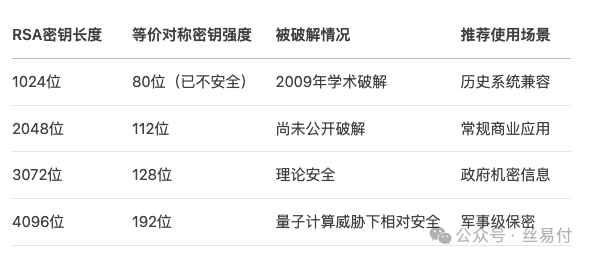
Relationship Between RSA Key Length and Security
ECC Algorithm: A New Generation Lightweight Solution
Elliptic Curve Cryptography (ECC) is a new generation asymmetric algorithm whose security is based on the elliptic curve discrete logarithm problem. Compared to RSA, ECC has shorter keys and faster computations for the same level of security.
2.3.1 Mathematical Foundation of Elliptic Curves
On finite fields, an elliptic curve is defined as:y² = x³ + ax + b (mod p) where a and b are parameters, and p is a large prime. The points on the curve form an Abelian group, and the discrete logarithm problem is stated as: Given point G and Q=kG, it is computationally infeasible to find integer k (where k is the private key, and Q is the public key).
2.3.2 Key Generation and Encryption
1️⃣ Private key selection: random integer d ∈ [1, n-1] (n is the order of the base point G)
2️⃣ Public key calculation: Q = d×G (G is the public base point)
3️⃣ Encryption process:
Select random k, compute C₁ = k×G
Compute C₂ = M + k×Q (M is the message mapping point)
The ciphertext is (C₁, C₂)
4️⃣ Decryption process: M = C₂ – d×C₁
Imagine viewing the elliptic curve as a Rubik’s cube, the public key Q is the scrambled state of the cube (after d turns), and the private key d is the sequence of turns.
It is easy to go from the initial state (G) to Q, but it is exceptionally difficult to deduce d from Q—this is the security basis of ECC.

ECC vs RSA Performance Comparison
|
Key Length |
ECC-256 bits ≈ RSA-3072 bits security |
|
Signature Speed |
ECC is over 20 times faster than RSA |
|
Bandwidth Savings |
ECC signature size is less than 1/10 of RSA |
|
Energy Consumption Advantage |
Using ECC can reduce encryption energy consumption by 90% for IoT devices |
The Core Value of Cryptographic Algorithms
✦
Cryptographic technology creates four major values:
Identity Trustworthiness:
Digital certificates bind entities to public keys.
CA signatures prevent identity forgery.
Transaction Integrity:
Transaction hashes ensure content has not been tampered with.
ECDSA signatures prove B’s true intent.
Fund Security:
Multi-signature controls lock funds.
Smart contracts automatically execute settlements.
Process Transparency:
Transaction hashes can be checked on-chain.
Settlement proofs are non-repudiable.

Blockchain Cryptographic System: Multi-Component Collaboration
✦
The integration of cryptographic algorithms and block structure
The chain structure of blockchain is essentially a perfect combination of hash algorithms and asymmetric encryption. Each block contains the following key cryptographic elements:
✴️ Block Hash—The result of running SHA-256 on the block header (including transaction Merkle root, timestamp, difficulty target, etc.), serving as a unique identifier;
✴️ Previous Block Hash—The hash value of the previous block embedded to form an immutable link;
✴️ Transaction Merkle Root—The root value of the binary tree of all transaction hashes, used for efficient verification of transaction existence;
✴️ Miner Signature—The block generator signs the block header with their private key, proving their workload.
✴️ Transaction Signature—Each transaction includes the sender’s digital signature.
Merkle Trees and Hash Algorithms
Merkle trees are the core data structure for efficient verification in blockchain, entirely relying on hash algorithms.
✴️ Each transaction is independently hashed (e.g., TX1→H1, TX2→H2)
✴️ Adjacent hashes are concatenated and hashed again (H1+H2→H12)
✴️ This process is recursively continued until a unique root hash (Merkle Root) is generated.
When a user needs to verify whether a transaction (e.g., TX2) is in a block, they only need to provide the verification path (H1, H34, etc.) instead of the complete transaction list.
Nodes can confirm whether the root hash matches with a small number of hash calculations.
As mentioned in previous articles,Merkle trees are like a multi-layer index system in a library. The root hash is equivalent to the total directory number, the intermediate nodes are partition directories, and the leaf nodes are specific book locations. To verify the existence of a specific book, there is no need to traverse the entire library; just check the partition directory along the path.
Cryptographic Verification in Smart Contracts
Smart contracts, as automatically executed on-chain programs, also rely on cryptographic technology for security:
✴️ Contract Deployment Signature—Developers sign the contract code with their private key to ensure trusted sources.
✴️ Call Permission Control—Contract functions can be restricted to specific public key addresses.
✴️ Oracle Data Verification—External data inputs must include the provider’s digital signature.
✴️ State Hash Storage—A new hash is generated after the contract state changes to prevent tampering with historical records.

Application of Cryptographic Algorithms in Cross-Border Payments
✦

Blockchain technology reconstructs the cross-border payment process through cryptographic algorithms, achieving efficient point-to-point transfers. The following is an example of corporate cross-border B2B payments, demonstrating the core role of asymmetric encryption.
🎯 Participants
Chinese Exporter A (Recipient)
American Importer B (Payer)
Bank of China (Issuing Bank)
American Bank (Clearing Bank)
Blockchain Payment Network (e.g., Ripple)
🕹️ Step 1: Identity Registration and Certificate Issuance
Exporter A submits business license and other KYC materials to the certification center ➡️ The certification center verifies the authenticity of the materials
➡️ The certification center issues a digital certificate to exporter A (containing A’s public key + CA signature) ➡️ Exporter A registers the certificate on-chain
Identity registration and certificate issuance.
🕹️ Step 2: Initiate Payment Request
American importer B needs to pay $1 million to A:
▶︎ B creates a transaction on the blockchain.
▶︎Generate transaction hash using SHA-256: tx_hash = SHA256(transaction content)
▶︎ Sign with B’s private key: signature = ECDSA_sign(B_privkey, tx_hash)
▶︎ Broadcast the signed transaction to the blockchain network
🕹️ Step 3: Interbank Clearing
After the blockchain network verifies the validity of the transaction signature:
▶︎ American Bank: verifies B’s account balance and locks $1 million in assets;
▶︎Blockchain: generates a fund lock certificate (including multiple signatures from the bank);
▶︎ Bank of China: after verifying the authenticity of the certificate, immediately pays A the equivalent amount in RMB (after deducting fees).
🕹️ Step 4: Fund Settlement and Clearing
After the blockchain network verifies the validity of the transaction signature:
▶︎ American Bank completes dollar settlement through the Fedwire system
▶︎Bank of China confirms the completion of RMB settlement;
▶︎ Both banks submit settlement proofs on the blockchain (digital signatures);
▶︎ Smart contracts automatically release locked funds and update account balances.

The cryptographic algorithms in blockchain form a trinity of security: Asymmetric encryption establishes identity and trust, hash algorithms ensure data integrity, and symmetric encryption enhances processing efficiency. This synergy allows blockchain to achieve:
🔆 Unforgeable identity authentication (public key as identity)
🔆 Immutable transaction records (hash chain links)
🔆 Non-repudiable transaction proofs (digital signatures)
🔆 Efficient data processing (hybrid encryption strategy)
As technology evolves, blockchain cryptographic algorithms face new challenges and opportunities. Quantum computers threaten existing asymmetric algorithms (e.g., Shor’s algorithm can break RSA/ECC). Lattice-based crypto and multivariate cryptography are being tested for application in blockchain.
Zero-knowledge proofs (ZKP) validate transaction validity while protecting privacy. Blockchains like Zcash have achieved complete concealment of transaction amounts and addresses, while Ethereum’s zk-Rollup technology has increased throughput to over 4000 TPS.
Moreover, homomorphic encryption allows direct computation on encrypted data. In supply chain finance, banks can verify the authenticity of accounts receivable without viewing specific transaction details.
Distributed identity (DID) systems based on asymmetric encryption enable users to manage identities across different chains uniformly, aggregating cross-chain identities, such as Microsoft’s ION project using the Bitcoin blockchain to store DID anchor points.
The future blockchain cryptographic system will resemble a cluster of intelligent safes—each safe (blockchain application) has an independent security mechanism, but users control the master key (private key) uniformly. Key fragments can be securely stored in shares (threshold signatures), allowing recovery even if some are lost (multi-signature backup). Safes are connected through encrypted tunnels (cross-chain protocols), forming a value internet that is both securely isolated and interconnected.


Like
Collect
Share