Why Do We Need AI Chips?

Why Do We Need AI Chips?

Source: Tiger Says Chip Original Author: Tiger Says Chip This article introduces chips specifically designed for AI computation. In the context of the rapid development of artificial intelligence (AI), traditional general-purpose processors (such as CPUs) can no longer meet the growing computational demands. Therefore, AI chips have emerged as the core hardware driving the popularization … Read more


Turning Noise into Gold! The World’s First Thermodynamic Chip Tape-Out, AI Efficiency Soars by a Thousand Times

Turning Noise into Gold! The World's First Thermodynamic Chip Tape-Out, AI Efficiency Soars by a Thousand Times

1. The World’s First Thermodynamic Computing Chip is Here Normal Computing has announced the successful tape-out of the world’s first thermodynamic computing chip, CN101. This news has sent shockwaves through the tech industry. The CN101 is an ASIC chip designed specifically for AI/HPC data centers, fundamentally different from traditional silicon computing methods. It leverages thermodynamics … Read more

What is a DSP?

What is a DSP?

A DSP chip, or Digital Signal Processor, is a microprocessor specifically designed for fast processing of digital signals. It efficiently performs tasks such as signal acquisition, conversion, filtering, analysis, and synthesis through a specialized hardware architecture and instruction set, making it widely used in scenarios requiring real-time signal processing. 1. Core Features of DSP Chips … Read more

The Quadruple Impact on Edge AI Chips

The Quadruple Impact on Edge AI Chips

Abstract Can AI chips be made just with money? Necessary but not sufficient. Only when you are successful enough can you have a name and reputation. Why are there only a handful of global CPU and GPU companies, yet the wave of artificial intelligence has led to the emergence of so many AI chip companies … Read more

SparseLoRA: Accelerating Large Language Model Fine-Tuning Using Contextual Sparsity

SparseLoRA: Accelerating Large Language Model Fine-Tuning Using Contextual Sparsity

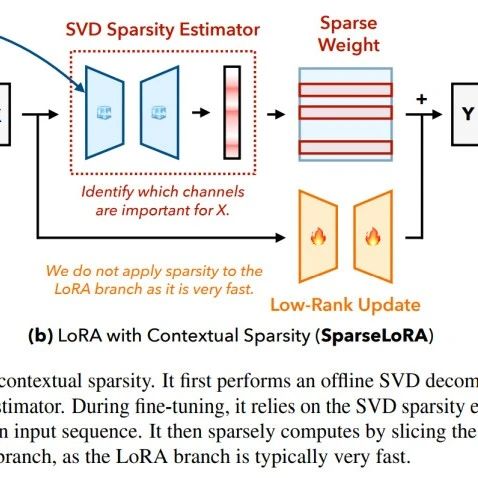
Source: ZHUAN ZHI This article is approximately 1000 words long and is recommended for a 5-minute read. This article presents SparseLoRA, a method to accelerate the fine-tuning of large language models through contextual sparsity. Fine-tuning large language models (LLMs) is often both computationally intensive and memory-consuming. While parameter-efficient fine-tuning methods such as QLoRA and DoRA … Read more

DAC’24: Implementation of Redundancy-Free Recommendation Model Training Based on Reusable-Aware Near-Memory Processing

DAC'24: Implementation of Redundancy-Free Recommendation Model Training Based on Reusable-Aware Near-Memory Processing

In recent years, recommendation systems have played an increasingly important role across various industries. Among them, the embedding layer of recommendation systems has become a performance bottleneck due to the large volume of data and irregular memory access patterns. Existing works utilize the data locality of the embedding layer to cache frequently accessed embedding vectors … Read more