What Are the Differences Between str and String in Rust?

What Are the Differences Between str and String in Rust?

In Rust, <span>str</span> and <span>String</span> are two core types for handling text data, and they have essential differences in memory management, ownership, and mutability. The table below summarizes their core differences for quick understanding: Feature <span>String</span> <span>str</span> (<span>&str</span>) Ownership Owns the data No ownership, it is a borrowed reference Mutability Mutable Immutable Storage Location Data … Read more

x-cmd pkg | oha – HTTP Load Testing Tool with a Graphical Interface for Easy Performance Analysis

x-cmd pkg | oha - HTTP Load Testing Tool with a Graphical Interface for Easy Performance Analysis

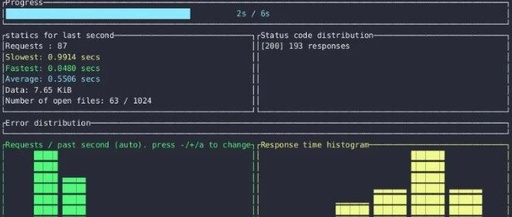
Please clickabove oh my x to follow this public accountIntroductionoha is a lightweight program designed to send load to web applications and features a real-time TUI inspired by rakyll/hey.This program is written in Rust, powered by tokio, and utilizes the beautiful TUI provided by ratatui.First-time UsersThis article demonstrates a quick installation and usage example of … Read more

Open Source Rust HTTP Performance Testing Tool – oha

Open Source Rust HTTP Performance Testing Tool - oha

Click the blue text above to follow “Yu Mo Zhi Yuan” Recommended Reading: 【Open Source】Green and Free Decompression Software! Check it out! – PeaZip Have you ever experienced this in your daily routine? Still using JMeter to painstakingly configure various parameters for testing interface performance? Looking at the complex graphical interface, don’t you feel exhausted? … Read more

Practicing Rust – Swapping Vowels

Practicing Rust - Swapping Vowels

Hi, everyone,This is the Practicing Rust column. Today, let’s look at a small case: swapping vowels. Question Given a string <span>s</span>, swap all the vowels in the string and return the resulting string. The vowels include <span>'a'</span>, <span>'e'</span>, <span>'i'</span>, <span>'o'</span>, <span>'u'</span>, <span>'A'</span>, <span>'E'</span>, <span>'I'</span>, <span>'O'</span>, <span>'U'</span>. Example: input: “hello” output: “holle” input: leetcode output: leotcede … Read more

Challenges in Developing a Screenshot Application with Tauri in Rust

Challenges in Developing a Screenshot Application with Tauri in Rust

Fullscreen on macOS If you are using <span>"fullscreen": true</span> on Windows or Linux, it might not be an issue. However, when it comes to the screenshot functionality, macOS tends to have unexpected behavior. As we discussed earlier, a screenshot application is essentially a transparent, always-on-top, and fullscreen application. Being always-on-top works fine on macOS. Transparency … Read more

Advanced Guide to Rust Optimization: Deep Dive into Reed-Solomon-SIMD and RS-SIMD Showdown

Advanced Guide to Rust Optimization: Deep Dive into Reed-Solomon-SIMD and RS-SIMD Showdown

Introduction and Advanced Background Building on the introductory guide, we have mastered the theory and basic API of RS codes. Now, we enter the advanced realm: the core of <span>reed-solomon-simd</span> lies in its modular design, allowing for custom optimizations through the Engine and Rate traits, perfectly suited for the erasure coding needs of distributed storage … Read more

Decoding Data Guardians: A Comprehensive Guide to Reed-Solomon-SIMD in Rust

Decoding Data Guardians: A Comprehensive Guide to Reed-Solomon-SIMD in Rust

Background and Introduction In the wave of digitalization, data reliability remains an eternal challenge. Reed-Solomon (RS) codes, as a classic forward error correction (FEC) technology, have become a cornerstone of storage and transmission systems since their introduction by Irving Reed and Gustave Solomon in 1960. They can recover lost data from redundancy and are widely … Read more

The Three Major Advantages of Rust: Performance, Safety, and Concurrency – Can You Refuse?

The Three Major Advantages of Rust: Performance, Safety, and Concurrency - Can You Refuse?

Why Learn Rust in 2025? According to developer survey data, Rust has entered the top 12 most widely used programming languages in the IT industry. The data shows that 10%-13% of software developers use Rust in their daily work. Notably, among those who are just starting to learn programming, this percentage even reaches 11%-18%. The … Read more

Popular Algorithm 100: 160. Intersection of Two Linked Lists

Popular Algorithm 100: 160. Intersection of Two Linked Lists

Popular Algorithm 100: 160. Intersection of Two Linked Lists Overview Given the head nodes of two singly linked lists, headA and headB, find and return the starting node where the two linked lists intersect. If there is no intersection, return null. The two linked lists intersect at node c1: The problem guarantees that there are … Read more

Introduction to Smart Pointers in Rust

Introduction to Smart Pointers in Rust

Smart pointers are a very core and powerful concept in Rust, involving memory safety management, and are deeply related to Rust’s ownership system, concurrency, recursive data structures, and more. In summary: In Rust, smart pointers are “pointers with additional functionalities” used to manage data on the heap, automatically implementing features such as deallocation, sharing, and … Read more