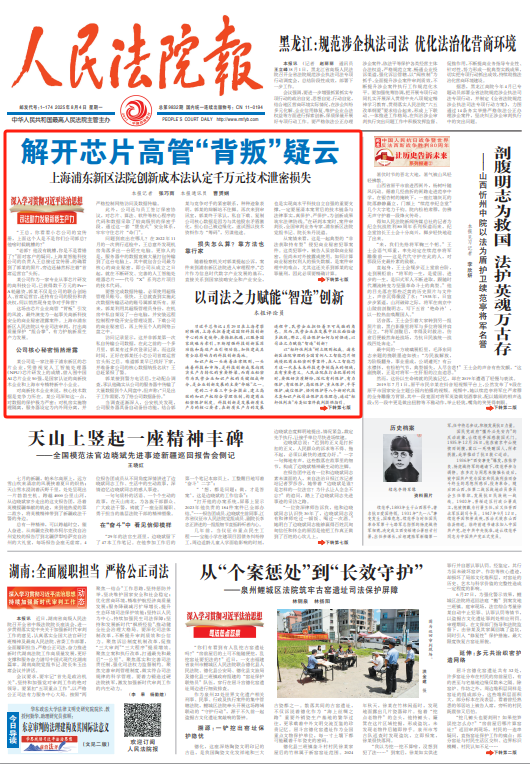
Unraveling the Betrayal of Chip Executives
The Shanghai Pudong New District Court innovatively recognized tens of millions in technology leakage losses using the cost method.
“Mr. Wang, take a look at the brochure from Xiaoxin Company. Is this person, Mr. Guo, from your company? When did he switch jobs?”
“Old Guo? He hasn’t switched jobs; did you misread it?” Facing the client’s question, Mr. Wang, the head of a smart technology company in Shanghai, took the brochure and indeed saw Mr. Guo’s photo, prominently labeled with the title “Chief Operating Officer.”
A certain company, a high-tech firm specializing in chip research and development, has secured tens of millions in Pre-A round financing. Mr. Guo is not only a co-founder and Chief Operating Officer of the company but also holds shares and voting rights. How did he quietly appear in the competitor’s camp?
This incident, triggered by the “betrayal” of chip company executives, ultimately evolved into a case concerning the leakage of commercial secrets related to high-tech security. The Shanghai Pudong New District People’s Court, through professional judicial adjudication, delivered a high-quality protective “combination punch,” effectively safeguarding the development of new productive forces.
Core secrets of the company leaked quietly
A certain company is a chip enterprise registered in Pudong New District, which, due to its achievements in the research and development of visual artificial intelligence processors (NPU), was shortlisted among the top 50 AI chip companies in China and is a nationally recognized high-tech enterprise as well as a specialized and innovative small and medium-sized enterprise in Shanghai.
For high-tech enterprises, core technical data is the source of competitiveness. This company is well aware of this and has implemented stringent data protection measures: physical isolation of the server room, separation of internal and external networks for servers, and strict control over network access and data transmission.
Additionally, the company has signed confidentiality agreements with employees and has adopted high-level confidentiality measures for the code and data of core programs such as chips, algorithms, and software. Through this “fortress-style” security system, the company firmly protects the “lifeblood” of its chips.
Where did the problem arise? During a routine inspection in November 2022, Mr. Wang unexpectedly discovered an unfamiliar computer in the corner of the server room. Even more astonishingly, a large amount of data from the server had been packaged and transferred to this computer, including the company’s most core commercial secrets, namely the technical code for the artificial intelligence processor chip project—codenamed “X” series, which has been continuously developed and improved since the company’s inception.
To complete the data transfer, a super administrator account must be used. Soon, Mr. Wang found that the account used for this data transfer activity belonged to Mr. Guo. It turned out that Mr. Guo had privately set up a computer in the server room using his super administrator identity and installed remote control software to bypass security management settings, downloading the company’s commercial secrets and then uploading them to his personal cloud storage.
Access records showed that this was not the first time Mr. Guo had privately transferred company data. In the month prior, he had multiple login records, coinciding with the time after he took on the title of Chief Operating Officer at Xiaoxin Company. Had Mr. Guo already found a new job and prepared to use the company’s core data as a bargaining chip? Mr. Wang quickly reported to the police.
After receiving a call from the police, Mr. Guo actively cooperated with the investigation, admitting that he had indeed transferred a large amount of data from the company’s server to his personal cloud storage, but claimed, “It was just for work purposes, to back up company data.”
As the investigation deepened, the police found that the company server had an automatic backup function. Combined with Mr. Guo’s close ties to competitors, various signs indicated that Mr. Guo’s defense was untenable. When he was brought back to the interrogation room, Mr. Guo finally admitted that he had privately downloaded and copied the company’s core data due to escalating conflicts with other shareholders, fearing he would be marginalized, and thus attempted to use the technical materials as “leverage” for other opportunities.
How to calculate the losses? It relies on methods and experts.
As the prosecution brought charges against Mr. Guo, the case entered the trial process at the Pudong New District Court. “Chips are the cornerstone of digital industry development in the information age, directly related to national strategic security and industrial safety, and are also an important support for achieving high-level technological self-reliance. We must clarify the technical chain and legal facts behind this case to truly protect and strictly safeguard innovation results,” said Zhu Dan, the presiding judge of the case and a national expert in adjudication, as well as the secretary of the party group and president of the Pudong New District Court.
From the case facts, this is a typical case of “illegal acquisition and possession” of commercial secrets. In such crimes, although the defendant steals commercial secrets, they have not yet disclosed or used them externally. How to calculate the loss amount for the rights holder of the commercial secret is a difficulty in the trial, especially since it also relates to Mr. Guo’s conviction and sentencing, thus requiring precise calculation.
According to relevant regulations, such cases are usually calculated based on the reasonable licensing fees for the commercial secrets. However, since the “X” series chip has not been licensed for external use, how can there be any licensing fees?
The collegial panel found that there are three solutions in judicial practice: the income method, the market method, and the cost method. However, since the sales time of the “X” series chip is short and the quantity is small, the relevant sales data does not meet the conditions for the income method; at the same time, the “X” series chip belongs to cutting-edge technology, and the market is still in its infancy, with no similar technology fully traded in the domestic market, making the market method also unsuitable.
Fortunately, the company can provide standardized and complete accounting vouchers and original documents for the R&D expenses related to the “X” series chip, and the collegial panel unanimously agreed that using the cost method to assess the value of the commercial secrets involved is feasible.
However, even so, the information involved in chip technology is highly specialized and complex, and defining R&D investment and making technical judgments at various stages of the R&D process pose significant challenges for judges. To achieve precise adjudication, in addition to the necessary legal knowledge, cross-disciplinary knowledge support is also required.
“Chip cases require the involvement of experts in the field.” The presiding judge of this case, Tao Ye, deputy head of the intellectual property trial division of the Pudong New District Court, mentioned. In 2021, the Standing Committee of the National People’s Congress authorized the Shanghai Municipal People’s Congress and its Standing Committee to formulate regulations for the Pudong New District. The “Several Provisions on Establishing a High-Level Intellectual Property Protection System in Pudong New District” was one of the first regulations issued, proposing innovative measures from multiple aspects such as intellectual property management, protection, and services. Among them, it is stipulated that individuals with specialized knowledge can be selected to serve as expert jurors in intellectual property cases.
This “expert juror system” helps to strengthen judges’ technical understanding. Upon invitation, Jiang Yinxin, a legal officer from a high-tech semiconductor company, participated in the case as an expert juror, providing support to the collegial panel and responding to the practical needs of legal protection for technological innovation with professional capabilities.
Calculating clearly, and understanding better
With the methodology established, how to operate specifically? Which expenses should be counted as R&D costs? How to distinguish between the R&D costs of core technology and other unrelated expenditures?
“The commercial secrets involved have not been disclosed by Mr. Guo, and the losses to the rights holder may not be as much as calculated by the cost method. Moreover, chip R&D includes multiple stages, and not all costs from every stage should be included in the assessment of commercial secrets,” expert juror Jiang Yinxin provided professional advice.
Generally speaking, chip R&D includes project pre-research, module R&D, chip tape-out, IP procurement, software development, firmware development, and intellectual property applications. After discussions with experts, the collegial panel cautiously assessed that only the investment related to “module R&D” is truly relevant to the commercial secrets involved.
This investment includes costs for human resources, material expenses, equipment depreciation, etc., while other unrelated costs were systematically excluded. At the same time, the “X” series chip contains multiple functional modules, of which only 2 modules were self-developed by the company and are considered technical secrets, while the other modules were procured, and the related procurement costs should also be deducted from the costs.
Regarding sentencing, the collegial panel believed that although Mr. Guo voluntarily surrendered, he claimed during the first interrogation that it was for the company’s data backup, which reflected a mindset of luck and eagerness to evade guilt, thus not constituting a voluntary surrender. However, he admitted to the criminal behavior in subsequent interrogations, which can be considered a confession and may warrant a lighter punishment.
However, during the trial, Tao Ye also noted that although Mr. Guo had left the company’s daily management, he still held shares and could exercise voting rights at shareholder meetings on significant company matters, which could lead to civil disputes and affect corporate governance, posing obstacles to new rounds of financing.
“Completing the sentence does not mean the problem is completely resolved.” For judges, it is not only necessary to make a fair judgment on the case itself but also to use judicial wisdom to help the parties find the best solution within the legal framework, maximizing the resolution of conflicts and repairing damages. Therefore, in addition to stopping and combating crime, Tao Ye also organized multiple mediations with his team to promote a comprehensive resolution of equity disputes between Mr. Guo and the company.
Ultimately, Mr. Guo signed a voluntary equity transfer agreement, paid economic compensation, and the company issued a letter of understanding, avoiding subsequent disputes, allowing the company to quickly shed its burdens and move forward with confidence.
Empowering more innovative enterprises with the wings of the rule of law
On the day of the trial, Mr. Guo stood in the defendant’s seat, deeply bowing his head: “I want to express my apologies to the company. Due to a lack of legal awareness and impulsiveness, I did something wrong, and my actions caused harm to the company. I sincerely apologize to the company, I am sorry.”
Ultimately, the court sentenced Mr. Guo to two years in prison, with a two-year probation, and a fine of 100,000 yuan.
Although the case has concluded, the issues raised point directly to the lifeblood of the industry. In the rapidly developing technological race, intangible assets such as algorithm models and source code have become the “core” of corporate competitiveness. Once this information is leaked, the loss is not just a technology but could destroy years of market layout accumulated by a company. How should the judiciary respond to this? How can it build a tangible defense for intangible assets?
The court’s trial must not only stand firm on legal principles but also keep pace with the forefront. The Pudong New District Court not only clarified the technical chain but also accurately determined the commercial secret value of the information involved, anchoring the company’s intangible assets under legal protection, delineating clear boundaries for the industry, and reflecting the judiciary’s deep understanding of technological innovation.
As one of the first pilot areas for commercial secret protection in the country, Pudong New District is also taking the lead at the institutional level. In March 2025, Pudong New District released guidelines for the protection of commercial secrets in three leading industries: integrated circuits, biomedicine, and artificial intelligence, constructing a comprehensive and multi-dimensional commercial secret protection model for enterprises in these three industries from self-protection, civil protection, administrative protection, and criminal protection.
“Technology is at the forefront, policies must lead, and judicial guarantees must keep up.” This case, as the first criminal case of commercial secret infringement involving artificial intelligence chips in the country, has significant implications. Tao Ye further summarized the case handling experience and wrote a lecture on judicial protection of corporate commercial secrets, combining circuit trials and other work, and has successively visited places such as the Shanghai Free Trade Zone Lingang New Area and Zhangjiang Hi-Tech Park to carry out legal publicity for enterprises in fields such as chips, AI, and new energy vehicles, extending judicial experience to industry governance. Regional policies and judicial practices resonate in synergy, releasing a systemic force for the rule of law to safeguard the development of new productive forces.
Today, the company is extending its technological accumulation in intelligent visual chips to more application scenarios, moving forward with lighter steps and greater confidence. The Pudong New District Court is also extending its reach. At the end of 2024, Tao Ye will go to Kashgar, Xinjiang, to assist in construction, bringing judicial experience from Pudong New District into the “Belt and Road” initiative, empowering more innovative enterprises with the wings of the rule of law.
From handling a single case to empowering an industry, and then to serving an important strategy, the exploration of the Pudong New District Court proves that only by continuously advancing through complex cases can a stable, fair, and trustworthy legal business environment be built. When the judiciary becomes the “anchor” in the hearts of enterprises, technology can become a powerful driving force for social progress.
Empowering “Intelligent Manufacturing” Innovation with Judicial Power
Commentator from this newspaper
On April 29, General Secretary Xi Jinping emphasized during his inspection in Shanghai that Shanghai bears the historical mission of building an international science and technology innovation center, seizing opportunities to serve national strategies, continuously enhancing the source function of technological innovation and the leading function of high-end industries, and accelerating the establishment of a globally influential science and technology innovation highland.
Intellectual property connects legal rules with technology and markets, serving as an important bridge for the transformation of scientific and technological innovation achievements into real productive forces. As a key component of private enterprises’ intellectual property, commercial secrets are one of the main “lifelines” for enterprise innovation and development.
The Third Plenary Session of the 20th Central Committee proposed establishing an efficient comprehensive management system for intellectual property and constructing a commercial secret protection system. Technological innovation is a core element in the development of new productive forces, and private enterprises play an indispensable role in this process. However, private enterprises often face numerous challenges in their development. How can judicial protection keep pace with the times and empower “intelligent manufacturing” innovation with judicial power?
Establishing authoritative rules through “benchmark judgments.” The Pudong New District Court’s trial of the first criminal case of commercial secret infringement in the field of artificial intelligence chips holds significant importance in this area, which represents the high ground of future technological competition. While combating crime, the people’s courts must also effectively resolve disputes, deepening the protection of technology-related intellectual property through eight specific concepts of protection in the new era: beneficial protection, strong protection, effective protection, efficient protection, focused protection, equal protection, integrity protection, and collaborative protection, providing guidance for similar case adjudications through “benchmark judgments.”
Activating corporate momentum through “forward-looking protection.” Judicial practice must keep pace with technological iterations, accurately identify new forms of infringement, and release institutional signals through judicial rulings to promote a good atmosphere of respecting innovation and protecting property rights. The people’s courts should achieve a leap from “case relief” to “industry protection,” releasing protective signals through rulings to prevent startups from falling into survival crises due to “blood loss,” injecting confidence into stable corporate development.
Empowering long-term development through “continuous innovation.” In recent years, the “three new economies” centered on new industries, new business formats, and new business models have flourished in China. In the market competition led by new productive forces, the people’s courts must not only be “guardians” but also become “enablers,” promoting the sustainable development of “Chinese chips,” making judicial protection a “stabilizer” and “accelerator” for the development of new productive forces, contributing judicial wisdom and strength to the construction of Chinese-style modernization.
Source: People’s Court Daily · Page 1
Reporter: Zhang Qiaoyu | Correspondent: Cao Yunxian | Commentator from People’s Court Daily: Zhang Qiaoyu
Intern Editor: Yao Han | Contact Number: (010)67550939 | Email: [email protected]
New Media Editor: Lu Lu