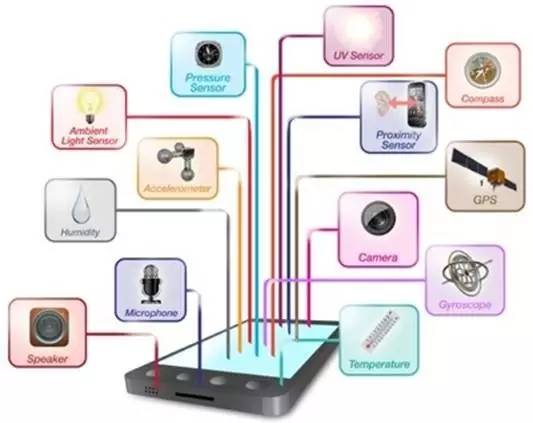
1Light Sensor
Principle: A photoresistor generates varying levels of current when it detects external light, allowing it to sense the brightness of the environment.
Usage: Typically used to adjust the automatic backlight brightness of the screen and can also be used for automatic white balance during photography. Additionally, it can work with the distance sensor below to detect if the phone is in a pocket to prevent accidental touches.
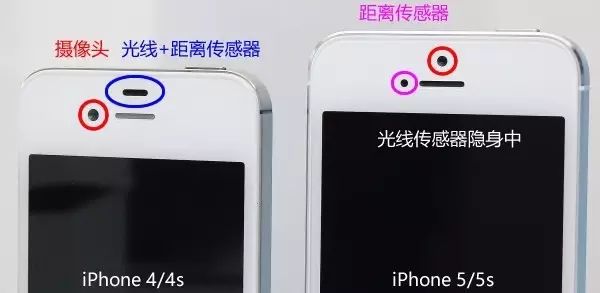
2Distance Sensor
Principle: An infrared LED emits infrared light, which is reflected by nearby objects. The infrared detector measures the intensity of the received infrared light to determine distance, typically effective within 10 cm. The distance sensor is relatively large and contains both emitting and receiving devices.
Usage: Detects whether the phone is held to the ear during a call to automatically turn off the screen to save power. It can also enable automatic unlocking and locking actions in case of cases or pocket modes.
3Gyroscope
Principle: Based on the conservation of angular momentum, a rapidly spinning object (the gyroscope) will maintain its axis of rotation unless acted upon by an external force. Gyroscopes use this principle to maintain a certain direction. A three-axis gyroscope can replace three single-axis gyroscopes and can simultaneously determine the position, movement trajectory, and acceleration in six directions.
Usage: Used for motion sensing, shaking, translating/rotating/moving the phone to control the view in games, VR (virtual reality), and for inertial navigation in situations where GPS signals are unavailable (such as in tunnels).
4GPS
Principle: There are 24 GPS satellites orbiting the Earth, each constantly broadcasting its current location coordinates and timestamp information worldwide. The phone’s GPS module receives this information via an antenna. The chip within the GPS module calculates the distance between the satellite and the phone based on the time difference between the satellite’s emitted coordinates and the time of reception, using spatial triangulation to determine the location coordinates.
Usage: Maps, navigation, speed measurement, distance measurement.
5Fingerprint Sensor
The mainstream technology is capacitive fingerprint recognition, but starting this year, ultrasonic fingerprint recognition with faster speeds and higher recognition rates will gradually become popular.
Capacitive Fingerprint Sensor Principle: The finger forms one pole of a capacitor, while the other pole is an array of silicon chips. A microcurrent is generated between the human body’s microelectric field and the capacitive sensor, with the peaks and valleys of the fingerprint creating variations in capacitance, thereby mapping the fingerprint image.Ultrasonic Fingerprint Sensor Principle: Ultrasonic waves are often used for distance measurement, such as in sonar systems for underwater terrain mapping. The principle of ultrasonic fingerprint recognition is similar; it directly scans and maps the fingerprint texture, even capturing pores. Therefore, the fingerprint obtained via ultrasonic is 3D, while the capacitive fingerprint is 2D. Ultrasonic not only has faster recognition speeds but is also unaffected by sweat or oil, providing richer details that are harder to spoof.
Usage: Encryption, unlocking, payment…
6Gravity Sensor
Principle: Utilizes the piezoelectric effect, where a heavy object and a piezoelectric element are integrated within the sensor. By measuring the voltage generated in two orthogonal directions, the horizontal direction can be calculated.
Usage: Intelligent switching between horizontal and vertical screens, photo orientation, gravity sensing games.
7Accelerometer
Principle: Similar to the gravity sensor, it also uses the piezoelectric effect to determine acceleration direction across three dimensions, but with lower power consumption and lower precision.
Usage: Step counting, determining the orientation angle of the phone.
8Magnetic Field Sensor
Principle: Anisotropic magnetoresistive materials change their resistance when they detect slight changes in magnetic fields, so the phone must be rotated or shaken a few times to accurately indicate direction.
Usage: Compass, map navigation direction, metal detector apps.
9Hall Effect Sensor
Principle: Based on the Hall effect, when current flows through a conductor situated in a magnetic field, the magnetic field exerts a force on the electrons in the conductor, generating a potential difference at the ends of the conductor.
Usage: Automatic unlocking when flipping open, automatic screen locking when closed.
10Barometric Sensor
Principle: There are capacitive or resistive barometric sensors, connecting a membrane with a resistor or capacitor. Changes in air pressure lead to changes in resistance or capacitance values, allowing for pressure data retrieval.
Usage: GPS altitude calculations may have about a ten-meter error; barometric sensors primarily correct altitude errors and can also assist GPS in determining the location of overpasses or floors.
11UV Sensor
Principle: Utilizes the photoemission effect of certain semiconductors, metals, or metal compounds, releasing a large number of electrons under UV light, allowing for the calculation of UV intensity.
Usage: Sports, health.
12Heart Rate Sensor
Principle: A high-brightness LED illuminates the finger. When the heart pumps fresh blood into the capillaries, the brightness (depth of red) exhibits periodic changes, which are quickly captured by the camera. The application on the phone then calculates this regular change to determine the heart’s contraction frequency.
Usage: Sports, health.
13Blood Oxygen Sensor
Principle: Hemoglobin and oxyhemoglobin in the blood absorb infrared and red light at different ratios. By simultaneously illuminating the finger with infrared and red LEDs and measuring the absorption spectrum of reflected light, blood oxygen levels can be determined.
Usage: Sports, health.
Today’s smartphones are practically all-in-one personal assistant tools. The practical functions commonly used today are largely achieved through hardware integration or indirect software implementation. One can imagine that future smartphones will integrate even more sensors. The first nine sensors mentioned are standard in smartphones, while the latter four are less common and mainly cater to special user groups such as outdoor enthusiasts, athletes, and health-conscious individuals, often found in high-end phones. Of course, many smart wristband products already widely use them.
Source: Hardware Academy ID:YJXTAPP

Join the group! Measurement technology organization exchange QQ group: 195438839
(This group is only for personnel from legal measurement technology organizations)