When everyone thought the U.S. would continue to lock down high-endAI chips, the White House unexpectedly approved the export of NVIDIA’sH20 to China!
Indeed, this is the chip whose computing power has been cut down to only15% of theH100, but its bandwidth has secretly increased to4TB/s—the “special version”!
If you have any understanding of theCUDA ecosystem, you can’t help but ask: is this charity or a trap?
It sounds like limiting anF1 engine to80 mph, while saying “Don’t worry, we’ll replace your tires with supercar-grade ones“—this matter is not that simple.
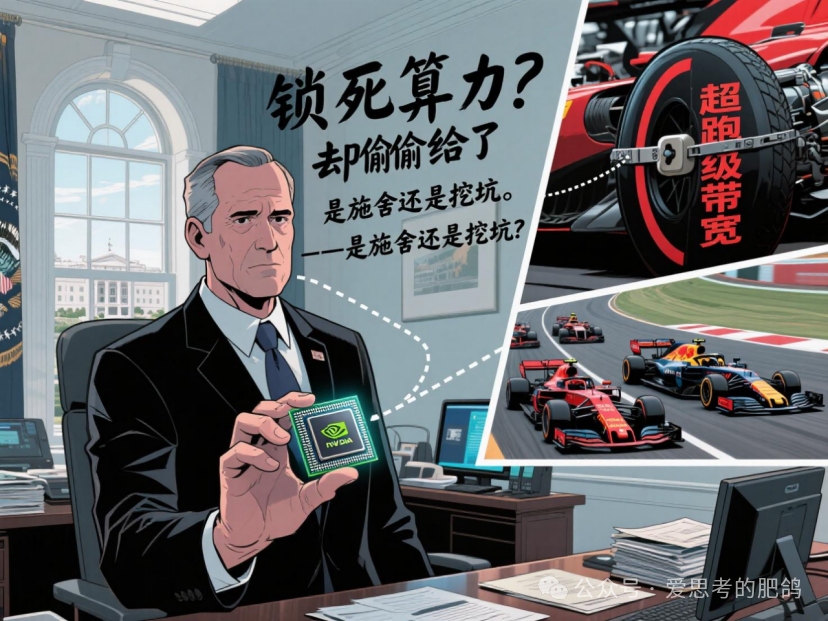
This news broke onJuly15, just as Jensen Huang made an appearance at the Shanghai Chain Expo, and the U.S. Department of Commerce nodded to approve theH20.
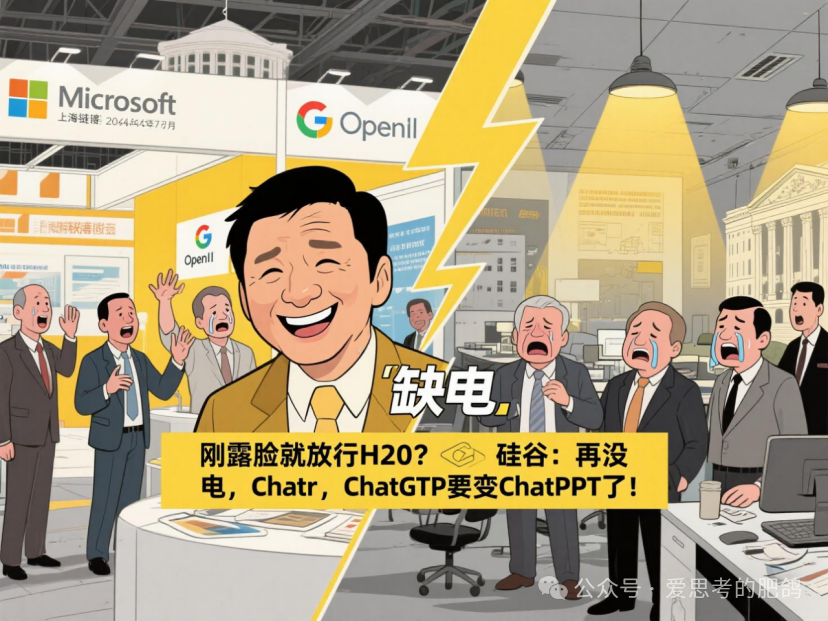
At the same time,OpenAI, Microsoft, and Google all complained, “We have enough GPUs, but not enough power“—in 2024, China will add400GW of electricity, while the U.S. will only increase by27GW, just one-tenth.
Even more absurd, on the same day, the White House urgently released theAI Action Plan, which only contained this sentence: in terms of electricity use in data centers, the federal government has priority, but localities must remain silent.
It sounds like Silicon Valley tycoons are going to Washington to cry poor: “If we don’t get more power,ChatGPT will turn intoChatPPT!“
In short, theH20 is such a “policy-compliant“ product:
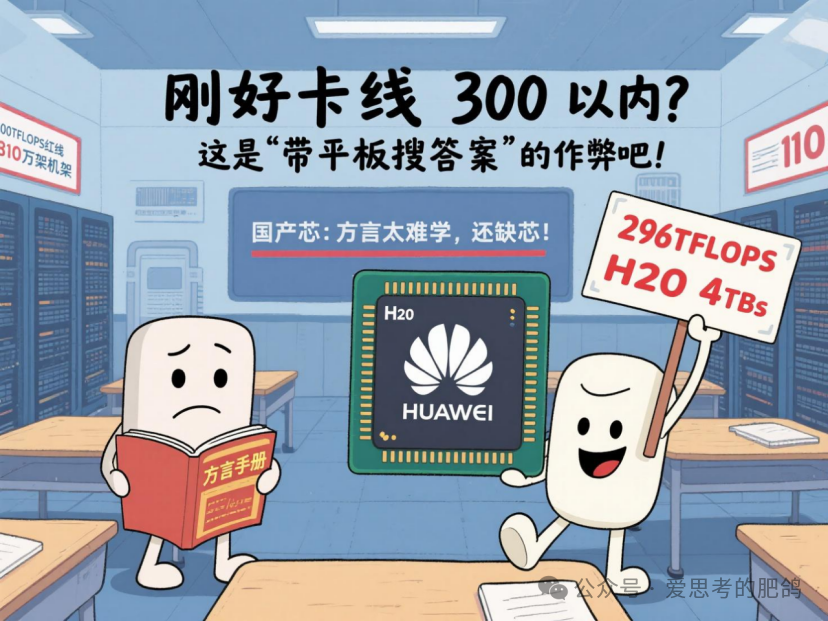
With an FP8 computing power of296TFLOPS, it cleverly keeps it under the300TFLOPS threshold; with96GB of memory and4TB/s of bandwidth, it quietly pushes the limits of “data transmission” to the extreme.
The question arises— isn’t this typical “cheating on an exam“?
The U.S. BIS regulations state, “No calculators allowed“.
Yet NVIDIA handed over a device that “can’t calculate trigonometric functions, but can search for answers online“—a tablet.
Even more outrageous, theCUDA ecosystem is monopolistic, just like Mandarin, and even if domestic chips are powerful, they must first learn that dialect.
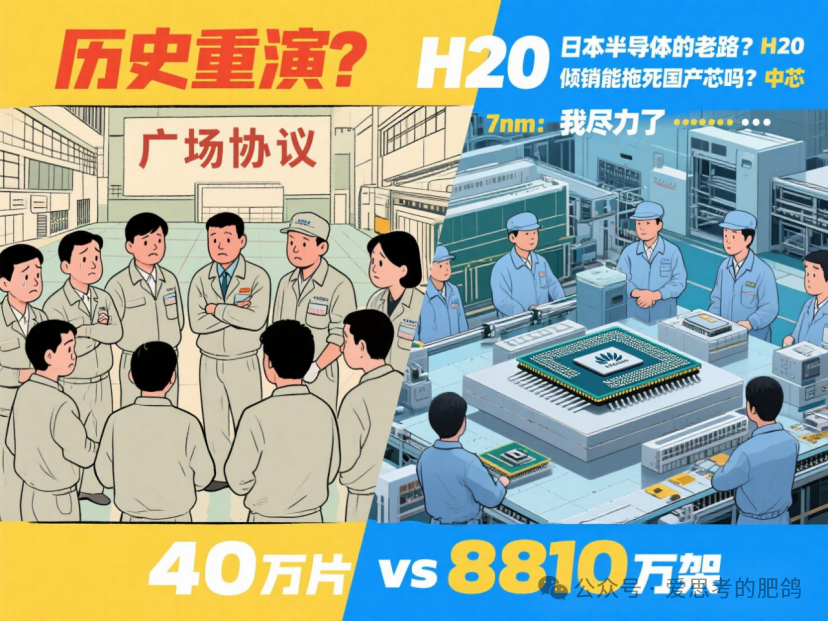
In contrast, Huawei’s Ascend910B has significant computing power, but its production capacity is only400,000 units per year.
At this time, domestic data center racks have already surpassed8.1 million racks—the chip shortage is more fatal than a lack of love.
So the question arises: is the U.S. this time “loosening restrictions” out of fear that China will catch up, or fear that NVIDIA won’t make enough profit?
Historical cases are there— in the 1980s, Japan’s semiconductor industry suffered from the “Plaza Accord + dumping accusations” combo, becoming incomplete, and the tactics are similar to today.
Smart as they are, can the “castrated dumping” really kill domestic chips?
Don’t forget that the Kirin chip was once treated by Qualcomm “like boiling a frog in warm water“—and then, Huawei surprisingly extracted the5G baseband.
More realistically, SMIC’s7nm production capacity, under the DUV lithography machine supply cut, will only reach600,000 units by 2025—after theH50 stock is sold out, can domestic chips really take over?
From a motivational perspective, the U.S. is playing “chokehold economics“—not allowing China to access theH100, while ensuring NVIDIA’s financial reports look good.
But if you say this is “technological opium” it may not be the case—DeepSeek used2048 H800s to easily train a trillion-parameter model, cutting the computing power requirement by10 times with its unique algorithm.
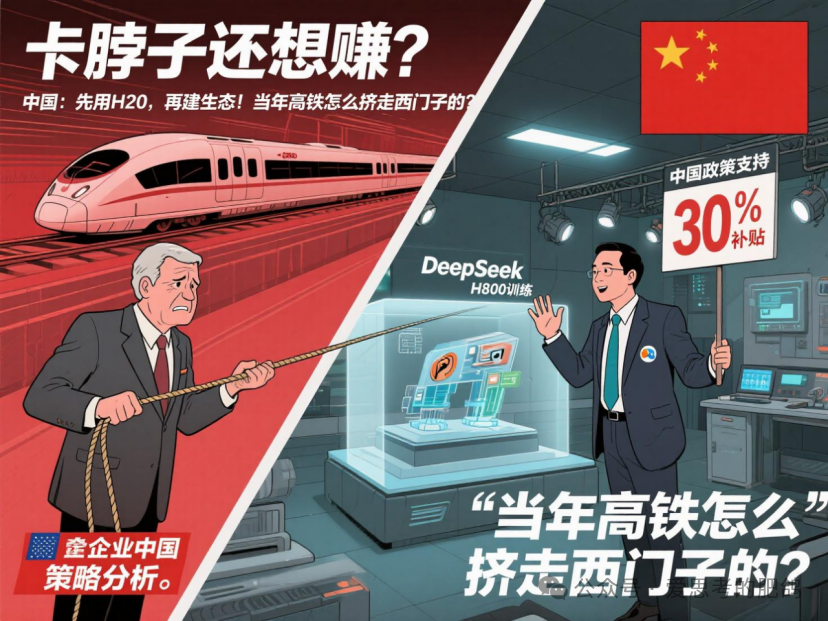
Logically, China’s strategy seems quite clever: first leveraging theH20 to continue its development momentum, and then investing heavily to build and enrich the ecosystem.
The state is purchasing domesticGPUs and providing a30% subsidy; state-owned enterprises are vigorously promoting localization.
This situation is reminiscent of the “market for technology exchange” implemented in high-speed rail, which unexpectedly pushed Siemens out of the Asia-Pacific market.
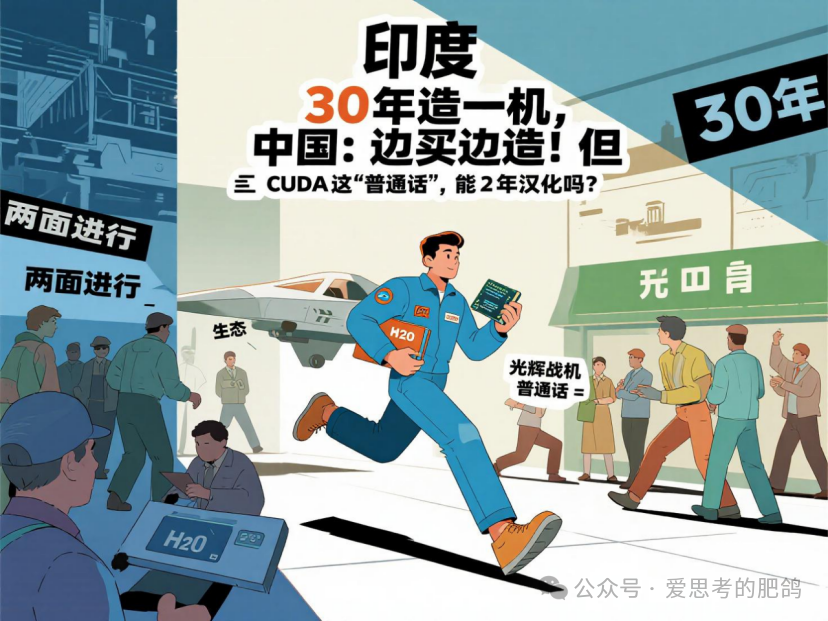
In contrast to India’s “Tejas fighter jet” which took 30 years to develop, China’s AI industry at least understands the concept of “buying while manufacturing“.
In 2024, Alibaba and Tencent have reserved800,000 units ofH20, while the shipment ofAscend910B is only400,000 units—the gap is evident, but time is on China’s side.
The key challenge is whether domestic chips can gradually “Sinicize” theCUDA ecosystem to a usable state within2 years.
Don’t forget that NVIDIA’s “moat” is not just silicon, but the developer habits accumulated over20 years—changing tracks is relatively easy, but changing developers’ “mindset” is truly difficult.
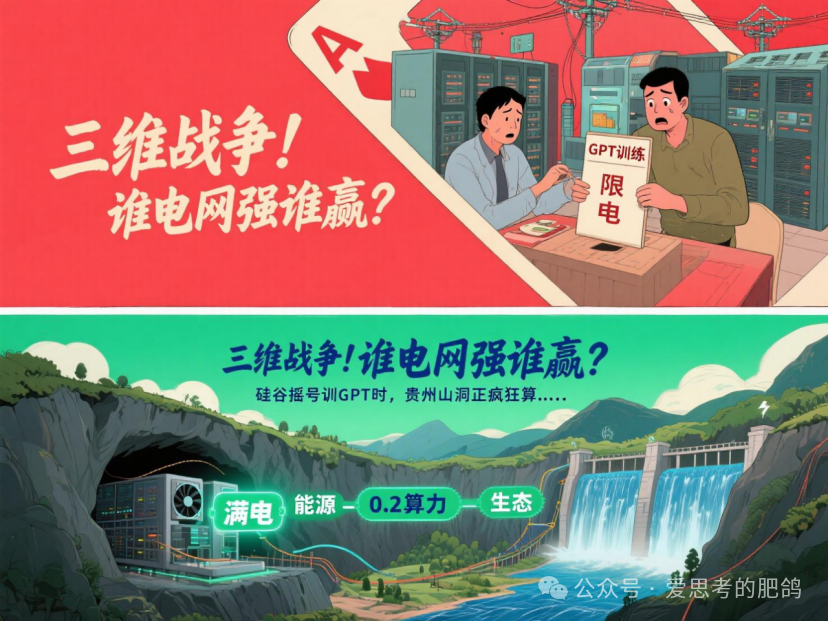
This is not just a chip war, but a “three-dimensional war of energy and computing power ecology“—who can smoothly convert electricity into computing power and cleverly transform computing power into an ecosystem will be the true winner.
The U.S. is now actively opening the green light for data centers; meanwhile, China is building a “city of computing power integrated with wind, solar, and hydropower” in the west.
In the next3 years, the most magical scene may be: Silicon Valley limits power to the extent that training onceGPT requires a lottery; while in the caves of Guizhou, GPUs are training large models madly with green electricity at0.2 yuan per kilowatt.
True security is not about buying the best chips, but about having a power grid that your opponents can never catch up to.
The reality is harsh, but the AI war is never a single-choice question.
While the U.S. is still entangled in the question of “to sell or not to sell” China has already turned the page to the next question—”If GPUs are unavailable, then let’s turn electricity into GPUs”.
If you like it, remember to follow and like, thank you very much!
Disclaimer: More than 90% of this article is based on original content, with a small amount of material assisted by AI, but all content has been strictly reviewed and verified. All image materials are sourced from real materials or AI originals. The article aims to promote positive social energy, without vulgar or negative guidance, and readers are advised to be aware.