Why is it so conservative?
Having worked in the 3D printing industry for five years—and as an outsider for a few years—I am still surprised by the level of conservatism in this industry.
On one hand, this is understandable: many companies have been struggling to survive. On the other hand, bold measures should be taken in times of crisis.
These companies are mostly good at technological innovation, and we still see a lot of such innovations. However, what they often lack is innovation in business models—and in my view, true disruption usually occurs in business model innovation.
Christensen’s Theory of Disruptive Innovation
Not long ago, the term “disruption” was everywhere. It quickly became a cliché. But Clayton Christensen’s original concept was very precise:
👉 “Disruptive innovation transforms products or services that are historically expensive and complex, accessible only to a few, into affordable and accessible products that more people can enjoy.”
This sounds similar to Schumpeter’s theory of “creative destruction,” but Christensen added three key factors:
Market entrants start from the low-end market or new markets: Disruptive innovations typically begin by targeting overlooked customer segments or creating new markets. The products or services they offer are cheaper, simpler, more convenient, or easier to obtain, but they are not necessarily superior in traditional performance metrics.
Existing companies focus on their most profitable customers: Mature companies often concentrate on sustaining innovation—improving products for the most demanding (and profitable) customers. As a result, they often overlook lower-demand, price-sensitive segments, which are precisely where disruptive entrants initially gain a foothold.
Performance improves over time: Although disruptive products may initially lag behind in mainstream performance metrics, they steadily improve. Over time, their performance reaches a level that satisfies mainstream customers, thereby displacing existing companies.
The Current State of Additive Manufacturing
Currently, all three elements of disruptive innovation are evident in the field of additive manufacturing:
Entry-level manufacturers offer low-cost systems while continuously raising the bar for what is considered “good enough.”
Mid-tier manufacturers are facing increasing pressure.
High-end manufacturers focus on lucrative niche markets, working closely with aerospace, automotive, and other large clients.
This aligns perfectly with Christensen’s model. We also know the typical outcome:
Entry-level manufacturers capture the market.
High-end manufacturers may survive for a while, but due to the small size of niche markets, one misstep can open the door for entry-level disruptors—leading to their downfall.
But this explains how the 3D printing industry can self-disrupt, and it is just the tip of the iceberg.
Can Additive Manufacturing Disrupt the Manufacturing Industry?
The birth of 3D printing was not intended to disrupt itself but to disrupt manufacturing—shifting from subtractive to additive manufacturing.
Have we reached that point? Clearly not yet. Its application in mass manufacturing remains limited.
However, additive manufacturing has already made a real impact in certain industries: aerospace, healthcare, automotive, and so on. In these fields, additive manufacturing has replaced traditional manufacturing methods.
So, why has it taken so long to achieve this?
The Challenge of General Technologies
Christensen initially mentioned “disruptive technologies,” later refining it to “disruptive innovations.” Why? Because technology alone does not bring about disruption—typically, it is the business models enabled by technology that do.
One of the challenges of 3D printing is that it is a general technology.
Televisions are easy to categorize: you know their functions, can estimate market size, and understand competitors. In contrast, 3D printers can produce not only fixtures for production lines; in healthcare, they can print tools, parts that enter the human body, consumer electronics components, or aerospace parts.
Currently, these industries rely on completely different suppliers and technologies.
Thus, in reality, the 3D printing industry serves vastly different tasks, with almost no commonalities, yet the demands are distinctly different.
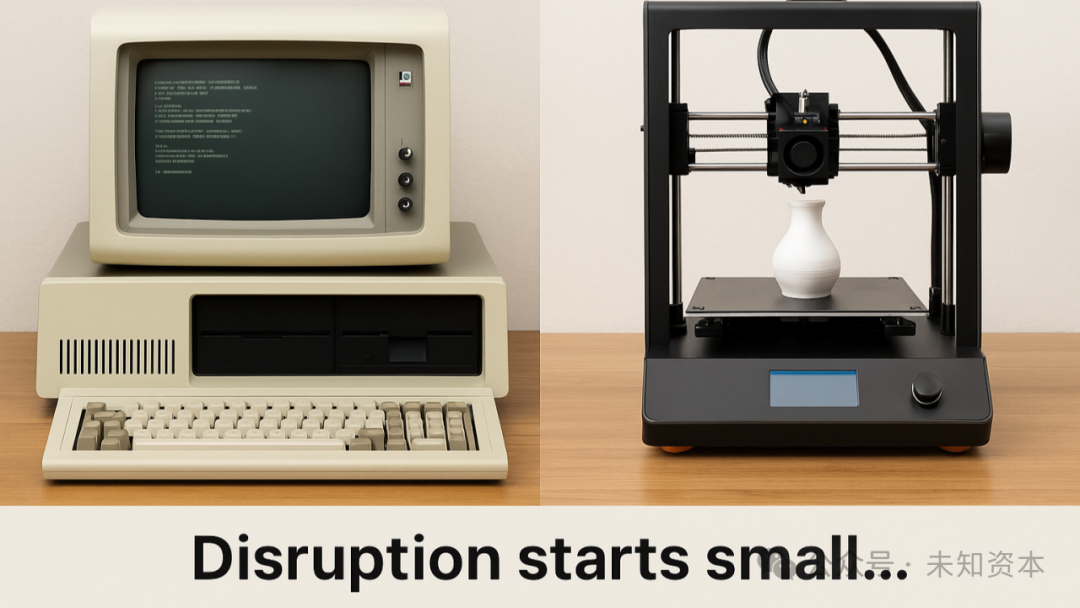
PC Analogy
This is one of the several similarities between additive manufacturing and the PC industry.
In the PC field, there are both hobbyists and gamers, as well as businesses creating spreadsheets and presentations, and powerful servers running cloud applications.
In the early days, there were mainframes and minicomputers—expensive centralized systems used by businesses and research centers. Later, low-cost basic PCs emerged, sometimes even sold as hobbyist kits.
Through standardization, open standards, and a virtuous cycle of hardware and software, PCs gradually became mainstream: first in professional fields, then in homes. The internet and mobility made them indispensable.
Even experts misjudged this. Thomas Watson of IBM famously said, “The world market for maybe five computers.” Bill Gates (though he denies it) is often quoted as saying, “640K ought to be enough for anybody.”
They were wrong because they only saw the applications that existed at the time and did not foresee the wave of innovation that PCs were about to unleash, nor the peripheral industries that would be disrupted.
How PCs Disrupted Entire Industries
PCs not only replaced mainframes but also disrupted entire industries and professions:
Early offices: typists, file clerks, draftsmen, messengers…
Later, with the advent of the internet: encyclopedias, music, video, gaming, education, research…
We haven’t even talked about information architecture (IA).
The key lesson is: 💡 Most disruptions did not come from PC manufacturers. They came from companies building new technologies and business models on top of PCs.
Salesforce disrupted customer relationship management (CRM) with SaaS.
Google disrupted the advertising industry with an ad-supported model.
Amazon disrupted distribution with a marketplace model.
Netflix disrupted the video industry with a subscription model.
PCs are platforms. Business models are the real disruption.
What Does This Mean for 3D Printing?
So, will 3D printing follow the trajectory of PCs? Not entirely. But there are strong similarities between the two.
Entry-level systems will continue to drive growth. Performance will keep improving, and the “good enough” market will continue to rise, putting pressure on all other manufacturers.
Software will spark the next wave. First, by simplifying workflows (just as Windows did for PCs), then empowering applications we cannot even imagine today.
New business models will drive true disruption.
And they will run on inexpensive hardware.
What About Top Manufacturers?
As Christensen predicted, high-end suppliers will continue to focus on their most profitable customers. This model will work for a while, but ultimately lead to diminishing returns.
Larger, faster, and more exotic machines will meet fewer demands at higher costs.
Their only way out will be to provide complete manufacturing solutions: printers, software, materials, robotics, services, quality control, integration…
But this is no easy task. It requires new talent, new technologies, and competition with larger companies. Historical experience tells us: SGI, Sun, Cray, HP, IBM—most companies have tried this route, but most have not survived. Many companies that once produced computers no longer manufacture them.
The Bottom Line
3D printing will continue to exist, but for most participants, market competition remains fierce.
Driven by entry-level suppliers, installations will grow rapidly, spurring innovation.
But the winners will not be those with the most advanced technology, but those with the best business models—and most likely, they will be outsiders.