According to relevant data, the global leading IP giant Arm is seeing significant results from its diversification strategy.
According to the company’s financial report for the second quarter of fiscal year 2024, released in November this year, Arm’s revenue for the quarter increased by 28% compared to the same period last year, reaching $806 million. Among this, licensing revenue was $388 million, a 106% increase year-on-year. This substantial growth indicates that the technology industry is actively preparing new technologies to seize the strong market opportunities brought by AI. From the shipment volume of Arm architecture chips, Arm’s future looks bright. Relevant statistics show that Arm’s IP is present in nearly every smartphone, many personal computers, and various other chips. Currently, the total shipment of Arm architecture-based chips has exceeded 27 billion units.
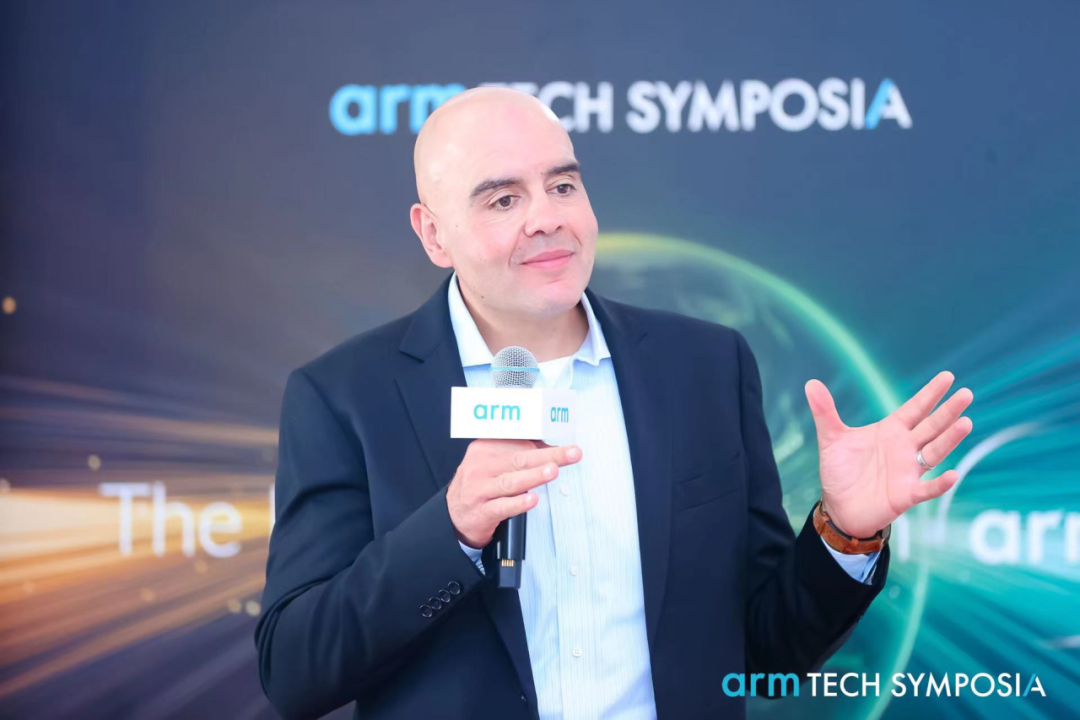
Among them, the performance of Chinese partners is particularly impressive. Mohamed Awad, Senior Vice President and General Manager of Arm’s Infrastructure Division, stated at the earlier Arm Tech Symposia annual technology conference that as of now, Arm has nearly 400 technology licensing customers in China, with a cumulative shipment of 30 billion chips based on Arm architecture. In other words, Arm’s Chinese customers can average nearly four Arm architecture chips for every person on Earth.
But Arm does not stop there.
Arm Technology, the Cornerstone of Global Technology
Arm’s history dates back to 1978. At that time, Chris Curry and Hermann Hauser co-founded a company called Acorn Computers and successfully obtained the manufacturing and production rights for the BBC Micro. As part of this program, Professor Steve Furber and Sophie Wilson designed the first Arm processor, ARM1, which could efficiently execute program instructions running on Acorn computers (such as word processing, spreadsheet calculations, and graphics rendering). This laid the foundation for Arm’s modern processors.
By 1990, Acorn Computers, in collaboration with Apple Computer (now Apple Inc.) and VLSI Technology (now NXP Semiconductors N.V.), established a joint venture that would later become the renowned Arm company. In 1993, the Apple Newton, based on Arm architecture, was launched, but its market sales were not ideal, prompting Robin Saxby, then CEO of Arm, to develop the Arm IP licensing business model and sign an agreement with chip supplier Texas Instruments that year. Since then, Arm has gradually become an industry giant and opened up a new track.
In terms of products, Arm has evolved from the early Cortex-A, Cortex-R, and Cortex-M to the later addition of Mali GPUs. Coupled with the recent launch of Cortex-X and Immortalis GPUs, Arm has built a rich and ample “toolkit”. Through collaboration with ecosystem partners, Arm has created dedicated solutions that combine hardware and software, enabling customers to achieve specialization in areas such as the Internet of Things (IoT), personal devices, automotive, and data centers.
First, looking at the IoT aspect, with Arm Cortex-M55, Cortex-M85, and the newly launched Cortex-M52, Arm can continuously provide various performance levels required by partners to meet the growing demand for IoT in the AI era. These products can also be used in conjunction with Arm Helium, which adds 150 new scalar and vector instructions, significantly enhancing AI performance; in terms of personal devices, Arm’s strengths in Cortex-A, Cortex-X, and flagship GPU—Immortalis are also well recognized by leading global manufacturers.
In the automotive sector, Arm’s Cortex-A, Cortex-R, and Cortex-M CPUs; Mali GPUs; Mali ISP, and CoreLink Interconnect system IP can provide extensive support. Among them, the AE IP (Automotive Enhanced) offers solutions for critical functional safety in automotive applications. Whether you are planning the design of the next electric vehicle or striving to achieve Level 5 autonomous driving, you can obtain comprehensive safety and performance from Arm IP and the world’s largest developer ecosystem.
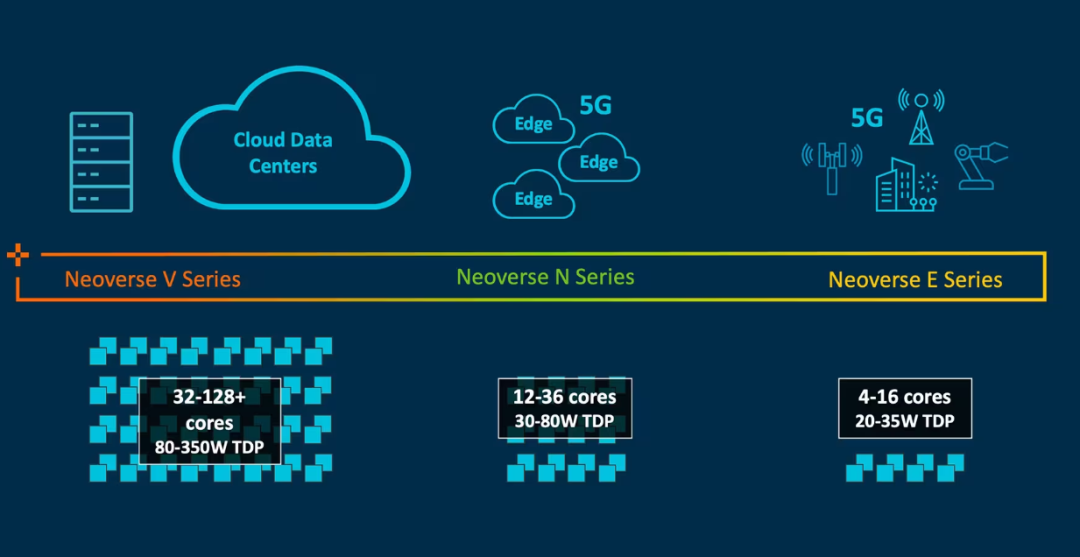
As for the increasingly popular infrastructure sector, Arm has launched the Arm Neoverse platform. As Arm states, the changes in global infrastructure are rapid, aimed at meeting the continuously growing workloads and increasing performance demands. The Arm Neoverse series is optimized for cloud, edge, and 5G networks, providing excellent speed, energy efficiency, performance-to-power ratio, and performance-to-cost ratio to meet the future infrastructure and its customers’ needs.
Arm emphasizes that the company will continue to focus on the IP licensing business, hoping to provide partners with greater flexibility to choose the most suitable way to develop products. At the same time, the company has also recognized the changes occurring in the industry. Thus, they are transforming from merely being an IP supplier to a computing platform company. Arm candidly states that this decision was made because the company’s management team realized about ten years ago that to help partners achieve specialization in various application fields, more needed to be done.
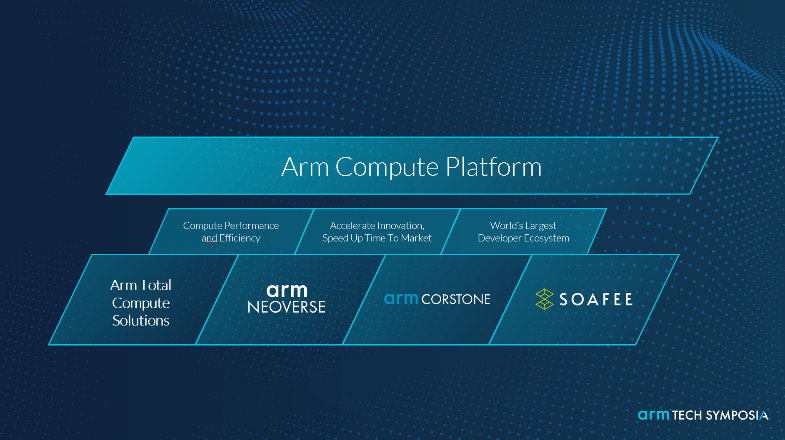
According to reports, the solutions currently offered by Arm include Arm Total Compute Solutions, Arm Neoverse platform, Arm Corstone, SOAFEE, and other computing platforms. In Arm’s view, by providing a complete solution, it can help customers quickly bring products to market. At the same time, customers can choose individual Arm IPs and configure them according to their needs, which is Arm’s uniqueness.
Arm emphasizes that the company’s computing platform is driven by three pillars: computing, performance, and software. As the most widely used computing platform globally, the emergence of the Arm platform is attributed to the excellent performance and energy efficiency achieved through the combination of computing and software. This platform relies on the close integration of hardware and software, which is precisely the area Arm has heavily invested in over the past decade.
Thanks to these persistent investments, Arm has become the cornerstone of the technology world. For example, in the rapidly growing AI sector, Arm reveals that currently, 70% of machine learning applications are already running on the Arm platform. As more AI-enabled devices enter the market, this proportion will continue to rise.
In discussions with the author, Arm repeatedly emphasized the importance of the infrastructure business for the company’s future development. From the current state of industry development, this is also inevitable.
Infrastructure, the Next Big Thing
Looking at the current technology industry, data centers are undoubtedly at the forefront.
In fact, since the big data wave began a few years ago, data centers have moved to the center of public opinion. However, in recent years, the heat of artificial intelligence, combined with the large model craze since last year, has caused data centers to sweep the globe at an unprecedented speed. This has brought significant business to server suppliers.
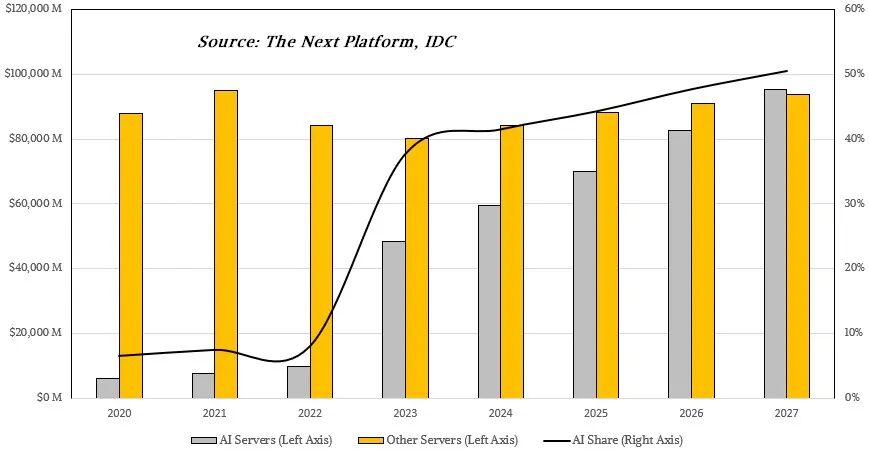
According to IDC’s forecast, server shipments will maintain stable growth in the coming years. As shown in the figure below, while traditional server demand remains high, AI servers are also experiencing rapid growth, mainly benefiting from the demand for GPUs driven by artificial intelligence. Meanwhile, significant changes are also occurring in server architecture.
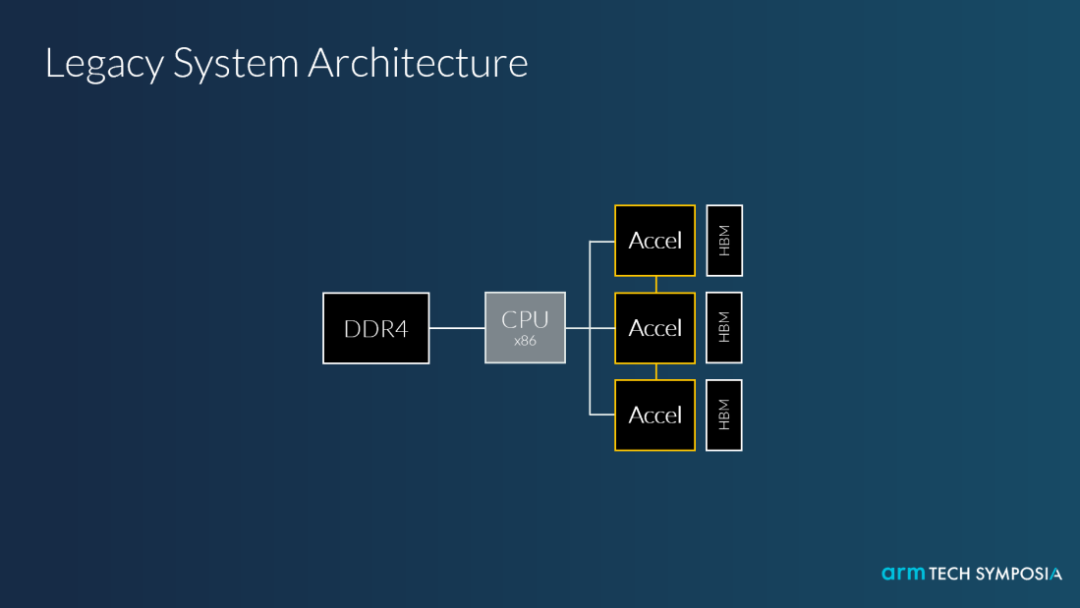
Mohamed Awad cited NVIDIA as an example, stating that in the traditional server system architecture, the left side is memory, which connects to a general-purpose off-the-shelf CPU, which in turn manages multiple accelerators. In the past, this traditional architecture was the only available architecture in the market. However, this architecture has a problem: the interface between the CPU and the accelerators directly limits the final performance level of the product.
“Because all accelerators must access additional memory through a CPU, this leads to a lack of memory consistency, meaning the performance of the accelerators cannot be fully utilized, and it cannot adequately support the demands of the generative AI era,” Mohamed Awad explained.
In light of this, the market is driving a modern system architecture that allows each custom CPU to connect directly to an accelerator, achieving strong memory consistency. With such an architecture, designers can better tailor CPU designs based on actual user scenarios and use cases, maximizing the efficiency of accelerator usage.
Mohamed Awad emphasized that NVIDIA has implemented this architecture in its NVIDIA GH200 Grace Hopper super chip. Test data shows that in this architecture, the combination of 72 Arm Neoverse cores and NVIDIA GPUs achieves AI performance that is ten times better than systems based on x86 architecture.
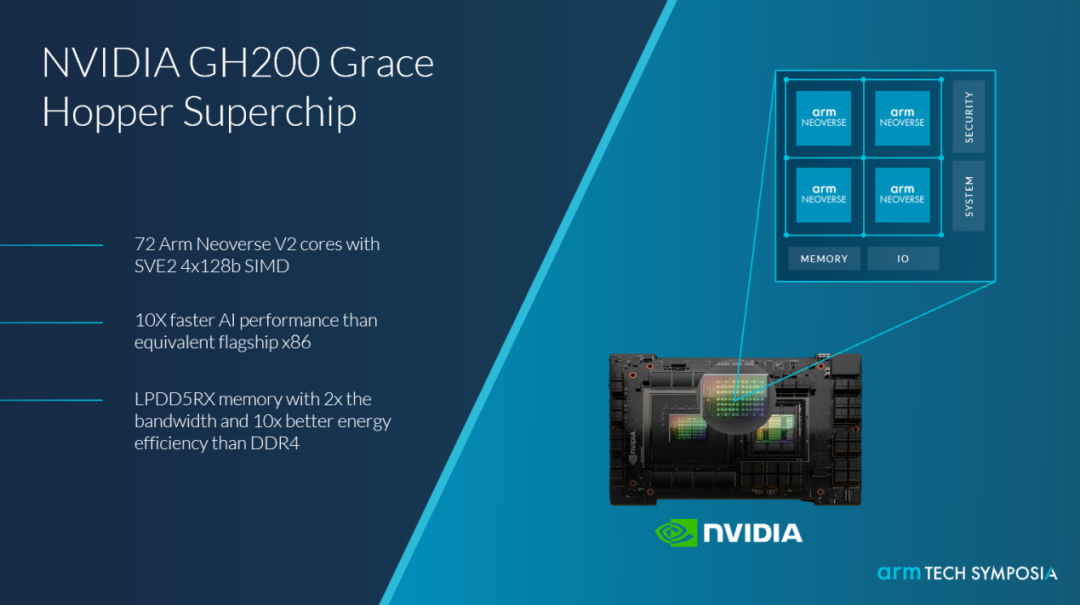
This demonstrates a very successful attempt. In fact, Arm Neoverse has gained favor from many chip companies over the past few years. For example, Ampere Computing in the United States is one of them. In China, there are also many focused companies, including but not limited to Yuxian Microelectronics and Hongjun Microelectronics, which have become important participants in the industry. Other companies, such as Cloud Leopard Intelligence, which focus on DPU, are also looking at the computing capabilities of Arm Neoverse and Arm’s ecosystem.
In addition, cloud vendors including Amazon, Microsoft, and Alibaba are also targeting Arm Neoverse. According to Mohamed Awad, the reason for this decision is that they can collaborate with Arm to create and optimize solutions based on their use cases and infrastructure.
To facilitate developers in product development based on Arm Neoverse, Arm has also launched the Arm Neoverse Computing Subsystem (CSS), which provides complete subsystems. Based on this, partners can accelerate the product launch process by adopting directly or on-demand.
“In summary, Neoverse CSS can help our partners further reduce investment, accelerate the accessibility of the entire ecosystem to our solutions, and speed up the time to market for partner products,” Mohamed Awad concluded. He further pointed out that feedback from partners indicates that using Neoverse CSS can save up to 80 person-years of engineering time; another customer reported that using Arm’s Neoverse CSS reduced the time from concept to tape-out to 13 months.
Mohamed Awad told Semiconductor Industry Observer that from an infrastructure perspective, Arm hopes to define AI from a broader perspective. “Traditionally, when people talk about AI, they refer to AI in servers or generative AI, but we believe that in the future, when we discuss AI, it can also exist at the edge, in the network, from traditional data endpoints to storage to servers, integrating into every process,” Mohamed Awad stated. In his view, it is precisely due to the very open cooperation model that the company can help startups and mature enterprises in the industry innovate and create very unique solutions. Of course, these companies can also leverage the strong software ecosystem provided by Arm to truly integrate these innovations into the infrastructure.
For Arm, like other chip companies, they also need to face geopolitical challenges. However, Zou Ting, Vice President of Arm’s China business, reiterated that the company will continue to support every partner and ecosystem in compliance. “Arm is also actively participating in local ecosystems and open-source software communities, including the Longxin community, to help these communities better integrate into Arm’s global ecosystem,” Zou Ting told Semiconductor Industry Observer.
Recommended Reading
Microsoft reportedly cuts orders for NVIDIA H100
Wafer giants compete for 2nm
South Korean chip duopoly, offense and defense

Follow global semiconductor industry trends and developments
Welcome to follow 【Semiconductor News】
Public Account ID: MooreNEWS