 Robot Football World Cup Champion’s Homecoming Debut! Domestic ‘Iron Players’ Kick Off a New Height in Technology, Netizens: Stronger than the National Team!
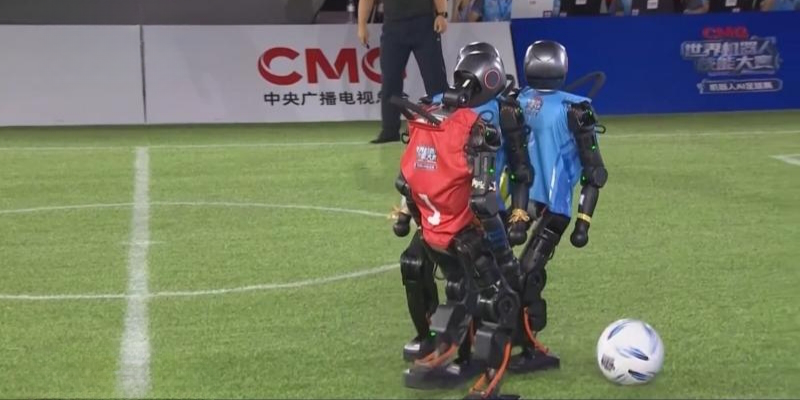
On the evening of August 9, CCTV-10’s Science and Education Channel broadcasted a special match—the Tsinghua Fire God Team, who just won the 2025 RoboCup Robot Football World Cup in Brazil, made their homecoming debut with their “Iron Players.” This is the first time China has won the championship in the most prestigious humanoid category of this event, even sweeping the top two spots, which has caught the attention of the global technology community.
At the match, the domestically produced “Accelerated Evolution T1” robot, nearly the height of an adult, ran flexibly, passed accurately, and shot powerfully, even autonomously completing header goals, with tactical execution comparable to that of human professional players. In the finals, the Tsinghua Fire God Team defeated the China Agricultural University Shanhai Team, which also used domestic robots, with a score of 5:2, allowing the five-star red flag to rise twice on the field.
These robots are not remote-controlled toys; they rely entirely on AI for autonomous decision-making. Visual sensors allow them to “see” the football, force control joint technology ensures smooth movements, and a chip with 200 TOPS computing power enables them to adjust tactics within 0.1 seconds. In the group stage, the Fire God Team crushed their opponents with scores of 16:0 and 9:0, prompting even foreign strong teams to exclaim, “China Dominates!”.
The championship is backed by 20 years of technological accumulation. The Tsinghua team has been participating since 2004, and in the early years, they struggled even with stable walking. It wasn’t until 2008 that they invented the “Virtual Slope Method” to prevent the robots from falling. Now, domestic robots have achieved comprehensive leadership from hardware to algorithms, with even American and German teams actively choosing the Chinese-made “Accelerated Evolution” series robots.
Netizens’ reactions were even more exciting than the match itself. Some joked, “The dream that the national football team has failed to achieve for decades has been realized by robots!” An elderly man commented, “If this robot could do my grandson’s homework, I would buy one immediately!” Others suggested, “Let’s quickly organize a robot league; the tickets will definitely sell better than the Chinese Super League!”.
The technical team revealed that these robots will not only play football in the future. Force control joints have been used in industrial production lines, and distributed decision-making systems can command unmanned vehicles to collaborate on deliveries. Experts predict that within 2-3 years, robots will be able to compete alongside amateur players, and in 5-10 years, they may challenge professional teams.
The World Robot Conference is currently being held in Beijing, with the champion models T1 and K1 becoming the focus. A mini football field has been set up in the exhibition area, where spectators can play penalty shootouts against the robots. A child shot 10 times in a row, all saved by the robot goalkeeper, causing frustration and laughter among the surrounding elderly spectators.
This victory is not only a technological breakthrough but also allows ordinary people to see China’s “hard power” in technology. In the past, we envied foreign robots for their ability to run and jump; now, the world is rushing to buy Chinese-made “football champions.” A spectator remarked, “I used to think high technology was all about foreign prowess; now our robots can even win world championships!”.
What is the next goal? The RoboCup officials have stated that by 2050, they aim to have robot teams defeat the human World Cup champions. The Chinese team indicated that at this development speed, we may not have to wait until 2050. By then, we might really see a “steel version” of Cristiano Ronaldo competing alongside robots.
This RoboCup has showcased China’s confidence in technology. From the laboratory to the pinnacle of the world, domestic robots are taking us towards the intelligent era with agile strides. The next time someone says Chinese technology is lacking, just show them this match—our “Iron Players” are indeed the world champions!