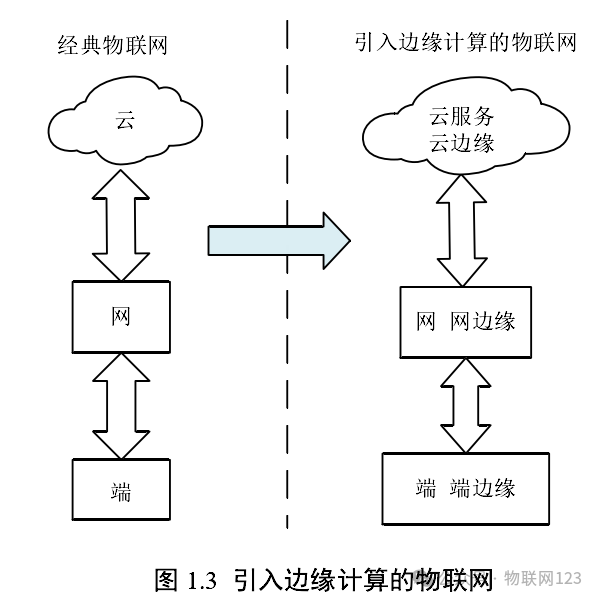
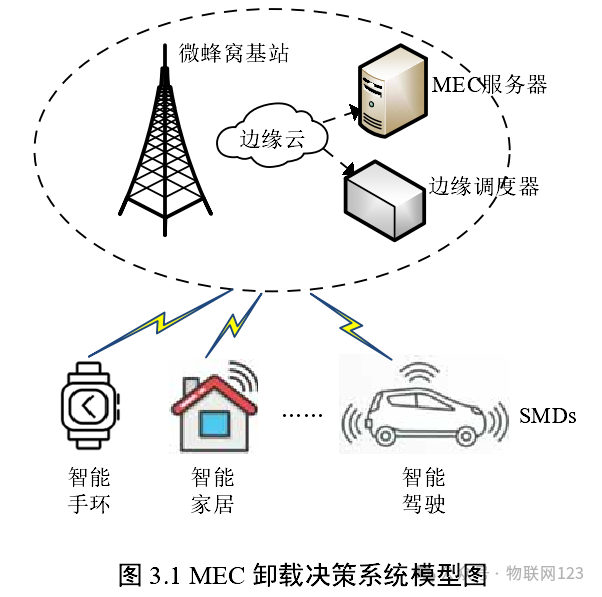
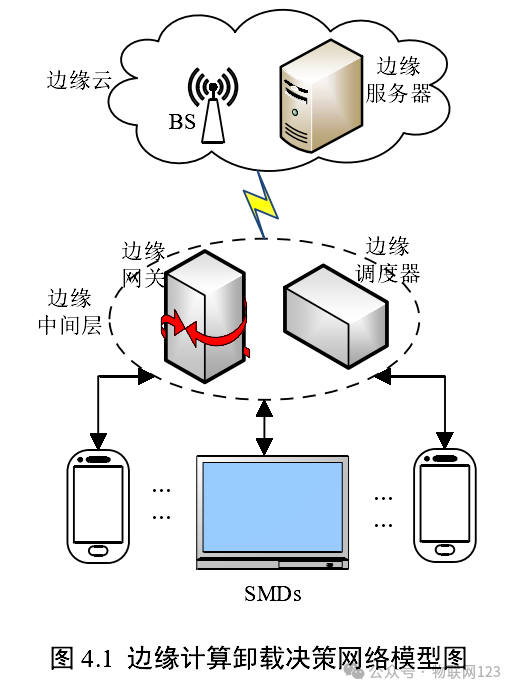
With the continuous innovation of IoT technology and the widespread popularity of IoT mobile terminal devices, new mobile applications are constantly emerging. Although the CPU and memory of IoT mobile terminal devices continue to innovate in physical design, a single device is limited by its own conditions such as CPU, battery, and memory, making it difficult to handle large applications. Edge computing technology can effectively solve the above problems, but as the demand for offloading computing tasks continues to grow, how to balance the decision-making of computing task offloading plays a positive role in the energy consumption and task latency performance indicators of IoT mobile terminal devices. Based on the above issues, the main research content of this paper is as follows:First, in response to the problem that smart mobile devices are insufficient to handle computation-intensive tasks, a task offloading decision aimed at reducing energy consumption of smart mobile devices is studied. First, a system model and mathematical calculation model are established in the scenario of a single edge server and multiple smart mobile devices; then, aiming to reduce the energy consumption of smart mobile devices, a function model regarding latency and energy consumption is formulated, and the problem is described as a nonlinear constrained optimization problem; finally, to overcome the advantages and disadvantages of genetic algorithms and binary particle swarm algorithms, a new algorithm is proposed: the GA-BPSO algorithm, which is used to solve the constrained optimization problem and obtain the offloading decision for the optimization problem, thereby achieving the lowest energy consumption of smart mobile devices under the latency threshold constraint. Simulation experiments are conducted using Matlab R2016a, setting various parameters, and experimental verification shows that the offloading decisions obtained by the GA-BPSO algorithm result in lower energy consumption compared to other algorithms.Second, addressing the execution time of computing tasks and the minimization of energy consumption of terminal devices in multi-device mobile edge computing systems, an optimization problem for edge computing offloading decisions is formulated with the goal of maximizing the system utility of mobile terminal devices. First, a network model of multiple users and a single edge server is constructed; then, by constructing communication models and related calculation models, a system utility function is built to balance latency and energy consumption, and an optimization objective function is formulated based on the system utility function; finally, by combining the binary artificial bee colony algorithm and the binary differential evolution algorithm, and improving the mutation operation and crossover probability factor, a new algorithm is obtained: the binAD algorithm, which is used for iterative updates to obtain edge computing offloading decisions, and the optimization objective function is solved based on the obtained offloading decisions. The binAD algorithm expands the feasible solution space and has strong global search capability, achieving better results in terms of system utility in simulation experiments.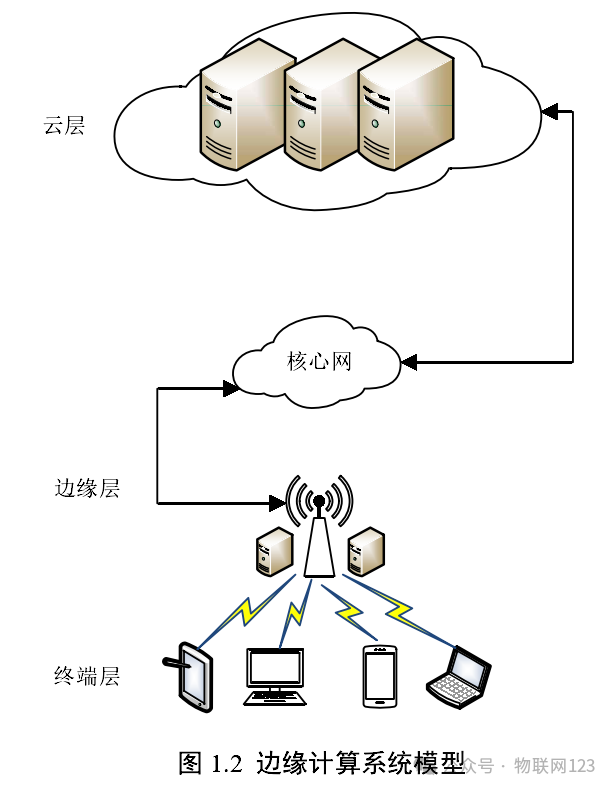
 References:[1] Wang Ze. Research on Offloading Decision Algorithms in IoT Edge Computing [D]. Sichuan Normal University, 2023.
| Disclaimer: The images and text used in this article are all reprinted. If there are any copyright issues, please inform us immediately, and we will confirm and delete the content based on the proof materials you provide. The content of this article represents the author’s personal views and does not represent the views or positions of IoT 123. |
Special Reminder:IoT Professional ExchangeGroup welcomes individuals related to the IoT industry to join. The group also welcomes various social influencers, experts, and seniors. In the group, aside fromnot being able to post sensitive content, pornographic content, and it is not recommended to send promotional content multiple times, other topics can be freely discussed~——Exchange QQ Group 724511126,friends joining the group please note: Name – Organization – Research Direction (without notes, please forgive us for not passing), and will be invited to join the group after editor review!