In the unprecedented changes of the past century, innovative talents, especially those in technological innovation, have increasingly become a key variable determining a country’s competitive advantage. For primary and secondary schools, science education, which focuses on natural science content, aims to enhance the scientific literacy of young people and cultivate reserve talents for technological innovation, is a crucial point for promoting the high-level integration of education, technology, and talent development.
Artificial intelligence is an important driving force behind a new round of technological revolution, bringing more possibilities for the modernization of education. General Secretary Xi Jinping emphasized in his congratulatory letter to the first International Conference on Artificial Intelligence and Education: “China attaches great importance to the profound impact of artificial intelligence on education, actively promotes the deep integration of artificial intelligence and education, and promotes educational innovation.” Artificial intelligence has gradually penetrated the field of education, and analyzing the changes and challenges faced by current science education in primary and secondary schools has far-reaching significance for the future development of science education in these institutions.
French sociologist Pierre Bourdieu uses the concept of “field” to define a network or configuration of objective relationships that exist between various positions. This “network” or “configuration” can change with history and reality, as well as actual and potential circumstances. With the deepening of artificial intelligence in the educational field, the real environment of science education in primary and secondary schools is changing, leading to transformations in the time-space, subjects, resources, and carriers of science education.
1. From Limited to Connected Time-Space in Science Education
The development of artificial intelligence has brought innovation to science education in primary and secondary schools, breaking the limitations of traditional educational time-space and transcending fixed locations and times. The space of science education is moving from within schools to outside, from physical to a combination of virtual and real, and from static to dynamic. By building a holographic science education space through cross-media intelligence, it breaks the physical limitations of time and space, forming a comprehensive “mental image” composed of textual, audiovisual, and sensory information, allowing scientific knowledge to be presented in an intuitive and three-dimensional manner for students to understand comprehensively and effectively. Science education in primary and secondary schools can utilize basic tools such as holographic imaging devices and intelligent sensors to achieve cross-time linkage, presenting past and predictive future scientific inquiry projects for students to engage in learning and research, freeing them from the irreversible shackles of time and transforming science education from “focusing on the present moment” to “experiencing the past, present, and future.”
2. From Unilateral to Rich Content in Science Education
The development of artificial intelligence can break the limitations of scientific education resources, eliminating the “island effect” of educational resources and alleviating the imbalance in the distribution of educational resources. Breaking the barriers of educational time-space allows for the transportation and integration of scientific education resources between schools, regions, and even internationally, compensating for the shortage of educational resources in remote areas. Artificial intelligence empowers science education to create embedded, multidisciplinary knowledge integration scenarios, prompting the content system of science education to break down previous strict disciplinary barriers, effectively bridging the knowledge gaps between disciplines, helping students deeply explore the relevance of scientific disciplines with other subjects, achieving knowledge that is “internalized in the heart and externalized in form,” ultimately enhancing scientific literacy in solving complex scientific innovation practices.
3. From Unidimensional to Multidimensional Subjects in Science Education
In the context of the digital age, the subjects of science education will shift from singularity to multiplicity, from hierarchical to egalitarian, and from exclusivity to cooperation. First, technology enables the realization of cross-time and space, gathering teachers, professionals, parents, and other members from different spaces into the classroom, building a faculty team for nurturing students’ scientific literacy. Generative artificial intelligence such as ChatGPT and Sora can serve as universal task assistants, providing intelligent support for teachers and students, relieving teachers’ burdens while offering rich intelligent tutoring to students. Secondly, the gathering of diverse teachers and the involvement of intelligent educators gradually erode the traditional authoritative position of teachers, assisting in the transformation of teacher-student relationships from “vertical” to “democratic.” The increasingly rich resources in science education can effectively reduce the competitive relationship among students over resources, helping to establish a cooperative “student-student” relationship.
4. From Singular to Diverse Carriers in Science Education
Artificial intelligence supplements the traditional educational carriers such as language, action, and activities with virtual information carriers, achieving diversification of educational carriers. The development of technologies such as machine perception recognition and natural language processing provides a rich variety of tangible carriers for science education. A wealth of online resources showcase and interpret knowledge related to science education, serving as carriers for the publication and transmission of educational content. Artificial intelligence creates nearly realistic VR simulation science education scenarios, comprehensively utilizing language, audio, video, and intelligent terminals as carriers, to create simulated practices, historical and cultural contexts, and interactive scientific activities, thereby building a platform for the comprehensive enhancement of students’ scientific knowledge, abilities, and attitudes.
As artificial intelligence gradually penetrates the field of education, it injects new vitality into educational venues, content, and evaluation systems. However, while bringing educational reform, it also poses new challenges for science education in primary and secondary schools.
1. Narrowing of Real Educational Venues for Science Education
With the support of technologies such as biometrics, knowledge graphs, human-computer interaction, and augmented reality, the proportion of virtual classrooms or intelligent holographic environments in science education in primary and secondary schools will increase, leading to a trend of narrowing real educational venues. However, real venues that present real people and objects are the ultimate destination for science education. Intelligent technology provides students with virtual simulation experiences, but cannot allow them to engage in practical experiences, lacking a sense of presence. As a comprehensive discipline focusing on natural sciences, which includes rich content from science and technology to the sociology of science, science education cannot do without direct personal interaction and practical experience. Over-reliance on virtual educational venues constructed by artificial intelligence in science education in primary and secondary schools, while neglecting the importance of real venues, may lead to misconceptions in students’ scientific concepts and a lack of technological innovation capabilities.
2. Imbalance in the Appropriateness of Science Education Content
Ecological education theory posits that each factor within an ecosystem interacts with other biological species or ecological environments within a moderate range; exceeding this range can lead to an imbalance of optimal conditions and even cause significant changes in the ecosystem. Intelligent technology constructs a rich and diverse knowledge base, aggregating a large amount of scientific education content in the classroom, exceeding the acceptable range for primary and secondary school students, leading to an imbalance between students’ capacity for understanding and the volume of content, resulting in increased cognitive load. High-quality scientific education content is mixed with a large amount of accumulated information, making it difficult to maximize its effectiveness. Furthermore, the presentation of science education content often emphasizes knowledge over practice, general applicability over individualization, lacking precise selection and provision, failing to represent in forms that align with students’ thinking styles and acceptance capabilities, and unable to meet the diverse and personalized development needs of students. As one of the factors in the “ecosystem” of science education in primary and secondary schools, the content of science education cannot fulfill its intended role, leading to a mismatch between actual educational outcomes and the requirements of science education.
3. Monolithic Evaluation System for Science Education
Currently, the evaluation system for science education in primary and secondary schools is monolithic, focusing on the assessment and feedback of explicit factors such as knowledge mastery and specific problem-solving, lacking accurate evaluation of implicit factors such as thinking formation and inquiry ability, making it difficult to comprehensively, accurately, and multilaterally reflect the development status of students’ scientific literacy. Moreover, the current universal and vague evaluation model emphasizes the consideration of students’ common performance, lacking personalized evaluations for students at different developmental levels and a diversified evaluation system for students at different stages of development, making it challenging to provide precise and individualized feedback on each student’s learning process and results. Accurate and scientific feedback results are essential for teachers and students to identify gaps and improve themselves. A monolithic evaluation system cannot accurately reflect the cultivation effects of science education covering knowledge, thinking, and practical abilities, thus failing to provide positive guidance for students’ subsequent learning.
As artificial intelligence deepens in science education in primary and secondary schools, it is necessary to reshape science education by constructing “virtual-real interconnected” educational venues, creating “precise and relevant” educational content, and establishing a “diverse and multidimensional” evaluation system to lay a solid foundation for cultivating technological innovation talents.
1. Constructing “Virtual-Real Interconnected” Educational Venues to Deepen Students’ Real Experience in Scientific Inquiry
Virtual educational venues are a complement and extension of real venues, and should make the virtual realm approach reality as closely as possible, breaking down the barriers between virtual and real educational venues to the greatest extent. First, based on real scientific inquiry scenarios, immersive teaching scenarios should be created using technologies such as VR, AR, and MR, referencing different roles in actual scientific inquiry scenarios, and constructing digital humans with three-dimensional images and real human speech, actions, and expressions through 3D Max modeling, maximizing the enhancement of students’ experiential sense and interpersonal emotional perception in virtual educational venues, guided and coordinated by science teachers.
Secondly, collaboration with real venues such as scientific research institutions, technology enterprises, and agricultural and forestry practice bases that possess both scientific atmosphere and educational functions should be achieved to link virtual science education scenarios in the classroom with real society. In scenarios that visualize scientific literacy, awaken students’ experiential perceptions in virtual scenarios, while promoting their ability to flexibly apply and comprehensively internalize scientific knowledge, enhancing their awareness and capacity for innovation. Additionally, students can flexibly apply the scientific knowledge and inquiry methods learned to solve practical problems in life, fostering interests and habits in scientific inquiry, promoting the actionization of scientific knowledge and thinking, and achieving everyday scientific learning.
2. Creating “Precise and Relevant” Educational Content to Meet Students’ Personalized Needs in Science Learning
According to Shelford’s law of tolerance, students’ capacity and tolerance are limited. When scientific education content is imposed on students, exceeding their capacity and tolerance can be counterproductive. Therefore, the provision of scientific education content is not about quantity but about “precision.” First, a model combining intelligent initial screening with secondary screening by teachers should be established, accurately identifying and analyzing primary and secondary school students’ existing scientific knowledge levels, cognitive levels, and scientific skill acquisition through multi-dimensional data analysis techniques. Based on teachers’ observations and records during the teaching process, students should be grouped and stratified, and based on data analysis, using the advantages of artificial intelligence for analysis and reconstruction, providing relevant scientific content and matching training modes according to the acceptance abilities and learning style preferences of different groups of students. Secondly, through intelligent collection, daily observations by teachers, and communication between teachers and students, the learning thinking, scientific interests, and behavioral preferences of primary and secondary school students should be analyzed, and based on the practical and integrative characteristics of science education, science content modules focusing on major concepts, experimental exploration, and interdisciplinary inquiry should be constructed to meet students’ developmental needs.
3. Establishing a “Diverse and Multidimensional” Evaluation System to Promote Progressive Enhancement of Students’ Scientific Literacy
Some scholars point out that “computationally powerful artificial intelligence excels at processing quantitative information, while creative humans are better at handling qualitative information.” On the one hand, data collection should be implemented using artificial intelligence to continuously, comprehensively, and throughout the process collect students’ scientific learning data, meticulously and comprehensively recording students’ performance in applying scientific knowledge and conducting scientific inquiry, providing a solid data foundation for academic evaluation. On the other hand, a diverse think tank primarily composed of highly qualified science teachers should be established, rationally analyzing the complex implicit factors in qualitative evaluations based on the foundational data provided by artificial intelligence, making personalized assessments for students at different developmental levels. Comprehensive collection and consideration of diverse evaluations and opinions from teachers, parents, and peers should be achieved, realizing both human-machine verification and the diversification and multidimensionality of evaluations. Furthermore, a transitional evaluation model should be constructed, establishing electronic portfolios for each student using artificial intelligence, monitoring and updating in real-time, and collecting complete evaluation data for primary and secondary school students at different stages. Based on feedback from previous stages, evaluation dimensions and standards should be updated to ensure the accuracy and completeness of educational evaluations, promoting the phased enhancement of students’ scientific literacy.
Author’s Institution │Jiangxi Normal University, College of Education
Content Source │ “Information Technology Education in Primary and Secondary Schools”2024 Issue 8
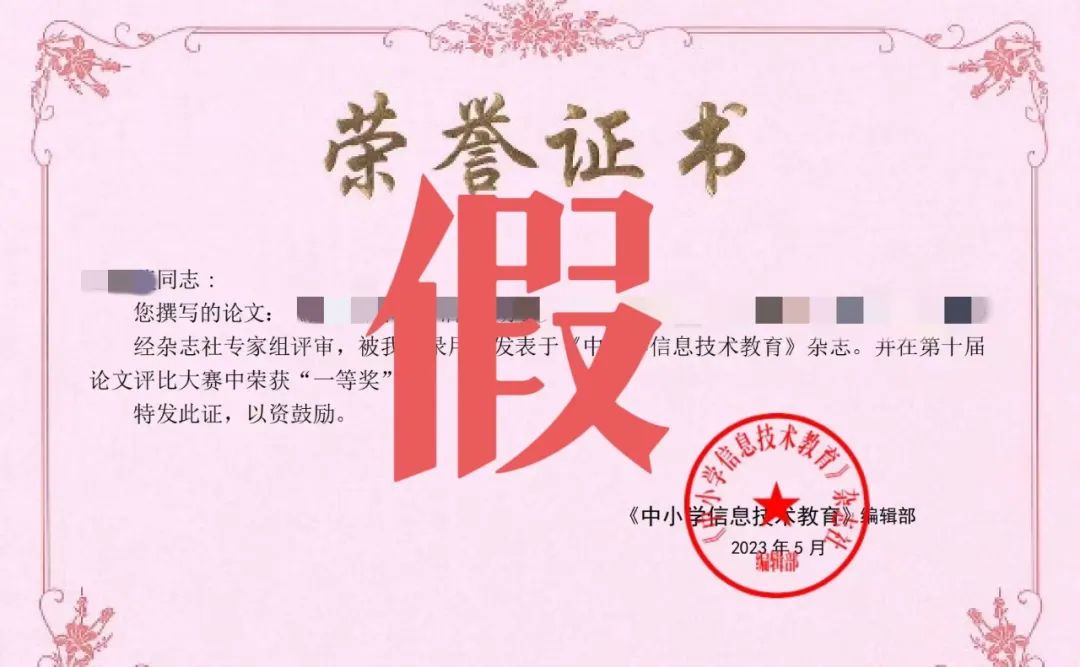
Recently, some teachers received the following manuscript notices and certificates, all of which are counterfeit documents and seals.
Special Reminder! Teachers must not believe it! Do not transfer payment!
↓↓↓


For submissions, please recognize the official submission email ([email protected]) and the WeChat mini-program “Information Technology Education in Primary and Secondary Schools Magazine“.


New Issue Delivery│2023 Issue 8Magazine Directory
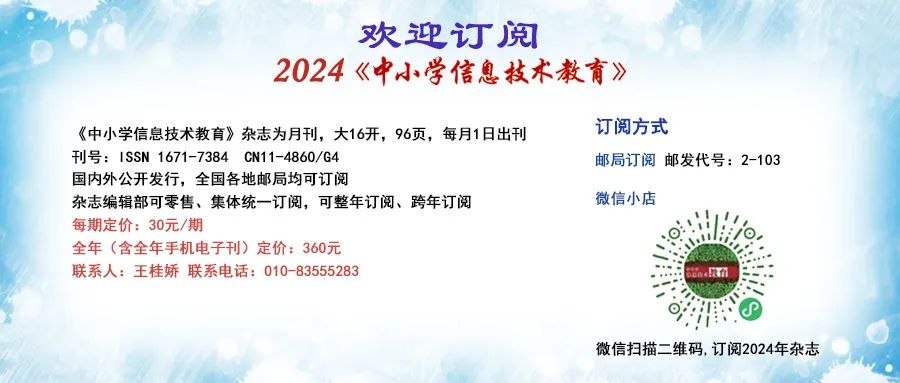
Benefits Here! Welcome to Subscribe to the 2024 Magazine of “Information Technology Education in Primary and Secondary Schools”
Call for Papers! Welcome to Participate in the 2024 Call for Papers on “Digital Empowerment of Primary and Secondary School Teaching Practices”
The 2024 Collection of Information Technology Innovation Applications by Primary and Secondary School Students has begun!