Research Updates
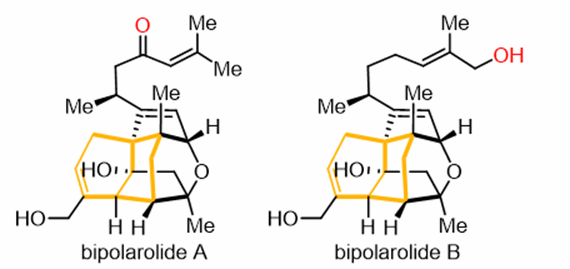
Recently, Professor Lu Zhaohong’s research group has made new progress in the total synthesis of complex diterpenoid natural products, with the related research results published in the Journal of the American Chemical Society as “Enantioselective Total Synthesis of Bipolarolides A and B” (DOI: 10.1021/jacs.5c09835).
Bipolarolides A and B are novel diterpenoid compounds derived from the Ophiobolin family, first isolated by Professor Zhang Yonghui’s group at Huazhong University of Science and Technology in 2019. They feature a [3.3.1] bridged bicyclic skeleton, containing three consecutive chiral centers and a chiral side chain, making their molecular structure quite complex. Notably, Bipolarolide A exhibits significant cholesterol-lowering activity (IC50=2.5 µM).
Professor Lu Zhaohong’s group innovatively employed the Type II Diels-Alder reaction as a key strategy to successfully construct the core structure of the [3.3.1] bridged bicyclic skeleton, ultimately achieving the efficient asymmetric total synthesis of Bipolarolides A and B. This synthetic route was realized through a series of critical transformation steps: first, the initial stereocenter was constructed via iridium-catalyzed enantioselective allylation; subsequently, the bicyclic [3.3.1] non-1-ene core skeleton was efficiently built using the Type II Diels-Alder reaction; then, the construction of the D ring was completed through reductive ether ring-opening and olefin isomerization, followed by aldol cyclization; finally, an electrochemical C-H oxidation reaction was employed to form the ether ring structure. It is worth mentioning that this is the first time the Type II Diels-Alder reaction has been successfully applied in synthetic research to construct a high-tension [3.3.1] bridged system, fully demonstrating the unique advantages of this strategy in the synthesis of complex natural products.
This research was completed under the guidance of Professor Lu Zhaohong, with doctoral student Liu Yufei (who has graduated), master’s student Sun Ke, and doctoral student Wei Qi as co-first authors of the paper. Doctoral students Chen Jin, Sun Shengling, Guo Yingying, and master’s students Li Yaxin and Feng Zhongkai participated in parts of the research work. This research was supported by the National Key R&D Program, the National Natural Science Foundation, and the National High-level Young Talent Support Program.
[Click at the end of the article to read the original paper]



Department of Chemistry, Xiamen University
Official WeChat Account
Click “View” to let more people in the chemistry department see this