“ Limited GPU memory, tight budget, and want a large model to learn new skills? LoRA allows you to “make a little change for a big difference” by training only a small number of parameters, enabling rapid fine-tuning of models for specialized domains. This article guides you through the LoRA fine-tuning process from principles to practical implementation, comparing traditional neural network training with tool-based fine-tuning solutions.“
Follow our WeChat public account for timely updates on more technical information.
Previous content links:
Coze Application Practice: Building a WeChat Smart Interactive Assistant with 0 Code
Coze Deployment Full Process: Quick Success Without Pitfalls
For this issue’s code running example, see GitHub: https://github.com/SWUSTcyt/LoRA
 01 What is LoRA?
One-Sentence Explanation
LoRA (Low-Rank Adaptation) is a fine-tuning method that trains only a small number of incremental parameters, keeping most of the base model’s weights unchanged, and only adding a trainable low-rank matrix in key layers (such as the attention q/k/v/o projection layers). This significantly reduces the number of training parameters, GPU memory usage, and file size while maintaining performance close to full parameter fine-tuning.
A Comparison
Imagine a large model as a versatile fighter jet:
-
Full Retraining: Rebuilding an entire aircraft
-
Full Parameter Fine-Tuning: Disassembling and modifying the entire aircraft piece by piece
-
LoRA Fine-Tuning: Only adding external attachments (like auxiliary fuel tanks or weapon mounts) at key points during inference, you can choose to fly with attachments (load adapters) or merge the attachments back into the aircraft (merge weights for deployment).
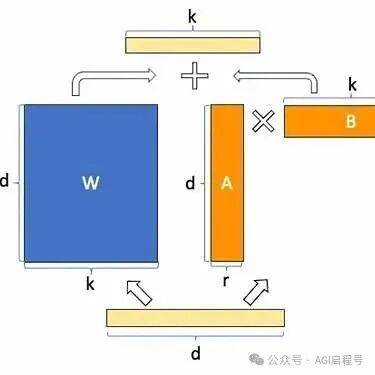
LoRA Injection Principle Diagram
Diagram Content: Shows the frozen pre-trained weights
02 Detailed Practical Process
Next, we will guide you step by step through the LoRA fine-tuning process according to the code execution order, explaining new concepts and evaluation metrics at each step.
1) Load Base Model and Tokenizer
Use <span><span>AutoModelForCausalLM</span></span> to load the base large model (such as Qwen, LLaMA, etc.), and <span><span>AutoTokenizer</span></span> is responsible for tokenizing the text (converting a sentence into a “sequence of numbers”).
Quick Tip:pad_token is needed to pad samples of different lengths within the same batch to the same length; if the model does not have a pad_token, it is common to use
<span><span>eos_token</span></span>as a substitute to avoid errors during training/inference.
2) Configure LoRA Parameters
The key fields of the core object <span><span>LoraConfig</span></span> are:
-
<span><span>r</span></span>(rank): Size of the low-rank matrix, determining the “attachment capacity”; too large may lead to overfitting -
<span><span>lora_alpha</span></span>: Scaling factor that controls the influence of LoRA updates -
<span><span>target_modules</span></span>: Mounting positions, usually the attention<span><span>q_proj/k_proj/v_proj/o_proj</span></span>(high yield) -
<span><span>lora_dropout</span></span>: Apply dropout to the LoRA branch to prevent overfitting
3) Optimal LoRA Configuration Search (Small Dataset, Quick Trial and Error)
Use a smaller subset of data to quickly test multiple sets of (<span><span>r</span></span>, <span><span>alpha</span></span>) combinations, selecting the one with the lowest perplexity PPL, and then formally train on the full dataset.
Concept Overview (Evaluation Metrics, clarified here):
PPL (Perplexity): Measures the model’s “uncertainty” about the next word, the lower the better, indicating the model is more “confident” and predictions are more accurate.
BLEU (Bilingual Evaluation Understudy): Compares the overlap rate of generated text with reference answers at the n-gram level, the higher the better, commonly used in translation.
ROUGE (Recall-Oriented Understudy for Gisting Evaluation): An overlap metric focused on recall (e.g., ROUGE-1/2/L), the higher the better, commonly used in summarization and Q&A.
N-Gram Repetition Rate: The proportion of repeated phrases in the generated text, the lower the better, indicating less redundancy and mechanical repetition.
In practical projects, PPL serves as the main metric (in language modeling scenarios), while also monitoring BLEU/ROUGE (to see how “human-like” it is/close to reference) and N-Gram Repetition Rate (to avoid redundancy).
4) Training (Comparison with Traditional Neural Network Training)
The core process is consistent: Forward → Calculate Loss → Backpropagation → Optimizer Update; the difference lies in “which parameters are updated”:
-
Full Parameter Training: Updates all weights
-
LoRA Fine-Tuning: Only updates the low-rank matrix parameters of LoRA, freezing the base weights which intuitively leads to less memory usage and faster training, while the code structure remains almost unchanged (only adding a “trainable branch” in some layers).
5) Evaluation and Early Stopping
Evaluate once per epoch (or fixed steps):
-
Mainly look at PPL (the lower the better)
-
Also look at BLEU/ROUGE (the higher the better) and N-Gram Repetition Rate (the lower the better) to achieve the best metrics and then stop early, saving the best weights.
6) Weight Merging
The result of LoRA training is “base + attachment”. There are two deployment paths:
-
Adapter Mode: Load “base + adapter” during inference, allowing flexible domain switching
-
Merging Mode: Use
<span><span>merge_and_unload()</span></span>to merge the attachment back into the base, resulting in a single model, simplifying deployment
03 Key Code Analysis (Optimal Configuration → Training → Merging)
1) Optimal LoRA Configuration Search
def find_optimal_lora_config(model, train_dataloader, val_dataloader, device, evaluator): configs = [ {"r": 16, "alpha": 64}, {"r": 8, "alpha": 32}, {"r": 4, "alpha": 16} ] best_ppl, best_config = float('inf'), None for cfg in configs: lora_cfg = LoraConfig( r=cfg["r"], lora_alpha=cfg["alpha"], target_modules=["q_proj","k_proj","v_proj","o_proj"], lora_dropout=0.1, task_type=TaskType.CAUSAL_LM ) peft_model = get_peft_model(model, lora_cfg) ppl = evaluator.evaluate(peft_model, val_dataloader, device) # Returns PPL if ppl < best_ppl: best_ppl, best_config = ppl, cfg return best_configKey Point: Small samples + multiple sets of (<span><span>r</span></span>, <span><span>alpha</span></span>) trials, using the lowest PPL as the “winning” criterion. Compared to the traditional NN’s “full grid search”, this method is lower cost and faster.
2) LoRA Training (Comparison with Traditional NN)
for epoch in range(num_epochs): model.train() for step, batch in enumerate(train_dataloader): outputs = model(**batch) loss = outputs.loss loss.backward() optimizer.step() scheduler.step() optimizer.zero_grad() model.eval() val_ppl = evaluator.evaluate(model, val_dataloader, device) if val_ppl < best_ppl: best_ppl = val_ppl model.save_pretrained(best_ckpt_dir) # Save "best weights" earlyComparison: The process is the same as traditional NN, but LoRA only updates the mounted branches; memory and time consumption are significantly reduced.
3) Merge Parameters (Generate Single Model)
from peft import PeftModel peft_model = PeftModel.from_pretrained(base_model, adapter_path) peft_model = peft_model.to("cpu") # Merging can be done on CPU to reduce memory usage merged_model = peft_model.merge_and_unload() # Get the "merged" base structure model merged_model.save_pretrained(output_dir) tokenizer.save_pretrained(output_dir)Key Point: No need to carry adapters for deployment; after merging, it becomes a “native” structured single model,making it easier to go live.
04 LLaMA Factory Comparison Analysis (with Current Process)
Similarities
-
Underlying principles are consistent: freezing base weights + attaching LoRA at
<span><span>q/k/v/o</span></span>and other projection layers -
Training paradigm is consistent: Forward → Backward → Gradient Update
-
Both support parameter search, early stopping, and weight merging
Differences:
| Dimension | Your Current Code | LLaMA Factory |
|---|---|---|
| Configuration Method | Handwritten <span><span>LoraConfig</span></span>, loop trials |
Configuration file/CLI specified at once, more standardized pipeline |
| Data Preparation | Custom <span><span>DataLoader</span></span>, free cleaning |
Built-in multi-data format parsing, templates, and augmentation |
| Parameter Search | Need to write experimental logic | Provides some automation/scaffolding for quicker onboarding |
| Monitoring & Logging | You decide (TensorBoard/MLflow, etc.) | Built-in logging, optional visualization/export |
| Export and Deployment | Manual merging/saving | Can directly export HF-compatible structure and adapters |
Applicable Scenarios
-
Handwritten Code: Strong research/customization, convenient for in-depth debugging and modifying model structure
-
LLaMA Factory: Standardized rapid implementation, batch model/task iteration, unified team collaboration configuration
05 Practical Suggestions
-
There is no need to wait for a full epoch, use PPL + BLEU/ROUGE + N-Gram Repetition Rate to comprehensively select the “optimal checkpoint”
-
Start with small samples for (
<span><span>r</span></span>,<span><span>alpha</span></span>) rough searches, finalize before full training -
When multiple domains coexist, prioritize adapter mode (quick switching); use merging mode when simplifying deployment.
06 Conclusion
LoRA is like adding attachments to a model: small investment, big returns. Your practical process has covered the complete loop of “configuration → training → evaluation → merging → deployment”. The next steps could include:
-
Multiple adapters coexisting (loaded by scenario)
-
Combining with quantization (like QLoRA) for further cost reduction
-
Integrating RAG to make the model better “understand” your knowledge base
Reference link:https://www.heywhale.com/home/competition/67f34af37c3581847bc67643/content/1
🤖 Discussion Area Interaction: What challenges have you encountered during LoRA fine-tuning?