✦
✧
UltraRISC Technology UR-DP1000
8-Core CPU Hardware Virtualization
Performance Exploration
✦

UltraRISC Technology (Shanghai) Co., Ltd. focuses on the development of high-performance, energy-efficient, and intelligent multi-core processor chip products based on the RISC-V architecture. The launched UR-DP1000 is a high-performance 8-core RISC-V CPU chip aimed at desktop-level applications.
The UR-DP1000 was designed from the outset to target applications requiring higher computing performance, such as desktop terminals, edge computing, and lightweight servers. It is also the first commercial CPU to implement the RISC-V H extension, and this article explores its hardware virtualization performance.
Environment Configuration
-
QEMU version 8.2.2 installed via apt
-
The VM image environment uses Linux kernel 6.8, Ubuntu 22.04.
-
The main testing method compares three approaches: native, pure software, and KVM-assisted virtualization.
CoreMark
The CoreMark was compiled using GCC 11 and GCC 14, with the following performance results:
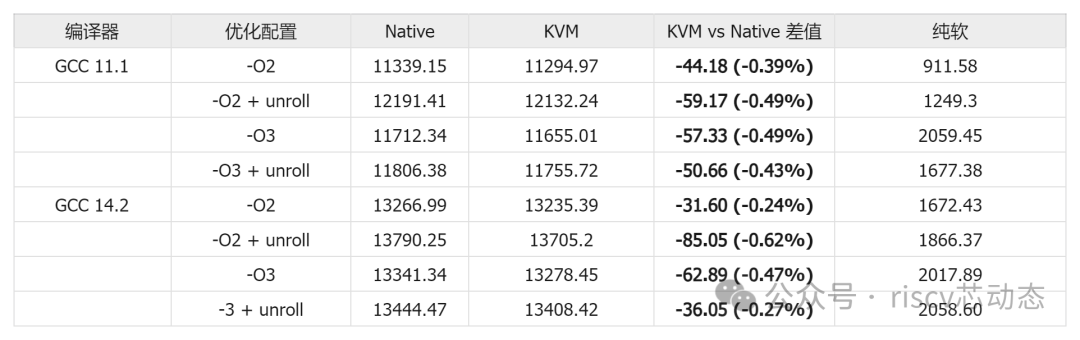
Based on the UltraRISC UR-DP1000 chip, we conducted CoreMark tests in three operating environments, showing significant performance gradients:
-
In the native environment, thanks to the chip’s out-of-order execution architecture and xur private instruction optimization, CoreMark reached 16315.88, a 23% improvement over the general GCC 14.2, fully validating its design goal of “matching ARM Cortex-A76.”
-
In the KVM virtualization environment, performance is almost lossless, with a loss of only 0.2%-0.6%, even with heavy optimizations like O3+unroll+xur, it still maintains 99.6% performance. This benefits from hardware’s native support for the RISC-V H extension, making the DP1000 highly promising for cloud-native and desktop virtualization.
-
In pure software simulation, due to the lack of support for custom instructions, related tests directly reported errors, with the performance of the standard GCC configuration being only 15.3% of KVM’s, highlighting the importance of hardware acceleration.
Additionally, the tests revealed that enabling compiler loop unroll optimization generally brings an extra 5%-13% performance, indicating a deep coupling between compiler strategies and hardware architecture. Interestingly, in the pure software environment, GCC -O3 even surpassed -O2 by 125%, suggesting that the simulator is more sensitive to compiler optimizations.
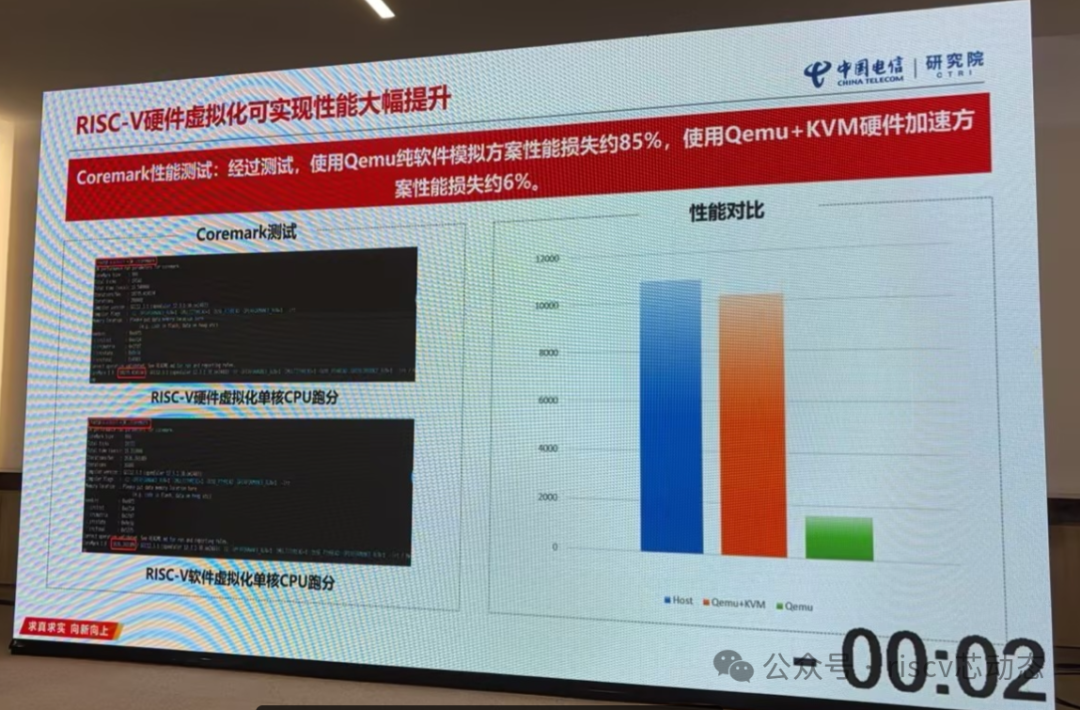
Furthermore, China Telecom Research Institute has already used the UR-DP1000 in its cloud computing solutions, and telecom has conducted similar evaluations, measuring the hardware-accelerated virtualization performance overhead at around 6%.
STREAM Test
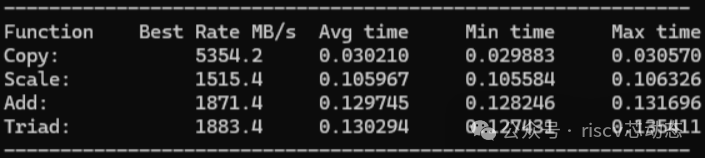
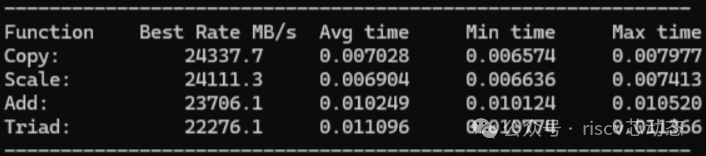
The STREAM test data is as follows:
Pure Software:
KVM Hardware Virtualization:
-
Copy operation bandwidth surged from 5354.2 MB/s to 24695.1 MB/s, an increase of 361%;
-
Scale operation skyrocketed from only 1515.4 MB/s to 24445.9 MB/s, an increase of nearly 16 times, thanks to KVM’s optimizations for memory access and address translation;
-
The Triad operation (reading two sets of data and writing the result) reached 22837.5 MB/s under virtualization, 12 times that of pure software simulation.
Notably, mixed memory operations like Add/Triad exhibit extremely high bandwidth and low fluctuations in the hardware virtualization environment, with latency stability improving nearly 10 times, which is significant for latency-sensitive applications like databases.
However, there remains a 4.7% bandwidth gap between Copy and Scale, possibly due to the current memory controller’s switching costs between moving and computing. Future introduction of new mechanisms like IOMMU or AIA will further optimize such instruction-memory mixed loads.
p7zip Benchmark Performance Test
p7zip was installed via apt on Ubuntu 22.04, version 16.02.
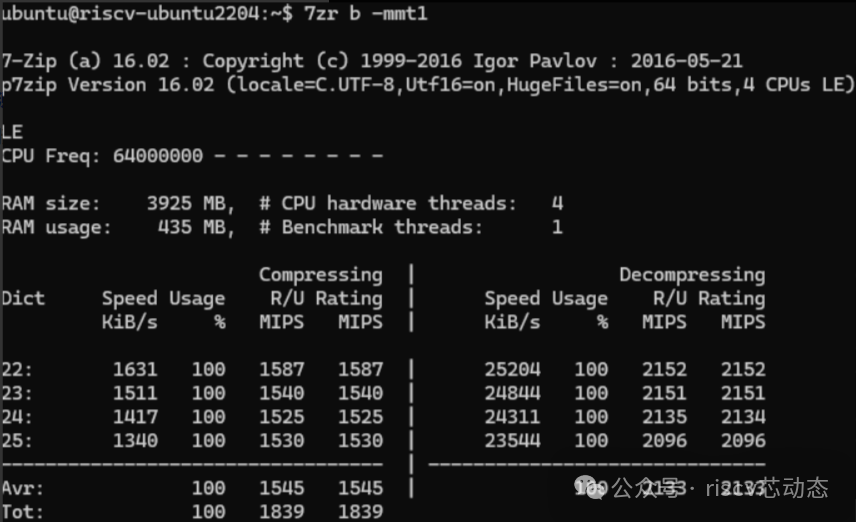
Single-threaded compression and decompression performance:
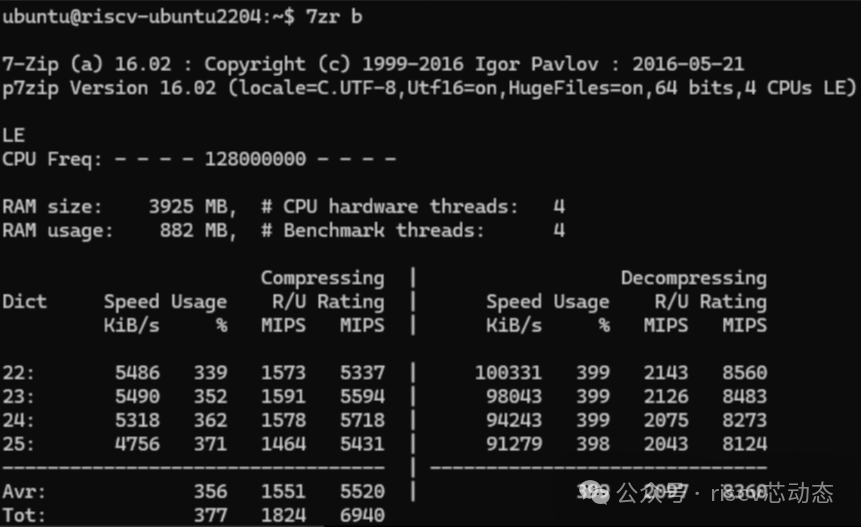
Multi-threaded compression and decompression performance:
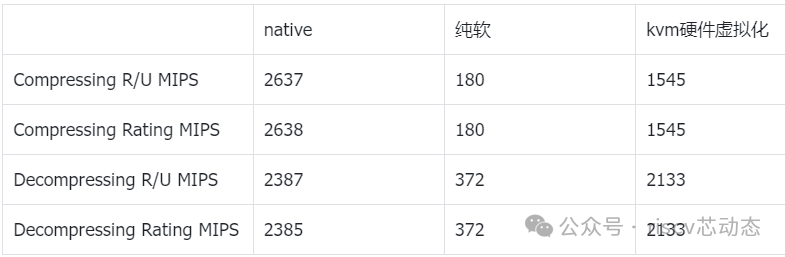
Comparison of single-core performance with native and pure software:
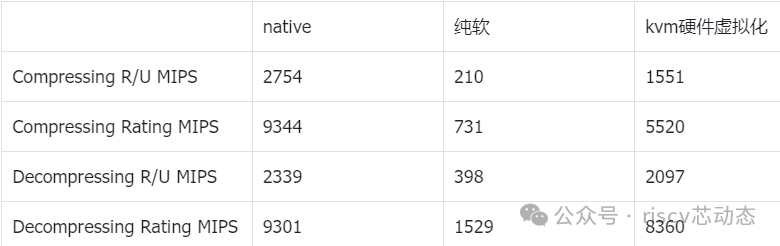
Comparison of 4-core performance with native and pure software:
In the single-core compression/decompression scenario, the UR-DP1000 demonstrates strong performance through KVM hardware virtualization:
-
Compression performance: KVM mode reaches 1545 MIPS, 8.6 times that of pure software virtualization, recovering 58.5% of native performance;
-
Decompression performance: KVM reaches 2133 MIPS, close to native (2387 MIPS) at 89%, far exceeding pure software simulation (only 372 MIPS).
When expanded to four-core parallelism, KVM still maintains good performance:
-
Multi-core compression performance reaches 5520 MIPS, 59% of native (9344 MIPS);
-
Multi-core single-thread performance (1551 MIPS) is basically on par with single-core mode (1545 MIPS), indicating good resource isolation in virtualization;
-
In the decompression scenario, KVM throughput reaches 8360 MIPS, recovering 90% of native performance.
OpenSSL Speed Test
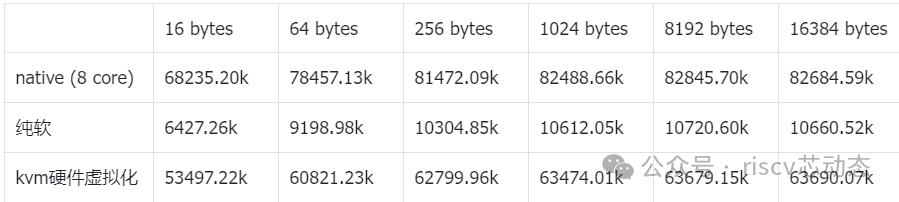
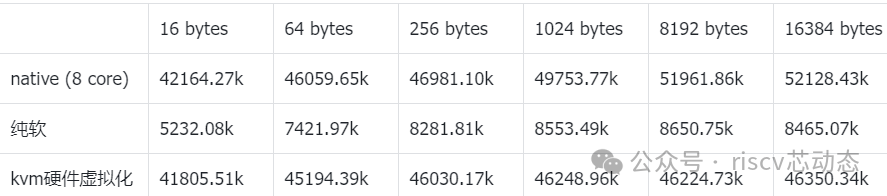
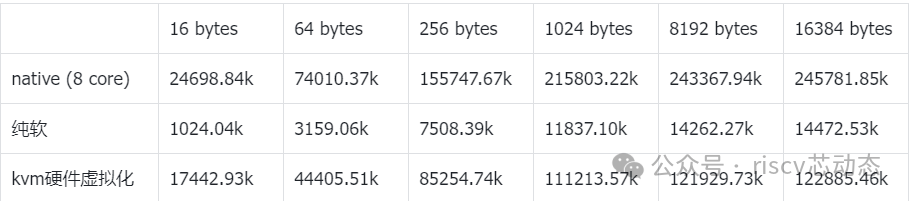
OpenSSL was installed via apt on Ubuntu 22.04. The test results are as follows:
AES-256-CBC
AES-256-GCM
SHA1
SHA256
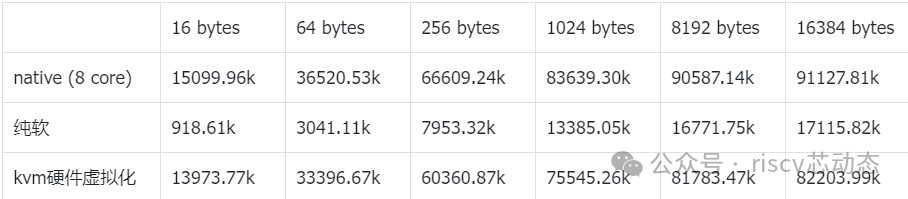
Based on OpenSSL encryption tests, the UR-DP1000 maintains excellent performance under hardware virtualization:
-
In AES-256-CBC mode, the VM small packet (16B) processing speed reaches 53.5GB/s, 78% of native performance, far exceeding pure software simulation (6.4GB/s).
-
The large packet (16KB) processing bandwidth approaches 63.7GB/s, 77% of native (82.7GB/s).
-
AES-NI instruction pass-through is crucial, avoiding instruction translation overhead in pure software environments.
Even in the more complex AES-256-GCM mode, KVM virtualization maintains 46.3GB/s, still more than five times that of pure software environments.
Hash algorithm performance shows more variability:
-
SHA1 has 70% of native performance for small packets (17.4GB/s), but only 50% for large packet processing, limited by memory copy overhead.
-
SHA256 is more stable, maintaining 92.5% and 90.2% of native performance for small packets (16B) and large packets (16KB), respectively, indicating better hardware acceleration support.
Additionally, tests found:
-
Under virtualization, cryptographic operations are easier to release performance, with AES instruction sets benefiting from KVM’s hardware-level pass-through;
-
Hash operations are limited by memory bandwidth, with larger data blocks showing more apparent virtualization overhead;
-
The best throughput performance occurs with data blocks larger than 4KB, providing key parameter references for system tuning.
Cold Boot Time
Next, we tested the cold boot time with and without KVM enabled, running the following command:
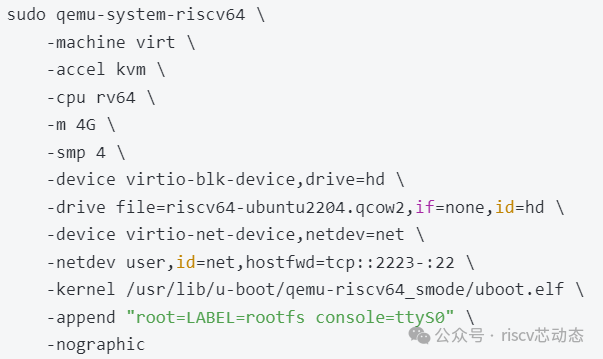
The test results are as follows:

Hardware-level virtualization acceleration compresses the VM cold boot time from minutes to just 7 seconds, achieving an efficiency improvement of up to 94% compared to traditional pure software virtualization. This achievement is attributed to its deep support for the H extension, particularly in the following three aspects:
-
Privilege instructions executed directly: KVM can natively run the virtual machine monitor without relying on QEMU software simulation;
-
Address translation pass-through acceleration: The MMU hardware completes the mapping of guest physical addresses, significantly reducing memory overhead;
-
Interrupt control hardware takeover: Virtual interrupt controllers like AIVIA reduce context switch latency.
VM Live Migration
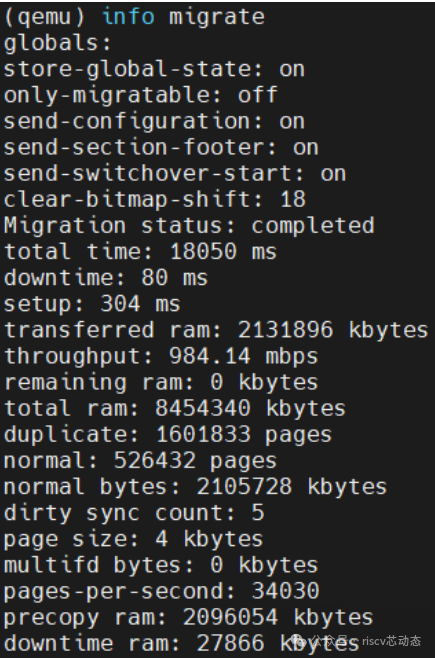
The video below demonstrates the VM live migration technology. A virtual machine is started, then using QEMU incoming to wait for migration, and after the VM is up, the migration is performed using the QEMU monitor’s migrate command.
From the video, it can be seen that the migration process from guest1 (top right) to guest2 (bottom right) is quite smooth. The specific data shows that the migration downtime is very small, only 80ms.
Conclusion
The UR-DP1000, with its deep support for RISC-V virtualization extensions (H extension), demonstrates near-native performance in several key scenarios:
-
Computational tasks: In CoreMark tests, KVM virtualization only incurs a performance loss of 0.2%~0.6%;
-
Memory read/write: STREAM bandwidth is nearly on par with native;
-
Compression/decompression: 7z decompression throughput reaches 90% of native, and compression tasks maintain nearly 60% performance, far superior to traditional pure software virtualization;
-
System boot: VM cold boot time reduced from 108 seconds to 7 seconds, achieving a 94% improvement;
-
Encryption/decryption performance: AES-256-CBC under virtualization bandwidth reaches 63.7GB/s for 16KB data blocks, 77% of native, far exceeding pure software solutions (only 9.4% of native).
Currently, the UR-DP1000 has demonstrated excellent performance in CPU and memory virtualization, and with the future addition of IOMMU and AIA, its I/O virtualization performance has even greater potential for improvement, aiding in the construction of a high-performance, low-latency RISC-V virtualization platform.

This article references:
https://zhuanlan.zhihu.com/p/1930666931305833544

✦
END
✦