 Detailed Explanation of the GESP Examination Syllabus | C++ Level 2Grade Examination of Software ProgrammingC++ Certification Knowledge System (Level 2)1. Assessment Objectives
Through the study of basic computer knowledge, understand computer storage and network knowledge, classification and characteristics of programming languages, common programming languages, and methods for drawing flowcharts. Through the study of C++ knowledge, master the methods of data type conversion and the use of mathematical library functions, and be able to independently complete programs with multiple branching structures and loop structures.
2. Knowledge Content
-
Computer Storage and Networks
-
Characteristics of Programming Languages
-
Concept and Description of Flowcharts
-
ASCII Encoding
-
Data Type Conversion
-
Multi-layer Branching / Loop Structures
-
Common Mathematical Functions (Absolute Value Function, Square Root Function, Max Function, Min Function)
3. Knowledge Blocks and Descriptions
Knowledge Points
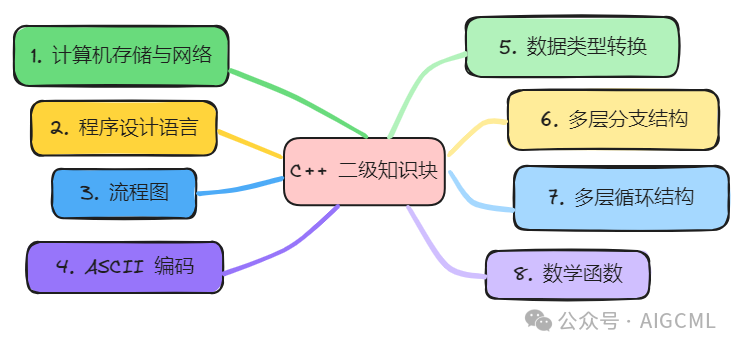
| Number | Description of Knowledge Points |
| 1 | ROM, RAM, CACHE, Classification of Computer Networks, TCP/IP Four-Layer Model and OSI Seven-Layer Model, IP Address and Subnetting |
| 2 | Classification of Programming Languages, Common High-Level Languages |
| 3 | Concept of Flowcharts, Drawing Flowcharts, Describing Flowcharts |
| 4 | Common Characters’ ASCII Encoding, Conversion Between Character Encodings |
| 5 | Explicit Type Conversion, Implicit Type Conversion |
| 6 | Nested if Statements, if…else Statements, switch Statements |
| 7 | Nested while Loops, do…while Loops, for Loops |
| 8 | Absolute Value Function: abs(), Square Root Function: sqrt(), Max Function: max(), Min Function: min(), Random Number Function: rand()/srand() and Related Functions |
4. Detailed Knowledge Points
Knowledge Details
01
Understand the basic concepts and classifications of computer storage, and understand the functions and differences of Random Access Memory (RAM), Read-Only Memory (ROM), and Cache.
02
Understand the concept of computer networks, the classification of computer networks (Wide Area Network WAN, Metropolitan Area Network MAN, Local Area Network LAN), the hierarchical structure and functions of computer networks (TCP/IP Four-Layer Model and OSI Seven-Layer Model), important protocols at different levels, and understand IP addresses and subnetting.
03
Understand the major classifications and characteristics of programming languages (machine language, assembly language, high-level language), and understand common high-level languages (C++, Python, etc.).
04
Understand the concept of flowcharts and basic representation symbols, master the methods of drawing flowcharts, and be able to correctly use flowcharts to describe the three basic structures of program design.
05
Understand the basic concept of encoding, understand the principles of ASCII encoding, be able to recognize the ASCII codes of common characters (space: 32, “0”: 48, “A”: 65, “a”: 97), and master the methods of conversion between ASCII codes and characters.
06
Master data type conversion: explicit type conversion and implicit type conversion.
07
Master multi-layer branching structures, master if statements, if…else statements, switch statements, and the methods of nesting them.
08
Master multi-layer loop structures, master for statements, while statements, do…while statements, and the methods of nesting them.
09
Master common mathematical functions: absolute value function, square root function, max function, min function, random number function, and understand the corresponding algorithm principles.
5. Question Type Distribution
Examinations
| Multiple Choice Questions | True/False Questions | Programming Questions |
| 15 questions (2 points each) | 10 questions (2 points each) | 2 questions (25 points each) |
Exam Duration:120 minutesOnline Judge ProblemsOnline Real Questions
Past programming questions can be directly evaluated online on the Luogu website.
The list of questions is organized as follows, the question list URL is:
https://www.luogu.com.cn/training/552#problems
In addition, you can also directly find past real questions on the GESP official website, the URL is:
https://gesp.ccf.org.cn/101/1010/index.html
As of now (November 2025), GESP C++ Level 2 has a total of 11 sets of real questions, and the corresponding solutions can be found directly in the CCF GESP official public account, the relevant article links are organized as follows:
-
March 2023, Solution to Real Questions / Review of GESP C++ Level 2 March Real Questions
-
June 2023, Solution to Real Questions / Review of C++ Level 2 June Real Questions
-
September 2023, Solution to Real Questions / Review of GESP September Certification C++ Level 2 Real Questions
-
December 2023,
-
March 2024, GESP Fifth Certification Real Questions Solution | Review of C++ Level 2 Real Questions
-
June 2024, GESP Sixth Certification Real Questions Solution | Review of C++ Level 2 Real Questions
-
September 2024, GESP Seventh Certification Real Questions Solution | Review of C++ Level 2 Real Questions
-
December 2024, GESP Eighth Certification Real Questions Solution | Review of C++ Level 2 Real Questions
-
March 2025, GESP Ninth Certification Real Questions Solution | Review of C++ Level 2 Real Questions
-
June 2025, GESP Tenth Certification Real Questions Solution | Review of C++ Level 2 Real Questions
-
September 2025,[Check the GESP official public account for the latest real questions solutions]
Note:The registration for the 12th certification will close on December 17, students should hurry up and prepare. Practicing real questions is very necessary! Since the past real questions provided by the GESP official website come with answers, it is inconvenient to print them out for self-testing training, so I have organized a set of answer-free printable real questions, the acquisition method is as follows: Click on the above Follow me
After following, send a message in the public account:“GESP C++“, you can obtain GESP C++ past real question materials, including both answered and unanswered real questions.
After completing the real questions, we can also go to some online evaluation systems (OJ) to do programming questions for further training.
More ProblemsProgramming Practice
#include <bits/stdc++.h>
using namespace std;
int main() {
  cout << "AK GESP C++";
  return 0;
}

// Follow us for more information and materials

/*
 * Information Technology Exchange
 * Code Knowledge Sharing
 * Programming Problem Solving
 * Promoting Science and Technology Education
 */
For most primary and secondary school students nationwide, they can practice programming questions on the Luogu platform, and can also practice on the Shanghai Computer Society Competition Platform according to star levels. Of course, Zhejiang also has many excellent OJ platforms from the Informatics Olympiad institutions, providing free programming practice and algorithm competitions/monthly contests, etc., everyone can participate more to promote learning through competition. If you have any questions or ideas, feel free to discuss and exchange! Scan to add friends for discussion Add friend | Note “C++”