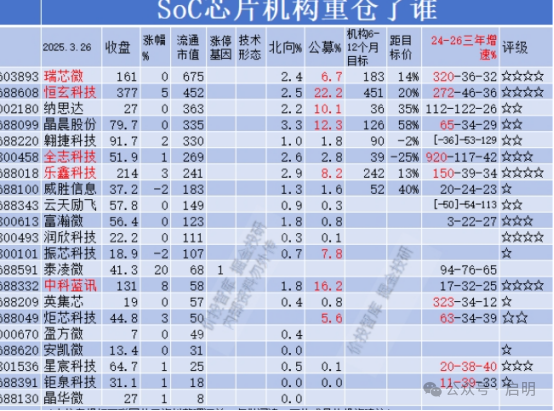
Last year, the SoC market was very popular, but it has been quiet for a while. Are there new opportunities in the SoC market? Today, we will summarize the data on the SoC market.
SoC is also known as System on Chip, which typically consists of three main modules: memory, interfaces, and processors. It achieves powerful computing and communication capabilities while meeting the requirements of mobile devices for low power consumption and small size. In the past 10 years, this technology has been widely applied in fields such as mobile phones, computers, automobiles, smart homes, autonomous driving, and artificial intelligence.
SoC chips are an industry that transmits from the supply side to the demand side, as they have many significant advantages, such as strong data security and privacy protection, low power consumption, low latency, and relatively low deployment costs. Therefore, SoC can be regarded as the core computing power for edge-side AI, which can empower downstream AI based on specific scenarios and needs of customers, thus achieving a significant increase in efficiency.
From a medium to long-term perspective, edge-side AI accelerates the iteration of terminal products, especially with various AI terminals such as AI headphones and AR glasses gradually coming to market, which will undoubtedly bring new development opportunities for SoC chips.
Today, we will summarize five core companies in the SoC chip industry.
First, Rockchip.
Focuses on smart application processor chips, with revenue mainly from SoC chips. It provides ASIC chips designed for specific functions, including interface conversion, wireless connectivity, and MCU chips. The downstream products are mainly IOT, primarily used in consumer electronics such as tablets, smart boxes, and smartphones. It has also been successfully applied in various robots, with products already in mass production in several domestic smart cars. The National Integrated Circuit Fund holds a 4.48% stake. The company has thousands of clients, including leading internet companies like Baidu and Alibaba, consumer electronics giants like Lenovo, Sony, and Xiaomi, as well as well-known automotive companies like BYD. The forecast for the 2024 annual report predicts a net profit of 550-630 million, a year-on-year increase of 308-367%.
Second, Hengxuan Technology.
Positions itself in wireless ultra-low power computing SoC chips, with its main business being the R&D, design, and sales of smart audio and video SoC chips. It ranks second globally in market share for Bluetooth headphones, and its products are widely used in smart Bluetooth headphones, WiFi smart speakers, smartwatches, and other low-power smart audio and video terminal products. Clients include Honor, OPPO, Huawei, Xiaotiancai, Xiaomi, iFlytek, and Oladance (acquired by ByteDance) among others. Xiaomi and Alibaba have both been shareholders of the company. Volcano Engine and Runxin Technology have collaborated to create voice toys, with its Wi-Fi modules using Hengxuan Technology, and Tuya Smart has also participated in providing related modules and docking platforms.
The company’s new generation of BES2700 series wearable main control chips developed based on 12nm FinFET technology has seen continuous improvement in market recognition, driving rapid growth in the company’s revenue scale. The new generation of 6nm smart wearable chip BES2800 has successfully completed tape-out and mass production, integrating multi-core CPU/GPU, NPU, large-capacity storage, low-power Wi-Fi, and dual-mode Bluetooth, providing strong computing power and high-quality seamless connectivity experience for wearable devices, and has been gradually adopted in projects of multiple clients’ headphones, smartwatches, and smart glasses.
2024 annual performance report shows revenue and net profit of 3.26 billion and 460 million, a year-on-year increase of 50% and 272%.
Third, Allwinner Technology.
The company’s main chips are smart terminal application processor SoC chips, accounting for over 80% of revenue, with products widely used in smart home and automotive intelligence fields. In the automotive electronics sector, multiple products have achieved mass production, covering various forms such as smart in-car infotainment systems and fully digital dashboards. The company’s RISC-V can meet the needs of processors of various sizes, from microcontrollers to supercomputers, supporting various implementations from FPGA to ASIC. Clients include Huawei, Xiaomi, Baidu, ByteDance, and iFlytek. The company holds a 0.126% stake in Shenzhen Anchuang, thus indirectly holding shares in Yushu Technology; Xiaomi’s robotic dog Cyberdog also uses Allwinner’s solutions. The company entered the ByteDance edge-side market early and has maintained a close and open cooperative relationship with Alibaba’s Pingtouge chip for many years.2024 annual report shows revenue of 2.29 billion, a year-on-year increase of 37%; net profit 167 million, a year-on-year increase of 626%。
Fourth, ZTE Blue Ocean.
The company’s wireless audioSoC chips integrate high-performance RISC-V architecture CPU, DSP extended instructions, dual-mode Bluetooth baseband, and RF modules, with main products applied in Bluetooth headphones and Bluetooth speakers. The smart wearable solutions have completed a comprehensive product layout, fully meeting different customer needs, especially the AB568X and AB569X series, which have received high recognition in the industry for their excellent display effects and high cost-performance ratio. The company’s AB569X chip has been applied in the smartwatches of the Indian sub-brand Fastrack.
The Xunlong third-generation BT896X series chips have been applied in the smart speakers of the Xiaodu Tiantian AI tablet robot. In addition to having Hi-Res small gold standard dual certification, providing consumers with a high-quality vocal experience, it can also achieve AI voice interaction functionality.
The Xunlong third-generation BT895x chip has completed docking with the Volcano Ark MaaS platform, providing users with software and hardware solutions compatible with Doubao large models. The Xunlong third-generation BT895x chip has been equipped in the FIILGSLinksAI high-quality open headphones, which is the second headphone product on the market supporting Doubao large model AI, following the previously launched OlaFriend headphones. The company’s BLE chip is currently applied in Honor personal care and sports health products; cloud platforms such as Tencent and Honor have been connected and achieved mass production and shipment.
Fifth, Espressif Technology., has significant advantages in the WiFi MCU chip field, launching integrated Wi-Fi and Bluetooth RISC-V IoT chips, primarily targeting smart home and edge computing devices, mainly reflecting voice wake-up and control at the device end, as well as image processing functions, supporting dual-band Wi-Fi6. On January 23, the Volcano Engine official account confirmed that Quectel and Espressif are smart hardware partners, and the company’s chip modules supply Doubao AI toys. The 2024 annual report shows revenue and net profit of 2.01 billion and 340 million, a year-on-year increase of 40% and 149%。Tianjin Jinmi once held a 2.5% stake in 2019.
The investment equation states that market value equals net profit times valuation. The key is to find companies with continuously growing net profits, making it easier to achieve a double Davis effect. By sorting through the industry, selecting companies, doing proper valuations, and waiting for the right opportunity.
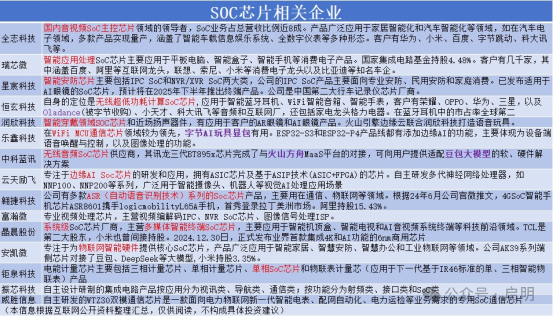
Sort through the industry, select companies, do proper valuations, and wait for the right opportunity!
If you find this useful, please like and share. If you have any questions, let’s discuss in the comments.
 Your shares, likes, and views are all appreciated!Thank you!