This article is the ultimate guide to object-oriented programming in C, providing a comprehensive analysis of the three core features: encapsulation, inheritance, and polymorphism. It offers complete code implementations and in-depth comparative analysis, revealing the unique value and practical applications of C in system programming. Through this article, you will master advanced techniques for implementing object-oriented programming in C and understand its practical applications in areas such as the Linux kernel and embedded systems.
Introduction
The Essence of Object-Oriented Programming
Object-oriented programming (OOP) is a programming paradigm centered around organizing code structure through entities known as objects. Objects encapsulate data (attributes) and behaviors (methods) into autonomous units, establishing hierarchical relationships through inheritance for code reuse, and utilizing polymorphism to achieve differentiated behavior through the same interface. The ultimate goal of OOP is to enhance software modularity, maintainability, and extensibility by simulating interactions of real-world entities, thereby constructing systems with high cohesion and low coupling. This paradigm is particularly adept at managing the state and behavioral interactions of complex systems, making it one of the cornerstones of modern software engineering.
The Core Advantages of Implementing OOP in C
- 1. Zero Abstraction Overhead: Direct memory manipulation
- 2. Transparent Memory Layout: Precise control over every byte
- 3. No Runtime Dependencies: Does not rely on the C++ standard library
- 4. Cross-Platform Compatibility: Supported by ANSI C standards
- 5. Binary Stability: C ABI compatibility for decades
Part One: Encapsulation and Visibility Control
1.1 Principles and Value of Encapsulation
Encapsulation is the cornerstone of object-oriented programming, binding data and functions that operate on the data into independent object units. In C, encapsulation is not only a way of organizing code but also a key safeguard for system security:
- • Data Protection: Prevents unauthorized modifications to critical states (e.g., kernel data structures)
- • Interface Stability: Hides implementation details, maintaining compatibility of public APIs
- • Module Decoupling: Reduces inter-module dependencies, enhancing maintainability
- • Resource Management: Centralizes control over resource lifecycles, avoiding memory leaks
Depth of Principle: The essence of encapsulation is to establish an abstract barrier that protects internal states by restricting access paths. In C, this barrier is achieved through compilation unit isolation—header files declare public interfaces while source files hide implementation details. This physical isolation is lower-level than C++’s syntactic access control but relies more on developers adhering to conventions.
1.2 C Implementation of Encapsulation
Header File Declaration (Public Interface)
// person.h
typedef struct person person_t;  // Opaque pointer type

person_t* person_new(const char* name, int age);  // Constructor
void person_del(person_t* self);                  // Destructor
void person_set_age(person_t* self, int age);     // Method
void person_introduce(const person_t* self);      // Method
Principle Explanation:
- •
<span>typedef struct person person_t</span>creates an opaque pointer type, where the compiler only knows this type exists but not its internal structure - • All operations are performed through function interfaces, with the first parameter being
<span>self</span>simulating member function calls - • The constructor allocates memory and initializes the state, while the destructor releases resources
- • Interface declarations use the
<span>const</span>modifier to ensure constant correctness
Comparison with C++:
| Feature | C Implementation | C++ Implementation | Difference Analysis |
|---|---|---|---|
| Type Declaration | Opaque pointer | class definition | C hides more thoroughly |
| Object Creation | Explicit constructor call | new operator | C is more explicit |
| this Pointer | Explicit self parameter | Implicit this pointer | C is more flexible but cumbersome |
| Constant Method | const pointer parameter | const member function | Same semantics, different syntax |
| Access Control | Physical file isolation | private/protected keywords | C lacks compiler-enforced checks |
Source File Implementation (Private Details)
// person.c
struct person {      // Private struct
    char* name;      // Private member
    int age;         // Private member
    int id;          // Private ID
};

static int generate_unique_id() {  // Private function
    static int counter = 0;
    return counter++;
}

person_t* person_new(const char* name, int age) {
    person_t* self = malloc(sizeof(struct person));
    self->name = strdup(name);
    self->age = age;
    self->id = generate_unique_id();  // Call private function
    return self;
}

void person_del(person_t* self) {
    free(self->name);
    free(self);
}

void person_set_age(person_t* self, int age) {
    if (self && age > 0 && age < 150) {
        self->age = age;  // Access member through self
    }
}
Principle Explanation:
- • The struct is defined in the .c file, completely invisible to the outside, achieving physical isolation
- • Using
<span>static</span>functions limits scope, preventing external calls - • The constructor allocates resources (memory, string copy) and initializes the state
- • The destructor reverses resource allocation to avoid memory leaks
- • The method implementation checks the validity of self to avoid null pointer dereferencing
Comparison with C++:
| Feature | C Implementation | C++ Implementation | Difference Analysis |
|---|---|---|---|
| Private Members | Source file isolation | private keyword | C lacks syntax support, relies on conventions |
| Private Methods | static functions | private member functions | Similar implementation mechanisms |
| Construction Process | Manual allocation + initialization | Constructor automatically called | C is more flexible but prone to errors |
| Resource Management | Manual release | Destructor automatically called | C lacks RAII mechanism |
| Binary Compatibility | Structs can be freely modified | Influenced by memory layout | C is easier to maintain ABI compatibility |
1.3 Visibility Control Techniques
C implements access control through various techniques:
| Access Level | Implementation Method | Application Scenario |
|---|---|---|
| public | Header file function declarations | Public API interfaces |
| private | static functions + static global variables | Internal module utility functions |
| protected | Restricted header file access | Shared between modules but invisible externally |
| package | Internal header file inclusion | Shared within subsystems |
Private Implementation Example:
// Private function within the file
static int validate_age(int age) {
    return age > 0 && age < 150;
}

void person_set_age(person_t* self, int age) {
    if (self && validate_age(age)) {  // Use private function
        self->age = age;
    }
}
Principle Explanation:<span>static</span> keyword limits the function’s scope to the current compilation unit, achieving true privatization. This linker-based visibility control is lower-level than C++’s private but equally effective.
1.4 Comparison of Encapsulation in C and C++ with Engineering Practices
C++ this Pointer Principle
class Person {
    void introduce() {  // Compiler adds implicit this parameter
        std::cout << name;
    }
};
Equivalent C Code:
void Person_introduce(Person* this) {
    printf("%s", this->name);
}
Engineering Practices:
// Error handling: Check self validity
void person_rename(person_t* self, const char* new_name) {
    if (!self || !new_name) return;
    free(self->name);
    self->name = strdup(new_name);
}

// Constant correctness: const self pointer
void person_print(const person_t* self) {
    printf("Name: %s\n", self->name);
}

// Memory layout optimization: Ensure struct is compact
#pragma pack(push, 1)
typedef struct {
    char type;
    int id;
} compact_t;
#pragma pack(pop)
In-Depth Comparative Analysis: The encapsulation scheme in C has unique advantages in system programming:
- 1. Zero Overhead Abstraction: Does not introduce additional overhead such as vtable pointers
- 2. Explicit Resource Management: Developers have complete control over memory lifecycles
- 3. Cross-Platform Compatibility: Only relies on ANSI C standards
- 4. Binary Stability: Clear struct layout, good ABI compatibility
The Linux kernel chooses C for these advantages, with its encapsulation model:
// Typical encapsulation in the Linux kernel
struct file_private; // Forward declaration
struct file {
    const struct file_operations *f_op;
    struct file_private *private_data; // Private data
};
Part Two: Construction and Destruction
2.1 Principles of Lifecycle Management
In C, the object lifecycle must be explicitly managed:
- • Constructor: Allocates resources + initializes state
- • Destructor: Releases resources + cleans up state
- • Lack of RAII: No automatic scope-ending release mechanism
Depth of Principle: C++ constructors are automatically called after object memory allocation, while C requires manual separation of memory allocation and initialization steps. This explicit management, though cumbersome, provides more precise control in resource-constrained systems.
2.2 Implementation of Constructor/Destructor Patterns
General Macro Definitions
#define NEW_OBJ(T, ...) ({
    T* self = malloc(sizeof(T));
    if (self) T##_ctor(self, ##__VA_ARGS__);
    self;
})

#define DEL_OBJ(T, self) do {
    if (self) {
        T##_dtor(self);
        free(self);
        self = NULL;
    }
} while(0)
Principle Explanation:
- • Utilizes compound statements
<span>({...})</span>to create a temporary scope - •
<span>##__VA_ARGS__</span>handles variable arguments, supporting different constructors - •
<span>do{...}while(0)</span>ensures macro syntax safety - • Destructor nullifies pointer to prevent dangling references
Comparison with C++:
| Feature | C Macro Implementation | C++ new/delete | Difference Analysis |
|---|---|---|---|
| Object Creation | NEW_OBJ(Type, args) | new Type(args) | C requires explicit type name |
| Constructor Failure | Returns NULL | Throws bad_alloc | C is simpler and more direct |
| Memory Allocation | Explicit malloc | operator new | C allows custom allocators |
| Exception Safety | None | Constructors can throw exceptions | C lacks exception mechanisms |
| Syntax Support | Requires custom macros | Language built-in support | C is more flexible but non-standard |
Complete Implementation of File Object
// file.h
typedef struct file file_t;
file_t* file_open(const char* path, const char* mode);
void file_close(file_t* self);
size_t file_read(file_t* self, void* buf, size_t size);

// file.c
struct file {
    FILE* fp;
    char* path;
    size_t size;
};

void file_ctor(file_t* self, const char* path, const char* mode) {
    self->path = strdup(path);
    self->fp = fopen(path, mode);
    fseek(self->fp, 0, SEEK_END);
    self->size = ftell(self->fp);
    rewind(self->fp);
}

void file_dtor(file_t* self) {
    if (self->fp) fclose(self->fp);
    free(self->path);
}

file_t* file_open(const char* path, const char* mode) {
    return NEW_OBJ(file, path, mode);
}

void file_close(file_t* self) {
    DEL_OBJ(file, self);
}
Principle Explanation: The constructor encapsulates resource acquisition logic, ensuring that the object is in a valid state after creation. The destructor implements resource release in reverse order to avoid resource leaks.
2.3 Virtual Destructor Implementation and Safety Practices
typedef struct shape {
    void (*destroy)(struct shape* self);  // Virtual destructor
} shape_t;

void shape_destroy(shape_t* self) {
    if (self) self->destroy(self);
}

// circle.c
void circle_destroy(shape_t* self) {
    circle_t* circle = (circle_t*)self;
    free(circle->texture);  // Release derived class resources
    free(circle);           // Release entire object
}

circle_t* circle_create() {
    circle_t* self = malloc(sizeof(circle_t));
    self->super.destroy = circle_destroy;  // Set virtual destructor
    return self;
}

// Safe destroy template
#define SAFE_DESTROY(self) do {
    if (self) {
        if (self->destroy) self->destroy(self);
        else free(self);
        self = NULL;
    }
} while(0)
Principle Explanation: Implements polymorphic destruction through function pointers, ensuring that derived class resources are correctly released. The safe macro handles null pointers and cases where destructors are not set.
Comparison with C++:
| Feature | C Virtual Destructor Implementation | C++ Virtual Destructor | Difference Analysis |
|---|---|---|---|
| Implementation Mechanism | Manually set function pointer | virtual keyword | C is more explicit |
| Memory Overhead | 8 bytes per object | 8 bytes per object (vptr) | Same |
| Inheritance Support | Manually set | Automatically inherited | C requires derived classes to set explicitly |
| Safety | Depends on manual setting | Compiler guarantees | C++ is safer |
| Polymorphic Call | Explicit function pointer call | Automatically through vtable | Performance is the same |
Part Three: Inheritance Mechanism Deep Dive
3.1 Principles of Inheritance and Memory Layout
The core of inheritance is establishing an “is-a” relationship:
- • Memory Layout: Base class as the first member of the derived class
- • Type Conversion: Achieved through pointer offset for upward conversion
- • Code Reuse: Derived classes can reuse base class functionality
Depth of Principle: C implements inheritance through struct composition, with base class instances as the first member of derived classes, ensuring that base class pointers and derived class pointers point to the same address. This layout is fully compatible with C++’s single inheritance.
3.2 Single Inheritance Implementation
// shape.h
typedef struct shape {
    int x, y;
} shape_t;

// circle.h
typedef struct circle {
    shape_t super;  // Base class as the first member
    int radius;
} circle_t;

// circle.c
circle_t* circle_new(int x, int y, int r) {
    circle_t* self = malloc(sizeof(circle_t));
    self->super.x = x;  // Initialize base class
    self->super.y = y;
    self->radius = r;   // Initialize derived class
    return self;
}

void move_circle(circle_t* self, int dx, int dy) {
    shape_move((shape_t*)self, dx, dy);  // Upward conversion
}
Principle Explanation: The base class as the first member of the derived class achieves contiguous memory layout. Upward conversion requires only simple pointer conversion, with no runtime overhead.
Comparison with C++:
| Feature | C Single Inheritance Implementation | C++ Single Inheritance | Difference Analysis |
|---|---|---|---|
| Memory Layout | Base class at the head of the derived class | Same | Fully compatible |
| Upward Conversion | Explicit pointer conversion | Implicit conversion | C requires explicit conversion |
| Memory Overhead | Only data members | Data + virtual pointer (if polymorphic) | C is more memory-efficient |
| Construction Order | Manual initialization of base class | Automatically calls base class constructor | C is more flexible but prone to errors |
| Type Safety | No compiler checks | Type-safe | C relies on developer |
3.3 Multiple Inheritance Implementation
typedef struct multifunction {
    printer_t printer_base;  // First base class
    scanner_t scanner_base;  // Second base class
} multifunction_t;

#define TO_SCANNER(self) \
    ((scanner_t*)((char*)(self) + offsetof(multifunction_t, scanner_base)))

void multifunction_scan(multifunction_t* self) {
    scanner_scan(TO_SCANNER(self));  // Call after conversion
}
Principle Explanation: Achieves safe conversion from derived classes to different base classes through offsetof calculations.
Comparison with C++:
| Feature | C Multiple Inheritance Implementation | C++ Multiple Inheritance | Difference Analysis |
|---|---|---|---|
| Memory Layout | Base classes arranged in order | Compiler determines layout | C layout is clear and controllable |
| Conversion Overhead | Pointer arithmetic | May require pointer adjustments | C has higher performance |
| Virtual Base Classes | Not supported | Supported | C cannot implement shared base classes |
| Ambiguity Resolution | Manual specification | Scope operator:: | C is more explicit but cumbersome |
| Debugging Difficulty | Higher | Medium | C requires manual offset calculations |
3.4 Safe Conversion from Parent Class to Child Class and Engineering Practices
typedef struct shape {
    shape_type_t type;  // Type identifier
} shape_t;

circle_t* shape_to_circle(shape_t* self) {
    if (!self || self->type != SHAPE_CIRCLE) return NULL;
    return (circle_t*)((char*)self - offsetof(circle_t, super));
}

// Memory layout optimization
#pragma pack(push, 1)
typedef struct {
    char type;
    int id;
} compact_t;
#pragma pack(pop)
Principle Explanation: Implements safe downward casting using an enumeration type identifier and the offsetof macro:
- 1. The base class stores a type identifier (enumeration value)
- 2. Checks type match during downward casting
- 3. Calculates the offset of the base class within the derived class using offsetof
- 4. Adjusts the pointer to obtain the derived class pointer
RTTI Implementation Comparison:
| Feature | C Enumeration + offsetof | C++ dynamic_cast | Difference Analysis |
|---|---|---|---|
| Implementation Mechanism | Manual type identification | Compiler-generated RTTI | C is lighter |
| Runtime Overhead | One integer comparison | May traverse inheritance tree | C has higher performance |
| Memory Overhead | 4 bytes per object | Each class has vtable + RTTI information | C is more memory-efficient |
| Safety | Depends on correct type identification | Compiler guarantees | C++ is safer |
| Multiple Inheritance Support | Requires handling multiple offsets | Automatically handled | C implementation is complex |
| Cross-Module Compatibility | Requires shared enumeration definitions | Requires ABI compatibility | C is simpler but requires coordination |
Relation to Global Table Polymorphism: The type identification mechanism here shares the same enumeration system with subsequent global table polymorphism schemes, forming a unified type recognition system:
// Unified type system
typedef enum {
    SHAPE_CIRCLE,
    SHAPE_RECTANGLE
} ShapeType;

// Global table using the same type identifier
static ShapeOps shape_ops[] = {
    [SHAPE_CIRCLE] = { circle_draw },
    [SHAPE_RECTANGLE] = { rectangle_draw }
};
Part Four: Advanced Implementation of Polymorphism
4.1 The Essence and Value of Polymorphism
The core value of polymorphism:
- • Unified Interface: Different objects share the same interface
- • Decoupled Implementation: Callers do not depend on specific implementations
- • Runtime Binding: Dynamically calls the actual method
- • System Extensibility: Adding new types does not affect existing code
Depth of Principle: The essence of polymorphism is dynamic binding of function pointers. C implements this explicitly through function pointers, while C++ implements it implicitly through vtables, but the underlying mechanisms are similar.
4.2 Interface-Oriented Programming
typedef struct renderable {
    void (*render)(struct renderable* self);
} renderable_t;

void render_scene(renderable_t** objects, int count) {
    for (int i = 0; i < count; i++) {
        objects[i]->render(objects[i]);  // Polymorphic call
    }
}
Design Advantages: Decouples the caller from the implementer, supporting runtime object replacement and enhancing system extensibility.
4.3 Detailed Explanation of Three Polymorphism Implementation Schemes
Scheme 1: Function Pointer Polymorphism (Direct Binding)
// Interface definition
typedef struct shape {
    void (*draw)(struct shape* self);  // Each object has its own function pointer
    float x, y;  // Position data
} shape_t;

// Specific implementation: Circle
typedef struct circle {
    shape_t base;  // Must include base class as the first member
    float radius;
} circle_t;

void circle_draw(shape_t* self) {
    circle_t* c = (circle_t*)self;  // Safe casting (base is first)
    printf("Drawing circle at (%.1f,%.1f) r=%.1f\n",
           c->base.x, c->base.y, c->radius);
}

// Usage example
circle_t my_circle = {
    .base = {.draw = circle_draw, .x=10, .y=20},
    .radius = 5.0
};

shape_t* shape = (shape_t*)&my_circle;
shape->draw(shape);  // Polymorphic call
Key Points:
- 1. The base class must be the first member of the subclass (ensures consistent memory layout)
- 2. Each object carries a complete function pointer (higher memory overhead)
- 3. Call path: Directly jump through object pointer
Scheme 2: Virtual Table (VTable) Polymorphism
// Virtual table definition
typedef struct shape_vtable {
    void (*draw)(void* self);
    void (*move)(void* self, float dx, float dy);
} shape_vtable_t;

// Base class definition
typedef struct shape {
    const shape_vtable_t* vptr;  // Virtual table pointer must be the first member
    float x, y;
} shape_t;

// Circle implementation
typedef struct circle {
    shape_t base;  // Base class must be the first member
    float radius;
} circle_t;

// Virtual table instance (shared among same class)
static const shape_vtable_t circle_vtable = {
    .draw = circle_draw,
    .move = circle_move
};

// Initialization function
void circle_init(circle_t* c, float x, float y, float r) {
    c->base.vptr = &circle_vtable;  // Set virtual table pointer
    c->base.x = x;
    c->base.y = y;
    c->radius = r;
}

// Usage example
circle_t my_circle;
circle_init(&my_circle, 10, 20, 5);

shape_t* shape = (shape_t*)&my_circle;
shape->vptr->draw(shape);  // Virtual function call
Key Points:
- 1. The virtual table pointer must be the first member of the object
- 2. Same class objects share the virtual table (saves memory)
- 3. Call path: Object → vptr → virtual table → function (two memory accesses)
Scheme 3: Global Table Driven Polymorphism
// Type definition (highly extensible)
typedef enum shape_type {
    SHAPE_CIRCLE,
    SHAPE_RECTANGLE,
    SHAPE_TRIANGLE
} shape_type_t;

// Global operation table (indexed by type)
static struct {
    void (*draw)(void*);
    void (*move)(void*, float, float);
} shape_ops[] = {
    [SHAPE_CIRCLE]    = { circle_draw,    circle_move },
    [SHAPE_RECTANGLE] = { rectangle_draw, rectangle_move },
    [SHAPE_TRIANGLE]  = { triangle_draw,  triangle_move }
};

// Base class definition (type must be the first member!)
typedef struct shape {
    shape_type_t type;  // Key: Type identifier must be at the head of the struct
    float x, y;
} shape_t;

// Polymorphic call macro
#define SHAPE_DRAW(obj) do { \
    shape_t* s = (shape_t*)(obj); \  // Force cast to base class pointer
    shape_ops[s->type].draw(obj); \  // Index function by type
} while(0)

// Usage example
circle_t my_circle = {
    .base = {.type = SHAPE_CIRCLE, .x=10, .y=20},
    .radius = 5.0
};

SHAPE_DRAW(&my_circle);  // No need to explicitly pass type
Key Points:
- 1. Type identifier must be the first member of the struct
- 2. Implements type-safe downward casting through macros
- 3. Call path: Read type → Global table index → Function jump
4.4 Multi-Table Association Implementation
// Rendering operation table (independent module)
static void (*render_ops[])(void*) = {
    [SHAPE_CIRCLE]    = circle_render,
    [SHAPE_RECTANGLE] = rectangle_render
};

// Physical operation table (independent module)
static void (*physics_ops[])(void*, float) = {
    [SHAPE_CIRCLE]    = circle_update_physics,
    [SHAPE_RECTANGLE] = rectangle_update_physics
};

// Unified processing function (no need to pass type!)
void process_object(void* obj) {
    // Extract type from object head
    shape_type_t type = ((shape_t*)obj)->type;

    physics_ops[type](obj, 0.016f);  // Physics update
    render_ops[type](obj);           // Rendering
}

// Polymorphic processing flow
void game_loop(object_t** objects, int count) {
    for (int i = 0; i < count; i++) {
        process_object(objects[i]);  // Unified interface processing
    }
}
Architectural Key Points:
- 1. Type auto-extraction: Utilizes the property of type being at the head of the object
- 2. Module decoupling: Different subsystems maintain independent operation tables
- 3. Dynamic extension: Adding new types only requires registering operation functions
- 4. Hot swapping: Runtime replacement of operation tables to implement functional updates
Cache Optimization Example:
// Efficient batch processing (data-oriented design)
void process_all(shape_t** shapes, int count) {
    // First phase: Physics update (continuously process same type)
    for (int i = 0; i < count; i++) {
        shape_type_t type = shapes[i]->type;
        physics_ops[type](shapes[i], 0.016f);
    }

    // Second phase: Rendering (continuously process same type)
    for (int i = 0; i < count; i++) {
        shape_type_t type = shapes[i]->type;
        render_ops[type](shapes[i]);
    }
}
Advantage Analysis:
- 1. Memory Efficiency: Saves 50% object memory compared to virtual table scheme
- 2. Instruction Cache: No virtual table jumps in loops, compact code
- 3. Data Locality: Continuously processing same type objects, high cache hit rate
- 4. Dynamic Extension: New types do not require recompiling the core system
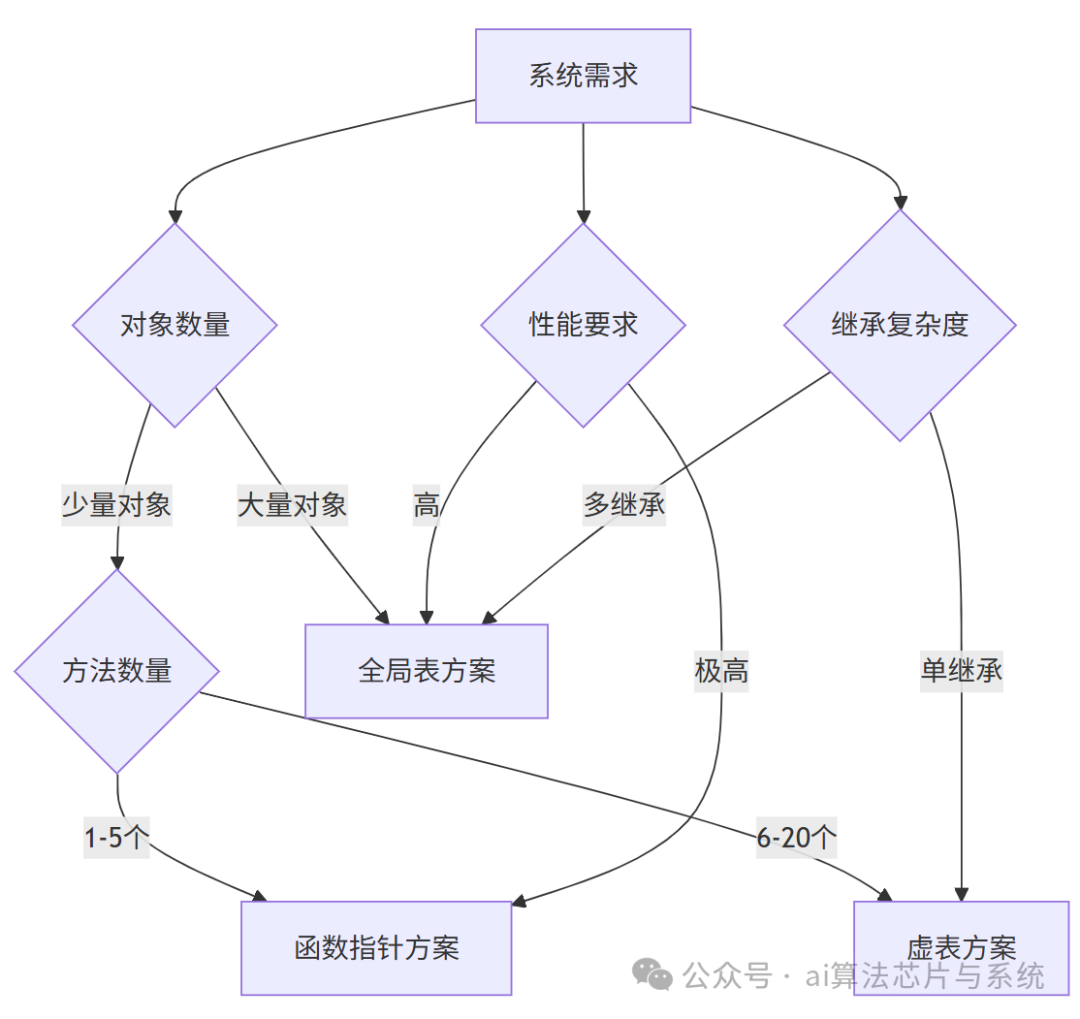
Polymorphism Scheme Selection Matrix:
4.5 Performance Key Metrics Comparison
| Feature | C Function Pointers | C Virtual Table Scheme | C Global Table | C++ Virtual Functions |
|---|---|---|---|---|
| Memory Overhead | Each object N pointers * 8 bytes | Each object 1 pointer * 8 bytes | Each object 1-4 bytes | Each object 1 pointer * 8 bytes |
| Call Overhead | 1 pointer jump | 2 memory accesses | 1 table lookup + 1 jump | 2 memory accesses |
| Inheritance Support | Difficult | Single inheritance support | Naturally supports multiple inheritance | Complete inheritance system |
| Dynamic Extension | Difficult | Requires modifying virtual table | Runtime addition of operation tables | Requires recompilation |
| Binary Compatibility | Good | Good | Excellent | Depends on ABI |
Part Five: Linux Kernel Practices
5.1 Virtual File System (VFS)
struct file_operations {
    ssize_t (*read)(struct file*, char*, size_t, loff_t*);
    int (*open)(struct inode*, struct file*);
};

struct file {
    const struct file_operations* f_op;  // Polymorphic interface
};

ssize_t vfs_read(struct file* self, char* buf, size_t count, loff_t* pos) {
    return self->f_op->read(self, buf, count, pos);
}
Design Essence: Implements file system polymorphism through function pointer tables, with the core kernel not depending on specific implementations.
5.2 Network Device Drivers
struct net_device_ops {
    int (*ndo_open)(struct net_device*);
    netdev_tx_t (*ndo_start_xmit)(struct sk_buff*, struct net_device*);
};

struct net_device {
    const struct net_device_ops* netdev_ops;  // Polymorphic interface
};
Best Practices: Interfaces remain stable for a decade, decoupling drivers from the core, with no additional overhead in critical paths.
Conclusion: A Comparison of Object-Oriented Programming Philosophies in C and C++
| Dimension | C Implementation | C++ Implementation | Essential Differences |
|---|---|---|---|
| Design Philosophy | Explicit control, close to hardware | Implicit abstraction, high-level abstraction | Control vs Convenience |
| Memory Model | Completely transparent, manual management | Partially encapsulated, automatic management | Transparency vs Safety |
| Runtime Overhead | Only overhead added by developers | Default overhead from vtables, etc. | Thoroughness of zero-overhead principle |
| Extension Mechanism | Function pointers, global tables | Virtual functions, templates | Explicit vs Implicit |
| System Impact | No runtime support needed after compilation | Requires standard library support | Trade-off between independence and dependency |
| Best Applicable Scenarios | System kernels, embedded, high-performance computing | Application layer development, complex business logic | Low-level control vs Development efficiency |
Through the in-depth analysis presented in this article, we reveal the powerful capabilities of implementing object-oriented programming in C. This capability is not achieved through syntactic sugar but through the developer’s profound understanding of computer systems. In system programming, embedded development, and high-performance computing, the object-oriented techniques of C demonstrate irreplaceable value, making them core skills that every seasoned developer must master.