Today, the phrase “C++ has become a battleground” is widely circulated among developers, reflecting the deep anxiety felt by many. Once, C++ held a crucial position in software development due to its powerful performance and precise control over system-level operations. From the stunning engines of large AAA games to industrial control systems that are vital to the national economy, and even to database kernels that pursue extreme speed, C++ is omnipresent, underpinning the core logic of countless high-performance, high-demand projects.
However, times have changed, and with the increasing diversity in the programming world, C++ faces growing challenges. Java has built a vast and mature ecosystem, dominating enterprise application development with various convenient frameworks, attracting a large number of developers. Python, with its simple syntax and vast libraries, has become a favorite in the wave of data science and artificial intelligence, often being the first choice for many programming novices. Even the emerging Rust, with its innovative memory management and robust safety features, is making its mark in system development, taking a share of the pie. Meanwhile, the job market for C++ developers has become increasingly stringent, with recruitment requirements demanding not only proficiency in complex syntax but also familiarity with relevant business domains and cutting-edge technologies, adding immense pressure on us. In this harsh environment, we must reassess our advantages and explore a new career path that can break through the difficulties and ensure sustainable development.
For those who are not yet familiar, you can first receive aLinux C/C++ development self-study resource package:
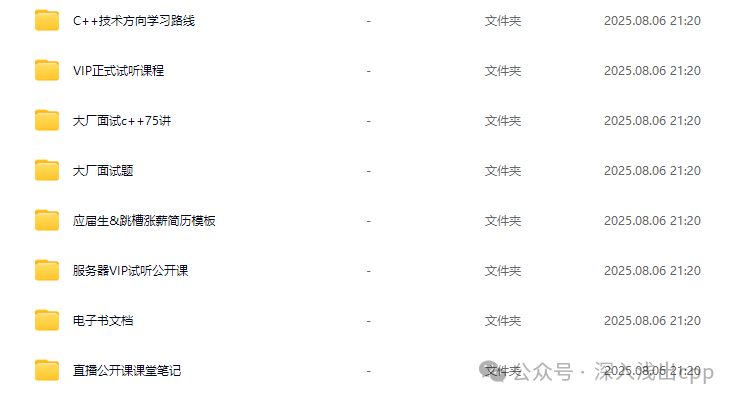
 (Note the codeword to receive exclusive materials)
1. Why is the job market for C++ developers so challenging this year?
Last year, C++ positions were in high demand, and many C++ developers received high-paying offers. This year, the number of people transitioning to C++ has increased, intensifying competition, with highly educated candidates flooding the market, leading to many good C++ positions receiving multiple applications, creating a situation where there are more candidates than available positions.
From a market perspective, this year, backend development has cooled, and Java-based backend positions are also tightening. Not to mention C++ backend positions, where major companies like Tencent have virtually no job openings, and the chip and automotive industries, which had expanded hiring in previous years, have begun layoffs this year, resulting in insufficient recruitment demand from traditional enterprises.
Additionally, some individuals underestimate the difficulty of learning C++, believing that having a web server project is enough to serve as a stepping stone to a job. However, for C++ positions, each direction is vastly different, making it impossible to generalize like Java, and the technical skills possessed may not meet the hiring requirements of companies.

2. What misconceptions do C++ developers have in learning/recruitment?
Misconception 1: Only learning general C++ technologies, thinking that C++ development is similar to Java development. Spending a lot of time learning the C/C++ language itself does not necessarily lead to finding a corresponding job.
Misconception 2: Not having a clear understanding of the classification of C++ positions, and not preparing the corresponding technical content for different C++ roles.
Misconception 3: When applying for positions, do not just apply for C++ roles; instead, specifically search for corresponding job titles, such as backend development, game development, audio and video development, quantitative trading, storage, etc. Although web server experience is generally applicable to C++ roles, this year, interviewers prefer to see technical content and project experience that closely match the specific roles.
Misconception 4: The technical content of C++ development is vast, and it is unrealistic to learn everything. Therefore, when facing job recruitment, it is sufficient to prioritize learning the technical content and preparing projects based on job requirements.
Misconception 5: Following trends and choosing technical directions based on popular opinion.

3. General C++ technologies and vertical technical content for job directions
1. General C++ technologies
-
Programming languages
-
Computer fundamentals: operating systems, computer networks, data structures and algorithms, design patterns
-
Network programming (network programming is required for all directions in C++)
2. Backend development
-
Open-source frameworks
-
Middleware
-
Distributed high concurrency
-
Performance analysis
3. Audio and video development
-
Audio and video fundamentals
-
FFmpeg
-
Streaming media clients: RTMP, HLS, RTSP
-
Streaming media servers: SRS
-
WebRTC
-
Android NDK
-
iOS
4. Qt development
-
Qt development basics
-
Database programming: MySQL, SQLite, OpenCV, OpenGL
-
Quick
-
QSS
5. DPDK
-
DPDK networking
-
Storage: SPDK, KV storage
-
Security and gateway development: VPP
-
Virtualization and cloud-native: OVS, DPVS
-
Testing tools: perf3, TRex, dpdk-pktgen, fio
4. How can C++ developers succeed in the job market?
1. Transitioning languages
For many large companies that primarily use C++, there are currently attempts to cultivate new programming languages. As an initial C++ developer, you are favored by many interviewers, as learning C++ is seen as beneficial for transitioning to other languages. For example, you can try interviewing for related Golang development positions.
2. Achieving a dimensional reduction in competition
Given this year’s market conditions, C++ backend development positions are undoubtedly a hellish mode within the C++ field. If you have an excellent educational background, such as a master’s degree from a 985 or 211 university, but lack confidence in your technical skills to compete with higher-level candidates, then exploring other areas within C++, such as audio and video or Qt development, would be a good choice.
3. Persisting in C++ backend development
If you choose to stick with C++ backend development, regardless of the number of available positions, you first need to have a strong educational background. If your academic qualifications are not outstanding, I would advise against pursuing this path this year. However, if you have a good educational background, you should strengthen your technical skills and project experience, as both are essential.
5. Recommended learning paths and projects
Here, I recommend the exclusive online course system of Zero Voice Education, 【Linux C/C++ Full Stack Development】. This course is based on industry standards, focusing on commonly asked interview questions and frequently used technology stacks, with general Linux C/C++ skills as the technical foundation. Through principles, source code analysis, case studies, and practical projects, it includes 16 live projects and over 20,000 lines of handwritten code, providing a comprehensive analysis:
 For more details about the course,please【read the original text✍】