
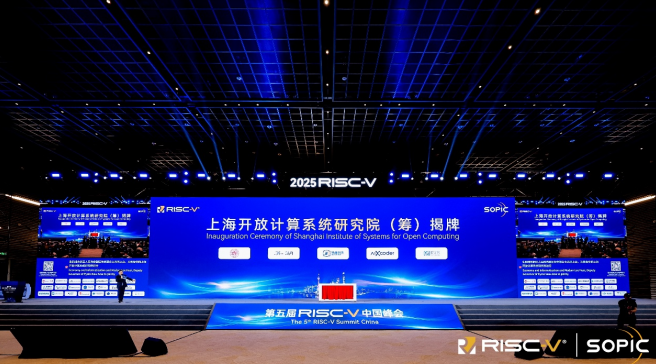
On July 17, the 2025 RISC-V China Summit opened in Shanghai. During the conference, the Shanghai Open Computing Systems Research Institute (provisional) (hereinafter referred to as the Institute) was inaugurated, with Professor Xie Tao, a top talent dual-appointed by Fudan University and a foreign academician of the European Academy, serving as the director.
As an important part of Shanghai’s RISC-V strategic layout, the Institute will primarily conduct research on open instruction sets, advanced computing architectures, parallel programming languages and compilers, operating systems, and software ecosystems, focusing on key application areas in artificial intelligence, aiming to promote the evolution of RISC-V-based computing architectures and the design of high-performance, highly reliable system software, and develop the open computing systems industry ecosystem in Shanghai and across the country.
1
Focusing on RISC-V,
Building an Advanced Open Computing Ecosystem
Currently, emerging computing technologies have brought new possibilities for the intelligent interconnection of all things through the integration of “human, machine, and object,” but they also pose new requirements for algorithms, computing models, programming environments, and software development, further increasing the difficulty of hardware and software research and development.RISC-V is a reduced instruction set architecture for all-scenario chip design, characterized by openness, simplicity, and flexibility, allowing any organization or individual to freely use, modify, and expand it without paying patent fees, which has garnered widespread attention and use in the global academic and industrial communities.
Shanghai is one of the earliest regions in China to support and promote RISC-V, and has initially formed a comprehensive industrial chain covering everything from chip design and manufacturing to applications, continuously promoting the development of RISC-V in high-performance computing, artificial intelligence computing power, smart terminals, and automotive electronics. In the era of artificial intelligence, enhancing the research and engineering level of advanced computing systems based on the RISC-V instruction set architecture as a common open foundation will help improve computing power scale, reduce computing power costs, and increase computing power efficiency, providing technical support for new scenarios such as the digital economy and the Internet of Everything.
The Institute will align with the development trends of advanced computing systems and the artificial intelligence industry in Shanghai, while also considering the specific requirements of Shanghai’s global science and technology innovation center construction, smart city development, and the orderly governance of Shanghai as a megacity, accelerating the deep application of advanced computing systems based on RISC-V in key areas of economic development, urban governance, and public services in Shanghai and across the country.
The Institute, led by Professor Xie Tao, will build on the existing relevant teams at Fudan University and introduce advantageous talent teams from home and abroad, focusing on advanced computing systems based on RISC-V, targeting key application areas in artificial intelligence, and forming a collaborative development pattern. The concurrently established Fudan University-level operational research institution (Advanced Computing Systems Research Institute) will provide institutional support for collaborative tackling of challenges and talent cultivation.
“Our R&D model is not only about developing on our own and pushing it to enterprises, but also actively seeking cooperation to work together on collaborative challenges.” Professor Xie stated that in the form of a collaborative innovation entity combining industry, academia, research, and application, the Institute will actively expand deep cooperation with top research institutions, leading enterprises, and industry alliances at home and abroad, building a new type of open-source research and innovation system, and promoting the technological innovation and industrial development of open computing systems into a new stage, establishing a global highland for key technology R&D and a source of industrial innovation for open computing systems.

▲
Professor Xie Tao
2
Towards the Intelligent Era,
Training Top Innovative Talents in New Engineering
Currently, the founding team of the Institute has gathered a research team with high academic standards and international influence, having a solid foundation in the field of open computing systems, forming comprehensive advantages in system software for large-scale intelligent computing, and possessing strong support from fundamental disciplines.
The Institute prioritizes the construction of a high-end talent team as a key focus for the development of open computing systems, adhering to a combination of cultivation and introduction, improving the integration system of industry, academia, research, and application for open computing systems, strengthening talent reserves and team building, especially accelerating the introduction of top global talents and young talents. Through major R&D tasks and base platform construction, the Institute aims to gather high-end talents in open computing systems from home and abroad, forming several high-level innovative teams in key areas of future open computing systems.
The key research directions of the Institute include: architecture and system software optimization for large-scale distributed systems aimed at artificial intelligence, design of parallel programming languages and compilers for next-generation artificial intelligence chips, construction of efficient runtime systems and software stacks supporting diverse artificial intelligence models and tasks, and collaborative design and vertical optimization technologies for hardware and software systems aimed at practical application scenarios.
Relying on the construction of open-source courseware and courses as well as the “AI Grand Course” initiative, Fudan University will also collaborate with the Institute to promote the training of top innovative talents in new engineering through interdisciplinary and multi-technology integration, carry out collaborative education projects focusing on advanced intelligent computing systems, and extend these to universities in Shanghai and across the country. Based on the development needs of key areas in advanced intelligent computing systems, the Institute will jointly formulate talent training plans for open computing systems with Fudan University and other universities, allowing students to choose training programs based on their professional direction and interests, enhancing students’ dual perspectives in academia and industry, and improving their practical and innovative capabilities.
▼ For more information, please read the original article
 Compiled by | Shanghai Fudan University Education Development Foundation
Source | “Fudan University” WeChat Official Account
Editor | Pan Zhenqin