Intel officially launched the Core Ultra 200V series yesterday, which is the Lunar Lake processor aimed at thin and light laptops, and it will be shipped by the end of this month. In the increasingly fierce competition in the PC processor market, does Lunar Lake have any advantages?The smoke of the PC processor industry has not dissipated for the past two years, especially this year when Qualcomm has aggressively entered the market with the Snapdragon X processor, and AMD’s Zen 5 has completely surpassed its predecessor architecture. Coupled with the new AI PC trend, the competition in PC processors has entered a new stage.At this year’s Computex, Intel previewed the improvements brought by the new Lunar Lake architecture—specifically, the next-generation processor of Core Ultra aimed at thin and light laptops. We previously summarized the highlights of Lunar Lake as a new generation of Core Ultra processors, which include:
- P-cores eliminate hyper-threading design, with double-digit improvements in IPC and energy efficiency; E-cores are significantly strengthened, with IPC even slightly surpassing the previous generation P-cores;
- Xe integrated graphics performance increased by 1.5 times;
- Significant improvement in AI computing power, with GPU AI computing power at 67 TOPS, NPU computing power at 48 TOPS, and total AI computing power of 120 TOPS;
- Low power design greatly enhances laptop battery life.
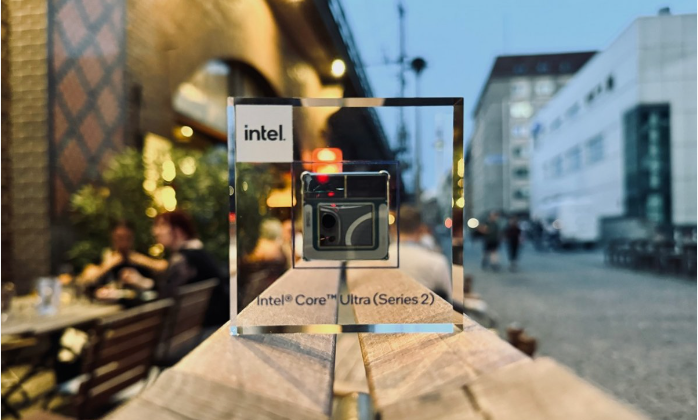 At the recent IFA (Berlin Consumer Electronics Show), Intel publicly revealed product information about Lunar Lake. Laptops equipped with this generation of Core Ultra 200V processors have already started pre-orders—over 80 models are available; these laptops are expected to officially launch starting September 24. The commercial version of Lunar Lake laptops based on the vPro platform will have to wait until early next year.It feels like the previous generation Meteor Lake was just released, and now Lunar Lake is here, highlighting the rapid pace of market competition. We will discuss Intel’s newly released Lunar Lake processor products in two articles; this article focuses on the product specifications of the new processor and its performance and power consumption; the next article will focus on the AI attributes of Lunar Lake.All models feature 4+4 cores, with a maximum turbo power of only 37WThe Lunar Lake aimed at thin and light laptops specifically refers to the Intel Core Ultra 200V series—belonging to the second generation of Core Ultra. Intel stated during the media Q&A that the “V” here has no special meaning, it is merely used to clarify that this is a product of the Lunar Lake family of processors. It is speculated that there will be processor products with suffixes other than “V” following updates with Arrow Lake.The newly released processors range from Core Ultra 5 to Core Ultra 9, with specific model information as shown in the table below:All CPUs in the series are based on an 8-core 8-thread solution with 4 P-cores and 4 E-cores, where P-cores no longer support hyper-threading—previously, we specifically discussed the logic behind Intel’s decision to not support hyper-threading in this generation of Core processors.From the perspective of core frequency, the maximum turbo frequency of P-cores varies according to different model positions. The highest configuration, the Core Ultra 9 288V processor, has a P-core turbo frequency of 5.1GHz. Additionally, the E-core turbo frequency and LLC capacity also vary by model.From the iGPU perspective, both the Core Ultra 9 and Ultra 7 feature 8 Xe cores—Intel refers to them as Arc 140V; while the integrated graphics of the Core Ultra 5 is named Arc 130V, which has one less Xe core (thus fewer 8 XVE vector engines and 8 XMX matrix extension engines, and the paired graphics fixed function units should also be reduced). The GPU frequencies of different models also vary.In terms of NPU—specifically the dedicated AI acceleration unit, the Core Ultra 5 will also have one less NPU core than the other two. It seems that for Lunar Lake, the main factor in differentiating the market positioning of Core Ultra 5/7/9 is clearly leaning towards GPU and NPU computing resources. Indeed, this is an era where accelerators are becoming increasingly important.
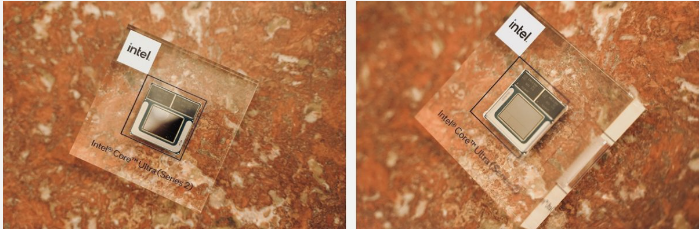 It is worth mentioning that Lunar Lake integrates the highest LPDDR5/x-8533 specification DRAM die into the chip, so the memory capacity is limited to two options: 16GB and 32GB. The 16GB DRAM die stack is a 1R solution, while the 32GB is a 2R solution. Support for Wi-Fi 7, Bluetooth 5.4, and 4x PCIe 5 in terms of IO will not be elaborated on here.In terms of power consumption, Intel has set the base power of these processors as low as 8W, with the maximum turbo power generally rated at 37W. It is worth noting that at the end of last year, when Meteor Lake was released, the base power of the CPU was set at 15W/28W, while the maximum turbo power reached 57W/64W/115W.Therefore, we can basically conclude that Lunar Lake is more positioned in the thin and light laptop market—its target market is actually narrower compared to Meteor Lake. In the next one or two years, the gaming laptops, all-purpose laptops, and design laptops markets will likely be more supported by the upcoming Arrow Lake, which will be released soon.
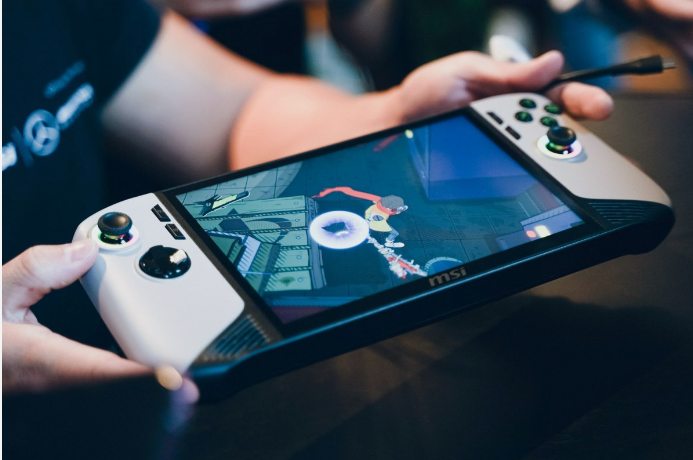 MSI showcased a prototype device using Lunar Lake at their exhibition areaHow low is the “low power”?In the article analyzing the architecture of Lunar Lake, we specifically discussed its low power design. This includes reducing communication overhead with on-chip DRAM, the elimination of hyper-threading design in P-cores for area and power efficiency, the strengthening of E-cores to reduce the wake-up of P-cores, improvements in IPC and performance per watt with the new architecture, and the addition of global Memory Side Cache, etc…Additionally, designs such as providing independent power control domains for different modules and enhancing ITD thread scheduling assistance have ultimately contributed to lower energy consumption and higher energy efficiency. Even though Intel previously claimed that Lunar Lake is more power-efficient than competitors and provided data showing significant reductions in Teams meeting power consumption, we still lack a quantitative understanding of just how power-efficient Lunar Lake is.This time, Intel emphasized at the media conference that “everything about Lunar Lake is related to energy efficiency,” providing more intuitive data on energy efficiency improvements and power reductions. First, when thin and light laptops are used as productivity devices, the most important application scenario is likely Office work.
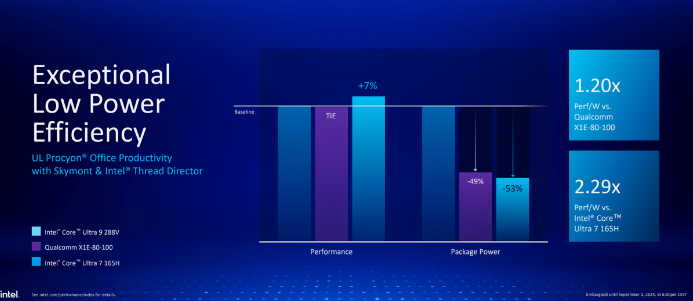 Based on the UL Procyon office productivity test (Word, Excel, PowerPoint, Outlook tests), the test data shows that compared to the previous generation Core Ultra 7 165H and Qualcomm Snapdragon X1E-80-100 (Snapdragon X Elite), the latest Core Ultra 9 288V performs about 7% better, but the packaging power consumption is reduced by as much as 50%.Therefore, from the perspective of performance per watt, Lunar Lake has improved over 2 times compared to the previous generation Meteor Lake, and is also about 20% higher than the Snapdragon X Elite. In other words, if laptops focus on off-grid work, Lunar Lake will be significantly more power-efficient than the other two.In addition to office work, considering more heavily loaded scenarios: using the iGPU of thin and light laptops to play 3D games, Intel cited three game scenarios: Assassin’s Creed: Valhalla, Cyberpunk 2077, and Farming Simulator 22, where Lunar Lake ensures a graphical performance increase of 32%-68% compared to the previous generation, while GPU power consumption has decreased by 35%-11%.
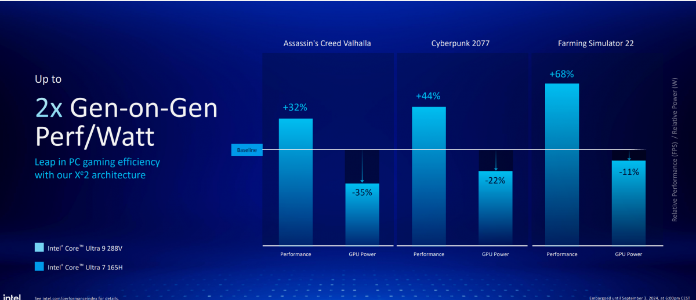 Thus, the performance per watt in gaming scenarios has also increased by up to 2 times. The new Xe2 architecture of this generation plays a significant role in power savings.Overall, in application scenarios including office work, web browsing, video conferencing, and streaming 4K video playback, the Core Ultra 9 288V has up to a 50% overall power consumption reduction compared to the Core Ultra 7 165H. Intel emphasizes that “this power reduction is achieved under difficult conditions, as we must not forget that the overall packaging of Lunar Lake also includes memory.” This part is also counted in the “overall power consumption”.Regarding low power consumption, the most valuable data is the laptop’s battery life. This time, Intel confidently compared the battery life of laptops with Qualcomm using the same OEM brand and mold (reportedly only the motherboard and CPU differ)—after all, this was Qualcomm’s absolute strong point emphasized when they released the Snapdragon X Elite.
 In the OEM display area, ASUS showcased their Zenbook laptopIncluding the use of UL Procyon office productivity tests and Teams meetings. The results showed that Lunar Lake can last 2 hours longer than Snapdragon X Elite in office work (20.1 hours vs 18.4 hours), while in Teams meetings, it lasts 2 hours less (10.7 hours vs 12.7 hours); it is a result where both have their strengths and weaknesses.The official promotion mentions that Lunar Lake laptops can achieve up to 20 hours of battery life, which should be the source of this test.If we compare with AMD, it is difficult to ensure that the molds and configurations are as similar as possible, aligning at 1080p resolution with 150 nit brightness display, and around 75Whr battery capacity (it is said that Intel slightly lost out by choosing a model with a battery capacity of 70Whr, while the AMD Ryzen model is equipped with a 78Whr battery), the office suite and meeting battery life comparison is shown in the following image:
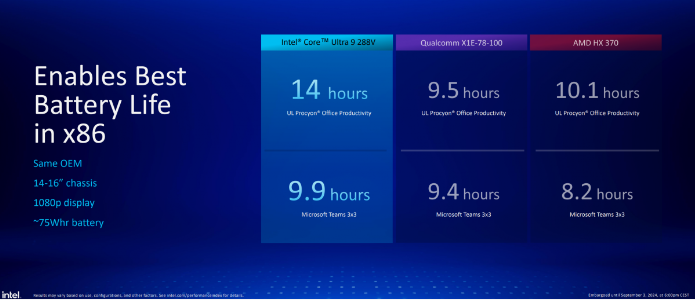 It is worth mentioning that due to the complexity of daily laptop usage, general battery life tests still require more complex models to reflect the actual situation. However, these two projects seem to be quite representative and suitable for horizontal comparison tests.If in actual use, Lunar Lake laptops can achieve battery life surpassing that of Snapdragon X Elite, it would further prove that low power consumption and high energy efficiency design are not significantly related to the instruction set, but rather tied to the microarchitecture implementation scheme.8 cores and 8 threads, can it still compete?In previous analysis articles, we mentioned that the next two years will be a challenging time for Intel in terms of CPU performance.Although we say that this generation of P-cores and E-cores indeed has many highlights in architectural design, especially E-cores even surpassing the previous generation P-cores in IPC, and P-cores have made significant improvements in design methodology; we are also quite optimistic about Lunar Lake’s decision to eliminate hyper-threading design;but in terms of single-thread performance, the recently released AMD Zen 5 has significantly caught up; and from the perspective of multi-thread performance, Lunar Lake’s entire series has 8 cores and 8 threads, which is significantly fewer than the 22 threads of the top configuration of the previous generation Meteor Lake…Intel itself is quite optimistic about the CPU performance competition within the TDP range of 9W-33W for Lunar Lake. First, from a single-core perspective, Intel has previously indicated that this generation of P-cores is absolutely superior to AMD and Qualcomm competitors. The single-thread performance test results in Cinebench 2024, Geekbench 6, and SPEC2017 are as follows:
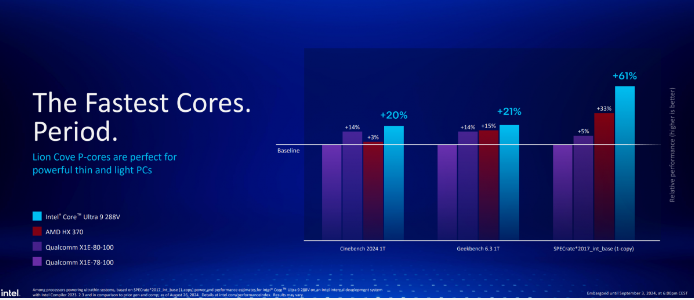 Using the Snapdragon X1E-78-100 as a performance benchmark, the single-thread performance of the Core Ultra 9 288V is about 20%-60% ahead. This is something we expected.As for the multi-thread performance that more people are concerned about, Intel also provided some data this time—though the focus is still on efficiency.
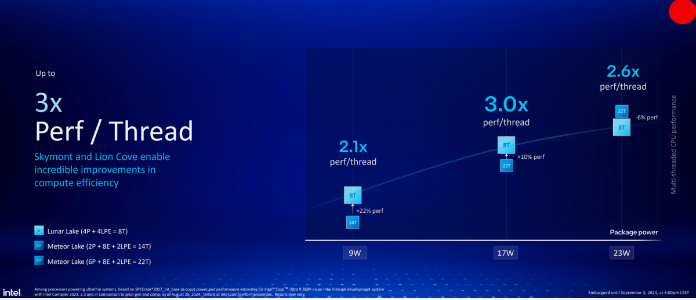 First, Intel confidently believes that within a specific power consumption range—represented by the horizontal axis in the above graph, the 8 threads of Lunar Lake can outperform the 22 threads of Meteor Lake in terms of performance. For example, when limited to a 9W packaging power, Lunar Lake outperforms the 14-thread Meteor Lake by 22%; and at 17W power, the 8T performance of Lunar Lake is 10% higher than that of Meteor Lake’s 22T performance.Above the 23W power point, the multi-thread performance of Lunar Lake will fall behind Meteor Lake by about 6%. After all, when sufficient power is provided, the performance advantage of more cores and threads can still be highlighted. Therefore, Intel mentioned that for the 8T of Lunar Lake and the 22T of Meteor Lake, 20W power consumption is the intersection point of their multi-thread performance curves.Here, Intel emphasizes Perf/thread, which is the multi-thread performance test result divided by the number of threads, yielding the average performance per thread. This value is more like an average single-thread performance in another dimension, indicating that the performance gain per unit thread of Lunar Lake is 2-3 times higher than that of Meteor Lake.Intel also provided the energy efficiency curve of the Lunar Lake CPU, which includes several different reference points from Apple, AMD, and Qualcomm. Intel believes that Lunar Lake has absolute competitiveness in the preset low power, thin and light laptop application scenarios, “even at 33W power consumption, we still maintain strong multi-thread performance.”
 Interestingly, Lunar Lake has 4 fewer cores than Snapdragon X Elite, but when the former reaches the performance that the latter can achieve at 50W power consumption, it requires 40% less power. Intel particularly emphasizes that this result has been repeatedly verified in multiple laboratories, “but each test has yielded the same result.”Finally, high-level system performance tests, which are more inclined towards actual loads—are also more valuable for end-user experience. Intel again chose scenarios such as office work, Photoshop graphics, multimedia transcoding, web browsing, and comprehensive productivity testing, with specific results shown in the following image:
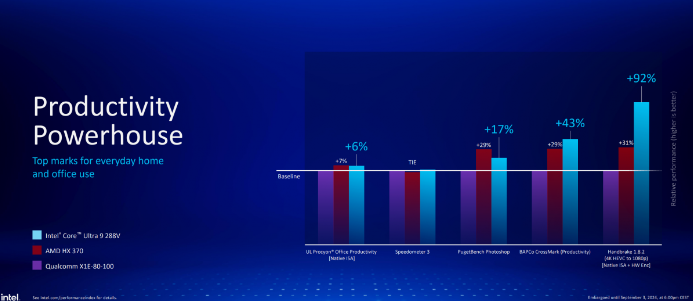 The performance advantage in media transcoding may be related to the hardware or instruction acceleration of Lunar Lake. However, in the context of having significantly fewer cores and threads, demonstrating such performance at the system level still exceeded our expectations—especially considering that the AMD HX 370 being compared has a higher TDP.We believe that in rendering tests, which pursue absolute multi-thread performance, Lunar Lake’s performance may naturally fall short compared to other competitors positioned in higher power consumption segments. However, the design of Lunar Lake gives a strong impression reminiscent of the launch of the Pentium M—significantly improved efficiency, no longer blindly pursuing high frequency and multi-core.This is the result of balancing IPC, frequency, inter-core communication latency, and even the overall system PPA, and the effectiveness is quite remarkable. Regarding the latency between cores, it is worth mentioning that Intel specifically showcased a slide at the media conference demonstrating the “low latency structure,” mentioning that the communication latency between E-cores is about 23ns, while between P-cores is around 26ns;more importantly, the communication latency between different clusters of E-cores and P-cores is also controlled within 55ns, which is a blatant mockery of AMD and Qualcomm… after all, the latter two have this value 3-4 times higher. Coupled with the on-chip integrated DRAM, which brings lower memory access latency (30-40% lower than off-chip solutions), this should also be a key reason why Lunar Lake can compete in certain multi-thread performance tests with fewer threads.
 At the exhibition area, performance comparisons of racing games—this time Intel did not hold back in comparing with AMD and QualcommOverview of Graphics and AI Performance, Primarily Mocking Competitors’ EcosystemHaving discussed the CPU, we should now look at the GPU and NPU. In the architecture analysis article, we also detailed the Xe2 architecture used in this generation of iGPU. The new architecture is characterized by a further expansion of the overall scale and the addition of XMX matrix units that are more focused on AI acceleration. Therefore, the graphical performance of Lunar Lake’s integrated graphics has increased by 1.5 times, and AI performance is 3.5 times that of the previous generation.The fully powered Arc 140V integrated graphics configuration of Lunar Lake shows an actual gaming performance improvement of about 30% compared to the previous generation (Core Ultra 7 155H). The frame rate improvement in certain games is particularly significant, with a 40% increase in F1 24, a 60% increase in Hogwarts Legacy, and an 80% increase in The Division 2. When XeSS is enabled, due to the acceleration from XMX, the gaming performance improvement can reach 60%.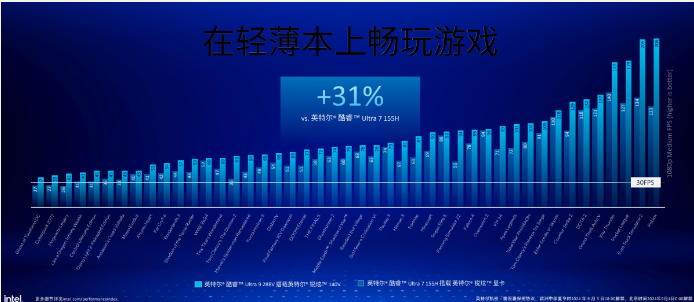
 Intel directly showcased benchmark tests of Tomb Raider and Cyberpunk 2077 running on Lunar Lake laptops, achieving an average frame rate of 60-70 fps at 1080p medium quality with XeSS super resolution enabled.In addition to the competitive comparisons, in these 45 game tests, Lunar Lake’s gaming performance is about 16% higher than that of AMD Strix Point integrated graphics, while the main focus is mocking the Snapdragon X Elite, which cannot run more than half of these games; even if it can run, Lunar Lake still leads in gaming performance by 68%.
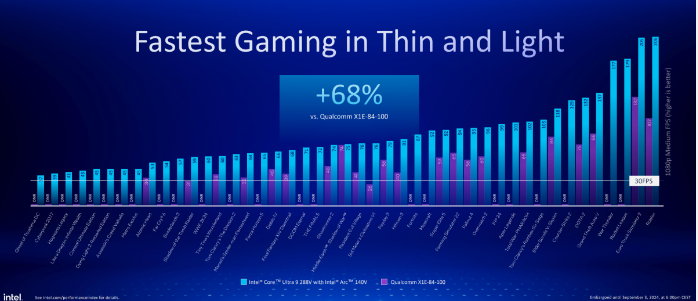 More data on integrated media engines, ray tracing, and other sub-item tests will not be elaborated on due to space constraints.However, based on the underdeveloped Windows on Arm ecosystem and Qualcomm’s incomplete support for graphics and AI standards on the Windows platform, the jokes about Snapdragon X Elite failing certain tests were quite frequent at the media conference. Not only in graphics and gaming tests, but also in running Stable Diffusion 1.5 on the GPU and certain AI benchmarks with FP16 precision were also common occurrences…
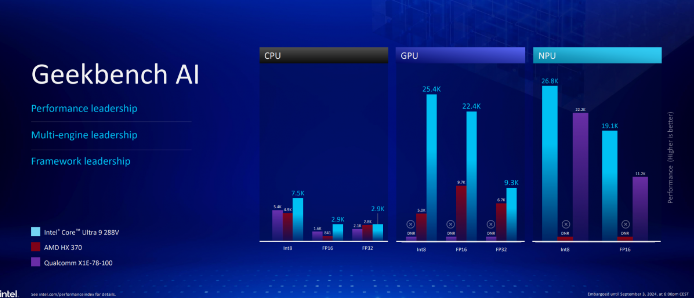 Therefore, regarding the attributes of AI processors, Intel naturally emphasizes the total computing power of 120 TOPS: in addition to the Copilot+PC concept being achieved, Microsoft did not forget to support Intel, as Lunar Lake also leads competitors in UL Procyon AI’s computer vision and image generation tests.On the other hand, Intel seems to emphasize the XPU strategy that combines CPU+GPU+NPU, reflecting absolute AI computing power while also pursuing flexibility. Thus, many comparisons either discuss how competitors’ integrated graphics cannot perform AI acceleration or how competitors cannot perform AI inference with FP16 precision.
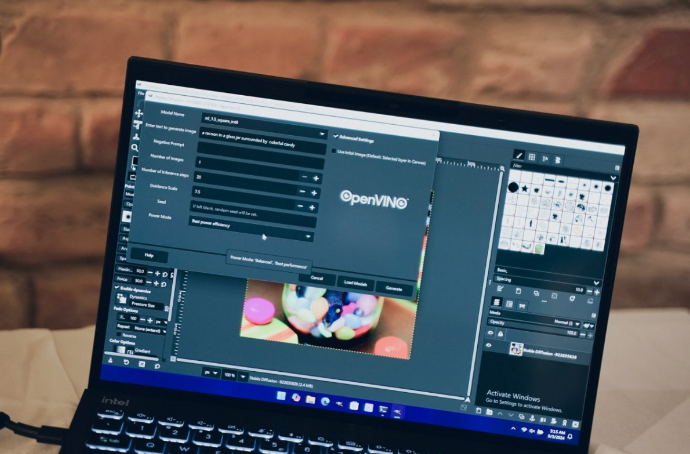 In the performance demonstration area, the Stable Diffusion test included options for performance mode and efficiency mode, with the former allowing all SD processes to run on the GPU, while the latter allows all loads to run on the NPU, emphasizing flexibility—giving a strong impression of being the fastest in speed and highest in efficiency.We believe that a valuable aspect of the AI performance data comparison is the performance differences exhibited by different processors when integrating AI features into existing content creation workflows. This includes the gradual integration of more AI features into tools like the Adobe suite and Blender, seeking GPU/NPU acceleration for AI inference.Qualcomm is still suffering from the shortcomings of the ecosystem, as certain apps do not even have native versions, let alone the need for developers to adapt AI features for NPU acceleration—moreover, compared to GPUs, NPU is also less friendly to developers. In the entire AI PC ecosystem, aside from Nvidia, Intel is indeed the PC processor company that has done relatively well in AI applications, AI model support, and the overall AI development ecosystem.
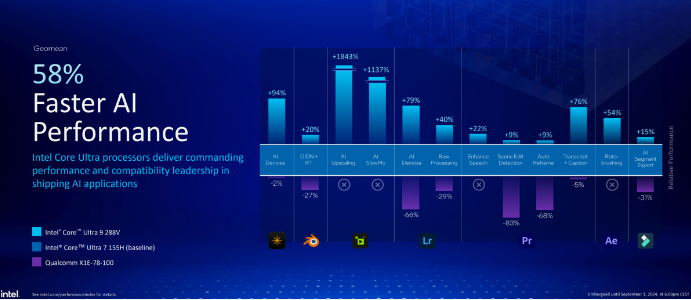 In fact, most of the application demonstrations and performance comparisons of Lunar Lake at the exhibition area were centered around AI PCs: the operating systems, OEMs, and ISVs invited to the press conference were generally focused on AI PCs. However, the next article will focus more on AI, so we will not elaborate further on AI PCs here.At this press conference, Intel presented a concept that is quite reliable: an excellent AI PC must first be an excellent PC. That is, before discussing AI features, the performance and efficiency that PCs originally pursue cannot be neglected: AI is a technology extension built on top of this. This may correspond to Intel’s introduction of the performance comparisons mentioned above:These comparison data do not come from Intel’s own reference platform, but are based on real data from existing OEM products. Even “when users get their hands on the product, there is a chance to see results that are even better than the comparison data above.” “The data we provided this time is relatively conservative.” Regardless of the operating system settings or the selection of third-party comparison objects, “in presenting certain data, we even placed ourselves in a less favorable position.”Although mocking Snapdragon is something we have never seen at an Intel press conference and demonstration before, Lunar Lake indeed seems to be Intel’s profound reflection after pursuing high frequency, multi-core, and stacking materials, a desperate attempt to turn the tide. Moreover, it is not solely based on the AI PC trend, but provides optimal solutions for PPA and user experience from multiple perspectives.

Recommended Hot Articles
-
Shenzhen Autonomous Driving Ride-Hailing Cars Begin Highway Testing
-
Disassembling Earphone Cases, Overvoltage Protection Circuit Analysis
-
I Found the Meaning of Black Myth: Wukong in Disassembling the PS3!
-
Xiaomi Loses 60,000 on Each Car Sold? Aren’t You Saving Money by Not Buying?
-
Disassembling the IBM ThinkPad Optical Drive from Back in the Day, Quite Surprising